How New York’s Mamdani and Ocasio-Cortez Sparked a Profound Debate About Politics and Religion in the U.S.
“Practices associated with Muslims often become a subject of controversy and skepticism when they appear in the public sphere.”
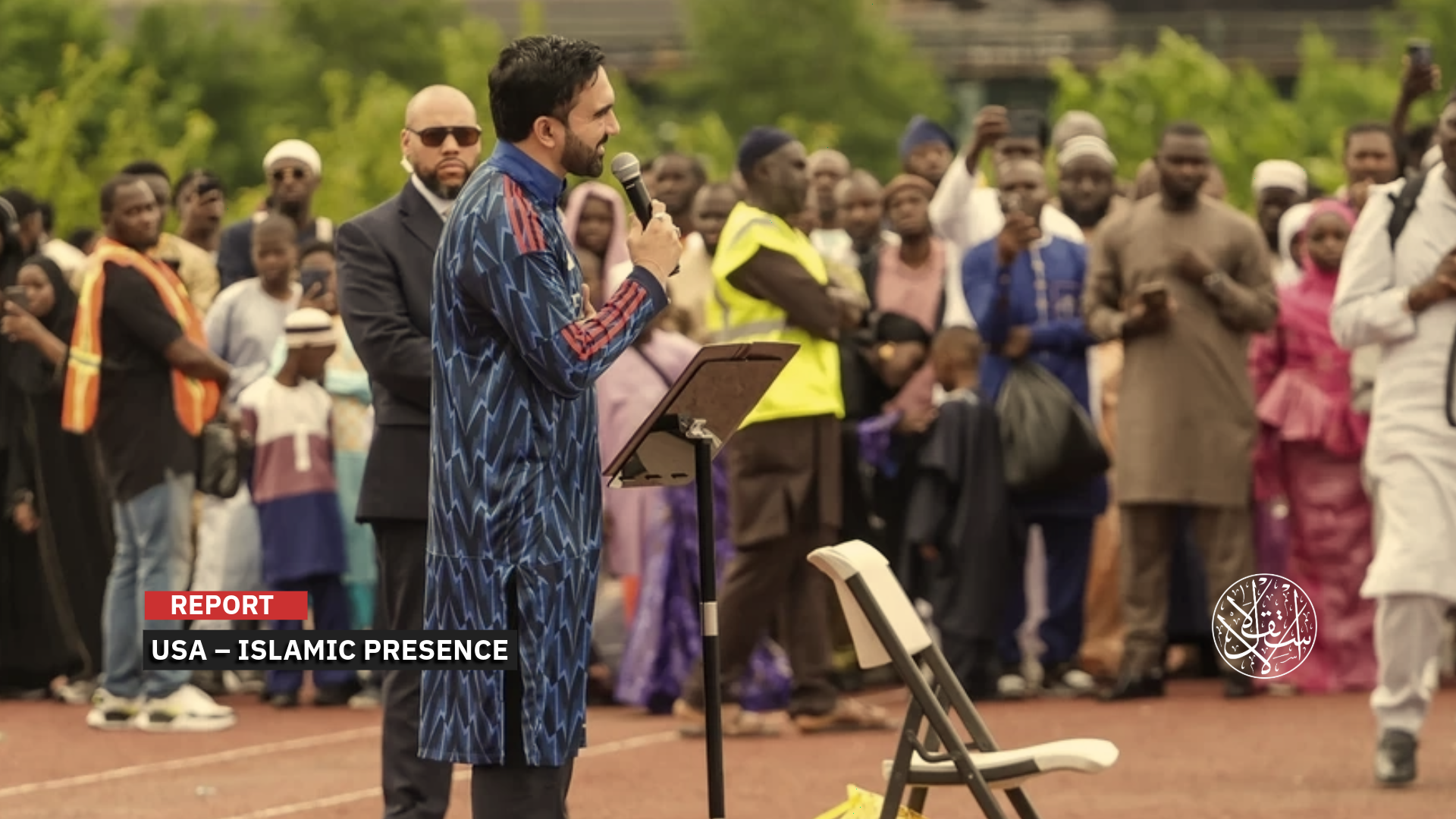
New York City Mayor Zohran Mamdani's participation in Eid al-Adha prayers on May 27 sparked widespread controversy in American political and media circles.
He appeared at a public event in the Bronx wearing an Arsenal-themed kurta, alongside Democratic Rep. Alexandria Ocasio-Cortez, who wore a hijab during the occasion.
Mamdani is considered one of the most prominent rising political figures within the progressive wing of the Democratic Party, while Ocasio-Cortez is known for her support of minority and immigrant rights in the United States.
Right-wing figures and groups criticized the Democratic officials' participation in the event, arguing that it represented the politicization of religious identity.
Supporters, however, defended the move as an expression of the religious and cultural diversity that characterizes New York City.
The controversy transcended the festive nature of Eid al-Adha, opening a broader discussion about the presence of Islamic identity in the American public sphere, the limits of expressing solidarity with Muslim communities, and how right-wing groups deal with religious symbols when they are associated with progressive political figures.
Religious Identity
The Eid al-Adha prayer in the Bronx, New York City, transformed into a major political and media event after Mayor Zohran Mamdani participated alongside thousands of worshippers from the Muslim community.
The scene quickly shifted from a celebratory religious occasion to a site of heated debate within the American political landscape.
The Eid prayer was held on the morning of May 27th at a football field within Macombs Dam Park, near Yankee Stadium.
An estimated 2,000 families attended the event, which was organized in cooperation with local authorities, imams, and representatives of the Muslim community to accommodate the large crowds that some mosques in the area could not accommodate.
Mayor Zohran Mamdani, the city's first Muslim mayor, posted photos and videos of the event on his social media accounts, accompanying the post with a message of Eid al-Adha greetings.
He emphasized that sacrifice represents an opportunity to belong to something greater than oneself and that solidarity is the source of strength.
Addressing the congregation, the mayor explicitly linked the theological concept of sacrifice inherent to Eid al-Adha with the grueling financial realities crushing working-class New Yorkers.
He framed the community's struggle for affordable housing, groceries, and childcare as a collective moral imperative.
But what attracted widespread attention wasn't just the participation itself, but the mayor's attire.
He wore a kurta designed to resemble the jersey of the English football club Arsenal, a clear indication of his well-known sporting affiliation.
The images quickly became the subject of widespread political debate, with reactions divided between those who saw them as a message of openness and coexistence reflecting New York's cultural diversity, and those who viewed them as a political exploitation of religious symbols in the public sphere.
The event did not pass without sharp political reactions. Several figures associated with the right wing launched an attack on the mayor's participation in the Eid prayer.
They argued that the appearance of Islamic religious symbols in a public setting in a major city like New York carried controversial political and cultural dimensions.
In a speech described as inflammatory, Republican Rep. Randy Fine posted a clip from the event, in which he harshly attacked Mamdani, claiming that the city had fallen into the hands of what he called mainstream Islam, and warning that America would be next if Americans did not pay attention to this shift.
This discourse reflects that the attack was not so much about Mamdani's policies or local agenda, but rather based on his religious identity, attempting to portray his presence as mayor as a cultural and political threat.
In contrast, Democratic Rep. Ritchie Torres defended Mamdani's participation, asserting that prayer is not shameful and that freedom of religion is a fundamental American value.
He emphasized that the freedom enshrined in the First Amendment to the U.S. Constitution is either a right guaranteed to all Americans or it is a right for no one.
Activists argued that attempts to exploit the incident within a narrow political or ideological framework ignore the core American values of pluralism and respect for religions.
They pointed out that targeting participants in public religious events opens the door to further division within American society instead of fostering coexistence.

Controversial Attack
The appearance of Democratic Rep. Alexandria Ocasio-Cortez wearing a hijab during an Eid al-Adha prayer event in the Bronx has sparked considerable controversy on social media.
The Bronx, New York, is a borough that includes parts of the congressional district Ocasio-Cortez has won repeatedly since 2018.
Earlier this week, it was reported that Ocasio-Cortez is taking serious steps towards a run for the presidency in 2028, with some polls even showing her as the current favorite.
According to Axios, the 36-year-old is taking increasingly national steps that Democrats see as laying the groundwork for a presidential bid, including rallies, endorsements, speeches across multiple states, and meetings with influential party figures.
Right-wing commentators accused her of political pandering and a show of identity to the Muslim community, while others questioned its consistency with her consistent rhetoric on women’s rights and feminism.
Conservative and pro-"Israel" accounts focused on portraying the hijab as a symbol of women’s oppression in some societies, accusing Ocasio-Cortez of ignoring this context by wearing it at a public event alongside a progressive Muslim mayor.
In contrast, others defended Ocasio-Cortez. Some commentators described her appearance in the hijab as a political performance aimed at the cameras, while others saw it as an act of cultural and religious respect for an Islamic event in which an elected official was participating with her constituents and local community.
They emphasized that turning the matter into a political attack reflects an overreaction and a rush to create controversy on social media.
Ocasio-Cortez explained on X that she wore a head covering to be respectful to those at the mosque.
However, others praised Ocasio-Cortez for respecting Muslim tradition.
“Oh no, someone's showing respect to a religion in the most diverse city in the country.” one X user wrote.
“Turning a simple Eid gesture into a full treason meltdown? Peak fragile outrage addiction. That’s not exposing pandering - it's your crew’s xenophobia jones flaring for cheap clicks while real problems get ignored," another user said.
As the controversy escalated, the attack on Ocasio-Cortez also seemed linked to her position within the Democratic left, as she is one of the most prominent progressive voices in the U.S. This made her wearing a hijab a new point of contention in the political struggle with conservatives over identity politics.
Political Polarization
As reactions intensified, the Eid prayer in the Bronx transformed from a religious event into a point of intersection between religion, politics and identity.
The debate reflected the deep divisions within American society regarding issues of pluralism and freedom of religious expression.
Practices associated with Muslims often become a subject of controversy and skepticism when they appear in the public sphere, despite being part of the right to practice religious rites.
This year's Eid al-Adha prayer in New York comes amidst the city's wide religious diversity. New York is one of the most multicultural and multi-religious cities in America, and Muslim communities have witnessed an increasing presence in public and political life in recent years.
In this context, critics argued that the participation of a Muslim official in the Eid prayer was treated by some as a political issue, rather than simply a normal religious practice for an elected official.
Conversely, the attack extended to Islamophobic comments. Blogger Sanaa Ibrahimi wrote that what many in the West fail to understand is that Islam is inseparable from politics, claiming it is designed to govern every aspect of human life.
Observers considered this rhetoric to be reinforcing stereotypes and deepening polarization.
Ocasio-Cortez's wearing of a hijab during the event opened another front in the debate. However, the intensity of the attack, according to observers, reflects a broader targeting of progressive alliances with religious and ethnic minorities.
Observers believe that the controversy surrounding the Eid prayer in the Bronx reflects a wider division in the American political landscape regarding issues of identity, religion, and political representation.

In recent decades, Muslims have been elected to the House of Representatives, such as Keith Ellison and Ilhan Omar, and Zohran Mamdani, a Muslim, became mayor of New York City, one of the world's most important cities.
These developments have not always been entirely welcome. Strong political and media campaigns have emerged against some officials belonging to non-Christian faiths, particularly against Muslims in public office, with voices questioning their belonging or their compatibility with the identity of the United States.
While the rise of minority figures to positions of power is seen by their supporters as an expression of the expansion of pluralism, it becomes, for their opponents, a source of political and cultural polarization.