Despite Public Solidarity, Why Many Palestinians in Britain Fear Revealing Their Identity
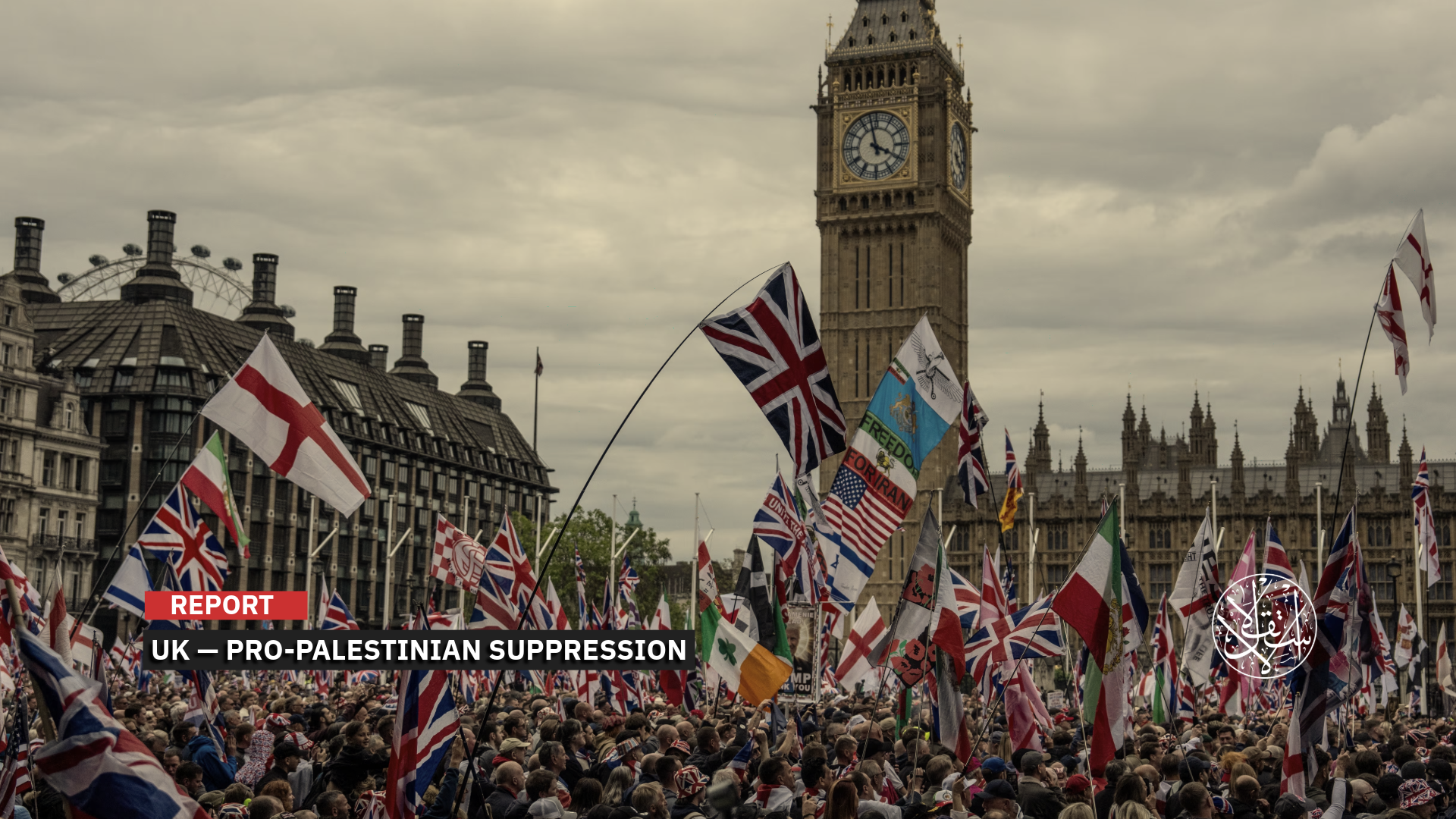
British universities opened disciplinary inquiries into pro-Palestinian activism.
Since the outbreak of the Israeli war on Gaza, its impact in Britain has not been confined to demonstrations and political debate. Within the Palestinian community, the war has extended into less visible aspects of daily life: what is said in workplaces, what is posted on social media, and what is worn at university or on the street.
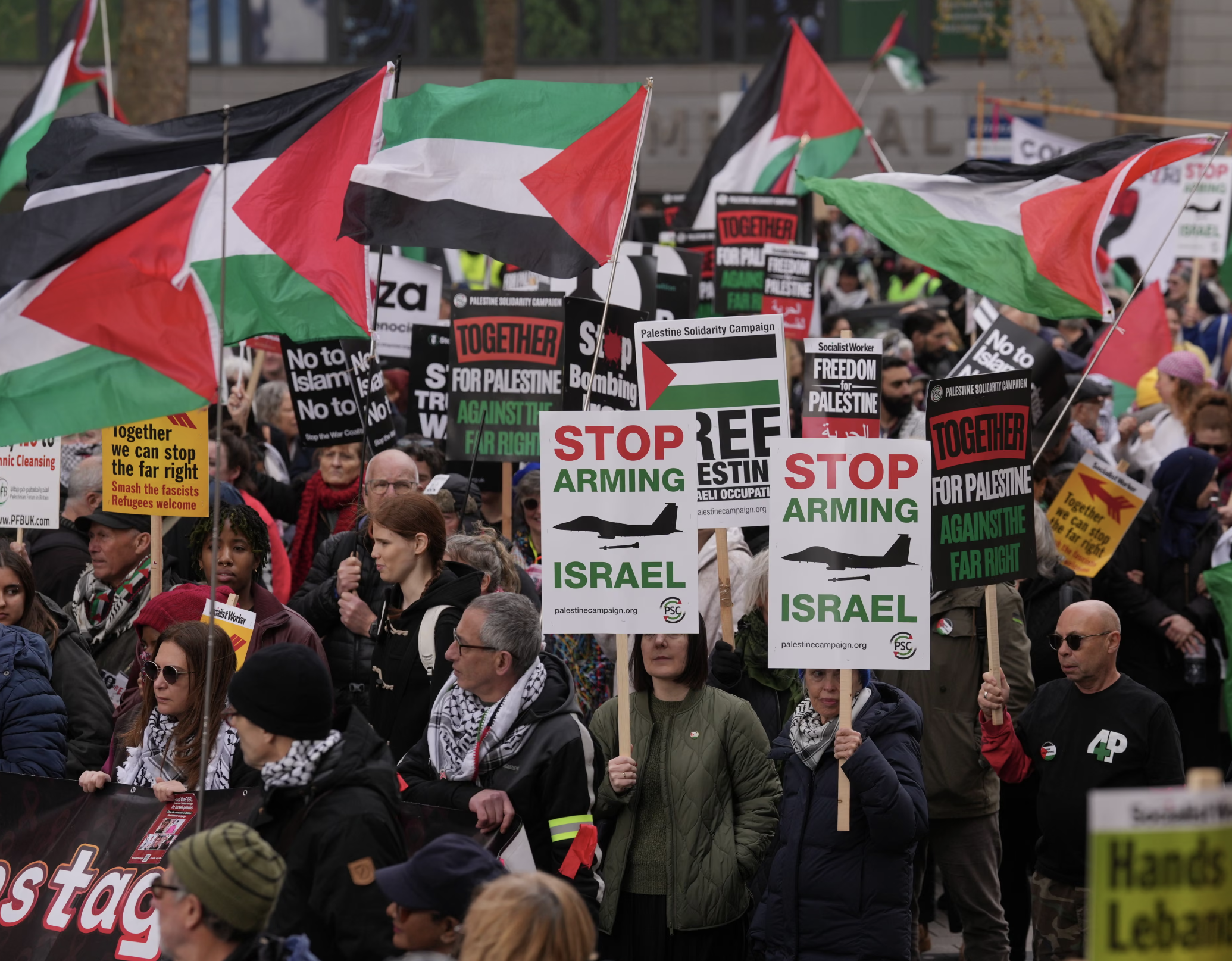
In a country that has witnessed widespread expressions of solidarity with Gaza, Palestinians say they have become more cautious about displaying their identity.
Concern is no longer limited to openly stated political views; it also stems from the possibility that a keffiyeh, a flag, or a necklace could be interpreted as a symbol that might prompt a complaint or lead to scrutiny.
Daily Fear
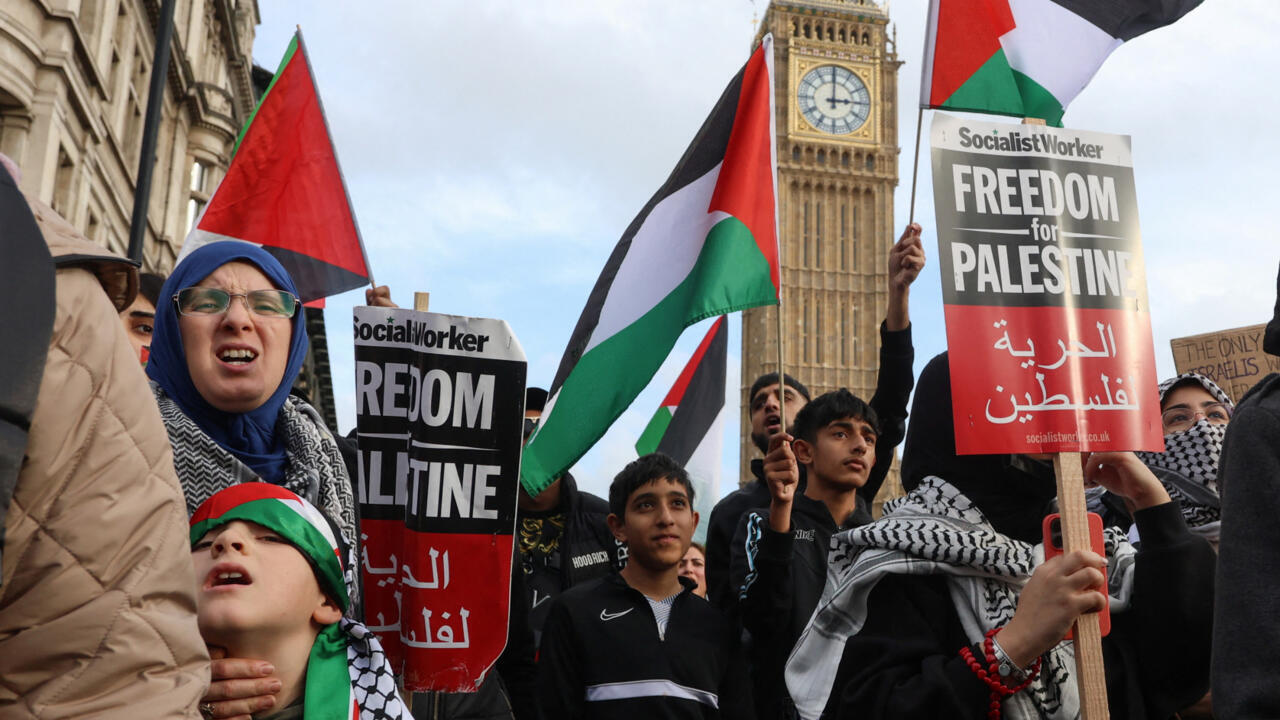
Fear often begins with seemingly small details: wearing a keffiyeh on the way to work, displaying a watermelon pin (a symbol commonly used online to represent Palestine), attaching a small flag to a bag or desk, or posting a message about Gaza and then deleting it out of concern that it might be interpreted out of context.
These actions may appear minor in themselves, but they reveal how self-censorship can become a daily habit. Palestinians may feel that any visible expression of their identity could be burdened with meanings beyond what was intended, making silence a form of self-protection.
Sara Husseini, director of the Palestinian British Committee, told The Guardian that some Palestinians in the United Kingdom have become hesitant to wear keffiyehs, watermelon symbols, or jewelry featuring Arabic script or references to Palestine, fearing that such symbols could be interpreted negatively in workplaces or public spaces.
Husseini does not present the issue solely as a political disagreement. Rather, she describes it as a sense that even Palestinian grief has come to require justification in workplaces and educational institutions.
A Palestinian speaking about Gaza may find themselves compelled, before anything else, to demonstrate that their grief is not a threat and that their identity is not an accusation.
This feeling is particularly acute among those with close family ties to Gaza, whose concern for relatives there can evolve into fears of scrutiny, disciplinary action, or even dismissal from work.
According to the Palestinian British Committee, the community is experiencing the compounded effects of the war, including trauma, family separation, displacement, and a need for greater support and representation within British society.
This fear does not arise in a vacuum. Tell MAMA, an organization that monitors anti-Muslim hate incidents in Britain, reported a record increase in complaints during 2024 and linked part of this rise to the impact of the Gaza war on public discourse, particularly online.
Although Britain has witnessed significant public solidarity with Palestinians, the fears described in these accounts do not always stem from the public at large.
Sometimes they arise from the possibility that an employer, university, healthcare institution, or professional body may interpret Palestinian symbols in a different, and potentially adverse, way.
At that point, the question is no longer simply about one's position on the war. It becomes a question of how much space Palestinians have to express their identity without risking their employment, education, or reputation.
The Cost of Expression
Self-censorship does not emerge in a vacuum. It is reinforced by concrete cases that signal to others that expressing support for Palestine can lead to professional or administrative consequences.
In the healthcare sector, one prominent case involved British Palestinian nurse Ahmad Baker Management at Barts Health NHS Trust, which operates several hospitals in east London, reportedly asked him to remove a video-call background showing a fruit bowl containing a watermelon, arguing that it could be interpreted as a political or "antisemitic" symbol.
Baker was among a group of healthcare workers who legally challenged the trust’s policy banning political or national symbols in both physical and digital workplaces.
The trust argued that the policy was intended to maintain a neutral and safe care environment. The claimants, however, contended that it was applied in a discriminatory manner, particularly given that other expressions of solidarity had previously been permitted in the context of Ukraine.
In universities, the issue appears to be even broader. In 2025, The Guardian and Liberty Investigates, a British investigative journalism unit, revealed that universities across the United Kingdom had opened disciplinary investigations into students and staff over pro-Palestinian activities since October 2023.
A subsequent investigation reported that 37 out of 154 universities had initiated disciplinary procedures between October 2023 and March 2025, affecting as many as 200 students and staff members.
Documents also indicated that some universities had employed private security firms and monitored student groups or communications connected to protests.
A broader picture of this pattern emerges from the UK Repression Index, compiled by the European Legal Support Center (ELSC) in collaboration with Forensic Architecture, a multidisciplinary research group based in London.
The database documented 964 incidents between January 2019 and August 2025 involving students, academics, workers, activists, journalists, and artists who had expressed support for Palestine.
The report presents these cases as a spectrum of pressures, ranging from smears and accusations to legal threats, investigations, and professional sanctions, and in some instances extending to dismissal, arrest, visa cancellations, or financial restrictions.
The cultural sector also offers a clear example of how pressure can move from politics into the arts. In Manchester, the HOME arts center cancelled a literary event titled Voices of Resilience, which was dedicated to writings from Gaza.
The decision followed a letter from the city’s Jewish representative council that included allegations against one of the participants and objections to the use of the term "genocide." The cancellation sparked widespread criticism from artists, after which the venue apologized and reinstated the event.
Even charitable work has not remained outside this sphere. The Guardian reported that bank accounts belonging to pro-Palestinian groups, including Friends of Palestine in Manchester and the Scottish Palestine Solidarity Campaign, were frozen in 2025, disrupting fundraising efforts and the delivery of humanitarian aid.
From Defamation to Investigation
The cost of expression does not always begin with an official decision or a direct penalty. In many of the cases documented by the European Legal Support Center in collaboration with Forensic Architecture, the process starts from a smaller point: a post about Gaza, a Palestinian symbol, a cultural event, or a student protest.
After that, the act is reinterpreted within a legal or media framework that associates it with “antisemitism,” “support for terrorism,” or a breach of institutional “neutrality” rules.
Institutions typically respond at this stage not as direct political actors, but under the stated aim of avoiding risk and the fear of being accused of tolerating what is described as hate speech.
The ELSC/Forensic Architecture report describes this process as a multi-sited network rather than a decision issued by a single authority.
Media and legal accusations reshape the meaning of solidarity with Palestine, and then educational, healthcare, cultural institutions, and workplaces translate this pressure into practical measures such as cancelling events, opening investigations, suspending activities, or imposing restrictions on symbols and language.
What is most significant in this process is that it does not always require a final punishment to produce its effect. The mere awareness among students, employees, or healthcare workers that a post or symbol could trigger a complaint or investigation is often enough to push others toward self-censorship.
This is what the report calls the “chilling effect”: people choosing silence before they are formally required to do so.
At the center of this network appears the organization “UK Lawyers for Israel” (UKLFI), described as a prominent legal advocacy group.
According to the ELSC report, the organization uses legal letters and formal complaints to pressure educational, cultural, and healthcare institutions, relying on equality law, counter-terrorism frameworks, and institutional conduct policies.
Reports based on the ELSC/Forensic Architecture database state that the organization’s name appears in 128 documented incidents, through complaints and letters sent to schools, universities, hospitals, and cultural institutions.
The organization is also mentioned in the case involving Barts Health NHS Trust, where lawyers for healthcare workers stated that the policy banning political or national symbols followed a complaint from UKLFI.
However, the issue does not rest with a single organization. The report points to broader legal and political tools used in this context, including the International Holocaust Remembrance Alliance (IHRA) definition of antisemitism, the UK Terrorism Act 2000, and institutional “neutrality” policies.
The concern, it argues, lies in the breadth of interpretation, where criticism of Israeli actions or the use of Palestinian symbols may be treated as a legal or security risk requiring explanation, defence, or professional caution.
Sources
- British Palestinians Feel ‘Gaslit’ and Unable to Speak Out, Says Leading Activist
- British Attitudes to the Israel-Gaza Conflict: July 2025 Update
- Ipsos Poll on British Attitudes Towards the Conflict in Israel and Gaza
- Britain’s Index of Repression
- ‘Relentless’: How UK Lawyers for Israel Targets Pro-Palestinian Voices
- Barts Nurse Told to Remove Watermelon Image Claims Discrimination