How 'Israel' Turned the Rafah Crossing into a Tool for Emptying Gaza
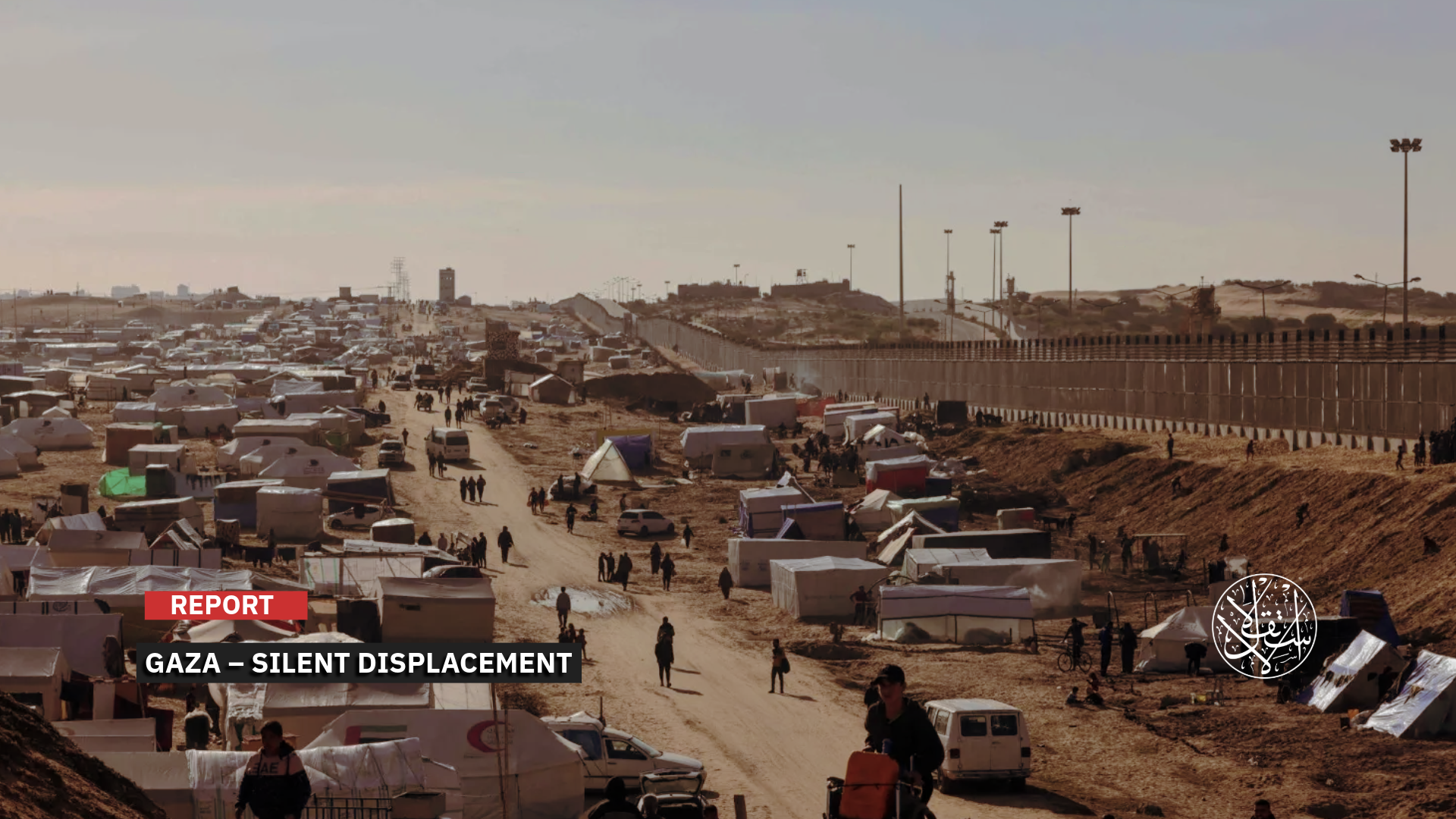
"The Rafah crossing began reopening at the end of January 2026 under the heading of limited movement."
Since its limited and intermittent reopening, the Rafah crossing in southern Gaza has been operating under suffocating Israeli restrictions in both directions. Thousands of patients, wounded individuals, students, and those with residency permits abroad remain unable to leave.
The suffering is not limited to these groups. Palestinians who left during the Israeli offensive for medical treatment, to accompany the wounded and sick, or due to compelling circumstances, face a different kind of obstruction when they try to return to their homes and families.
The names of those returning are subject to prior Israeli security approval, allowing the occupation authorities to remove, freeze, or return them to Egypt without any stated reason or clear mechanism for appeal. This effectively transforms the crossing into a tool for controlling who leaves Gaza and who is allowed to return.

Israeli Control
The Rafah crossing reopened at the end of January 2026 under the guise of limited movement.
The United Nations Office for the Coordination of Humanitarian Affairs in the Occupied Palestinian Territory (OCHA) confirmed that returns from Egypt would be limited to those who left Gaza during the war and would require prior Israeli security approval.
The process begins with those wishing to return registering their names at the Palestinian Embassy in Cairo or through designated coordination bodies. The lists are then transferred to the Egyptian authorities and subsequently sent to the Israeli occupation authorities for verification.
The Israeli Broadcasting Corporation (Kan) reported in late January 2026 that names are submitted to the Israeli side before the crossing, and that the occupation authorities retain the authority to approve the names of those entering and exiting, as well as the technical capability to remotely block movement.
Palestinian staff affiliated with the Palestinian Authority operate on the Palestinian side of the crossing, under the supervision of the European Union Border Assistance Mission in Rafah (EUBAM).
The EUBAM describes itself as a third party that monitors border procedures, supports the work of Palestinian staff, and coordinates between the parties, while security approval of the names of those returning remains with the Israeli authorities.
After having their documents and identity checked at the crossing, returnees proceed to a second checkpoint established by the Israeli occupation's security forces within an area controlled by the army.
There, Palestinians are subjected to investigation, interrogation, and searches before being allowed to continue their journey to Gaza. Thus, the occupation maintains two stages of control over returnees: one beginning with name checks before travel and continuing after crossing the border.
The Israeli occupation authorities do not provide a definition of what they call the security criteria for returnees. Some Palestinians attempting to return are surprised to find themselves barred from entering Gaza without any explanation or justification.
The Gaza Center for Human Rights documented these decisions in a statement published on July 15, 2026.
The statement described them as frequent and sudden, noting that they disproportionately affect women, children, the sick, and the elderly, without any reason or effective legal recourse, while Palestinians are left in limbo, facing decisions whose reasons and review dates remain unknown.
The consequences of this system were evident from the very first day the crossing reopened. On February 3, 2026, only 12 Palestinians entered Gaza, while the return of 30 others was blocked. This gap has widened in the weeks since.
Dr. Ismail al-Thawabta, director-general of the Government Media Office in Gaza, stated on February 1, 2026, that more than 80,000 Palestinians wish to return to the Gaza Strip.
On February 3, an official at the Palestinian embassy in Cairo estimated that around 30,000 people had registered to return, while initial discussions centered on allowing approximately 50 returnees per day.
Thus, the return became an exception subject to vetting, while tens of thousands remained outside Gaza awaiting an Israeli decision regarding their right to return home.

Stranded Abroad
Many of those stranded left Gaza under conditions imposed by the devastating Israeli offensive; Some were transferred for treatment after injury or illness, others accompanied a sick person or child, while still others left during the waves of displacement that preceded the occupation and closure of the Rafah crossing.
They carried with them the belief that their absence would last weeks or months, but then the war dragged on, and their return became contingent on a list and security approval.
Among these cases is “Amina,” a Palestinian mother in her mid-fifties, who left the Gaza Strip during the war with one of her daughters after her health deteriorated and she needed treatment and follow-up for a heart condition that the Strip’s hospitals could no longer provide.
She told Al-Estiklal, refusing to reveal her name for fear of reprisals, that she left for Egypt, leaving her husband and three other children in Gaza, believing that her absence would last only a few weeks, after which she would return to them once her treatment was complete.
After her condition stabilized, she registered her name with the Palestinian embassy in Cairo and waited to be included on the lists of returnees.
She re-registered multiple times, sometimes being told her name was under review. Later, she received word that the Israeli authorities had rejected her return for security reasons, without explaining the decision or offering her any means of appeal.
Amina says, “I left because my treatment wasn’t available in Gaza, and I left my children with the understanding that I would return quickly. My treatment period ended, but I’m still stuck here. All I hear is that my name is rejected for security reasons.”
She asks, “I don’t know what danger my return home poses, nor who to turn to for an explanation. I’m afraid this will turn into a permanent forced deportation.” She points out that there are dozens of others like her stranded in Egypt.
This woman is avoiding the risk of returning without approval, citing her fear of facing harsh measures from the Israeli occupation and its affiliated militias should she cross into Egypt.
After the Rafah crossing reopened, the Israeli occupation forces established checkpoints, some manned by the army and others by militias that now operate on its behalf. These militias interrogate, harass, and assault Palestinians returning to Gaza.
Rotana al-Raqab, Huda Abu Abd, and Sabah al-Qara, in testimonies published by the Associated Press on February 3, stated that Israeli soldiers handcuffed them, blindfolded them, subjected them to interrogation, and confiscated their personal belongings on the way to Gaza. They described threats, insults, and detailed questioning before being allowed to continue their journey.
OCHA warned on February 12, 2026, that forced interrogation, degrading treatment, and intimidation could deter Palestinians from returning.
The cost increases with each additional week outside Gaza. Those stranded bear the burden of housing, food, accommodation, and medical treatment, living far from their families and sources of income, while their paperwork and legal status in their host countries remain subject to expiration or further complications.
The Gaza Center for Human Rights described their psychological and humanitarian situation as extremely difficult, given the repeated registration, open-ended waiting periods, and decisions made without explanation.

Permanent Displacement
Preventing Palestinians from returning to their homes comes within the context of a broader Israeli policy whose objectives are no longer confined to the marginal statements of right-wing ministers. Prime Minister Benjamin Netanyahu and his Army Minister, Israel Katz, have publicly adopted plans based on expanding the occupation of Gaza and confining its residents to a smaller area.
On May 27, 2026, Katz confirmed that the government would proceed with what he called the voluntary emigration of Gaza residents at the appropriate time and in the appropriate manner, placing the departure of Palestinians among the long-term objectives of the war.
This statement followed previous Israeli steps, including the establishment of a special administration to facilitate the departure of Gaza residents and the proposal of routes for their exit by land, sea, and air, without any mention of their return to their homes.
The following day, Netanyahu announced that he had instructed the army to expand its control over Gaza to 70% of the Strip. The fragile ceasefire agreement had previously placed Gaza at approximately 53%, beyond what was termed the yellow line, before the occupation forces pushed its markers westward and expanded the areas Palestinians were prohibited from accessing.
With this expansion, more than two million Palestinians are being crammed into an ever-shrinking area, while cities, neighborhoods, and agricultural lands east of the line are being transformed into devastated and depopulated zones.
Over the following months, the yellow line transformed from a temporary military arrangement into a physical structure that delineates the Gaza Strip’s long-term division.
Satellite images published by the Associated Press in July 2026 revealed that the Israeli army had constructed earthen berms stretching over 23 kilometers along the line and equipped the area with surveillance technology.
This coincided with the demolition of towns and agricultural lands on the Israeli-controlled side and the displacement of residents toward the western coastal strip, where many now live in overcrowded camps.
Alongside this, projects revealing the occupation’s intention to solidify its presence within Gaza were expanded.
In July 2026, Katz announced his intention to establish three outposts of the Nahal Brigade in the northern Gaza Strip. These outposts combine military presence with agricultural activity and have historically been used by Israel to consolidate control and prepare land for settlement.
This move comes after Israeli officials declared that the army would remain within the areas it occupied, while the displacement of residents of northern and eastern Gaza continues.
Within this context, the term 'voluntary migration' serves a propaganda function, masking a process based on destroying living conditions, shrinking the land available to the population, and closing off avenues of return, while presenting departure as an individual choice.
Control of the Rafah crossing is crucial to this plan because it allows for one-way movement. The Israeli authorities permit the exit of limited numbers according to quotas, lists, and rigorous checks, then re-examine the names of those requesting to return to Gaza, with the power to disqualify them or turn them back.
For this reason, the Israeli human rights organization Gisha and the Adalah Legal Center in the Occupied Territories, in a joint statement on February 16, 2026, described the investigation, humiliation, and property confiscation procedures to which returnees are subjected as indicative of an attempt to thwart the return of Palestinians.
The Gaza Center for Human Rights also observed on July 15 that the arbitrary security rejections entrench forced displacement and deepen family disintegration, especially since they affect women, the sick, and the elderly, and there is no effective avenue for appeal.
This policy clashes with clear international legal rules that prohibit arbitrarily denying a person entry to his country, or forcibly transferring or deporting the inhabitants of occupied territory.
Sources
- Palestinians mourn slain Hamas militant chief as Israel escalates Gaza attacks
- Israel is building a miles-long earthen barrier inside Gaza, entrenching its division
- Gaza Humanitarian Response | Situation Report No. 65
- Women returning to Gaza say Israeli troops bound and interrogated them after Rafah crossing
- Netanyahu directs Israeli forces to expand Gaza control to 70 percent
- Gisha and Adalah Demand Immediate Halt to Harassment of Palestinians at Rafah, Warning of Apparent Efforts to Prevent Their Return to Gaza