Gaza Between Two Lines: How "Israel" Is Expanding Its Areas of Influence Within the Besieged Territory
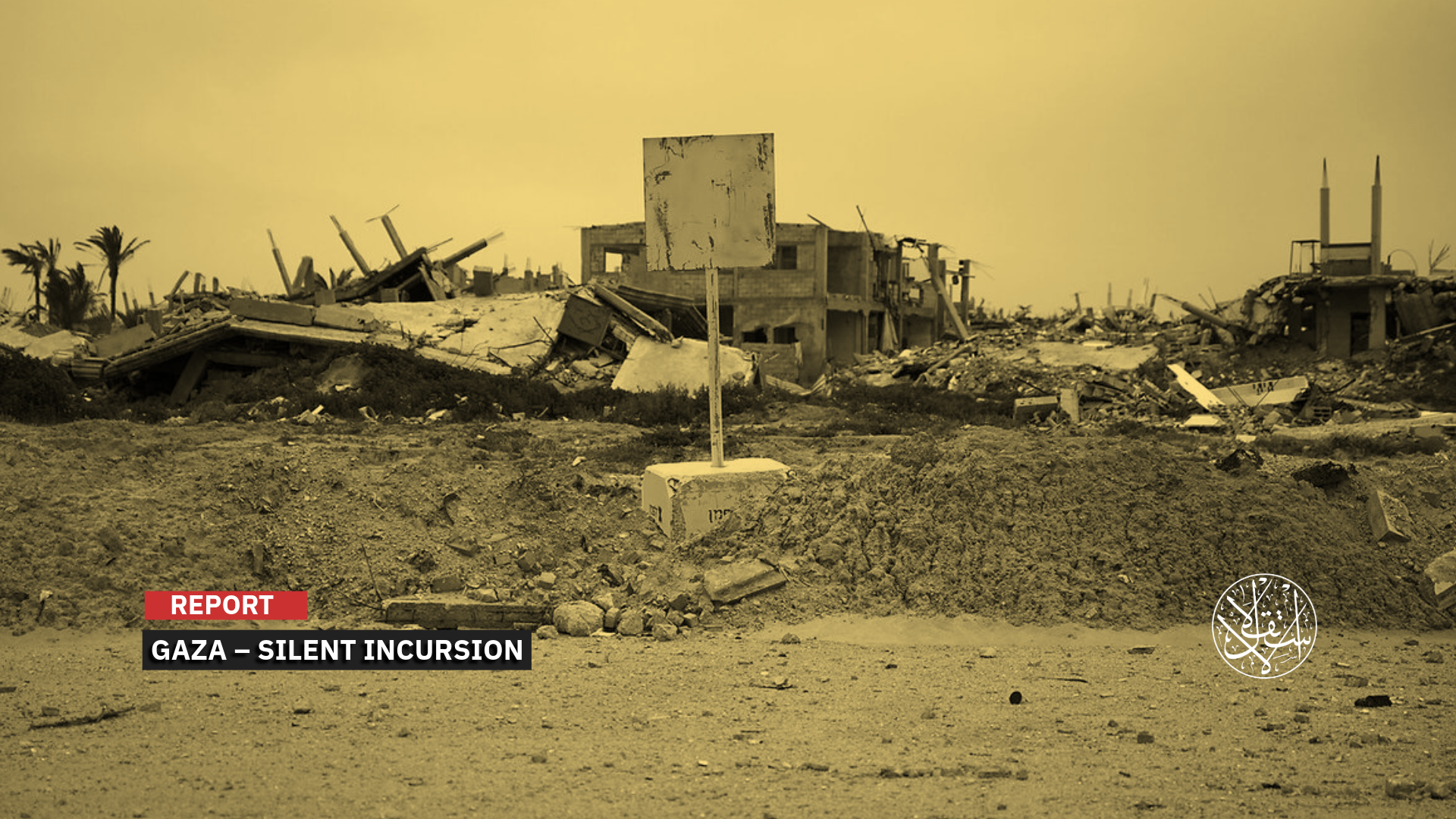
“In recent months, the Israeli occupation has intensified its military incursions into the Gaza Strip.”
The Israeli occupation army continues to expand its control within the Gaza Strip, coinciding with an escalation of its daily bloody attacks against Palestinians, in an attempt to impose a new reality on the ground.
In recent months, the Israeli occupation has intensified its military incursions into the Strip, deploying what are known as yellow blocks that delineate the boundaries of its areas of influence deep inside Gaza, effectively expanding the Yellow Line, an arbitrary line that defines the areas under Israeli military control.
At the time the ceasefire came into effect on October 10, 2025, the areas within the Yellow Line constituted approximately 53% of the Gaza Strip. This percentage rose to 58% in December 2025, then reached 60%, and is currently estimated at about 64% of the total area of the Strip.
Once any area is annexed to the Yellow Line, the Israeli occupation designates it a closed military zone, and approaching it becomes extremely dangerous. Since the ceasefire came into effect, approximately 300 Palestinians have been killed, allegedly for approaching these areas.
Logistical Preparations
In parallel, the Israeli occupation army continues to reinforce its military presence within the Gaza Strip by establishing more fortified military sites, bringing the total to 32, distributed across various areas of Gaza, all situated along the Yellow Line.
The Israeli occupation has also expanded its network of high earthen berms along this line, granting it direct control over Palestinian neighborhoods and allowing tank snipers and sniper units to monitor vast areas of the devastated regions and target any movement within them.
Israeli control is not limited to the areas within the Yellow Line. It has also added what is known as the Restricted Area, marked by an orange line on maps, which is estimated to comprise about 11% of the total area of the Gaza Strip.
Including the areas seized by the Israeli occupation since the ceasefire in October 2025, the isolated or restricted areas approach two-thirds of the Gaza Strip's total area.
According to two sources in the relief sector, the Israeli army sent maps of these areas to humanitarian organizations operating in Gaza on March 15, 2026, without officially publishing them or making them available to the public.
Al-Estiklal verified this information through an employee of the World Kitchen organization, who confirmed that the Israeli occupation forces have imposed severe restrictions on the movement of aid workers within the areas designated as the Orange Line.
The employee, who preferred to remain anonymous, stated that the orange line encompasses more than half of the area of the camps in the central region, located east of Salah al-Din Street, and that international organizations are prohibited from entering these areas without prior approval from the occupation authorities.
He added, "We have suspended our operations in the orange line areas, as have most international organizations. This is why signs of famine are beginning to reappear in those areas. There are virtually no soup kitchens to distribute food within the areas that the Israeli occupation has prohibited access to, and water tankers have stopped delivering drinking water to them."
He pointed out that restrictions on the entry of aid and humanitarian workers have exacerbated the living conditions of the population, with thousands of families relying almost entirely on relief services to meet their basic needs.
In this context, the spokesperson for the UN Secretary-General, Stephane Dujarric, stated that Israel has provided aid agencies with maps that include a new colored line, known as the Orange Line, in addition to the existing Yellow Line.
Meanwhile, Palestinian human rights organizations revealed that the area under direct Israeli control or subject to strict military restrictions has increased to approximately 64% of the total area of the Gaza Strip as of May 5, 2026.
Under the new designations, the Orange Line now runs alongside Salah al-Din Street, one of the most vital arteries connecting the north and south of the Gaza Strip.
The Israeli occupation has also moved the boundaries of the Yellow Line towards the same road in the northern part of the central region, raising increasing concerns about its complete closure or the imposition of further restrictions on movement along it.
These measures are seen as part of a policy to expand territorial control within the Gaza Strip, impacting population movement, relief efforts, and access to basic services.

Displacement Operations
Following the Israeli occupation's demarcation of what is known as the Orange Line and the expansion of the Yellow Line, it resumed the displacement of Palestinians from new areas within the Gaza Strip, in a move that appeared to be part of a comprehensive plan to depopulate additional areas.
Areas in the northern Gaza Strip and east of Gaza City witnessed successive waves of displacement, which later spread to the central Gaza Strip.
The central region recently witnessed a large-scale displacement, with more than 10,000 Palestinians forced to flee areas east of Deir al-Balah following threats issued by armed groups operating in areas under Israeli control.
In this context, Bashar Abu Shamsia said that his family and several relatives, residents of the Abu al-Ajeen area east of Deir al-Balah, were forced to flee westward on orders from the Israeli occupation forces, conveyed by armed groups loyal to them. He noted that the measure affected thousands of residents in areas east of the city.
He added in an interview with Al-Estiklal: “At approximately 9:30 PM on May 13, 2026, militias loyal to the collaborator Shawqi Abu Nasira stormed our area, and their members began firing into the air and insulting the residents.”
He added: “They informed us through loudspeakers that we had until midnight to completely evacuate the area, from Abu al-Ajeen to Abu Miri roundabout, and that anyone who remained after that would be killed.”
He explained that he and his family were forced to flee westward to the village of al-Masdar, where they pitched a modest tent, the only one they owned. He noted that he was only able to take some clothes and basic belongings.
He said that thousands of residents experienced the same conditions and were forced to leave their homes hastily, managing to take only a very small portion of their possessions.
He pointed out that their area was previously classified as a safe zone outside the Yellow Line, but the displacement operations began after it was included in the so-called Orange Line.
He said: “They were firing at the windows of houses and tents, attacking anyone who tried to cultivate their land or reach it, in addition to insults and beatings. All these practices were aimed at forcing the residents to leave.”
"Last time, there were no more indirect pressure tactics; clear and explicit orders were issued to evacuate the area, with a direct threat that anyone remaining in their home would be killed," he added.

The Yellow Line
The Israeli occupation did not stop at displacing residents from their homes and lands and annexing them to the Yellow Line. It also began making radical changes within these areas by destroying and bulldozing all aspects of civilian life.
In April 2026, the occupation army completed digging a deep trench along the Yellow Line in the Gaza Strip, creating a barrier to Palestinian movement, according to the Israeli channel i24NEWS.
The channel explained that the army dug at least 1.5 kilometers in the southern Gaza Strip, in addition to carrying out further digging in the north and constructing artificial hills in various locations to reinforce the barrier, in accordance with operational planning and the requirements for protecting Israeli forces deployed in the area.
It added that the purpose of the trench is to create a barrier that prevents or delays the crossing of Palestinians and vehicles to the other side.
According to the channel, this trench is part of a series of Israeli measures aimed at strengthening field control and preventing any potential infiltration by residents of the Gaza Strip or vehicles.
The Israeli occupation has also militarized the areas along the Yellow Line, providing them with electricity, lighting, communication towers, and heavy equipment.
The Israeli newspaper Haaretz reported in February 2026 that the Yellow Line is gradually transforming into a permanent de facto separation line through the establishment of 32 military sites and the construction of a 17-kilometer-long land barrier, making it a key axis for Israeli military deployment within the Gaza Strip.
In turn, Ibrahim Bakr told Al-Estiklal that the Yellow Line had confiscated all of his and his family's agricultural land, which included fruit trees.
He explained that the land, wells, and irrigation networks were all now located within the line's boundaries after the occupation forces bulldozed them and destroyed their agricultural equipment.
"What the Israeli occupation has been doing in recent months is a complete and radical geographical transformation of the area. They have leveled the land and removed houses and trees in the areas along the Yellow Line parallel to the central region. They have also begun digging a long and deep trench in the western part of the line," he said.
He explained that "the Israeli occupation has constructed asphalt roads and rectangular empty spaces covered with materials resembling beach sand. They have also erected structures resembling water reservoirs and diverted some of the water lines that used to supply Gaza to these areas, in addition to other civilian infrastructure projects that he described as suspicious."
Mr. Bakr emphasized that "the areas along the Yellow Line have become a hub for militias collaborating with the occupation. These groups use buildings and schools as their headquarters, patrol in four-wheel-drive vehicles, and can be seen daily moving within these areas, which he described as having become larger than the space available to the residents of the Gaza Strip."
He added that there are also civilian families believed to be affiliated with these groups, explaining that their members are effectively responsible for securing the Yellow Line areas and attacking residents outside them, whether through gunfire or raids on homes.
He noted that the Shawqi Abu Nasira militia roamed the central Gaza Strip within the Yellow Line areas, operating under the directives and orders of the occupation, and carrying out its attacks continuously. Anyone can observe its movements around the clock.
He pointed out that these groups head to areas east of Deir al-Balah, east of al-Masdar village, and east of al-Maghazi camp, where they approach residents and young men to join them, using various methods, including threats at times, or enticement by offering them cigarettes (which are banned from entering Gaza), as well as money and drugs in exchange for joining.
He added that these attempts come amid the numerical shortage suffered by these groups following the losses they sustained in ambushes carried out by the resistance. He emphasized that the vast majority of the population refuses to respond to these offers, despite the resulting exposure to repeated attacks.

The Israeli Plan
The rapid developments on the ground indicate the possibility that the occupation is seeking to implement a plan circulating under the name 'New Gaza'.
This plan involves transferring the residents of the Gaza Strip to areas under its control located within the Green Line and placing them under the security administration of local groups loyal to it.
In this context, the Israeli newspaper Maariv revealed on May 2, 2026, that Hamas had prevented contractors from Gaza from working with the so-called Peace Council for Reconstruction within the Green Line.
Palestinian observers interpreted this as an indication of the council's potential role in implementing Israeli plans for the future of those areas.
In turn, Dr. Saleh Ibrahim, an expert on Israeli affairs, stated that the occupation continues to adopt an approach based on confining Gaza's population to areas outside Hamas's control, within projects proposed under various names, including 'New Rafah' and 'Green Gaza'.
In an interview with Al-Estiklal, he noted that "this project is based on expanding the Yellow Line, which has already happened, to the point that Israeli control now exceeds 64% of the Gaza Strip.
"These areas are administered by groups loyal to the occupation, with residents being encouraged to move there by providing caravans, tents, and relatively better living conditions. This is happening in parallel with the reshaping of the geographical landscape in the western areas that remain under Hamas control," he added.
He indicated that military operations might resume or escalate in order to push more residents toward these areas under the control of armed groups collaborating with the occupation.
He emphasized that the project is not new, and that some of its features were being implemented before the ceasefire agreement signed on October 10, 2025.
He explained that the first experiment was launched in Rafah, where, according to him, a civilian entity is currently being run by a group led by Ghassan al-Dahini under the supervision of the occupation.
He added that talk of Emirati support for this model in Rafah is widely circulating in Palestinian circles, noting that the Israeli plan is to replicate the same experience in other governorates of the Gaza Strip.
He explained that Israeli Prime Minister Benjamin Netanyahu views the completion of this project as the image he wants to market as a victory, as it would allow him to claim that he has succeeded in isolating Hamas politically, militarily, and civilly within the Gaza Strip.
He also pointed out that the success of such a project could open the door to Israeli demands to re-establish settlements in large parts of Gaza, especially after calls made by a number of senior Israeli rabbis in recent months to return settlements to the Strip.
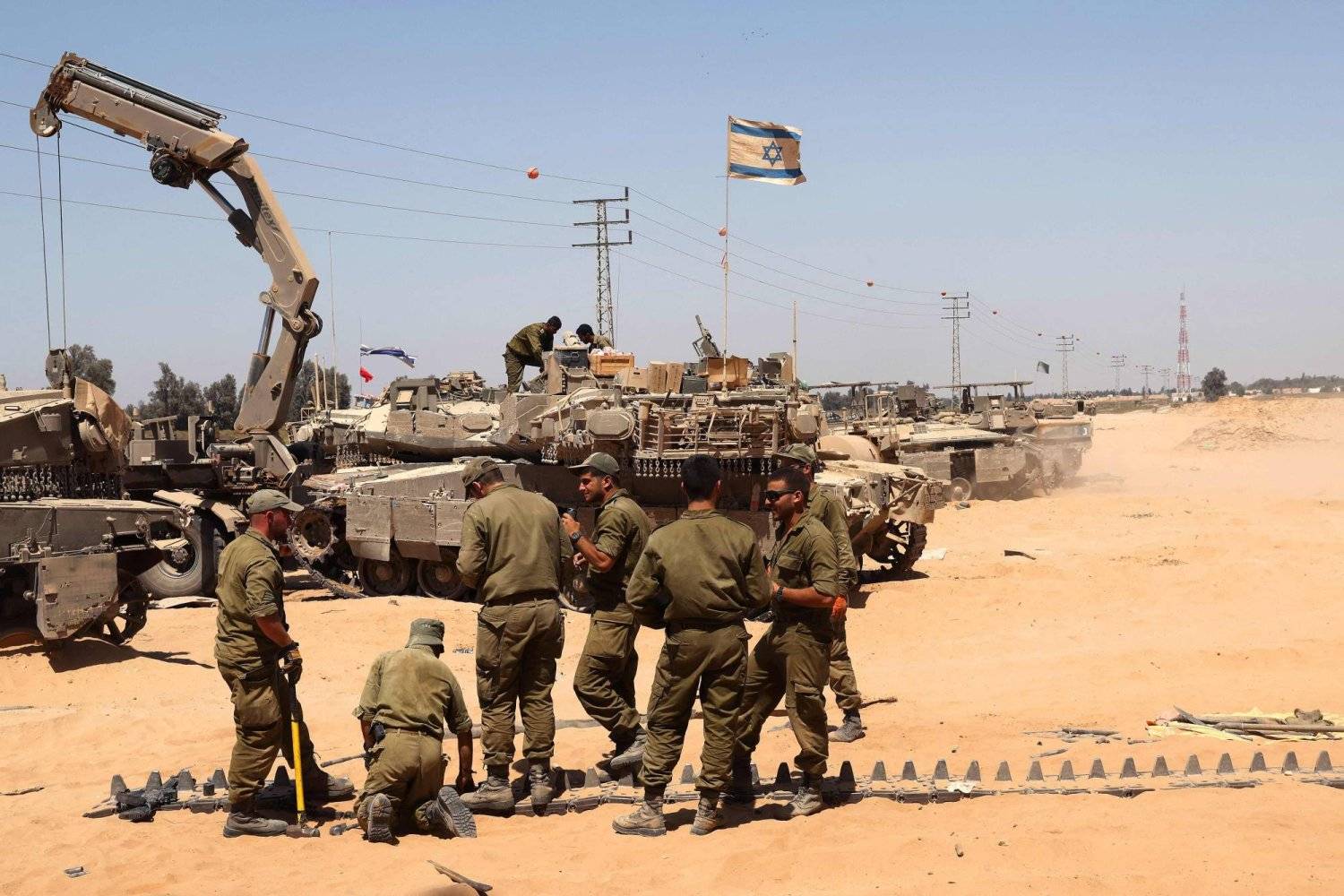
Regarding the chances of success for this plan, Dr. Saleh emphasized that the fundamental issue is not simply about expanding the Green Line or preparing areas to receive residents, but rather the extent to which Palestinians are willing to move to these areas and submit to the authority of armed groups affiliated with the occupation.
He added that there is widespread hostility between the residents of Gaza and these groups, due to accusations by Palestinians of committing violations and working for the occupation, which makes popular acceptance of the plan extremely difficult.
The expert suggested that the majority of the Gaza Strip's residents would not accept moving to those areas or living under the administration of these groups, estimating that this represents one of the most prominent challenges that any attempt to implement this project on the ground might face.
Sources
- Gaza between the Yellow Line and the orange line [Arabic]
- Observers: Mladenov seeks to impose a transitional government in eastern Gaza under humanitarian and military pressure [Arabic]
- Israel's consolidation of the Yellow Line in Gaza threatens the course of the Mladenov Plan [Arabic]
- The occupation continues to deepen the Yellow Line and claims nine martyrs in Gaza [Arabic]