Trump–Vatican Dispute Over ‘Divine Authority’: Who Has the Right to Speak in ‘God’s’ Name?
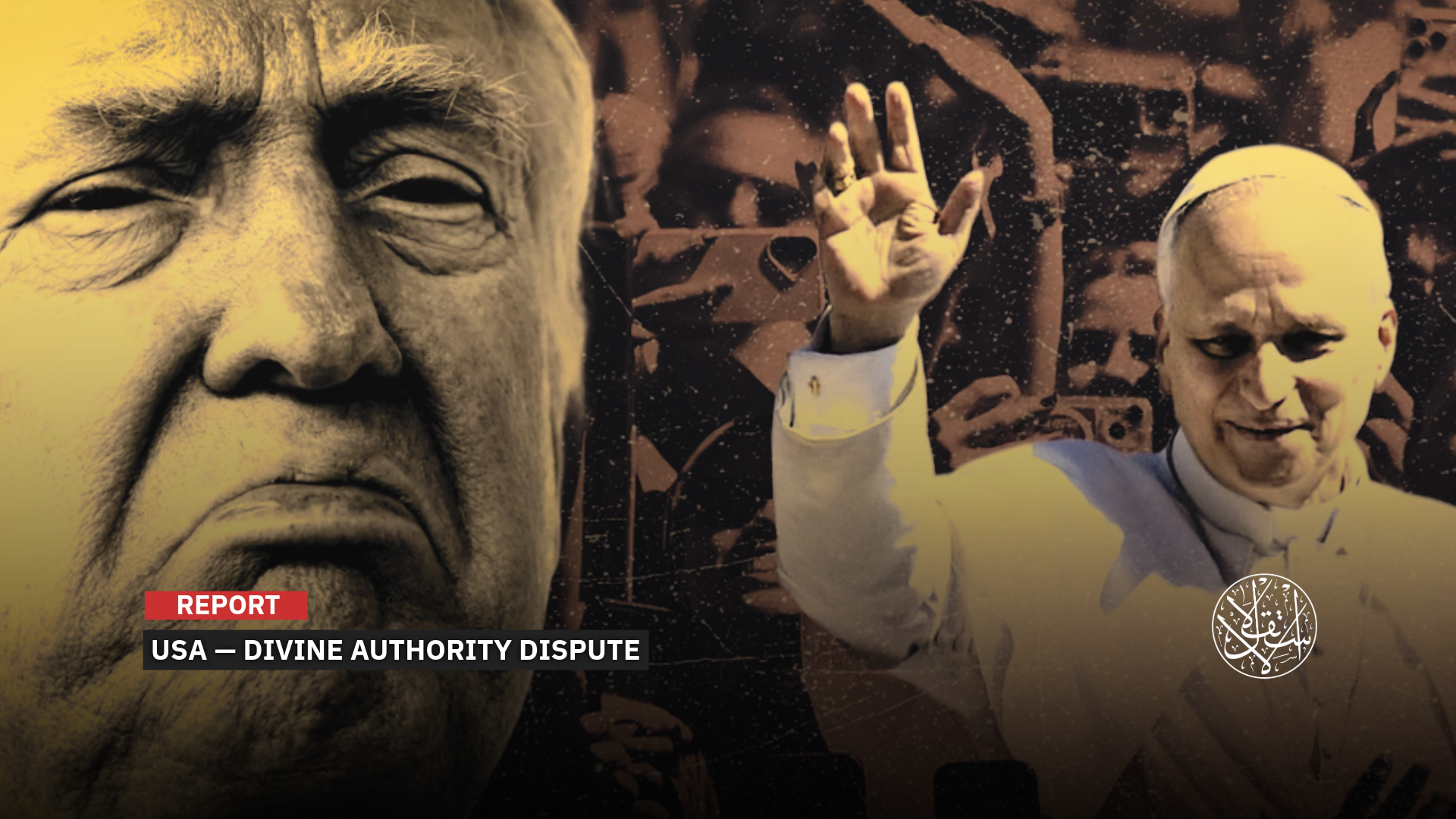
The pope sharpened his criticism, condemning “lords of war” whose “hands are soaked in blood.”
“Woe to those who manipulate religion and the very name of God for their own military, economic, and political gain, dragging that which is sacred into darkness and filth.”
With that sharp rebuke, Pope Leo XIV, head of the Catholic Church, took direct aim on April 16, 2026, at remarks by President Donald Trump and members of his administration after they invoked what critics described as a “divine right” to speak in “God’s” name and interpret His will.
What began in the shadow of the war on Iran has quickly grown into something larger, a struggle over who holds the symbolic authority to speak for “divine values” in the public square.
The clash, which at one point saw images circulating online depicting Trump in traditional religious attire as a kind of stand-in for Christ before being quietly removed amid concerns over backlash among Christian audiences, is less about theology than about power. At its core is a deeper contest over who gets to claim the language of faith and use it in politics.
Trump has leaned into a form of religious rhetoric that resonates with segments of the evangelical right, presenting himself as a figure of providential purpose and suggesting that God stands behind the nation’s mission. It is a framing that blends political authority with divine legitimacy, rooted in ideas of strength, popular mandate, and national destiny.
The Vatican, by contrast, offers a different vision, one grounded in universal moral authority shaped by centuries of church teaching and a global understanding of Christian values. From that position, it has issued pointed criticism of what it sees as a narrow form of religious nationalism that blurs the line between faith and political use.

The Rift
Since early April 2026, Pope Leo XIV has issued a steady stream of indirect rebukes aimed at President Donald Trump, holding his ground despite the escalating rhetoric and counterattacks that followed.
Although American-born, the pope has entered an open political and spiritual confrontation with Trump, often described as the “Emperor of the White House,” resisting pressure to change his position on the war with Iran and relying on his symbolic authority as leader of around 1.4 billion Catholics worldwide.
When Leo XIV condemned threats to destroy Iranian civilization as absolutely unacceptable, the response from Washington was swift and sharp. Trump lashed out on social media, accusing the pope of being soft on crime, ignorant of foreign policy, and acting more like a political figure than a religious leader.
The pope, in turn, sharpened his language, denouncing “lords of war” whose “hands are soaked in blood” and warning of a world “run by a handful of tyrants.” He went further, condemning those who drag the sacred into darkness and defile it.
Trump did not hold back. On April 13, 2026, he said he was “not a fan” of the pope, calling him “very liberal” and accusing him of failing to understand how to stop crime. He also alleged that the pope was appeasing a state seeking nuclear weapons, later branding him “weak” in a lengthy post on Truth Social and urging him to stop what he called pandering to the radical left.
Tensions escalated further when religious symbolism moved to the center of the political clash. On April 14, 2026, Trump posted an image of himself with Christ-like features, sparking widespread controversy across American religious and Catholic circles and raising concerns about the use of sacred imagery in political messaging. The image was later removed after a wave of criticism, with Trump saying he believed it was a symbolic depiction related to medicine.
The AI-generated image showed Trump dressed in white and red, standing beside a patient on a hospital bed, surrounded by American symbols including the flag and the eagle, a scene many saw as a direct blending of religious and national imagery for political effect.
The moment was amplified by remarks from his spiritual adviser, Paula White, who compared Trump to Christ during an Easter gathering, drawing backlash from religious figures who viewed such comparisons as crossing theological boundaries.
In another twist, Trump reignited the controversy by reposting an earlier image of himself dressed in papal attire, a move widely seen as a thinly veiled political message to the Vatican and one that drew sharp criticism across Catholic circles.
On April 16, 2026, he escalated further, claiming he had information that could bring down the Vatican and the Catholic Church overnight. He added that he respects a billion Catholics and would not release it, but warned the pope to stay out of politics.

U.S. media reports said the Pentagon summoned the pope’s representative in January 2026 and reprimanded him after the pope criticized the U.S.-Israeli War on Iran and took aim at Trump’s church prayer event at the White House.
Pope Leo responded by saying he is not afraid of the Trump administration and would continue to speak out loudly against the war.
Writing in The Guardian on April 24, 2026, columnist Jonathan Freedland argued that it is no surprise Trump has found a rival in Pope Leo, saying the U.S. president represents the opposite of Christian values.
“Name the deadliest of sins—cruelty, deceit, avarice—and Trump will both exhibit them and celebrate them,” he wrote.
Trump has also been accused of using his high office to enrich himself and his family, generating at least $1.4 billion in profits during his presidency, according to an analysis published by The New York Times in January 2026.
That figure, some argue, may be far higher. Senator Bernie Sanders, a leading figure in the Democratic Party, wrote that the Trump family’s gains could have reached $4 billion, citing corruption and the exploitation of political influence and wartime conditions.

He Is Losing the Christian World
By presenting himself as a figure entitled to speak for divine values and even “the word of God” and by entering into open confrontation with the Vatican, Pope Leo XIV, Trump has triggered warnings in American and European media that the fallout could carry a political price and potentially unsettle parts of his Christian support base.
According to the Financial Times, Trump’s claim to divine authority will come at a political cost and has angered segments of his Christian base.
At the heart of the clash is a fundamental divide: Trump’s belief that “God is in service of the nation” versus the Vatican’s view that “God stands above nationalism.” That framing has underpinned his willingness to issue extraordinary threats, including his claim that, as president of the United States, he possesses information that could bring down the papacy, the Vatican, and the entire Catholic Church overnight.
The intensity of the response reflects a broader current within parts of Trump’s base and administration, where some have described the presidency in quasi-divine terms.
The Trump-Vatican standoff has also unsettled segments of American Catholic voters, a politically significant bloc, many of whom see his rhetoric as crossing a line in its attacks on the pontiff, according to Agence-France Presse (AFP) on April 18, 2026.
Historically, U.S. presidents have avoided direct public criticism of the pope in order not to alienate Catholic voters. Trump, however, has broken with that tradition, even as Catholic support played a key role in his 2024 election victory.
That confrontation may now become a political liability, with potential consequences for Republicans in the 2026 midterm elections.
Trump has built a narrative of a “white Christian nationalism,” drawing legitimacy from the state, electoral power, and his self-image as a chosen defender of Christianity. He has directly challenged Vatican authority, saying, “If I weren’t in the White House, Leo wouldn’t be in the Vatican,” a remark widely seen as positioning political power against religious leadership.
The Vatican, for its part, under Pope Leo XIV, continues to assert authority through a universal moral framework rooted in church tradition, emphasizing ethics, peace, and protection of the poor, independent of secular political power.
In effect, Trump presents himself as carrying a form of divine legitimacy derived from the nation and electoral mandate, while the Vatican rests on a universal moral authority grounded in doctrine. The result is a direct contest over who gets to speak for the voice of “God” in political life.

Two Competing Brands
A CNN analysis on April 19, 2026, summed up the dispute between Trump and the Vatican as a clash between two competing brands of Christianity, each claiming to represent Christ, but built on sharply different interpretations of faith.
One is the “historical Jesus” as framed by the Vatican, the other a “MAGA Jesus” promoted within Trump’s political narrative. According to the analysis, Pope Leo XIV’s aim is to challenge what it calls a political reinterpretation of Christ.
In this framing, the Jesus advanced by Trump supporters is not the nonviolent figure taught in Sunday schools but a “warrior Christ” drawn from the Book of Revelation, with “eyes like flames of fire” and a “robe dipped in blood,” leading heavenly armies on a white horse, as CNN described it.
That imagery has echoed in political rhetoric, including remarks by War Secretary Pete Hegseth, who called on Americans to pray “every day, on bent knee” for military victory “in the name of Jesus Christ” against what he described as catastrophic Iranian enemies.
The report also pointed to a separate moment that drew widespread ridicule, when Hegseth appeared to read what seemed like a biblical passage during a Pentagon prayer, which was in fact lifted from the film Pulp Fiction.

Peter Wehner, a former speechwriter for President George W. Bush, wrote in The Atlantic in an article titled “MAGA Jesus Is Not the Real Jesus.”
He argued that in recent years, many American fundamentalists and evangelicals have come to prefer the image of a MAGA-branded Christ over the historical Jesus.
Wehner said right-wing movements are pushing Christianity further and further away from the ethics and teachings of Jesus, adding that the Trump administration has turned authentic Christian faith upside down by promoting cruelty and a will to power in the name of Jesus.
He warned that this has placed Christians in a theological grey zone, where the teachings of Christ are being repurposed to serve a political movement with authoritarian tendencies.
This image of Jesus has gained strength in part because the MAGA movement is not only political but also carries a religious dimension, portraying Trump as a “chosen one” and “Israel” as a “chosen nation.”
CNN noted that critics have attempted to deconstruct this Trump-aligned version of Christ, with some evangelical Christians, theologians, and others describing it as heresy and false Christianity.
Yet the appeal of this narrative has persisted, making Pope Leo XIV a key theological opponent of this strand of contemporary Christianity.
Against this backdrop, the relationship between Trump and the Vatican increasingly resembles a theological confrontation over who has the authority to speak for “God” and divine values in public life, rather than a conventional doctrinal dispute.
Since his rise, Trump has positioned himself as a defender of “Christian America,” drawing strong support from conservative evangelical movements and using religious language as a central tool in shaping political identity.
The Vatican, by contrast, rejects reducing faith to national identity or political project or using it to justify exclusionary policies, insisting instead on its universal moral and human message.
The Financial Times argues that this use of religious language inside the White House is reshaping U.S. foreign policy, shifting it away from international law and secular frameworks toward concepts closer to religious conflict.
At the same time, the newspaper notes that Trump is unlikely to bring religious leadership under his influence in the way he has with political and media institutions in the United States, given the independent spiritual authority of the Vatican and the Catholic Church.
Sources
- How the dispute between Trump and Pope Leo escalated
- Pope Leo’s resolute response to Trump attack reveals a man of God, not politics
- The divine right of Trump
- It’s no surprise Trump has met his match in Pope Leo – the US president represents the polar opposite of Christianity
- Why the pope’s authority is confounding and maddening for Trump
- MAGA Jesus Is Not the Real Jesus