Sharjah Secession Rumors: Have Abu Dhabi and Dubai Turned Against the UAE Constitution?
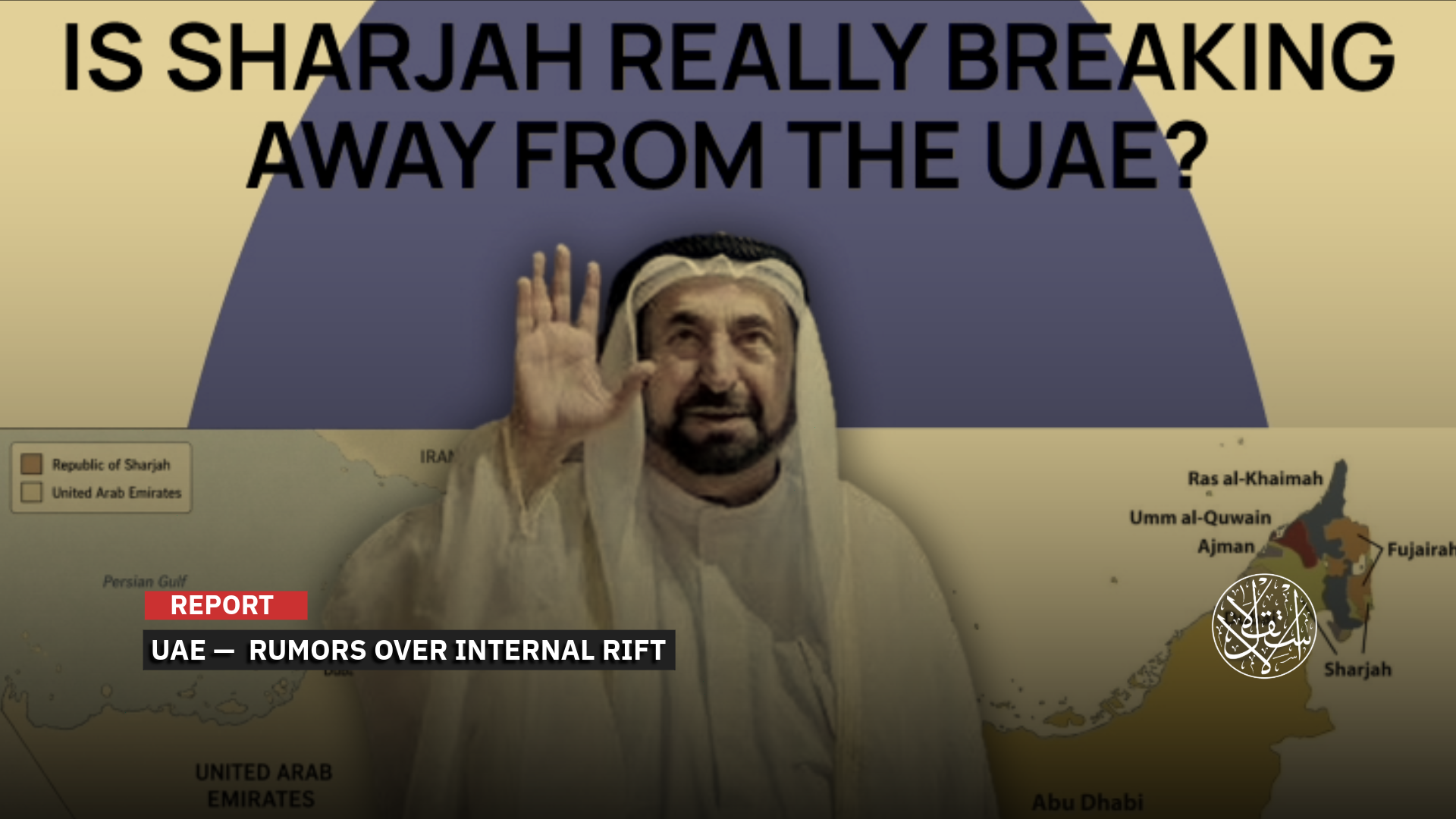
Article 4 of the UAE Constitution draws a clear red line: no secession, no surrender of any part of the nation’s territory.
As Abu Dhabi and Dubai embrace increasingly liberal domestic policies modeled on the West and pursue foreign agendas that break sharply with their historic Arab and Islamic identity, including normalization with the Israeli Occupation, intervention in regional conflicts, and support for armed factions across the Arab world, rumors of internal fractures within the United Arab Emirates (UAE) have surged across digital platforms.
Among the most provocative claims were whispers that Sharjah could break away from the seven-emirate federation, fueling speculation that the narrative itself was being amplified to warn Abu Dhabi’s leadership that it is drifting from the constitutional foundations of the union.
Yet the rumors surrounding division and possible secession exposed a deeper tension at the heart of the UAE. While Sharjah has largely remained committed to the principles and political identity on which the federation was founded, Abu Dhabi and Dubai appear to have charted a dramatically different course.
The circulating accounts also point to widening ideological fault lines between some of the seven emirates, particularly those uneasy with the direction taken by Abu Dhabi and Dubai. Sharjah, in particular, is often portrayed as increasingly frustrated by what it sees as a departure from the conservative Arab Islamic character that once formed the backbone of the UAE’s social and political compact.
Fire Beneath the Ashes
Although the constitution of the UAE, ratified in 1971, bars any of the seven emirates from withdrawing from the federation, Article 4 goes even further, explicitly outlawing both “secession” and the surrender of any territory. The text leaves little room for ambiguity: “The UAE may not cede its sovereignty or relinquish any part of its territories or waters.”
Sharjah’s ruler, Sheikh Dr. Sultan bin Muhammad al-Qasimi, who has governed the emirate since January 25, 1972, has long stood among the fiercest defenders of Emirati unity, framing the federation not merely as a political arrangement but as a national and civilizational commitment. As recently as April 2026, he publicly reaffirmed his loyalty to the UAE and its continuity.
Yet the viral rumor claiming that Sharjah was preparing to declare itself an “independent republic,” despite being false, exposed what many now describe as fire smoldering beneath the ashes of online speculation. Beneath the sensationalism lies a more serious undercurrent: genuine disagreements within the UAE, reportedly fueled by the political and cultural transformation underway in Abu Dhabi and Dubai and by their gradual departure from some of the ideological foundations on which the UAE was originally built, particularly its Arab and Islamic identity.
The controversy deepened after the global prediction and betting platform Polymarket, partly owned by the sons of President Donald Trump, listed the “probability of Sharjah seceding from the UAE” among its geopolitical wagers, triggering fierce debate in political and financial circles alike.
What gave the speculation extra momentum was the platform’s unusual track record. Polymarket has previously hosted predictions dismissed as outlandish, only for some to later materialize in unexpected ways, particularly in relation to global political and security developments.
At the same time, an in-depth analysis published by Global Fact Checking on April 28, 2026, dismissed the secession narrative as a classic example of wartime disinformation. Yet even that report acknowledged that the campaign drew strength from genuine policy divisions within the federation, especially over normalization with “Israel.”
German broadcaster Deutsche Welle (DW) also warned that the mere circulation of a secession scenario could fuel wider concerns over Gulf stability and the cohesion of the UAE itself, particularly amid growing regional uncertainty, despite the absence of any official evidence supporting the claims.
Some reports went even further, alleging that countries including Somalia, Saudi Arabia, and Turkiye were closely monitoring the developments because of strategic calculations tied to the Strait of Hormuz, according to diplomatic sources.
The Times of Islamabad argued in an April 28, 2026, report that the secession rumor was driven by visible disagreements over regional partnerships, particularly ties with “Israel” and India.
The report identified two major sources of discontent that allegedly extend beyond Sharjah and resonate across other emirates uneasy with the direction of Abu Dhabi and Dubai.
The first is the increasingly liberal social model embraced by both emirates as they seek to cement their status as global financial hubs and magnets for foreign investment.
The second is the rapid expansion of relations with the Israeli Occupation following the “Abraham Accords,” with cooperation stretching into security, military, and economic sectors, a shift that has stirred unease in parts of Emirati society.
According to multiple international media reports, the rapprochement has extended into defense cooperation and intelligence coordination, underscoring a profound strategic transformation in the UAE’s foreign policy orientation.
The Islamabad Times report also pointed to circulating opinion surveys suggesting a widening gap in public attitudes toward normalization, with noticeably more cautious and conservative sentiment emerging in certain emirates, particularly Sharjah, long regarded as the UAE’s cultural and religious stronghold.
Sharjah’s leadership, under Sheikh Sultan bin Muhammad al-Qasimi, is widely known for its strong support of the Palestinian cause, a stance reflected in official and semi-official statements that have criticized certain aspects of cooperation with the Israeli Occupation.
Controversy intensified further following remarks by Sheikha Jawaher Alqasimi, the wife of Sharjah’s ruler, who publicly criticized educational cooperation with “Israel” despite the UAE’s normalization agreements, exposing the growing tension between the federation’s new geopolitical direction and the more traditional currents that still run through parts of Emirati society.
Those positions stand in sharp contrast to the course adopted by Abu Dhabi since the signing of the “Abraham Accords” in 2020. At the time, Emirati officials defended normalization with “Israel” as a strategic necessity, alleging that the move would halt plans to annex parts of the occupied West Bank, plans that later continued according to multiple international reports.
Amid the growing debate, media sources revealed in March 2021 that Sharjah’s ruler had sent a message to the UAE leadership expressing reservations about several aspects of the UAE’s foreign policy, particularly normalization with “Israel,” while also criticizing the mechanisms through which major decisions were being made within the institutions of the federation.
Sharjah has also reportedly taken a cautious stance toward a number of religious and cultural initiatives promoted in recent years, including the so-called “Abrahamic Faith” project, as well as the rapid expansion of ties with India through defense partnerships, trade cooperation, and participation in a widening network of regional and international alliances.

A Silent Fracture
The challenges facing UAE President Mohammed bin Zayed al-Nahyan within the ruling family increasingly point to something deeper than ordinary political disagreement. A “silent fracture” has begun to emerge between Abu Dhabi and Dubai, the two power centers that have driven the UAE through sweeping transformations far removed from the principles on which the federation was originally built.
The debate is no longer confined to Sharjah or to questions of cultural identity. It has expanded into broader concerns over the gradual erosion of the federal model itself amid widening political and economic divergences across the Emirates.
Western media outlets have increasingly taken notice of this “silent fracture,” particularly the growing differences within the ruling establishment. The Financial Times has published analyses suggesting that Dubai increasingly views itself as constrained by Abu Dhabi’s aggressive foreign policy agenda. According to those reports, Dubai ruler Mohammed bin Rashid al-Maktoum sees rising tensions with Iran, including threats to regional shipping routes and airports, as undermining Dubai’s carefully cultivated image as a stable global financial hub.
Some analysts have gone so far as to describe these shifts as a forced rewriting of the unwritten bargain on which the UAE was built. For decades, Dubai largely managed the economic engine of the federation while Abu Dhabi dominated political and strategic affairs. But according to that reading, the balance has begun to tilt as Abu Dhabi moves to consolidate control over both spheres.
Foreign Policy examined what it described in early May 2026 as the price of over-militarization, arguing that Sharjah, under the leadership of Sultan bin Muhammad al-Qasimi, has increasingly emerged as a conservative voice within the federation, particularly in its reservations toward some of the UAE’s expanding regional alliances.
The magazine argued that Sharjah’s deeply rooted Arab cultural identity makes it less receptive to the sweeping strategic shifts reshaping the country, especially the widening scope of security and technological cooperation with foreign powers.
According to the report, these differences could increasingly affect decision-making within the UAE’s Supreme Council, as signs emerge that several emirates, particularly the northern states including Sharjah, Ras al-Khaimah, and Fujairah, are growing more cautious about some of the policies advanced by Abu Dhabi.
Meanwhile, Le Monde Diplomatique devoted part of its May 2026 edition to the impact of regional tensions, particularly the U.S.-Israeli War on Iran, on the cohesion of the Emirati model itself. The paper suggested that the crisis exposed a degree of structural fragility in areas tied to security and energy stability.
The report also pointed to emerging currents within influential circles in both Dubai and Sharjah calling for a reassessment of certain strategic choices, warning that deep involvement in regional conflicts could carry mounting long-term costs for the UAE.
At the same time, international research institutions, including the Stockholm International Peace Research Institute (SIPRI) and the Carnegie Endowment for International Peace, published analyses examining the growing pressures facing Emirati foreign policy, including widening differences with some regional allies, developments that could eventually reverberate inside the federation itself.
Taken together, these assessments reveal mounting concern among some emirates over the long-term consequences of the UAE’s regional policies, particularly in the event of a major geopolitical crisis that could require a far broader and more resilient network of alliances than currently exists.
Against this backdrop, a number of media analyses have outlined three possible trajectories for the evolution of the UAE’s silent fracture.
The first is a scenario centered on economic contraction in Dubai if regional security tensions continue to escalate. Such pressure could force the emirate into deeper financial dependence on Abu Dhabi, potentially weakening the autonomy that has long defined Dubai’s economic decision-making and global commercial identity.
The second envisions a model of functional divergence within the union, where the state remains formally unified while each emirate gains a wider de facto degree of autonomy in managing its economic and security affairs, a trend already hinted at by growing differences in approach across several policy areas.
The third scenario envisions a move toward stronger centralization, with the federal center assuming an expanded role in governing state affairs, a trajectory that could in turn generate internal tensions by unsettling the traditional balance of power among the emirates.
Despite the circulation of rumors on digital platforms about alleged on-the-ground developments or extraordinary measures within the country, none of these claims have been officially confirmed, and they appear to reflect, at least in part, an increasingly speculative and highly charged media environment.
It is also important to note that the constitution of the UAE provides no legal pathway for any emirate to secede. The UAE was built on the principle of permanent unity, with no constitutional mechanism allowing withdrawal or internal self-determination.
Beyond the constitutional barriers, the deep economic and geographic interdependence linking the seven emirates makes even the theoretical prospect of separation extraordinarily costly. Integrated infrastructure networks, intertwined trade routes, and shared financial and service systems mean that any secession scenario would carry profound economic consequences while threatening the stability of the federal model itself.

Dissident Emirates
Mahjoub, a young Sudanese expatriate who works in Dubai while living in Sharjah, recalls a routine familiar to many residents of the UAE’s sprawling urban corridor. After finishing work in Dubai, he would often spend the evening in the emirate’s bars before returning home to Sharjah, where rents are significantly lower.
One night, after drinking heavily, he nearly caused a traffic accident before Dubai police stopped and detained him until he regained sobriety. He was eventually released with a minor fine, largely because alcohol consumption is legally permitted in Dubai under regulated conditions.
But, he told Al-Estiklal, had he crossed into Sharjah in the same condition without being stopped, the consequences could have been far more severe, potentially including arrest, imprisonment, or even deportation. The irony, he noted, is that the two emirates are separated by little more than a highway.
Unlike Dubai, Sharjah enforces some of the strictest alcohol laws in the UAE. Being publicly drunk can lead to serious penalties and, in some cases, deportation for non-citizens.
The emirate completely prohibits the consumption or possession of alcohol, treating violations as criminal offenses punishable by up to six months in prison, fines reaching 100,000 dirhams, or both.
Sharjah has long distinguished itself through a deeply conservative social and cultural model rooted in religious values, while emirates such as Abu Dhabi and Dubai have embraced a far more liberal approach, including permitting the sale and consumption of alcohol in designated venues.
Within the UAE, these differences are not viewed as anomalies so much as reflections of the federation’s highly localized governance structure, where each emirate retains significant latitude in shaping its own social and cultural policies. Sharjah, in particular, has remained firmly attached to a more conservative vision, even as other emirates have accelerated toward a more globalized and permissive model.
Observers argue that Sharjah continues to adhere more closely to aspects of the founding principles that accompanied the birth of the federation, while policies in other emirates have undergone profound transformation over the past decade.
Part of that debate draws on the UAE constitution itself. Article 6 states that the Union is part of the Arab nation, bound to it by religion, language, history, and common destiny, while Article 7 affirms that Islam is the official religion of the state and that Islamic Sharia is a principal source of legislation.
Article 15 further defines the family as the foundation of society, based on religion and morality, language frequently cited in domestic debates over the widening social differences between the emirates.
However, Abu Dhabi has adopted policies that contradict Sharia, and it has licensed casinos for gambling and betting, such as the launch on December 12, 2025 of a licensed website for sports betting and electronic games, in a step considered a notable legal shift after decades of prohibition.
Earlier, on October 7, 2024, Bloomberg reported that Wynn Resorts had secured the first commercial casino license in the UAE, despite the state’s longstanding insistence that Islamic law remains a primary basis for legislation.
Among segments of Sharjah’s elite, the rapid expansion of the “Abraham Accords” and the deepening military and intelligence partnership with “Tel Aviv” are increasingly viewed as a departure from the traditional Arab nationalist and Gulf-oriented approach that once defined Emirati foreign policy.
Many within those circles also see the accelerating pace of social liberalization, Westernization, and new regional alliances championed by Abu Dhabi as fundamentally at odds with the federation’s conservative Islamic and cultural identity.
Sources
- Sharjah’s Growing Rift with the UAE Sparks Secession Whispers [Arabic]
- How the Myth of Sharjah’s Secession from the UAE Was Engineered
- Emirates Leaks Reveals a Heated Letter from the Ruler of Sharjah to Mohammed bin Zayed [Arabic]
- The Constitution of the United Arab Emirates
- Sheikha Jawaher al-Qasimi criticizes the normalization of education with Israel: "Their curricula recommend killing and raping Arab land" [Arabic]
- Scoop: Israel sent "Iron Dome" system and troops to UAE during Iran war
- The Real Meaning of the UAE’s OPEC Exit