After Abraham Accords: The Story of the Isaac Agreements That ‘Israel’ Is Forging With Latin America
The ‘Isaac Agreements,’ named after the Prophet Isaac (peace be upon him).
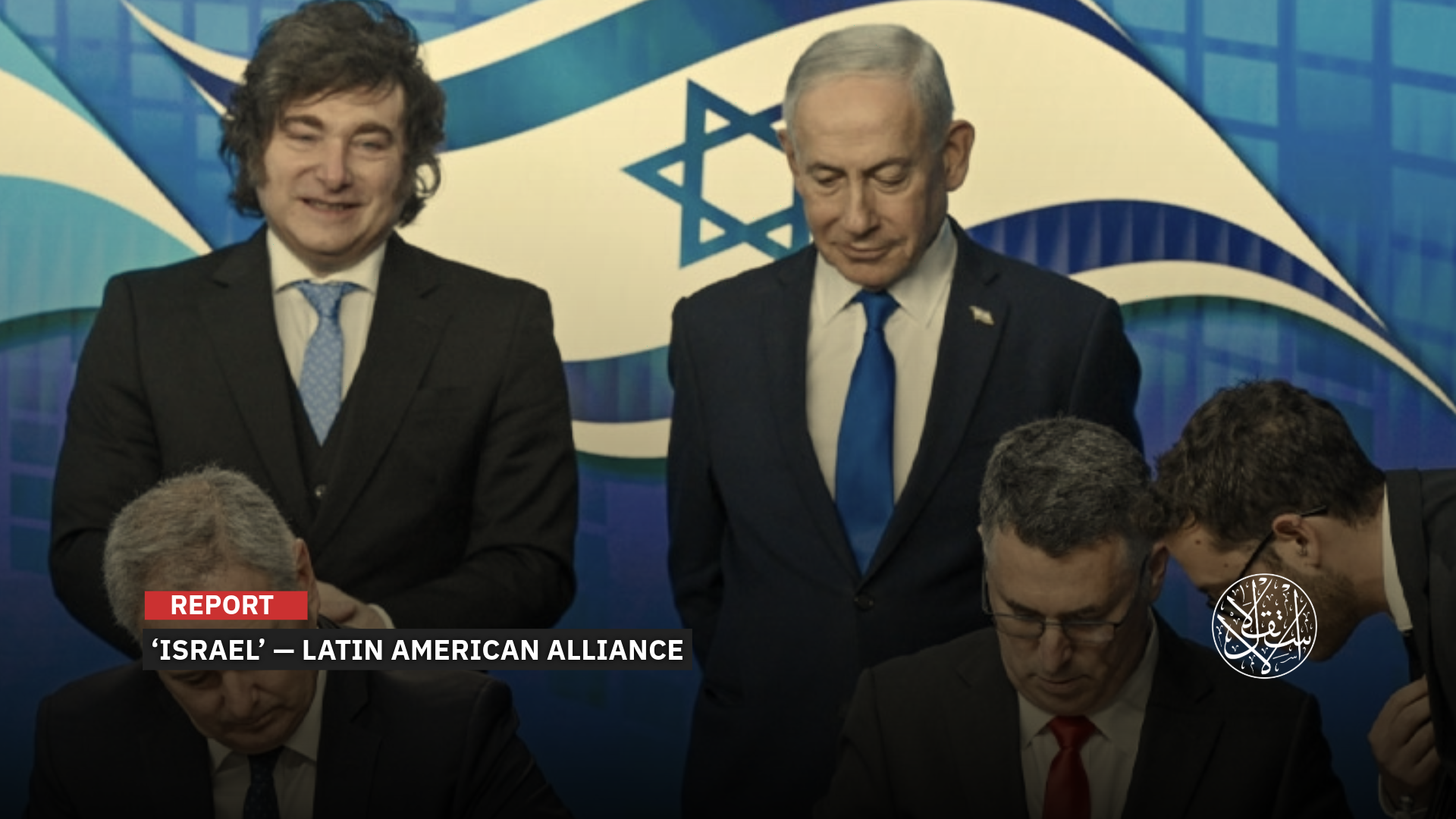
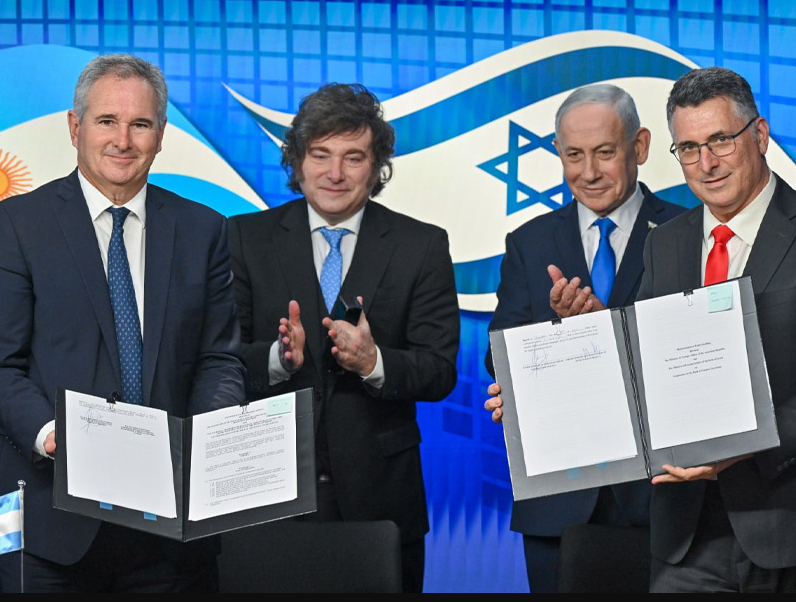
During his visit to “Israel” on April 19, 2026, which sparked widespread controversy due to his visit to the Western Wall and the signing of three memoranda of understanding, along with the inauguration of the relocation of his country’s embassy to Jerusalem, Argentine President Javier Milei announced a notable political step by launching what he called the “Isaac Agreements.”
Behind this name lies an initiative that goes beyond a symbolic declaration; it aims to establish a political, economic, and security alliance comprising countries from western Latin America that support “Israel” and the United States, as part of efforts to curb Iranian, Russian, and Chinese influence in the region.
In “Israel”, this move is seen as an attempt to build a new regional framework with Latin American countries and expand its influence westward through the “Isaac Agreements,” mirroring its eastward expansion through the Abraham Accords in the Middle East.
What are the Isaac Accords?
The “Isaac Accords,” primarily driven by Argentine President Javier Milei, represent an attempt to draw inspiration from the Abraham Accords of 2020, which aimed to normalize relations between “Israel” and several Arab and Islamic countries.
This initiative seeks to transfer the spirit of those agreements to the Western Hemisphere by strengthening partnerships between “Israel” and Latin American countries such as Argentina, Uruguay, Panama, and Costa Rica.
According to what was announced at its launch, the accords focus on areas of intelligence and military cooperation, alongside economic and technological partnerships. Analysts view this as a step by “Israel” to expand its alliances beyond the Middle East, particularly into Latin America.
The idea was first introduced on January 14, 2025, when Milei announced the “Isaac Accords” initiative following his receipt of the Genesis Prize, and his donation of its monetary value to fund the project.
The announcement was made during a ceremony held at the Museum of Tolerance Jerusalem, attended by Israeli President Isaac Herzog and representatives of the prize foundation, often referred to as the “Jewish Nobel,” which is awarded annually to prominent figures supporting Jewish values and a connection to “Israel”.
Milei presented the initiative as a new political and diplomatic framework to expand relations between “Israel” and Latin American countries, inspired by the Abraham Accords while seeking to adapt them to the regional context of the Western Hemisphere.
During a meeting with Israeli Foreign Minister Gideon Sa'ar on November 29, 2025, an agreement was signed to launch this initiative.
The accords were officially launched during Milei’s visit to “Israel” on April 19, 2026, where they were promoted as a step to strengthen political, economic, and cultural cooperation between “Israel” and Latin American countries.
The initiative is being implemented by the “American Friends of the Isaac Accords” (AFOIA), chaired by former U.S. ambassador to Costa Rica Stafford Fitzgerald, reflecting American support for the project.
According to the organization’s website, the accords aim to enhance diplomatic, economic, and cultural cooperation, as well as to monitor regional voting patterns at the United Nations, including the classification of certain Palestinian and Lebanese organizations on “terrorism” lists.
The official statement at the signing said participating countries would work to “defend freedom and democracy” and cooperate in combating “terrorism, antisemitism, and drug trafficking.”
It also called for coordination to counter what it described as Iran’s attempts to expand its influence in the Western Hemisphere, referring to alleged networks linked to resistance movements such as Hezbollah in Latin America.

Ecuador and Paraguay’s Accession
President Javier Milei described the “Isaac Accords,” named after the Prophet Isaac (peace be upon him), as “an initiative to expand the model launched by President Donald Trump in the Middle East to Latin America,” aiming to address challenges such as “terrorism, antisemitism, and drug trafficking.”
Milei also called for other countries to join, stressing that “countries that share values have a duty to work together,” and adding that “with the support of the United States, there is an opportunity to bring about radical change.”
In this context, a diplomatic source told the Israeli outlet Jewish Insider on April 20, 2026, that Ecuador and Paraguay are among the candidates to join the accords, alongside interest from countries such as Uruguay, Panama, and Costa Rica, all of which maintain strong relations with “Israel”.
Available indications suggest that the potential member states are mostly governed by right-wing or economically liberal administrations and maintain positive relations with the United States, while adopting less critical positions toward “Israel” compared to other countries in the region.
Accordingly, the initial map of the “Isaac Accords” appears to outline an axis extending from Argentina in the south to Central America, linking politically aligned countries with Washington and “Tel Aviv” in an attempt to build a transcontinental alliance that could reshape power dynamics in the Western Hemisphere.
The United States is seen as encouraging these accords as a tool to contain Iranian, Russian, and Chinese influence in Latin America, strengthen the Western bloc in the region, and help “Israel” gain broader international support and integration into new alliances, particularly amid declining support in parts of Europe.
Although 31 of the 33 countries in Latin America recognize “Israel”, the region still hosts strong anti-colonial and pro-Palestinian currents, which intensified following the war in Gaza.
This has pushed several left-leaning governments toward harder stances, including in some cases breaking diplomatic ties with “Tel Aviv”.
Countries such as Brazil, Colombia, and Chile have condemned Israeli policies and taken diplomatic or economic measures against them, while Bolivia severed ties entirely. Brazilian President Luiz Inacio Lula da Silva even compared the situation in Gaza to a “Holocaust.”
In this context, the “Isaac Accords” are seen as a strategic move to break “Israel’s” growing political isolation and expand its influence in Latin America, especially after the momentum of the Abraham Accords appears to have slowed in some arenas.
The accords are also viewed as part of broader efforts to repair “Israel’s” international image and open alternative pathways to strengthen its external relations amid increasing criticism of its policies in the Palestinian territories.
At the same time, other assessments argue that the initiative carries political and ideological dimensions, including using alliances to counter rivals such as Iran and expand U.S.–Israeli influence in the Global South.
Critics of Milei attribute his closeness to “Israel” to both domestic and external factors, including Argentina’s large Jewish community and his desire to secure political support from Washington.
The accords have also faced criticism from political parties and groups across Latin America, as well as Jewish organizations such as the “Jews for Palestine” branch in Argentina and similar networks in Brazil, Chile, Mexico, and Uruguay.
These groups argue that the “Isaac Accords” are being used to bypass international legal obligations and marginalize legal accountability mechanisms concerning “Israel”, while warning against separating economic and security cooperation from issues related to occupation and war.
Concerns have also been raised that cooperation in areas such as water management could replicate practices allegedly used in the Palestinian territories, referring in particular to the role of the Israeli company Mekorot in this sector.
New Pathway
The name “Isaac Accords” reflects a symbolic idea of continuity, as the Prophet Isaac (peace be upon him) is viewed as the heir to the legacy of the Prophet Abraham, the “father of prophets.” Similarly, the agreements are presented as building on the legacy of the Abraham Accords and expanding its scope, according to The Jerusalem Post on October 29, 2025.
In this sense, just as the Abraham Accords opened the door to normalizing relations with several Arab states, the Isaac Accords aim to open a new pathway with Latin American countries by strengthening diplomatic cooperation, coordinating voting within international organizations, and developing security, economic, and technological partnerships, alongside efforts to counter Iranian influence in the region and promote what are described as Western or Judeo-Christian values, according to Israeli reports.
This orientation is also linked to the background of Argentine President Javier Milei, who has shown notable interest in Judaism. He studied the Torah with a rabbi and expressed a desire to convert to Judaism in the future.
He has also appeared on several occasions holding a Torah scroll and wearing a kippah, and he visited the Western Wall while performing religious rituals.
Milei has previously described himself as a “first-degree Zionist,” repeatedly expressing support for “Israel” and Judaism, despite not being Jewish, and he even displayed the Israeli flag during his election campaign.
During his meeting with Israeli Foreign Minister Gideon Sa'ar on November 29, 2025, when the accords were first preliminarily announced, Sa’ar described Milei’s sympathy for Judaism and the Jewish people and “Israel” as “sincere, strong, and deeply moving.”
He also noted that he recited the Jewish blessing “Shehecheyanu” at the beginning of the meeting, adding that when he placed a kippah on his head, Milei immediately put on a similar one he kept in his office, in a symbolic gesture reflecting the closeness between them.
Sources
- PM Netanyahu and Argentine President Javier Milei Announce the Launch of the Isaac Accords
- Milei, Netanyahu Launch “Isaac Accords” to Encourage Israel–Latin America Engagement
- Netanyahu, Milei Launch “Isaac Accords” to Foster Cooperation Between Israel and the Western Hemisphere
- The Isaac Accords: Building New Bridges Between Israel and Latin America
- American Friends of the Isaac Accords (AFOIA)
- Genesis Prize Foundation Presents Argentine President Javier Milei with the “Jewish Nobel Prize” 2025 [Arabic]
- Latin American Jewish Groups Warn: After Abraham Comes the Isaac Accords