Against the U.S. and Gulf States: Could Iran Weaponize Undersea Cables in the Strait of Hormuz?
In a development that reflects the expanding scope of geopolitical competition in one of the world’s most strategic waterways, Iran warned on April 28, 2026, that the undersea cables passing through the Strait of Hormuz constitute a “serious vulnerability” for the region’s digital economy, raising growing concerns over the possibility that this critical infrastructure could face pressure or threats as part of Tehran’s efforts to strengthen its control over the strategic passage.
On May 9, 2026, Iranian media discussed what they described as three practical measures Iran could adopt to generate financial revenues from the internet undersea cables crossing the Strait of Hormuz, signaling an increasingly assertive approach toward treating this infrastructure as a strategic economic asset that reinforces the concept of Iranian sovereignty over the vital maritime corridor.
The Strait of Hormuz, widely regarded as one of the world’s most critical maritime chokepoints, is not only essential for global oil shipments but also serves as a key artery for the world’s digital infrastructure.
Fiber-optic cables running along its seabed connect Asian countries, particularly India and Southeast Asia, with Europe through the Gulf states and Egypt, making the strait a central hub of the global digital economy.
Observers believe that any move to impose fees or restrictions on undersea cables would mark a major shift in the nature of conflict in the strait, potentially adding a new dimension to the already ongoing tensions surrounding energy and maritime navigation.
Such a development could expand the confrontation into what may be described as a “digital conflict” alongside the long-standing “oil conflict,” as Tehran seeks to leverage its strategic geographic position to maximize its economic and political gains.
This potential shift suggests that the Strait of Hormuz may evolve from being merely an “energy chokepoint,” through which a significant share of the world’s oil supplies passes, into a “global digital economy chokepoint” as well, reflecting the widening scope of international competition in the region and the growing importance of digital infrastructure as a source of power and influence in the contemporary international order.

Sovereign Right
Amid escalating tensions surrounding the Strait of Hormuz, undersea cables have emerged as one of the most sensitive and strategically important components of the global digital infrastructure, carrying nearly 99% of the world’s internet data traffic.
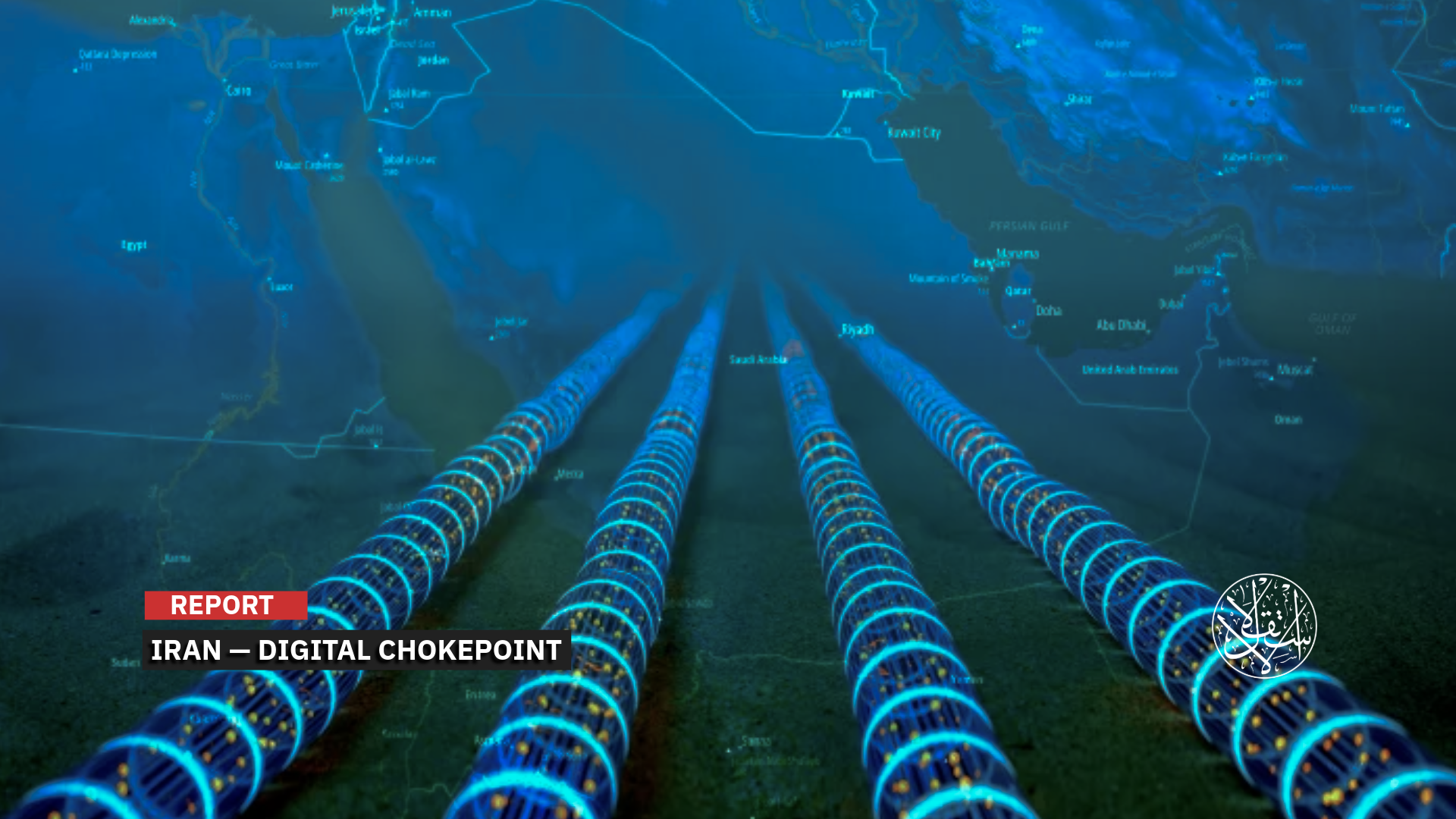
Between 10 and 17 undersea fiber-optic cables cross the seabed of the Strait of Hormuz, transmitting around 30% of data traffic between Asia and Europe and nearly 90% of data flows between the Gulf states and the rest of the world, making the narrow waterway a vital artery for the international digital economy.
These cables hold immense strategic significance, serving as the backbone for major financial and technological sectors, including banks and financial transfers through the SWIFT system, cloud computing services, artificial intelligence applications, international communications, and global financial market operations.
Most of these cables are operated and managed by major technology companies such as Google, Meta, Microsoft, and Amazon, reflecting the scale of global dependence on this critical maritime route.
Experts warn that any disruption to the cables passing through the Strait of Hormuz could trigger immediate and far-reaching consequences across Asia, the Middle East, and Europe, potentially disrupting online banking services, card payment systems, and essential internet services, directly affecting both ordinary users and national economies alike.
In this context, Iranian statements issued in March 2026 raised growing concerns after Tehran warned that these cables represent a “serious vulnerability” for the region’s digital economy, suggesting they could face security risks whose impact might exceed that of disruptions to oil shipments through the strait.
Tasnim News Agency, which is affiliated with the Iranian Revolutionary Guard Corps, stated that the concentration of cables within a narrow maritime corridor makes the Strait of Hormuz an extremely sensitive strategic chokepoint for regional digital infrastructure, warning that simultaneous damage could result in widespread outages across Gulf countries.
On May 9, 2026, the debate intensified following Iranian media reports discussing what they described as “three practical steps” to generate financial revenues from undersea cables in the strait, within the framework of a vision that considers this infrastructure part of the country’s economic sovereignty resources.
According to Tasnim, these cables carry daily global financial transactions worth trillions of dollars, reinforcing, from the Iranian perspective, the need to reconsider how they are managed economically.
The agency argued that Iran sees itself as deprived of economic and sovereign revenues linked to this infrastructure due to what it describes as a traditional understanding of the strait’s role. Under the proposed framework, the plan consists of three main measures: imposing initial licensing fees and annual renewal charges on foreign companies, requiring global technology firms to comply with Iranian laws, and granting local companies a monopoly over cable repair and maintenance operations.
According to the reports, this vision is based on the concept of sovereignty over the seabed of the Strait of Hormuz under Article 34 of the United Nations Convention on the Law of the Sea, while also referencing similar international models, including the economic utilization of undersea cables in the Suez Canal.
Other Iranian media outlets, including Fars News Agency, promoted the idea of viewing the Strait of Hormuz as a “hidden superhighway” through which global digital infrastructure passes.
These proposals further argue that even a limited disruption to undersea cables could lead to major economic losses ranging from tens to hundreds of millions of dollars within just a few days, underscoring the world’s heavy dependence on this vital route. They also suggest that, under the proposed Iranian framework, the passage of cables would require permits, fees, and local regulation, while granting Iranian companies a leading role in their management and maintenance.
While some observers view these proposals as economically motivated efforts aimed at maximizing national revenues, others warn that turning undersea cables into an instrument of geopolitical confrontation could introduce a dangerous new layer of tension to one of the world’s most strategically sensitive waterways, where energy security increasingly intersects with information security in an increasingly complex geopolitical landscape.

Detailed Maps
This escalation coincided with state-linked Iranian media outlets publishing detailed maps of undersea cable routes, landing stations, and regional data centers spread across the Gulf, a move that sparked widespread debate over its timing and implications.
Analysts writing for The Jerusalem Post on April 22, 2026, argued that these disclosures could not be separated from the broader context of rising regional tensions, suggesting they may represent indirect preparation for the potential targeting of sensitive digital infrastructure sites across the region.
In a related development, the Houthis in Yemen published a plan via Telegram on February 7, 2024, outlining its intention to target undersea cables linking Europe and Asia through the Red Sea, according to the BBC.
On the same day, Foreign Policy noted that while the Houthis might lack the full technical capability to carry out such operations independently, Iran was capable, according to its assessment, of providing the necessary expertise and support.
At the time, the magazine warned that the nature of the threat had been clear from an early stage, but that the international community had failed to treat it with sufficient seriousness before some of those concerns later materialized.
Less than three weeks later, on February 26, 2024, four undersea cables connecting Saudi Arabia and Djibouti were severed in an incident that renewed earlier warnings, particularly after the Houthis had publicly declared their intentions regarding the targeting of this type of critical infrastructure.
Observers suggest that a similar pattern now appears to be re-emerging, but on a broader and potentially more dangerous scale, extending beyond a single region to encompass the digital infrastructure linking much of the world, especially after pro-state Iranian media outlets published precise maps of cable routes in a manner similar to the methods previously employed by the Houthis before their attacks in 2024.
According to reports cited by Reuters and The Jerusalem Post, some of the most important cables passing through the Strait of Hormuz that could be affected in the event of escalation include the Falcon cable, AAE-1, TGN-Gulf, and SEA-ME-WE networks, all of which form key pillars connecting Middle Eastern data centers with Europe and Asia.
Although no direct attack against these cables has been recorded so far, the growing volume of statements and warnings has triggered broad international concern over the future security of digital infrastructure and the possibility that it could evolve into a new arena of unconventional conflict.
Previous experiences show that, despite their sensitivity, these cables have not suffered major direct damage during recent conflicts. However, experts warn of indirect risks, most notably the possibility of damage caused by ship anchors or military maritime activities in areas of heightened tension.
The risks associated with any cable disruption are amplified by the limited availability of viable alternatives. Satellite communication systems, despite their technological advances, remain unable to match the enormous capacity and transmission speeds provided by undersea cables, while also being significantly more expensive, according to reports by Reuters.
Low Earth orbit satellite internet services offer speeds ranging between 100 and 200 megabits per second, making them suitable for individual users and limited institutional operations. However, they remain incapable of meeting the massive demand generated by the region’s more than 200 data centers, according to estimates by the Stimson Center.
By contrast, fiber-optic cables are capable of transmitting enormous volumes of data with extremely low latency. A single cable from the 2Africa network, for example, can carry up to 21 terabits per second per fiber pair, equivalent to the capacity of millions of simultaneous satellite communications, underscoring the scale of global dependence on this critical infrastructure.

Major Corporations
American and international reports indicate that the conflict involving Iran has revealed a new and more dangerous level of threats targeting global technological infrastructure, extending beyond the traditional military domain to encompass data centers and the networks underpinning the digital economy.
According to a report issued on April 16, 2026, by the Stimson Center, Tehran carried out drone attacks targeting data centers in Bahrain and the UAE, reflecting an escalation of conflict into critical digital infrastructure.
According to reporting by the Financial Times, two data centers operated by Amazon Web Services in the UAE came under attack in early March 2026, while another AWS data center in Bahrain was targeted in early April 2026.
A third data center belonging to Oracle in Dubai was also reportedly targeted on April 2, 2026. These developments point to an escalating pattern of attacks against Gulf digital infrastructure as part of the broader architecture of global economic power.
The attacks coincided with earlier threats suggesting that several major American technology companies could also become targets, including Microsoft, Google, Apple, Meta, Oracle, Intel, HP, IBM, Cisco, Dell, Palantir, and NVIDIA, highlighting the expanding scope of potential conflict to include the global technology sector as a whole.
Analysts argue that the vulnerability of commercial data centers, compared with traditional military infrastructure, stems from their massive physical footprint and their reliance on protection systems not designed to withstand direct military-grade threats, making them potential targets in future conflicts.
Experts also suggest that attacks on such facilities may be linked to attempts to exert influence over, or control of, the digital infrastructure upon which major global corporations depend.
In this context, a report published by The Conversation on April 2, 2026, warned that the growing global dependence on artificial intelligence and cloud services is turning data centers into highly sensitive strategic targets, particularly if they become arenas of confrontation between regional and international powers.
The Middle East is currently undergoing a rapid transformation from a traditional energy hub into a global digital center, hosting more than 300 data centers across 18 countries, alongside massive investments by companies such as Amazon, Microsoft, and Google in advanced cloud infrastructure throughout the region, particularly in the Gulf states.
Experts warn that any attack on, or disruption of, the undersea cables supplying these centers, or the data centers themselves, would not merely interrupt communications services or email systems, but could instead trigger widespread paralysis across the global digital economy, including financial markets, banking services, and international trade, amid the world’s growing dependence on the internet to manage everyday transactions.
What Are the Risks?
Several Western and Asian assessments suggest that Iran theoretically possesses some of the tools that could enable it to influence the undersea cables passing through the Strait of Hormuz, whether through intimidation or indirect disruption operations.
At the same time, however, Tehran faces significant constraints that make turning such threats into an actual policy both complex and highly risky.
From a geographical perspective, the waters of the Strait of Hormuz are relatively shallow, making undersea cables more accessible to various maritime activities.
Technically, this creates the possibility of damaging them through multiple methods, including naval mines or indirect sabotage operations.
Iran also possesses unconventional naval capabilities, including fast attack boats, naval mines, and asymmetric warfare tools, alongside accumulated experience in using indirect pressure tactics in maritime tension zones.
In addition, repairing damaged undersea cables during periods of conflict could take weeks or even months, increasing the seriousness of any potential disruption.
At the same time, assessments indicate that carrying out a direct attack on this infrastructure would pose major strategic risks for Iran itself, given its own dependence on the same networks for communications and economic activity.
Moreover, any large-scale disruption could negatively affect the economies of the Gulf states, China, Asia, and Europe, and could trigger collective international reactions due to the central role these cables play in the global economy.
For this reason, analysts believe the more likely Iranian approach is not direct implementation, but rather the use of deterrence and political and media pressure, through highlighting the vulnerabilities of undersea cables and publishing official and semi-official reports about their fragility, alongside proposals to impose fees or regulate their passage as a means of asserting economic influence over this strategic corridor.
Some analyses suggest that this pattern reflects an attempt to employ “indirect threat” tactics instead of direct military escalation.
Regarding the possibility of imposing fees on undersea cables, an analysis published by Eurasia Review on May 12, 2026, argued that the Iranian proposals face significant legal and practical obstacles and are closer to “political pressure” than to an implementable plan.
Under the United Nations Convention on the Law of the Sea, although states possess sovereignty over their maritime zones, Article 79 explicitly protects the right of states and companies to lay and maintain international undersea cables, limiting the ability of any country to impose direct sovereign fees on them.
Experts also note that forcing global technology companies to operate fully under local laws within this maritime context appears unrealistic, given the transnational nature of these corporations and their reliance on international regulatory frameworks.
Some analysts compare these proposals to “protection fees,” suggesting they function more as tools of political leverage than as a legally recognized international system.
As a result, some Western and Asian reports have begun referring to what is described as the “Digital Hormuz Problem,” reflecting concerns that the strait could evolve into a chokepoint not only for energy supplies but also for the flow of global data.
In a report published on May 5, 2026, Asia Times warned that the most dangerous potential scenario may not be a direct missile attack, but rather a sudden disruption of undersea cables that appears outwardly accidental while causing widespread paralysis in global internet and communications traffic.
Some analyses connect this scenario to previous regional incidents in which damage to undersea cables disrupted data flows, even though those incidents were not classified as direct military operations.
Experts also emphasize that the risks are not limited to deliberate targeting, but include accidental incidents linked to shipping and maritime navigation, such as dropped anchors or heavy maritime activity in cable transit zones.
These concerns are becoming increasingly significant given the limited alternatives currently available. Despite advances in satellite communications, they still cannot compensate for the enormous data capacity and transmission speeds provided by undersea cables, making this infrastructure a critical pillar of global digital economic stability.
In this context, some international initiatives, including the 2024 Joint Statement of New York, signed by more than twenty countries, acknowledge the existence of security vulnerabilities in the protection of undersea cables, including the possibility that they could be severed or damaged without any clear ability to determine whether the incident was accidental or deliberate, further complicating the management of such risks in the future.
Sources
- The Hormuz Digital Chokepoint: How Does the Iran War Threaten Subsea Cables?
- IRGC-Linked Media Calls for Fees on Hormuz Undersea Internet Cables
- Could Iran Start Charging Global Tech Firms for Undersea Cables in the Strait of Hormuz? – Analysis
- IRGC-Linked Tasnim Warns of Risks to Undersea Cables Below Strait of Hormuz
- The Internet Has a Strait of Hormuz Problem
- Why Iran Targeted Amazon Data Centers and What That Does – and Doesn’t – Change About Warfare
- Beneath the Strait: Iran Could Threaten Gulf Data Centers, Undersea Cables