From Abu Dhabi to Bahir Dar: How Did Ethiopia Become an Emirati Platform To Strike Sudan?
After months of relative calm in Khartoum, Khartoum International Airport was targeted on May 4, 2026, in a drone attack launched from Ethiopian territory, using drones of a type reportedly supplied by the United Arab Emirates to the Rapid Support Forces militia led by Mohamed Hamdan Dagalo.
Talk of Ethiopian involvement, and behind it the UAE, in the Sudanese war is no longer based on speculation or mutual political accusations, after the Sudanese army presented, on May 5, 2026, what it described as documented evidence accusing both parties of participating in the attack on Khartoum airport. This marks a new escalation that raises the possibility of the war shifting from an internal Sudanese conflict to a broader regional confrontation involving Ethiopia.
The timing of the strikes carries clear political and military implications, as they coincided with intensified pressure from the Sudanese army and its siege of Hemedti’s militia in the Kordofan and Darfur regions. This opens the door to interpretations suggesting that the aim of the attack was to relieve pressure on the Rapid Support Forces militia and prevent the return of stability to the Sudanese capital except under political arrangements imposed by the balance of power on the ground.
These developments also reflect a growing trend toward the internationalization of the Sudanese crisis, through the expansion of foreign interventions and the transformation of the war from an internal conflict into an open regional crisis. This threatens to widen the geographical scope of the conflict, complicate prospects for a political settlement, and increase fears of the situation sliding into a direct confrontation between Sudan and Ethiopia.
Evidence Behind the Allegations
Alongside the Ministry of Foreign Affairs and the Ministry of Information, the Sudanese army released a set of official evidence that it said proves the involvement of the United Arab Emirates and Ethiopia in drone airstrikes on Sudan, not only during the May 3, 2026 attack, but also in earlier operations over the past months. It described these actions as a direct violation of Sudanese sovereignty and a clear breach of international law.
According to the official Sudanese account, the attacks were launched from Ethiopian territory starting in March 2026 and continued until May, through hostile sorties carried out by three drones that took off from Bahir Dar Airport in Ethiopia at the beginning of March. These strikes targeted sites in the White Nile, Blue Nile, and North and South Kordofan states.
On March 17, 2026, the Sudanese army announced that it had shot down an Emirati “Wing Loong II AS-88” drone, stating that technical analysis of its data showed it had been launched from inside Ethiopia. This was part of an attack targeting Sudanese army positions in Al-Karama and the Blue Nile region, as well as parts of Kordofan.
As for the May 3, 2026 attack, Sudanese authorities said it was carried out using several drones supplied to the Rapid Support Forces militia by the UAE and also launched from Ethiopian territory.
The army explained that its air defenses managed to intercept some of these drones, while others exploded on installations located relatively far from Khartoum Airport, which allowed the airport to resume operations and continue receiving international flights.
Sudanese army spokesperson Brigadier General Asim Awad Abdelwahab said the authorities possess technical evidence linking these attacks to Bahir Dar Airport in Ethiopia, based on data extracted from the drone shot down in mid-March 2026.
He added that another drone launched from the same airport participated in the May 3 attack, describing the actions of Ethiopia and the UAE as a “direct aggression against Sudan,” and stressing that it “will not go unanswered.”
In a related context, the website Africa Intelligence reported in a document published on May 5, 2026, that Egypt’s General Intelligence Service, headed by Hassan Rashad since 2024, identified Shakhbout bin Nahyan Al Nahyan as the Emirati official in charge of the African portfolio and one of the main “sources of concern” in the Sudanese crisis.
The report also indicated that Cairo is closely monitoring Tahnoon bin Mohammed al Nahyan regarding the Sudan file, amid what Egyptian intelligence describes as a lack of enthusiasm for Arab joint security cooperation.
For their part, both Sudanese Foreign Minister Mohieldin Salim and Information Minister Khalid al-Eisir confirmed that the government and relevant authorities had obtained “conclusive evidence and proof” showing that the attack was carried out using drones launched from an Ethiopian airport.
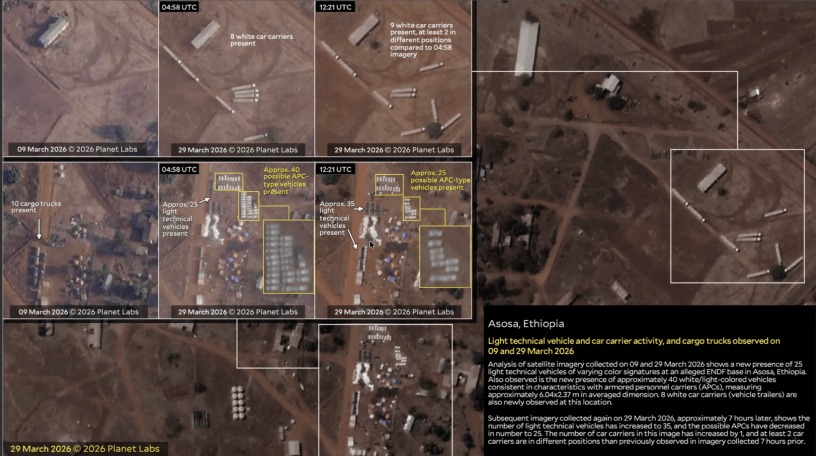
A report published on April 8, 2026, by a research unit at Yale University stated that an Ethiopian military base near the Sudanese border in the Asosa region is providing logistical and military support to the Rapid Support Forces militia, based on satellite imagery analysis.
The authors of the study also confirmed that extended visual analysis over five months showed “conclusively” that Rapid Support Forces militia attacks on Blue Nile State in southeastern Sudan were “launched from inside Ethiopia,” noting information indicating that Emirati drones belonging to Hemedti were being stored at the same base.
In the same context, Reuters reported on May 3, 2026, citing local residents, that the latest strikes targeted military sites and civilian neighborhoods in Khartoum, which had been witnessing a gradual return of residents, ministries, and international agencies after the Sudanese army regained control of the city in March 2025.

From the UAE to Ethiopia to Sudan
Specialized open-source intelligence (OSINT) accounts revealed over the past months details of the route used to transport the drones deployed in attacks on Sudan, starting from the United Arab Emirates, passing through Ethiopia, and ending at bases from which the strikes are launched toward Khartoum and other regions.
These accounts also explained that some of the drones used in the attacks, including Turkish “Bayraktar Akıncı” drones reportedly acquired by the UAE, were airlifted from Abu Dhabi to Addis Ababa before being transferred to Bahir Dar base in Ethiopia, which, according to these findings, has become a key operational hub for drone attacks against Sudan.
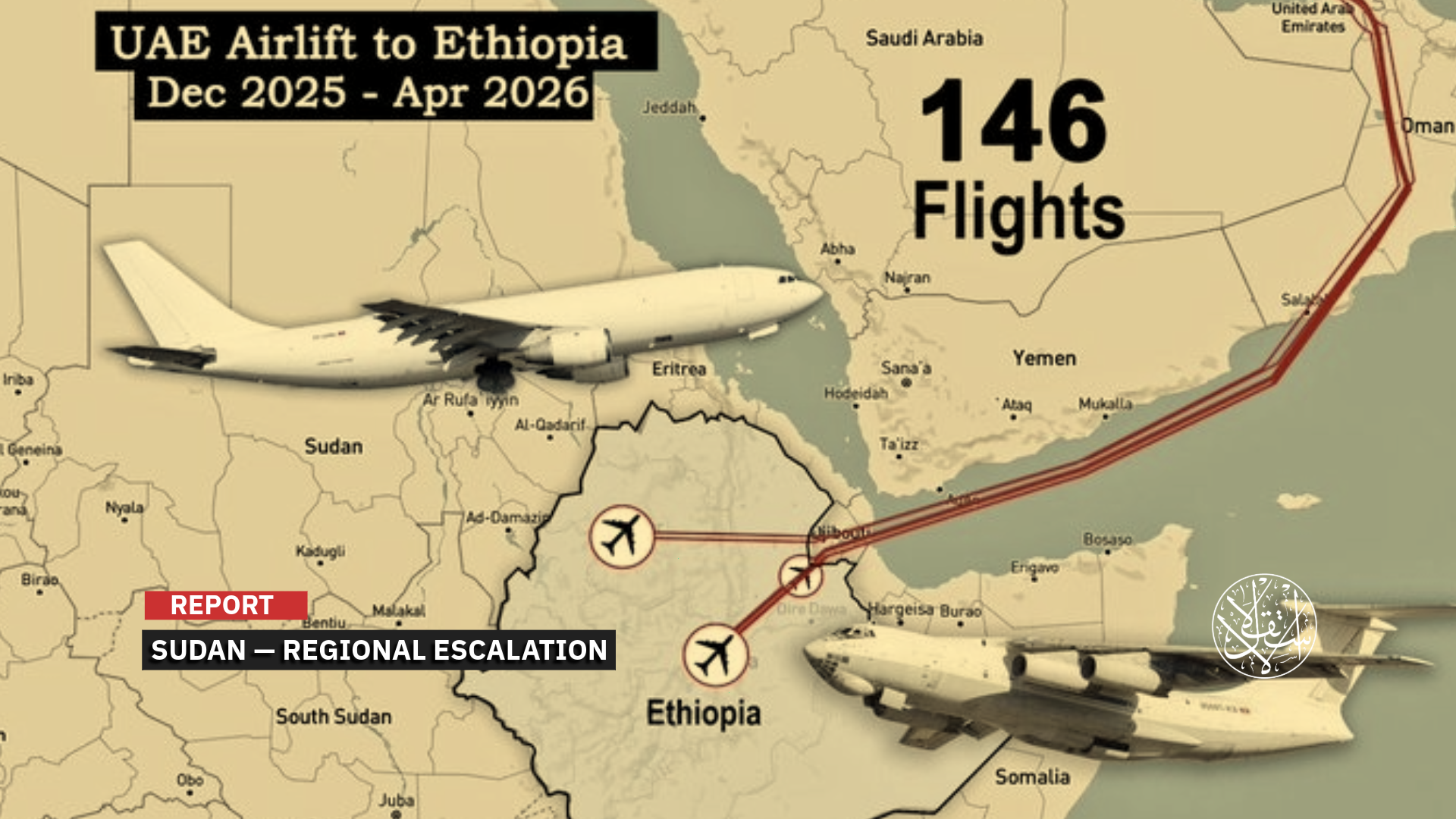
In this context, the OSINT account “Rich Tide,” which specializes in tracking military aviation and cargo movements, stated that it had recorded more than 146 suspicious cargo and transport flights linked to the UAE over the past five months. These included repeated flights by Emirati military transport aircraft belonging to the UAE Air Force, many of which reportedly landed at Bahir Dar airbase in Ethiopia.
The account noted that the frequency of these flights increased significantly from December 2025, reaching a peak during January and February 2026, with around 35 flights per month. It described this as an indication of an ongoing air bridge supporting operations connected to the Sudanese conflict.
It further stated that several Emirati cargo aircraft were observed turning off their transponders after entering Ethiopian airspace in an apparent attempt to conceal their routes. However, open flight data and satellite imagery still confirmed that at least 10 flights had reached Ethiopian bases since December 2025.
These findings gain additional significance given their timing alongside a reported decline in the use of traditional supply routes previously accused of being used by the UAE to support the Rapid Support Forces militia, such as Libya or the Somali port of Bosaso, strengthening the hypothesis of a logistical shift toward Ethiopia as a central hub.
Open-source reports also noted that Bahir Dar base itself hosts Turkish drones operated by the UAE, raising further questions about possible direct operational coordination within the base rather than merely transit use of Ethiopian territory.
The accusations against Ethiopia are not limited to hosting drones or facilitating their launch toward Sudan, but also extend, according to reports and research centers, to the use of Ethiopia’s aviation infrastructure in transporting weapons and fighters linked to the Rapid Support Forces militia.
In this context, the International Geopolitical Operations Center stated in a report published on April 14, 2026, that Ethiopian Airlines played a logistical role in transporting fighters and mercenaries associated with the Rapid Support Forces militia.
Similarly, prominent Ethiopian activist Jawar Mohammed alleged in February 2026 that Ethiopian Airlines transported RSF militia members and foreign mercenaries from the Chadian capital N’Djamena to the western Ethiopian city of Asosa, via flights ET 8137 and ET 8139, using Boeing 737-860 aircraft.
These allegations were further reinforced, according to reports published by Daily News Egypt in March 2026, which cited flight-tracking data and testimonies from inside Bole International Airport and Asosa Airport. These accounts claimed that passengers arriving on those flights were immediately transferred from the aircraft to military trucks on the runway.
In the same context, a March 2026 investigation by The National Interest stated that flight-tracking data indicated the involvement of Ethiopian Airlines in transporting weapons and military equipment to RSF militia rear bases in western Ethiopia, through at least eight flights carried out by Boeing 737-800 aircraft since February 2026.
Additionally, Eurasia Review reported in March 2026 that Ethiopian Airlines cargo aircraft were not only used to transport military supplies but also to move RSF militia leaders, including Mohamed Hamdan Dagalo (“Hemedti”), as well as foreign mercenaries of various nationalities, including Russians, Ukrainians, and Colombians. The report described these operations as having been conducted “very quietly” and out of public sight.

What Is Ethiopia’s Interest?
The recent escalation between Sudan and Ethiopia intersects with a complex web of accumulated regional crises and disputes, making it impossible to understand it in isolation from the geopolitical contexts that have shaped relations between the two countries for years.
The current tension is not only linked to the Sudanese war, but also extends to unresolved strategic issues, foremost among them the Grand Ethiopian Renaissance Dam, border disputes, and competition for influence in the Horn of Africa and the Red Sea region.
The GERD file remains one of the main sources of tension between Khartoum and Addis Ababa, especially as Sudan has gradually aligned its position with Egypt’s view regarding the dam’s risks and its implications for water security.
While Ethiopia views any Sudanese-Egyptian coordination on this issue with concern, Khartoum considers the matter to go beyond technical disagreements and to directly affect the safety of its vital infrastructure and national security. This has turned the dam into a mutual political and security leverage tool between the two sides.
Border disputes, particularly in the fertile al-Fashaga region, also play a central role in fueling tensions.
The area has witnessed intermittent clashes in recent years, as well as attacks carried out by Ethiopian armed groups inside Sudanese territory, bringing the border issue back to the forefront of the regional conflict between the two countries.
In this context, the UAE’s role emerged prior to the outbreak of the Sudanese war, when Abu Dhabi proposed a project to transform the al-Fashaga region into a joint agricultural investment zone between Sudan and Ethiopia, fully financed by the UAE. However, Khartoum rejected the proposal at the time, viewing it as an infringement on its implicit sovereignty over the sensitive border area.
The repercussions of the war in the Tigray region have also cast a heavy shadow on bilateral relations, as Sudan strengthened its military presence in some border areas, while the Rapid Support Forces militia claimed that fighters from Tigray had participated alongside the Sudanese army in battles against them.
When the Ethiopian Foreign Ministry denied Sudan’s accusations regarding support for the Rapid Support Forces militia, it in turn accused Sudan of providing military and financial support to the Tigray People’s Liberation Front, claiming that Sudanese territory had become a hub for opposition forces targeting Ethiopia’s stability.
This reflected the extent of overlap between internal security issues and regional disputes between the two countries.
In practice, the Ethiopian statement does not directly deny Sudan’s accusations concerning support for Hemedti’s militia, but instead implicitly attempts to justify them through a “counter-accusation” strategy, by reviving the Tigray file and referencing older security issues, with the aim of diverting attention from Sudan’s evidence-based claims and politically and media-wise confusing the situation.
Rather than providing a clear response to allegations related to the use of Ethiopian territory for launching drones, Addis Ababa instead reverted to earlier accusations involving Tigray fighters, in an attempt to apply security pressure on Khartoum and reduce growing international scrutiny.
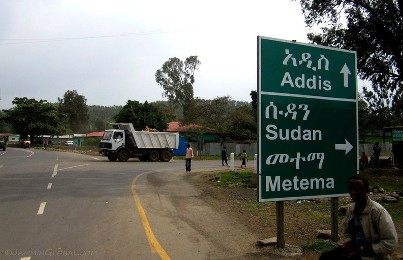
Sudanese expert Dr. Walaa Elsadig believes that Ethiopia’s involvement alongside the UAE in the Sudanese war is driven by a set of overlapping political, economic, and security interests.
In a post on X, he explained that partnership with Abu Dhabi provides Ethiopia with a significant financial lifeline amid its economic crises and escalating internal pressures, through funding flows, investments, and external political support.
According to Elsadig, opening a new pressure front against Sudan from the eastern side helps disperse the Sudanese army’s capabilities and disrupt its operations against the Rapid Support Forces militia, leading to the weakening and exhaustion of the Sudanese state, which directly serves Ethiopian interests.
More importantly, he argues, alignment with the UAE places Ethiopia within a regional axis seeking to reshape the balance of power in the Horn of Africa and the Red Sea. This gives Addis Ababa additional leverage in highly sensitive issues such as the Grand Ethiopian Renaissance Dam and the al-Fashaga region, by weakening Sudan’s negotiating position and keeping it preoccupied with its internal crises.
How Does Sudan Respond?
Sudanese analysts believe that the primary objective of Abu Dhabi in the recent escalation is not limited to supporting the Rapid Support Forces militia, but goes further, aiming to disrupt the Sudanese army and scatter its military priorities, particularly amid its advances on the Kordofan and Darfur fronts and the increasing pressure on Hemedti’s militia forces, which, according to multiple reports, are facing rising internal defections and disputes.
They argue that opening a new front of tension with Ethiopia is intended to draw Khartoum into a broader regional conflict, thereby exhausting the Sudanese army and shifting its focus from resolving the internal war to managing a complex external confrontation. This, in turn, serves the interests of the militia and its regional backers.
In this context, Khartoum treats the issue of Ethiopian involvement as a matter of sovereignty and cross-border aggression, rather than an isolated security incident.
However, analysts warn that any direct military response against Ethiopia could push the region into an open border war, from which the Rapid Support Forces militia and their regional allies would be the primary beneficiaries, a scenario that, according to their assessments, the UAE is seeking to encourage.
Sudanese writers and observers also caution against sliding into a conventional confrontation with Ethiopia, given the differences in geography and military conditions between the two countries. Ethiopia’s mountainous and rugged terrain provides it with defensive advantages, while Sudan’s open plains could make any direct war costly and prolonged for Khartoum.
As a result, calls are growing within Sudanese political and media circles to address the crisis through legal and diplomatic international channels rather than engaging in full-scale military confrontation.
Among the proposed options is resorting to the International Court of Justice by filing a formal case related to violations of Sudanese sovereignty and interference in its internal affairs, supported by evidence that Khartoum claims to possess, including radar data, drone flight paths, and analysis of recovered drone wreckage.
Sudan is also seeking to use previous UN reports that mentioned external support for the Rapid Support Forces militia to argue that the situation is not an isolated military incident, but part of a broader regional scheme aimed at destabilizing Sudan and prolonging the war.
The Sudanese diplomatic effort also includes escalating the issue at the United Nations Security Council and the African Union, alongside strengthening coordination with Egypt, whose interests intersect with Khartoum’s on sensitive issues, particularly the GERD and regional balances in the Horn of Africa.
Meanwhile, some assessments suggest that Khartoum may also consider indirect pressure options, including expanding communication channels with Ethiopian opposition groups as a political and security deterrent tool against pressure from Addis Ababa.
According to a Sudanese diplomat speaking to Al-Estiklal, Khartoum is currently operating on two parallel tracks: a diplomatic track aimed at internationalizing the accusations and mobilizing regional and global support, and a security track based on maintaining options for indirect responses without sliding into an open regional confrontation that could further complicate the situation.
In this context, Sudanese Sovereignty Council head and army commander Abdel Fattah al-Burhan said in remarks to Middle East Eye on May 5, 2026, “If it is confirmed after investigations that the drones came from Ethiopia, we will take the necessary steps to protect Sudanese territory and the Sudanese people, in coordination with the international community.”
The site also quoted a Sudanese intelligence source as saying that the army and government expect this type of attacks to increase in the coming period, amid continued deterioration in relations between Khartoum and Addis Ababa and rising risks of indirect confrontation between the two countries.
Sources
- Sudan Army Says UAE and Ethiopia Linked to Khartoum Drone Attack
- Special Report: Military Assistance to RSF Occurring at ENDF Base in Asosa, Ethiopia
- Sudan's Burhan Confronts UAE and Ethiopia Over Khartoum Airport Drone Strikes
- Sudan Accuses the UAE and Ethiopia of Striking Khartoum Airport with Drone Attacks [Arabic]
- Border Conflicts, GERD Dam Dispute, and Support for Opposition Movements… Key Causes of Tensions Between Sudan and Ethiopia [Arabic]
- Reports Reveal Hidden Details of Ethiopian Airlines: Secret Flights to Conflict Zones [Arabic]
- New Boss of the Arab League Tries to Persuade Abu Dhabi to Stay Engaged