How the Hantavirus Turned a Quiet Scientific Expedition Into a Health Disaster
“The WHO director announced that a total of 11 cases have been reported in the outbreak.”
An outbreak of Hantavirus on a transatlantic cruise ship has sparked global health concern after deaths and infections were reported among passengers and crew, prompting close monitoring by the World Health Organization (WHO) and health authorities in several countries.
This virus, genetically belonging to the Hantavirus family, represents a unique biological rebellion within its species, being the only strain known to break traditional rules and spread between humans.
The hashtag #Hantavirus quickly became one of the most trending topics worldwide, amid fears of its potential spread like the coronavirus, which continues to claim lives globally.
What is Hantavirus?
Amid growing global concerns about emerging viral diseases, the Hantavirus outbreak on the MV Hondius cruise ship, en route from Argentina to Cape Verde, has reignited questions about the possibility of a new pandemic similar to COVID-19, after the incident resulted in three deaths and several confirmed infections among passengers.
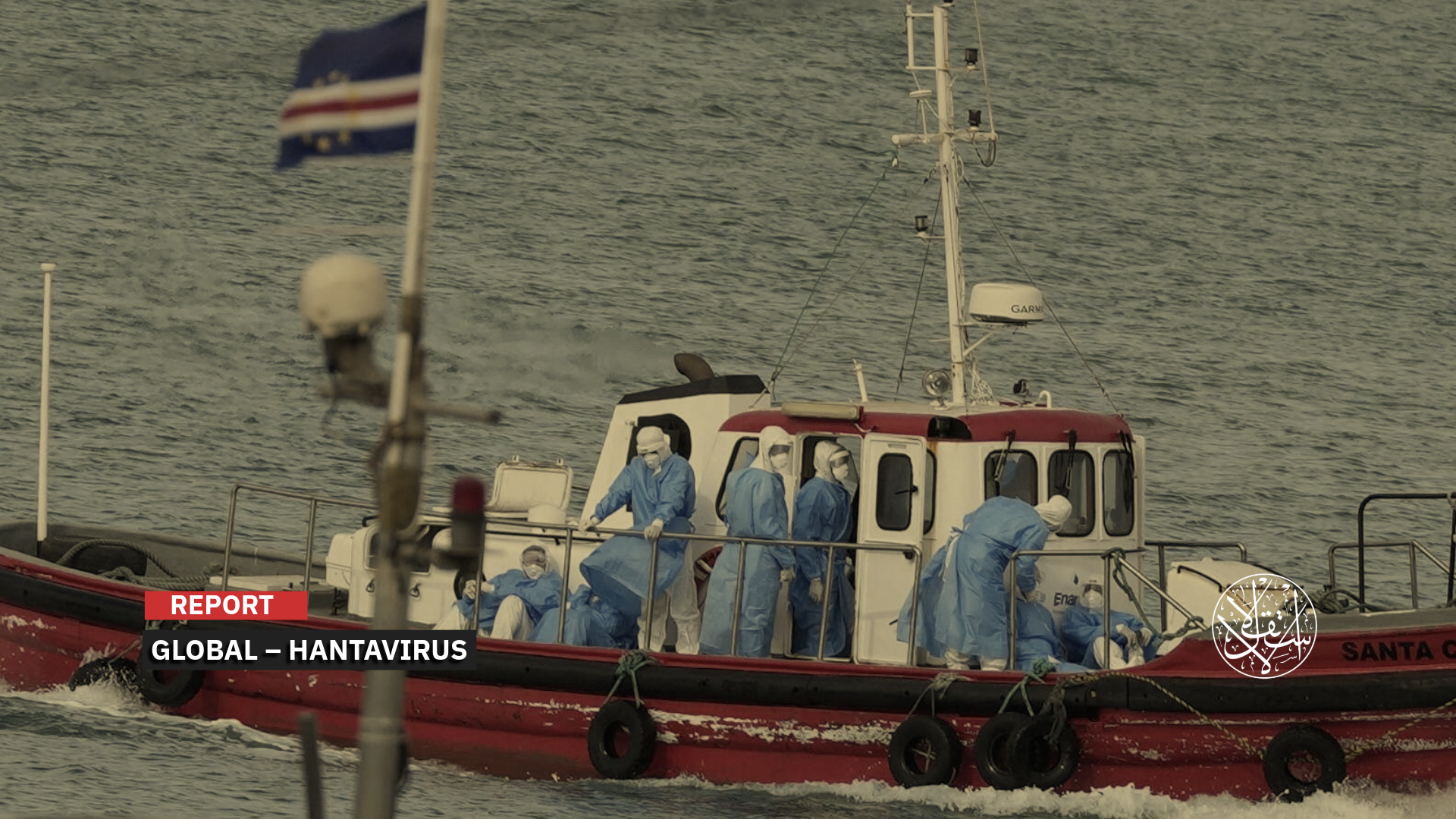
This outbreak prompted the evacuation of some patients to hospitals in Europe and Africa, while others were quarantined on board the ship, which was carrying more than 140 people of various nationalities.
The World Health Organization (WHO) warned of the possibility of additional cases in the coming weeks and urged countries that received the evacuated passengers to adhere to WHO recommendations for strict health monitoring until June 21.
It is estimated that the source of the outbreak may have been a Dutch couple who are believed to have contracted the virus in South America before boarding the ship. They were the first to show symptoms of the disease before later dying.
Doctors emphasize that early intervention is crucial in saving lives, as the chances of survival increase the earlier the case is detected.
The Hantavirus outbreak on board the ship is a rare occurrence, but it highlights one of the most dangerous rodent-borne viruses.
While the WHO was quick to emphasize that the current situation does not constitute the start of a pandemic and that the risk of widespread transmission remains low, the emergence of the Andes virus—the only known strain capable of human-to-human transmission—is raising concerns within the health community, especially given the travel of passengers between several countries before the infections were detected.
Hantaviruses are a group of viruses that are primarily transmitted from rodents to humans, causing illnesses that can affect the respiratory system or kidneys with varying degrees of severity.
The Andes virus presents a complex medical challenge, as its incubation period ranges from one to six weeks, a period long enough to evade traditional screening procedures at airports.
The battle against the virus begins with a deceptive phase resembling seasonal influenza, where the patient suffers from high fever, muscle aches, and severe headaches.
However, this respite is short-lived, as the body quickly progresses to the critical stage known as Hantavirus Pulmonary Syndrome.
At this stage, the virus aggressively attacks the lungs, causing fluid leakage and acute respiratory failure, which can lead to a shocking 35% to 40% mortality rate if intensive medical intervention is delayed.
Infection often occurs through inhaling particles contaminated with the urine, feces, or saliva of infected rodents, especially in enclosed or poorly ventilated spaces. It can also be transmitted by touching contaminated surfaces and then touching the nose or mouth, and in rare cases, through rodent bites.
Most Hantavirus strains are not transmitted between humans, but the Andean strain found in South America is the only known exception, capable of spreading from person to person through respiratory droplets or close contact.
This limited outbreak once again puts the world to the test regarding the speed of response, the effectiveness of health surveillance systems, and preparedness for the possibility of rare viruses becoming more widespread threats.

Biological Rebellion
The roots of this health threat trace back to 1995, when the city of El Bolzon in Argentina awoke to a mysterious epidemic. Scientists quickly identified it and named it the Andes virus, after the towering mountains that harbored its natural reservoir.
This virus was not a newcomer to nature; rather, it had been endemic to the long-tailed mouse that roamed the wilds of Chile and Argentina for decades, keeping its epidemic secret within narrow geographical boundaries.
Then, the transformations of the spring of 2026 broke this geographical confinement and brought it to the forefront of international events through the gateways of transcontinental tourism.
As public fears of a return to the 2020 lockdowns intensify, public health experts are reassuring markets and communities, emphasizing that a complete lockdown remains unlikely at present.
This cautious optimism stems from the fact that, while dangerous, the Andes virus's ability to spread among humans is not as rapid as that of other respiratory viruses like the coronavirus, which require close contact over extended periods of time to transmit.
Furthermore, the epidemiological awareness gained by global health systems has made them more capable of implementing targeted quarantines and containing local outbreaks rather than resorting to a complete economic and social shutdown.
While awaiting developments in the coming days, prevention remains the cornerstone of combating this pandemic.
On the scientific front, the medical community has not stood idly by in the face of the Andean strain's resurgence.
The research field is witnessing a frantic race to develop a preventative arsenal that goes beyond traditional methods.
DNA vaccines are at the forefront of the current pandemic response. International laboratories, most notably the US Army Medical Research Institute of Infectious Diseases, are working on developing genetic platforms that target the virus's envelope proteins to stimulate an early immune response.
In parallel, viral vector technologies, which proved their effectiveness during the COVID-19 pandemic, are emerging as a strategic option for providing rapid protection to the most vulnerable groups.
Although these vaccines are still in their experimental stages, the recent outbreak in the Atlantic may prompt the WHO to accelerate clinical approval, ensuring that medical personnel and travelers are not left exposed to a virus for which medicine still lacks a specific treatment, relying currently only on supportive care protocols in intensive care units.
In the absence of a specific vaccine to date, a culture of prevention remains the first line of defense and the only way to break the chains of infection.
International health organizations emphasize the need to follow strict protocols that go beyond traditional precautions, especially in areas with rodent activity or where human cases have been reported.

Alarming Outbreak
Although the World Health Organization has reassured the public that the Hantavirus is not transmitted in the same way as the coronavirus, and, therefore, unlikely to cause a pandemic, several outbreaks in Europe have sounded the alarm for health ministries in France and Spain, due to confirmed cases of this dangerous virus.
Spain's concern stems from several factors. The ship was docked near the Canary Islands, one of Europe's most popular tourist destinations, raising fears of potential transmission to port workers, medical personnel, or even passengers who disembarked before the cases were discovered.
The crisis has also brought back memories for many in Spain and Europe of the chaos that accompanied the COVID-19 pandemic, when some cruise ships became closed hotspots for infection.
Health authorities in France, the United States, and Switzerland have announced confirmed cases among passengers and crew members evacuated from the ship in recent days, while Spain prepares to complete the repatriation of the remaining passengers after weeks of a health crisis that has become one of the most alarming outbreaks on cruise ships in recent years.
The French health minister announced that a French passenger evacuated from the ship tested positive for the Andean strain of the Hantavirus, noting that her condition is deteriorating while she is in isolation in Paris.
The US Department of Health and Human Services confirmed that an American citizen, one of 17 passengers airlifted from the ship, has tested positive, while another American passenger is showing mild symptoms and is currently under medical observation.
Australia organized a special flight to evacuate some passengers, and the Netherlands transported 18 people.
The ship is scheduled to depart for the Netherlands after all passengers have been evacuated, with a limited crew of approximately 30 remaining on board to carry out thorough cleaning and disinfection of the vessel.
In Switzerland, health authorities announced that a Swiss national, a member of the ship's crew, is under quarantine in the Netherlands after testing positive for the virus. Another crew member is self-isolating in Switzerland after suspected exposure.

Currently, there is no approved treatment that can directly eliminate the Hantavirus, nor is there a universally effective vaccine against all its strains.
Therefore, treatment focuses on supporting the body and assisting affected organs so the immune system can fight the infection.
Medical care includes administering oxygen to assist breathing, using ventilators in critical cases, dialysis in cases of kidney failure, and close monitoring in intensive care units.
There are currently no globally approved vaccines for this virus.
To date, experts believe the likelihood of a vaccine being developed is very low, as the virus does not spread as easily among humans as COVID-19.
However, scientific concern centers on the possibility of new mutations or environmental changes that could affect its transmission in the future.
Therefore, the World Health Organization continues to closely monitor any new outbreaks, especially those associated with the Andes strain.