'Sky News': How a British Channel Turned Its Arabic Edition Into a UAE Propaganda Mouthpiece
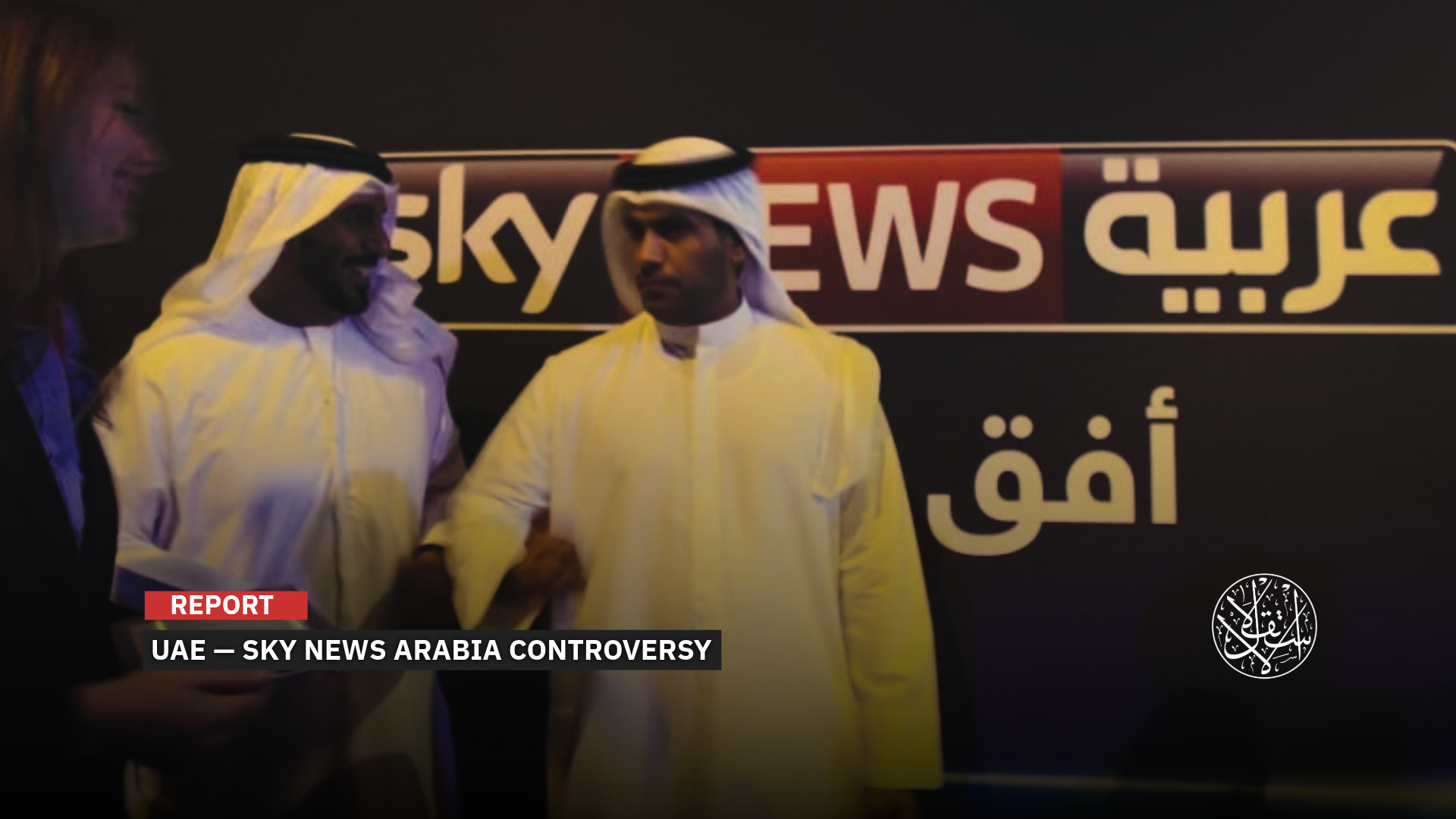
Sky News Arabia has turned into a biased propaganda platform.
Following a series of warnings issued by the parent channel (Sky News), British reports have revealed that there is a move to withdraw the license of the Arabic version, “Sky News Arabia,” and terminate the partnership agreement with the UAE, on the grounds of accusations that it has turned into a biased propaganda platform and has broadcast political content that undermines the professionalism for which the English-language channel is known.
According to London-based newspapers, on March 18, 2026, it is expected that the ownership company and the license of “Sky News Arabia” will be terminated during the year 2027, after warnings and criticisms accusing the channel of promoting propaganda and overlooking alleged violations attributed to the Rapid Support Forces militia in Sudan, which Abu Dhabi is said to support.
Under this anticipated decision, the UAE could suffer a significant media setback in terms of its external presence, particularly regarding platforms that reflect its political narrative, which may push it to seek alternatives, whether by launching a new channel or strengthening the presence of other outlets seen as close to it, such as Al-Ghad TV.
Media reports link Al-Ghad TV to Emirati funding, as well as ties to Palestinian figure Mohammed Dahlan, an advisor to the UAE president, while the channel is classified, according to those reports, among platforms that lack editorial independence.
It is also accused of ignoring or denying internationally documented incidents of massacres in the Darfur region, as well as denying allegations related to Emirati funding of armed groups said to be involved in those violations.

The Origin and Closure Story
In 2010, Sky News signed an agreement with IMI, the investment arm controlled by Sheikh Mansour bin Zayed al Nahyan, Vice President of the United Arab Emirates and owner of Manchester City, to launch an Arabic-language news service.
The agreement called for the launch of an Arabic media service, granting it a license to use the “Sky News” brand as part of a joint project with Sheikh Mansour bin Zayed.
News Corporation originally concluded the deal for this project at a time when it controlled the Sky network. Under the agreement, Sky entered into a 50/50 partnership with Abu Dhabi Media Investment Corporation, a private investment company owned by Mansour, to launch a news channel that began broadcasting from Abu Dhabi in 2012.
At its launch, the channel declared its commitment to independence and professional coverage “without fear or bias,” and Nart Bouran, who was then head of Sky News Arabia, said that “balance is what will distinguish us.”
The channel also contracted with International Media Investments, an Emirati company owned by sovereign entities in the UAE, to create a platform capable of competing with Arabic-language news channels such as Al Jazeera and BBC News Arabic.
However, according to media reports and criticism, the channel later evolved into a platform used to promote Emirati policies and defend Abu Dhabi’s regional positions, including its stances against Islamist movements.
These reports suggest that the editorial board within the channel does not hold real authority due to ownership dominance, with journalists describing the Arabic version’s work as “overt propaganda.”
They also stated that the editorial standards committee no longer has effective powers to counter the influence of the owning management, according to The Telegraph.
At the time, the British Sky network was under News Corporation and businessman Rupert Murdoch, who sought to build profitable partnerships with the UAE and planned to license his entertainment brands to the “Twentieth Century Fox World” project, an entertainment city that was to be built in Dubai.
However, the project was canceled in 2018 before construction began, following the transfer of Sky’s ownership to the American cable giant Comcast that same year.
Concerns among Sky News officials gradually increased regarding the positions adopted by Sky News Arabia, which were seen as diverging from professional editorial policy and standards of neutrality in covering regional news, particularly amid accusations that the channel had shifted toward supporting repressive regimes, broadcasting fabricated reports, and, more recently, supporting the “Hemedti” militia in Sudan despite allegations of serious violations.
According to The Guardian, internal discussions took place within the British parent company about ending the partnership with the UAE altogether, amid concerns about the impact of these practices on the network’s image and credibility.
This coincided with increasing scrutiny within the United Kingdom regarding the relationships between media institutions and foreign investments, especially those linked to Gulf countries.
Media reports also sparked debate about press freedom, amid Abu Dhabi’s efforts to obtain licenses or acquire media institutions, such as the Daily Telegraph, alongside criticism that Sky News Arabia has become a biased platform producing content that conflicts with standards of editorial independence.
On March 18, 2026, both The Guardian and The Daily Telegraph revealed that the British Sky News network is considering ending its joint venture with the UAE and withdrawing the license of Sky News Arabia, amid accusations of broadcasting propaganda and denying acts of genocide in Sudan.
The reports confirmed that Sky is holding talks with its Emirati partner regarding the future of the channel, including the possibility of terminating the brand licensing agreement within the coming year.
They also noted that the channel is accused of “promoting propaganda narratives” and whitewashing violations in Sudan, and that the UAE-based version has clearly diverged from the editorial line of the parent channel, with the project from its inception described as not purely media-driven, but also tied to political and economic dimensions.
The Daily Telegraph reported that one of the main reasons behind Sky’s move to cut ties with its Arabic channel is its coverage of the war in Sudan, where the parent company expressed dissatisfaction with the use of its brand in a context perceived as justifying human rights violations attributed to the Rapid Support Forces militia.
It added that there are increasing indications, according to media reports, of UAE support for these militias, which have been accused of committing genocide and widespread sexual violence in Darfur, while Sky News Arabia is accused of defending them and promoting their narrative.
Nevertheless, The Daily Telegraph noted that there are reports suggesting a possible agreement to preserve the partnership and avoid withdrawing the channel’s license, provided that it adheres to the standards of the parent English-language channel, refrains from editorial bias, and avoids supporting armed parties in regional conflicts, including in Sudan and Yemen.
Suspicious Roles
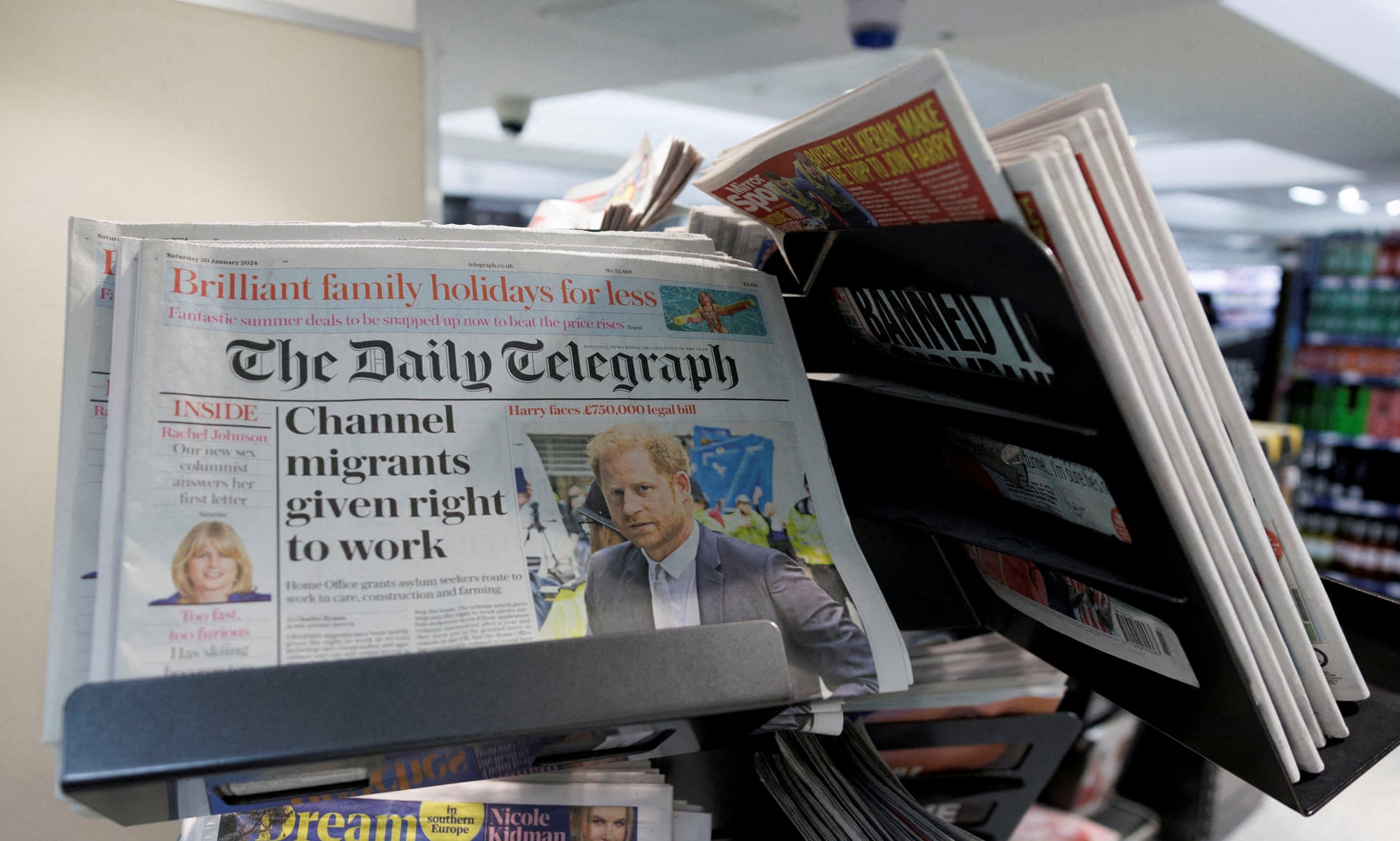
A law banning foreign governments from owning British newspapers came into force in March 2024, as an amendment to the Companies Act of 2002, blocking the UAE from attempting to acquire the historic Telegraph group.
The law prohibits deals involving the sale and merger of newspapers and periodicals that may include ownership, influence, or control by foreign states, which reportedly angered Abu Dhabi, according to The Guardian on March 15, 2024.
Earlier that year, London also rejected Abu Dhabi’s bid to acquire the Telegraph Media Group, dealing a major blow to its ambitions to expand its media influence within the United Kingdom, amid concerns over freedom of expression, according to Reuters on March 19, 2024.
At the time, British lawmakers and journalists strongly opposed the deal, arguing that ownership of one of Britain’s most prominent newspapers by a foreign state, particularly the UAE, could threaten press freedom.
They noted that the Telegraph had previously been critical of the UAE and Sheikh Mansour bin Zayed al Nahyan, the Vice President of the state, suggesting it was paradoxical for ownership to be transferred to him, making him, in effect, a member of its board.
Among the main concerns was the possibility of Abu Dhabi gaining control over the British media landscape. A source within the Telegraph told The Guardian on January 26, 2024, “We have seen money laundering through sport, are we now seeing news laundering?”
Journalist Peter Oborne wrote on the Middle East Eye website on September 3, 2023, that the Emirati bid to purchase the Telegraph posed a threat to press freedom, pointing to Abu Dhabi’s record in restricting media and its ranking of 119 out of 180 in the global press freedom index.
On December 2, 2023, Britain blocked the takeover of Telegraph Group by an Emirati-backed company, which includes the Daily Telegraph and The Spectator, over concerns raised by media institutions about freedom of expression, according to Reuters.
The Abu Dhabi-backed firm RedBird IMI had taken control of the Telegraph and The Spectator in December 2023 after helping settle £1.2 billion ($1.5 billion) in debts owed by the Barclay family to Lloyds Bank, but the deal remained subject to regulatory approval, which was later denied.
British newspapers and commentators have spoken of “suspicious roles” for the UAE, both in security matters and in relation to influence over press freedom.
They attributed the UK’s reluctance to allow ownership of media or communications assets to Abu Dhabi’s record of interference in other countries’ affairs, and concerns that the Telegraph’s editorial line could be altered into a propaganda platform serving Emirati policies.
The debate resurfaced on January 24, 2024, when the Emirati group e& submitted an offer to purchase a 15% stake in the British company Vodafone, but the UK government viewed the move as a “national security risk” and ordered measures to mitigate those risks.
Two days later, on January 26, 2024, London confirmed it had taken “proportionate measures” to address national security concerns regarding the relationship between Vodafone and e&, allowing the strategic partnership to proceed, although the deal was ultimately not completed.
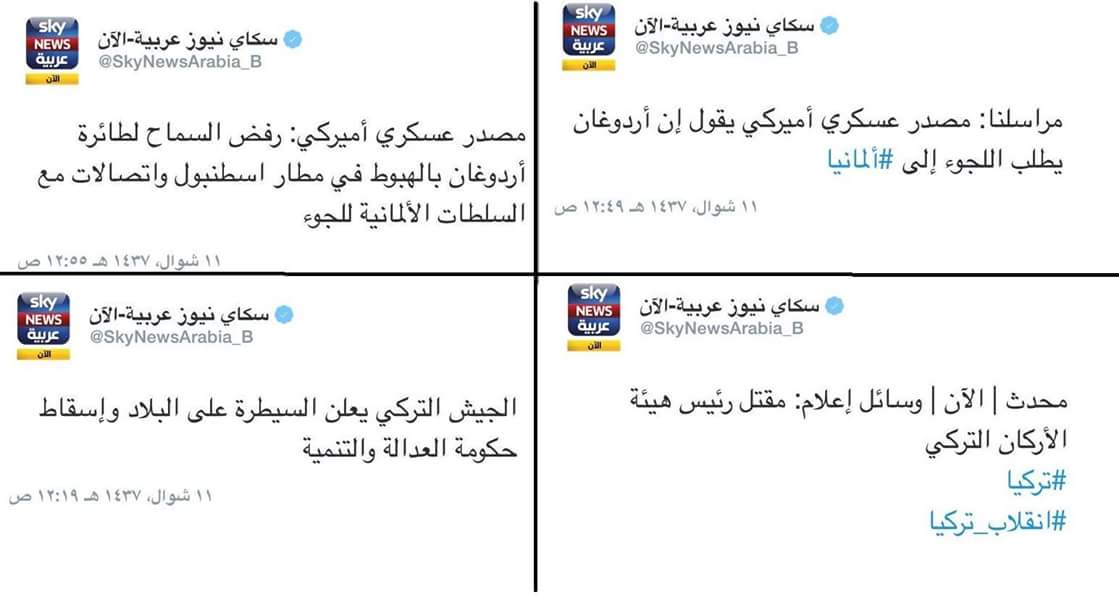
Lie: Erdogan Has Fled!
The UAE-backed network has previously been involved in publishing several misleading reports, including its coverage of the 2016 attempted coup in Turkiye, when it claimed that Turkish President Recep Tayyip Erdogan had fled to Germany, a claim that was later proven false as the coup attempt was being foiled.
In the aftermath of the failed coup attempt in July 2016, Sky News Arabia interrupted its regular programming and broadcast breaking news claiming that the coup had succeeded and that Erdogan had fled, along with other information described as misleading, in coverage critics considered biased and supportive of counter-coups in the region.
During that night, the channel cited unnamed “American sources” alleging that Erdogan had requested asylum in Germany, information that was later proven false, prompting the channel to delete it after facing criticism over its credibility.
The channel also aired reports claiming that an explosion had occurred in Istanbul and that the Turkish military had taken control of all city facilities after the “government fled,” claims that were later found to be inaccurate.
It further alleged that there was “popular support” for tanks entering the streets, which was contradicted by on-the-ground events showing large numbers of citizens taking to the streets in rejection of the coup attempt, along with police confronting the participating soldiers.
In a related context, the channel reported that the fate of then Turkish Chief of General Staff, General Hulusi Akar, was unknown and cited unspecified media outlets claiming he had been killed, before it later emerged that he was alive, a report that observers described as misleading and aligned with the coup narrative.
It also reported, citing an unnamed American source, that Erdogan’s plane had been prevented from landing at Istanbul airport and that he was in contact with German authorities to seek asylum, while subsequent developments showed his return to Istanbul and a public reception, as efforts intensified to thwart the coup.

Whitewashing of Violations
Sky News Arabia has been accused of whitewashing violations committed by the UAE-backed Rapid Support Forces militia in Sudan and downplaying reports documenting widespread violence.
In this context, concerns about conflicts of interest have been raised, with reports noting that one of the channel’s correspondents, Tsabih Mubarak, is married to a senior official in the parallel government linked to the Rapid Support Forces militia.
On November 9, 2025, the correspondent appeared in a video hugging a senior RSF militia figure who had previously been accused of inciting abuses in Darfur, expressing her support by saying, “We are with you.”
Media reports also stated that the channel aired material questioning the validity of evidence related to the abuses, including satellite imagery and testimonies from displaced people, describing some of it as unreliable.
The channel also published reports and articles suggesting that there was insufficient on-the-ground evidence to support such accounts, a stance that sparked widespread debate in media and human rights circles.
In contrast, a United Nations fact-finding mission concluded in February 2025 that the siege imposed on Darfur for about 18 months, followed by RSF militia’s control of the region, involved serious violations, including acts described as amounting to war crimes and genocide.
Following the escalation of controversy surrounding its coverage, the Sudanese government decided in November 2025 to ban Sky News Arabia from operating in the country.
Reports indicate that the channel’s coverage of the war in Sudan, along with allegations that it justified or minimized violations, was among the factors that prompted the British parent network to review its partnership and consider withdrawing its license.
The main accusations against the channel focus on publishing narratives that question documented international reports on violations, contradicting UN findings and field testimonies about widespread crimes in Sudan.
Most British newspapers addressing the possible termination of Sky News Arabia’s license have emphasized issues of professionalism and editorial independence as central to the debate, noting that the channel has, according to these assessments, evolved into a platform reflecting political orientations rather than an independent media outlet.
They also explained that the Arabic channel project, since its inception, was part of a broader effort to enhance the UAE’s global media presence through investment in major media institutions and platforms, as part of an attempt to influence regional and international narratives.
They further noted that the Emirati partner’s ties to state structures make it difficult to separate funding from editorial direction, raising questions about the channel’s independence, particularly in its coverage of sensitive regional issues.
According to media reports, this has been reflected in its coverage of several issues, such as the Qatar blockade crisis in 2017, developments in Turkiye, and events related to the Arab Spring, where the channel was accused of bias.
This controversy, observers say, has contributed to declining confidence in the channel’s independence and increasing criticism within British media circles, alongside calls to reassess the partnership to protect the reputation and professional standards of the Sky brand.
Sources
- Sky Considers Ending Controversial UAE News Joint Venture
- Sky News To Cut Ties With UAE Channel
- Sky News Teams Up With Sheikh Mansour To Launch Arabic TV Channel
- UAE Faces Online Boycott Calls Over Sudan War
- The Telegraph Sale: The UAE Bid Is A Risk To Press Freedom
- Telegraph Takeover Decision Put Back By Fresh Inquiry Into Barclay Family’s UAE-Backed Deal
- UK Bars Abu Dhabi-Backed Group From Acquiring Telegraph, Pending Review
- “Sky News Arabia”: “The Suspicious Person Almost Says, Take Me!” [Arabic]