Shiite Anger, Government Silence: Why Riyadh’s Remarks Rattled Ties With Baghdad
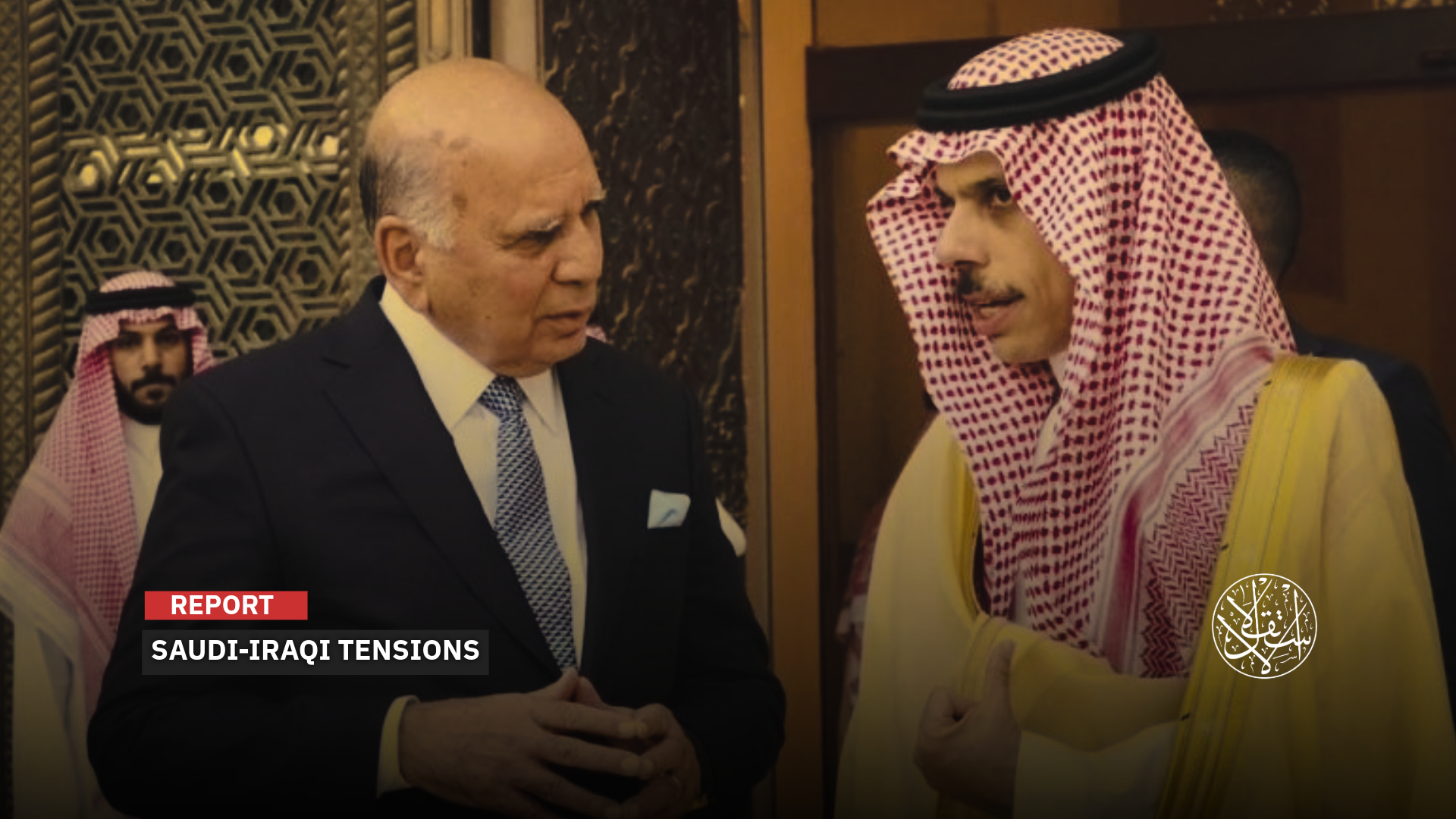
Bin Farhan criticized Iran’s role in the region.
Saudi Foreign Minister Faisal bin Farhan al Saud’s statements regarding Iraq’s Popular Mobilization Forces sparked a wave of anger within Shiite political circles, extending even to the institution itself linked to the prime minister’s office, which quickly issued a strongly worded statement attacking the minister and using descriptions that were deemed “offensive.”
In contrast, the Iraqi government remained silent in response to those remarks, despite growing calls from political factions to summon the Saudi ambassador in Baghdad.
Meanwhile, no official response was issued from Riyadh regarding the criticism directed at its foreign minister, neither through a clarifying statement nor through a reciprocal diplomatic move toward the Iraqi ambassador in the Kingdom.
An Iranian Tool
The crisis escalated after remarks made by Faisal bin Farhan al Saud to reporters following a meeting of Arab and Islamic foreign ministers in Riyadh on March 19, 2026.
The comments came roughly 20 days after the outbreak of war in the Middle East, triggered by an attack carried out by the United States and “Israel” against Iran.
Bin Farhan criticized Iran’s role in the region, accusing Tehran of backing armed groups across several countries, including the Houthis in Yemen, factions within Iraq’s Popular Mobilization Forces in Iraq, and Hezbollah in Lebanon.
He argued that such policies do not genuinely support the causes of the Islamic world, but instead advance Iran’s own interests.
The Saudi foreign minister added that Iran had supported the former regime in Syria in committing violations, was involved in the assassination of political figures in Lebanon, and had enabled armed factions to influence political decision-making in Iraq.
He questioned what he described as Iran’s real contributions to issues facing the Islamic world.
Bin Farhan also stated that the Kingdom reserves the right to respond, including militarily if necessary, following missile and drone attacks targeting U.S. bases and interests in Riyadh.
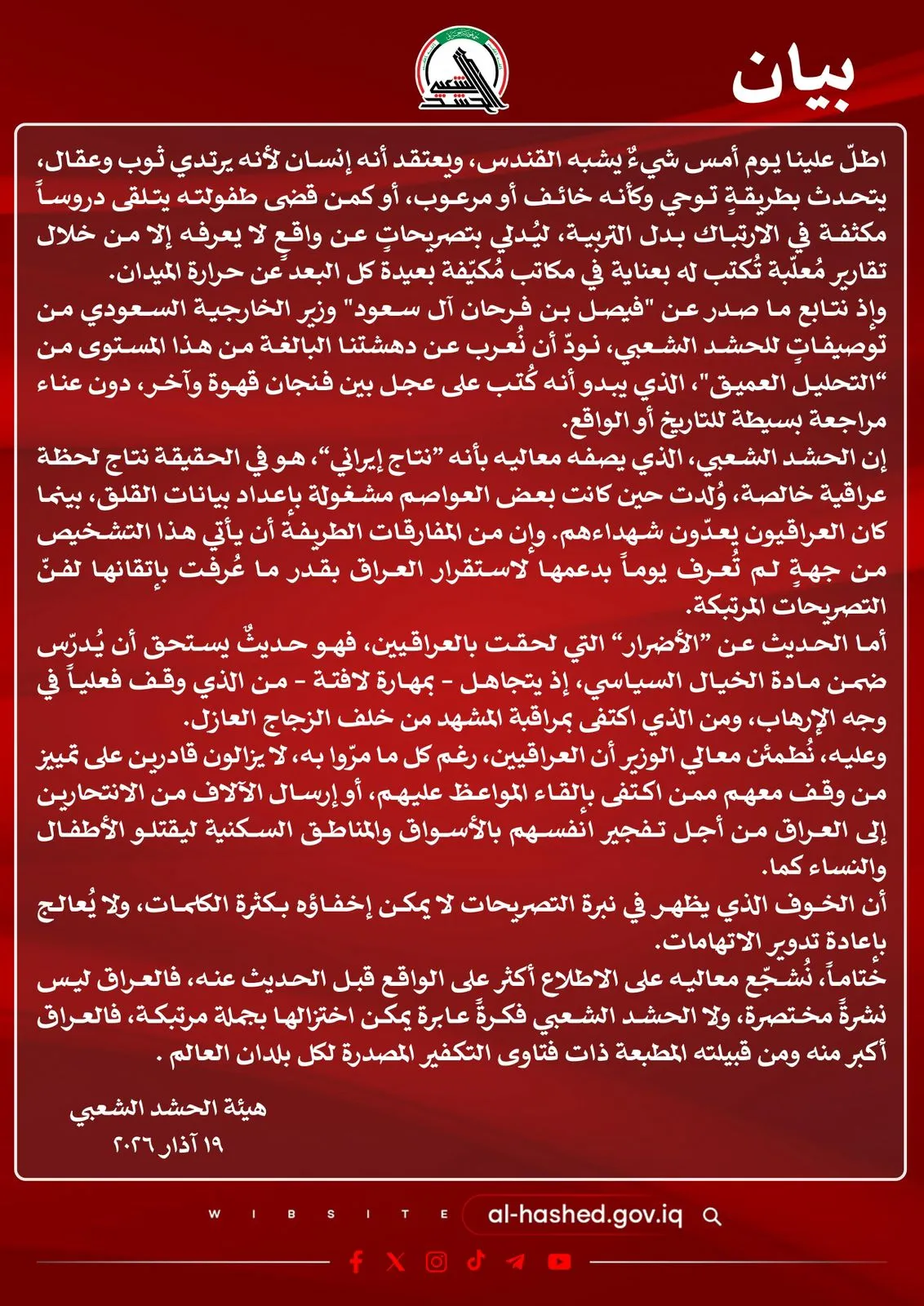
In response, Iraq’s Popular Mobilization Forces issued a sharply worded statement, saying, “A figure resembling a beaver has appeared before us, imagining himself human because he wears traditional attire, making statements about a reality he only knows through carefully prepared reports written in air-conditioned offices far removed from the heat of the field.”
In a statement released on March 19, and later removed from its platforms, the commission criticized Bin Farhan’s characterization of the Popular Mobilization Forces, expressing surprise at what it described as “a level of analysis that appears rushed and lacking even a basic review of history or reality.”
The statement added that “the Popular Mobilization Forces, which he describes as an Iranian product, are in fact the result of a purely Iraqi moment, born when some capitals were busy drafting statements of concern while Iraqis were burying their dead.”
It further noted the irony of such criticism coming from a party “not known for supporting Iraq’s stability as much as for issuing confused statements.”
The commission also rejected the minister’s remarks about the “harm suffered by Iraqis,” calling them “the kind of statement that belongs in a course on political imagination,” arguing that they ignore who actually confronted terrorism and who merely observed events from a distance.
In conclusion, the commission urged the Saudi foreign minister to develop a deeper understanding of Iraq’s realities, emphasizing that Iraq “cannot be reduced to a simplistic or confused statement.”
Official Silence
In the same context, Iraqi political analyst Sabah al-Akili, who is close to the Popular Mobilization Forces, criticized the lack of a firm governmental and parliamentary response to what he described as “overreach” by Saudi Foreign Minister Faisal bin Farhan al Saud against the PMF, arguing that such silence does not match the scale of the offense directed at an official security institution.
The Iraqi news agency Almaalomah, affiliated with the Kataib Hezbollah militia, quoted al-Akili on March 20 as saying, “The government, the Ministry of Foreign Affairs, and parliament are required to take a clear stance regarding the Saudi minister’s statements, which overlook the role of the Popular Mobilization Forces in eliminating the greatest terrorist threat that endangered the entire region, including Saudi Arabia.”
He added that “these statements, which described the PMF with unacceptable terms, clearly align with U.S.-Zionist policies hostile to Iraq,” noting that “Riyadh, which attacks the PMF today, did not take any action to condemn what he described as aggression against Lebanon and Palestine, or the ongoing massacres against civilians there.”
According to al-Akili, “attempts to undermine the Popular Mobilization Forces are aimed at weakening Iraq’s military institution and stripping it of its national sources of strength,” calling on official bodies to “break their silence and protect Iraq’s sovereignty from external interference.”
In the same vein, Iraqi parliamentarian Alaa Ouda al-Nashi, from the “Khidmat” bloc led by Shibl al-Zaidy, launched a sharp attack on the Saudi foreign minister, describing him as one of “Trump’s bootlickers” who incites against “our sons in the sacred Popular Mobilization Forces,” referring to Donald Trump.
In a post published on Facebook on March 19, al-Nashi called on the government to urgently summon the Saudi ambassador and submit an official protest note regarding the foreign minister’s remarks, which she described as “illegitimate,” and to issue a clear governmental stance toward what she called a blatant violation against an Iraqi security institution operating under the law and the authority of the state, stressing that no one would be allowed to infringe upon it.
In a move interpreted by some as an indirect response to the Saudi minister, Iraqi Prime Minister Mohammed Shia al-Sudani visited the headquarters of the Popular Mobilization Forces on March 19, praising its “role and sacrifices that have contributed to protecting Iraq and strengthening its sovereignty,” and affirming his “full support for this key force within our security apparatus.”
In a statement, al-Sudani said that “accusing the Popular Mobilization Forces of carrying out actions outside the framework of the state and the law is an allegation that either reflects ignorance or represents deliberate misinformation with specific objectives.”
He added that “the Popular Mobilization Forces today represent a fundamental force operating under the umbrella of the constitution and the law, and they adhere to the orders issued by the competent official authorities.”
Military Deterrence
Regarding the extent to which the media exchanges may affect relations between Iraq and Saudi Arabia, Iraqi affairs researcher Hamed al-Obaidi said that “the situation is unlikely to escalate beyond this level of tension, and the issue will remain limited to an exchange of accusations between the Popular Mobilization Forces and Saudi Foreign Minister Faisal bin Farhan al Saud. That is why we have not seen any official Iraqi intervention in response.”
Al-Obaidi added in remarks to Al-Estiklal that “the Iraqi government is not capable of protecting its vital and security institutions, as the headquarters of the intelligence service was targeted by one of the militias. Therefore, in the recent period, the state has suffered a severe erosion of its authority and official standing.”
The researcher also noted that “even the possibility of an attack by armed factions affiliated with the Popular Mobilization Forces against Saudi Arabia could be conceivable, although Iraq would bear the consequences, especially amid reports that the Kingdom may have carried out strikes against PMF formations under media silence, in response to previous attacks.”
Meanwhile, former Iraqi MP and opposition figure Faiq al-Sheikh Ali revealed that militias associated with the Popular Mobilization Forces are responsible for many of the rockets and drones launched toward neighboring countries, including attacks targeting Kuwait and Saudi Arabia.
Speaking during a podcast interview published on March 22, al-Sheikh Ali said that “one of the secrets of the Iraqi state, which may be revealed here for the first time, is that Saudi Arabia responded to these militias with a strong military retaliation, after which they were deterred, particularly those operating along the Saudi-Iraqi border.”
He added that “after they attacked Saudi Arabia two or three times, the Kingdom responded forcefully, and they were subsequently restrained and stopped launching attacks against it. However, they continue to fire many rockets and drones toward Kuwait and other countries, actions carried out by undisciplined militias.”
Saudi Arabia’s role was absent during the phase of reshaping Iraq’s political system after the U.S. occupation of Iraq in 2003. Although it welcomed the removal of Saddam Hussein’s regime, it did not resume relations with Baghdad, which had been severed following the 1990 invasion of Kuwait.
With the rise of King Salman bin Abdulaziz Al Saud to power in 2015, and the departure of Nouri al-Maliki from office after serving two terms (2006–2014), during which Riyadh accused him of pursuing sectarian policies, a new chapter in relations between the two countries began, welcomed by Iraqi Sunni political forces.
On the other side, one of the factors behind the rapprochement between the two countries was the appointment of Haider al-Abadi as Iraq’s prime minister in 2014.
At the end of December of that year, he called for the development of bilateral relations to help accelerate the defeat of the Islamic State group, which had overrun Iraq and controlled one-third of its territory.
After a break lasting more than 25 years, it was announced in early December 2015 that the Saudi embassy would reopen in the Iraqi capital, Baghdad, amid criticism from Shiite parties and welcome from Sunni factions.
Saudi Arabia appointed Thamer al-Sabhan as its ambassador to Baghdad, but after about a year, the Iraqi Foreign Ministry requested on August 7, 2016, that the Kingdom withdraw its ambassador, accusing him of interfering in internal affairs.
On October 14, 2016, Saudi Arabia sent Abdulaziz al-Shammari as its new ambassador to Baghdad, a position he still holds. He is a military officer holding the rank of brigadier general and had previously served as the military attaché at the Saudi embassy in Germany.
Saudi Arabia’s opening was not limited to the governmental level; it also began engaging with influential Shiite figures in Iraq, including Sadrist movement leader Muqtada al-Sadr, who visited the Kingdom in 2017 and met with Crown Prince Mohammed bin Salman.
Sources
- The Prime Minister praises the role of the Popular Mobilization Forces and their sacrifices that contributed to protecting Iraq and strengthening its sovereignty [Arabic]
- The Popular Mobilization Forces respond to bin Farhan a frightened beaver [Arabic]
- Saudi Arabia PMF militias in Iraq serve Iran’s agenda and the military option is on the table [Arabic]
- A politician criticizes the silence of the government and parliament regarding Riyadh’s remarks about the Popular Mobilization Forces [Arabic]
- This is how Saudi Arabia lost Iraq’s Sunnis and handed the country over to Iran [Arabic]