Trump Bogged Down in Iran: Will China Seize the Opportunity To Take Taiwan?
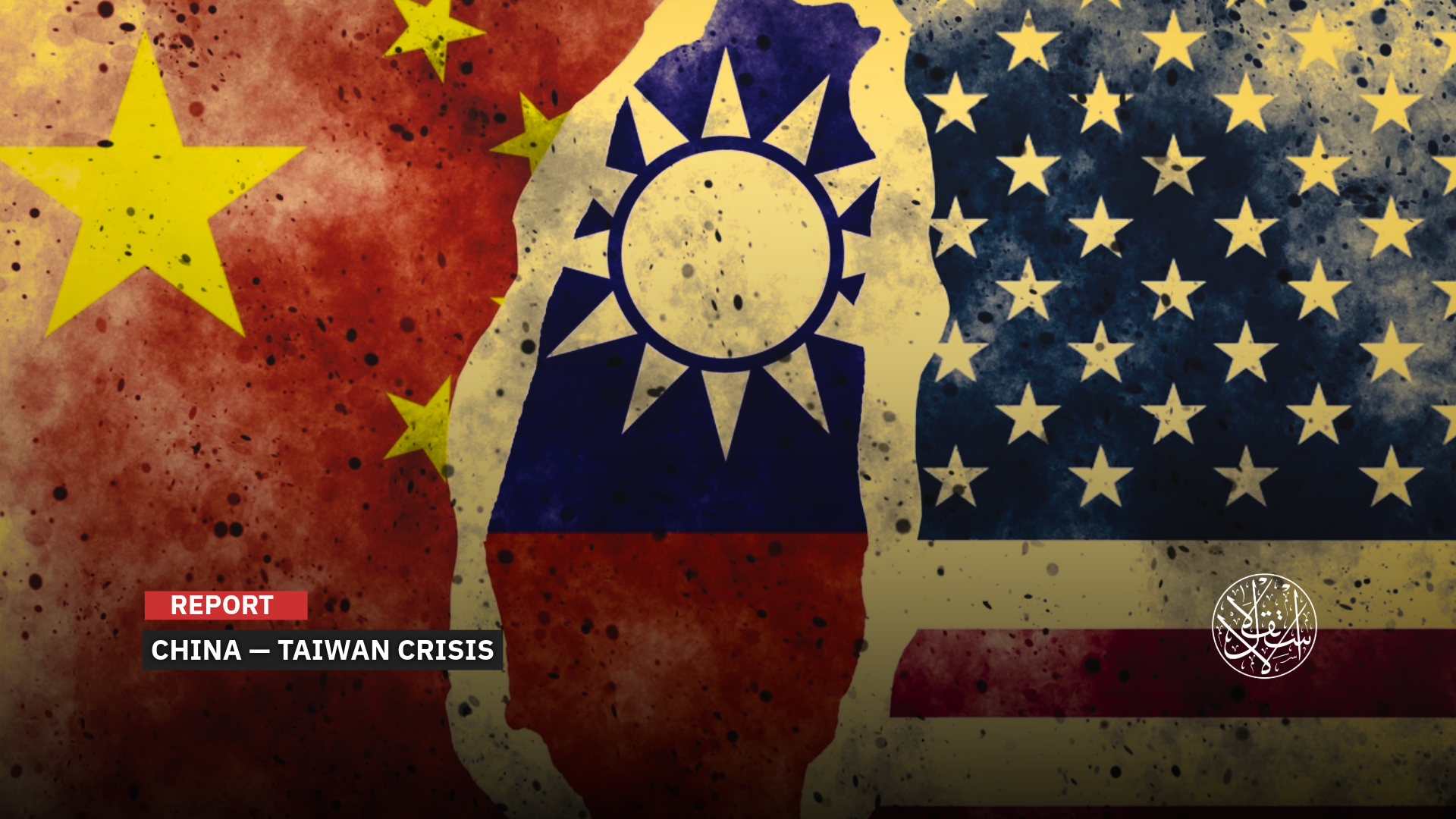
China considers Taiwan part of its territory and seeks to reunify it with the ‘motherland.’
As U.S. President Donald Trump becomes entangled in the ‘quagmire’ of the war on Iran, and fails to achieve a breakthrough that would weaken Iran’s military capabilities, the Asian arena has witnessed notable Chinese moves toward Taiwan, which China considers part of the ‘motherland’ and seeks to annex, at a timing that appears far from coincidental.
Taiwanese and Western assessments have warned of strong indications that China may exploit the U.S.-Israeli war on Iran as cover to regain control of the island and formally annex it.
This scenario differs from Chinese actions during the war in Ukraine, when threats did not escalate into an actual invasion attempt.
These indicators suggest that the Chinese military has broken from its traditional measures used to signal pressure on Taiwan.
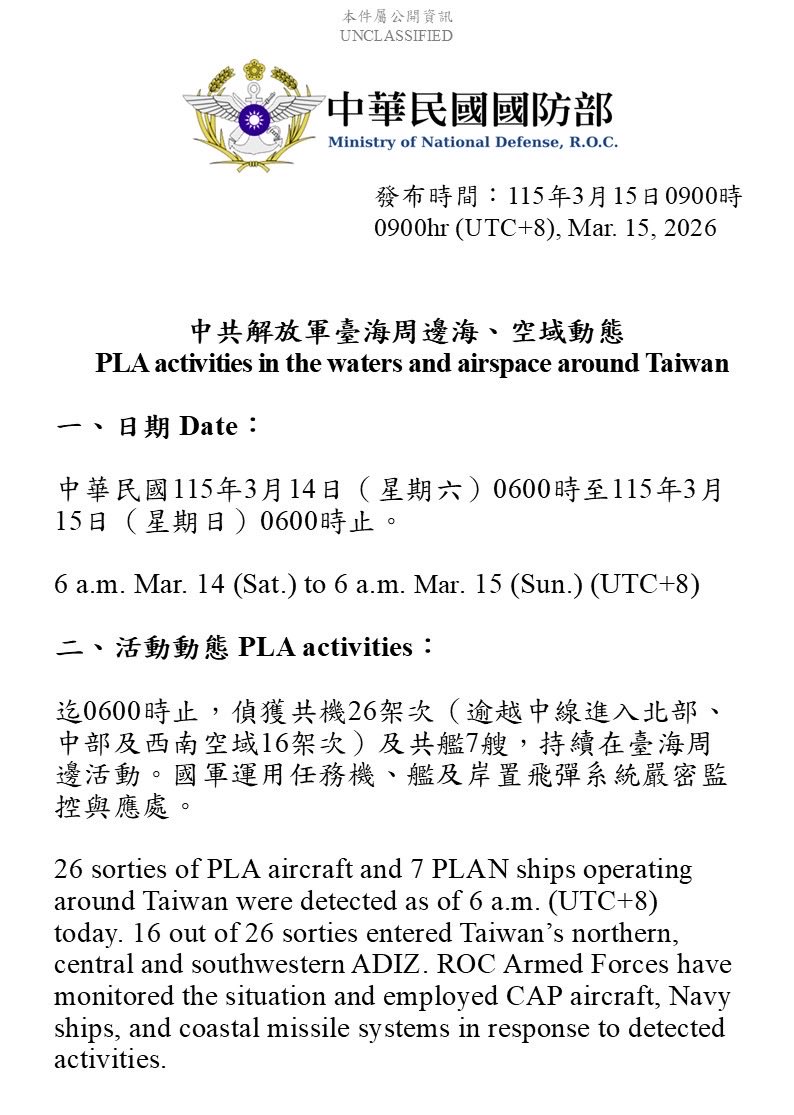
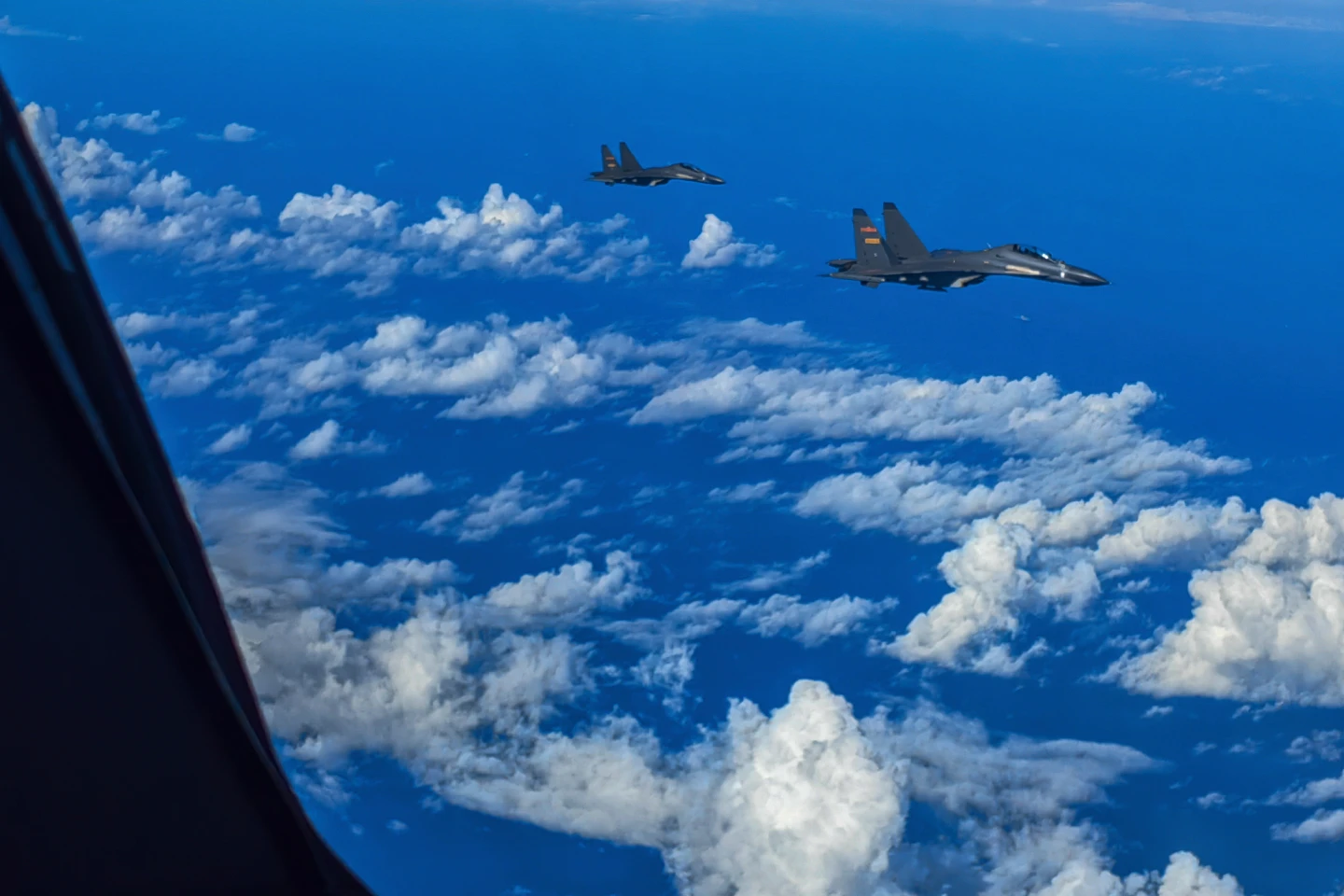
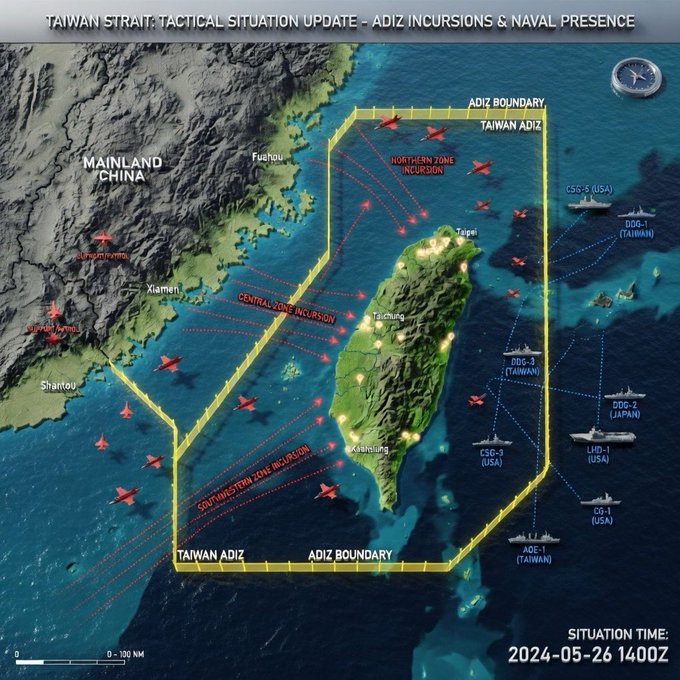
It breached the island’s airspace with a large-scale deployment that included 26 warplanes and 7 Chinese naval vessels, effectively forming a near-encirclement of the territory, according to data from the Taiwanese military.
What makes these Chinese moves more dangerous this time is the level of seriousness and strategic positioning. Taiwan’s Ministry of Defense and Politico confirmed on March 13, 2026, that 16 out of the 26 Chinese aircraft entered the island’s northern, central, and southwestern air defense identification zones, representing an unprecedented escalation in the military threat against Taiwan.
Strategic Opportunity
China, which considers Taiwan part of its territory and seeks to annex it to the “motherland,” may exploit the latest developments in the Middle East as an irreplaceable strategic opportunity.
This is what several Western reports have stated, warning the United States that the gamble of U.S. President Donald Trump in Iran could open a favorable window for Beijing to pressure the island and attempt to annex it.
As Trump becomes engaged in the war against Iran, new fires have begun to flare up elsewhere. China has nearly encircled Taiwan, taking advantage of the United States' withdrawal of its military assets, munitions, and air defense systems from Asia to the Middle East, creating a strategic imbalance that Taiwan may ultimately pay for.
In recent years, Beijing has intensified its military pressure around the island, carrying out large-scale air sorties and repeatedly breaching Taiwan’s airspace to impose a new reality.
What has raised surprise this time is the timing of these moves, coinciding with the U.S. attack on Iran.
Taiwan announced that between February 27 and early March 2026, almost no Chinese military aircraft activity was recorded near the island, an unusual pause in the near-daily flights typically conducted by the Chinese military.
This temporary calm raised questions among analysts in Taipei about whether Beijing was recalibrating its pressure campaign, while China provided no public explanation for the temporary reduction in flight activity.
But suddenly, as the U.S. offensive against Iran escalated, Taiwan revealed that 26 Chinese military aircraft had flown near the island, marking a return to intensive aerial activity after a two-week pause and sparking widespread speculation about Beijing’s intentions.
A Western report indicates that this Chinese move appears more serious and may be linked to an intersection of the policies of Trump and his Russian allies in expanding influence and imposing faits accomplis on external territories, as seen in Ukraine and Iran.
Chinese leaders, who have previously threatened a military invasion of Taiwan and vowed to confront the United States when former U.S. House Speaker Nancy Pelosi visited the island in August 2022, may now find the opportunity more favorable amid U.S. distraction due to the war on Iran.
According to estimates published by Asia Times on March 5, 2026, if the war on the Iran continues for months rather than weeks and U.S. losses increase, Chinese President Xi Jinping may be inclined to carry out his threat to act against Taiwan, something he has described as an “unstoppable reunification.”
The report suggests that China may view its military superiority around Taiwan as significant enough that the United States would be unable to mobilize sufficient force to prevent or respond to a Chinese attack without suffering heavy losses.
In this scenario, if Washington does not act quickly, no other regional country, including Japan, would confront China alone, as Japan’s self-defense capabilities, despite their development, do not allow it to wage a major war independently.
Chinese Foreign Minister Wang Yi stated in 2025 that Beijing welcomed U.S. involvement in Ukraine because it depleted American weapons stockpiles and distracted political attention, thereby easing pressure on Asia and Taiwan.
Admiral Philip Davidson, former commander of the U.S. Indo-Pacific Command, indicated that the U.S. military believed Xi aimed to prepare his forces to seize Taiwan by 2027, according to a warning he delivered before the Senate Armed Services Committee in 2021.
Despite doubts about whether this could happen so quickly, the equation has changed with the outbreak of war on Iran.
At the same time, some military analysts, such as Kris Osborn, president of the “Warrior Maven” center, argue that China exploiting the Iranian conflict to impose a rapid annexation of Taiwan is unlikely in the near term, given the presence of two U.S. aircraft carriers in the Pacific, USS George Washington in Yokosuka, Japan, and USS Theodore Roosevelt in the operational area, making any Chinese attack extremely costly.
According to Osborn, China is instead planning to use U.S. preoccupation with Iran as an opportunity to strengthen its positions around Taiwan before U.S. forces and their allies can intervene.
If any force attempts to reverse control, the cost in lives and resources would be extremely high, placing defenders of the island in a serious dilemma.
Since 1949, China and Taiwan have been governed separately, after the Nationalist Party retreated to the island following the Communist Party’s rise to power in Beijing.
Taiwan later transitioned from a period of martial law to a pluralistic democratic system, while maintaining broad self-rule, making any attempt at Chinese annexation a highly sensitive issue both domestically and internationally.
Possible Repercussions
Although Taiwan imported U.S. weapons worth $9 billion before the March 15, 2026, deadline, in the hope that this would delay China’s ambitions to invade it, military experts believe that the power gap between the two sides may not be sufficient to deter China from attempting to annex the island.
European assessments have taken a broader view, warning that if China moves, it could simultaneously embolden North Korea, potentially placing Japan and South Korea in direct confrontation, at a time when the United States is preoccupied with the Middle East war and depleting its missile stockpiles there.
The United States has withdrawn its aircraft carriers and warships from Asia and Japan, and has also quietly removed the THAAD missile defense system from South Korea due to the Iranian crisis, meaning that no U.S. military units are readily available to repel any Chinese attack on Taiwan.
Because of these movements and expectations, some reports have expressed concern that the escalation could lead to a third world war, if a Chinese invasion of Taiwan coincides with a North Korean move against South Korea and Japan.
However, Jo Inge Bekkevold, a researcher on Chinese affairs at the Norwegian Institute for Defense Studies, rejected this argument, stressing that talk of a third world war reflects a “strong desire” rather than a realistic probability.
He called for ignoring exaggerated comparisons, noting that the current war in the Middle East and the Russian invasion of Ukraine do not constitute a direct indicator of a global war.
In an analysis published by Foreign Policy on March 12, 2026, Bekkevold explained that the term “World War III” is not merely a phrase used lightly, and that predicting its imminent outbreak should be avoided, reflecting a prominent tendency in modern political analysis.
He noted that in 2022 and 2023, prominent figures such as John Mearsheimer, Tucker Carlson, and Elon Musk warned that supporting Ukraine against Russia could ignite a global war, and that the current Middle East conflict is no exception to such concerns.
A recent poll conducted by Politico showed that a majority of respondents in Britain, Canada, France, and the United States believe that a third world war could be likely within the next five years, reflecting growing international anxiety over major conflicts.
Western reports point to a series of factors that may prevent China from launching a military invasion of Taiwan, foremost among them the experience of Ukraine, which demonstrated that a small, unified country with strong resolve can withstand and exhaust a larger adversary, according to a report by Foreign Policy on August 10, 2022.
The war in Ukraine has shown that a smaller state, if it possesses political and military will, can confront a great power despite the latter’s vast territory and resources, while geography works in Taiwan’s favor, as it is surrounded by water on all sides, making any Chinese invasion a high-risk geopolitical gamble.
A military invasion of the island would not be limited to geopolitical risks, but would also carry severe economic consequences.
It could damage Beijing’s trade relations with Taiwanese suppliers and investors, and the West might impose economic sanctions on China similar to those imposed on Russia, increasing pressure on the Chinese economy and affecting global markets.
Nevertheless, the leadership of the Chinese Communist Party believes it may be possible to force Taiwan into surrendering and accepting unification peacefully through coercion and subversion rather than direct war.
According to these assessments, Chinese President Xi Jinping does not necessarily need to invade the island, but rather to demonstrate that Taiwan’s security guarantees weaken whenever the United States becomes engaged in war elsewhere, thereby strengthening Chinese influence without direct confrontation.
Why Is Taiwan Important?
If Taiwan falls, every company working in artificial intelligence, every smartphone manufacturer, and every global car brand would lose its supply of semiconductor chips, which the New York Times described as potentially “paralyzing the U.S. economy.”
The Taiwanese company TSMC produces nearly 90 percent of the world’s advanced semiconductors, making it a critical hub in the global technology industry.
Bloomberg projects that a complete collapse of Taiwan’s production could cause the S&P 500 index to drop between 30 and 50 percent due to the breakdown of global chip supplies.
Every graphics processing unit from Nvidia used to train AI models, every Apple processor in smartphones, and every AMD chip in data centers rely on silicon wafers manufactured at TSMC, located on the island over which 26 Chinese aircraft flew the same day the U.S. destroyer USS Tripoli sailed toward Iran.
The American newspaper confirmed on February 24, 2026, that a Chinese invasion of Taiwan and the severing of chip exports to U.S. companies would paralyze both the technology industry and the U.S. economy.
It reported from “classified briefings” held in Washington and Silicon Valley that any Chinese blockade of Taiwan could disrupt the supply of computer chips manufactured on the island, inflicting severe damage on the U.S. tech sector.
U.S. Treasury Secretary Scott Bessent said during the World Economic Forum in Davos, Switzerland, in February 2026, that “the greatest threat to the global economy, and its biggest vulnerability, is that 97 percent of advanced semiconductors are produced in Taiwan. If that island is blockaded and its production capacity destroyed, it would be an economic disaster.”
In the event of a Chinese invasion of Taiwan, a large portion of the global semiconductor industry would be at risk. TSMC holds roughly half of the world market share in this $100 billion industry, according to the Wall Street Journal.
A secret report prepared in 2022 by the Semiconductor Industry Association for its members, including the largest U.S. chip manufacturers, warned that cutting off chip supplies from Taiwan would trigger the largest economic crisis since the Great Depression.
The report projected that U.S. GDP could drop by 11 percent, twice the decline seen during the 2008 financial crisis, while China’s economy could fall by 16 percent, according to the New York Times.
The numbers indicate that China’s economy would shrink by $2.8 trillion in GDP, while the United States would see a $2.5 trillion decline.
This reality has led the United States, since the administration of former President Joe Biden, to spend around $200 billion on semiconductor factories through 2030, enough to increase chip production capacity by 50 percent, according to the global industry group SEMI.
Nevertheless, even with Taiwan, China, and other countries investing billions in semiconductor manufacturing, the United States will still account for only about 10 percent of global chip production by 2030, underscoring Taiwan’s strategic importance and sensitivity for the global tech and industrial sectors.
Sources
- Taiwan Reports Large-Scale Chinese Military Aircraft Presence Near Island
- Does Iran War Make a China Attack on Taiwan More Likely?
- Two U.S. Carriers Still in Pacific: Doubtful China Will Attack Taiwan During Iran War
- The Irresistible Urge to Invoke World War III
- After Quieter Weeks, Taiwan Reports Large-Scale Chinese Military Aircraft Presence Near the Island
- Why Doesn’t China Invade Taiwan?
- The Looming Taiwan Chip Disaster That Silicon Valley Has Long Ignored