From Earth to Orbit: How Data and Starlink Satellites Became Weapons in War
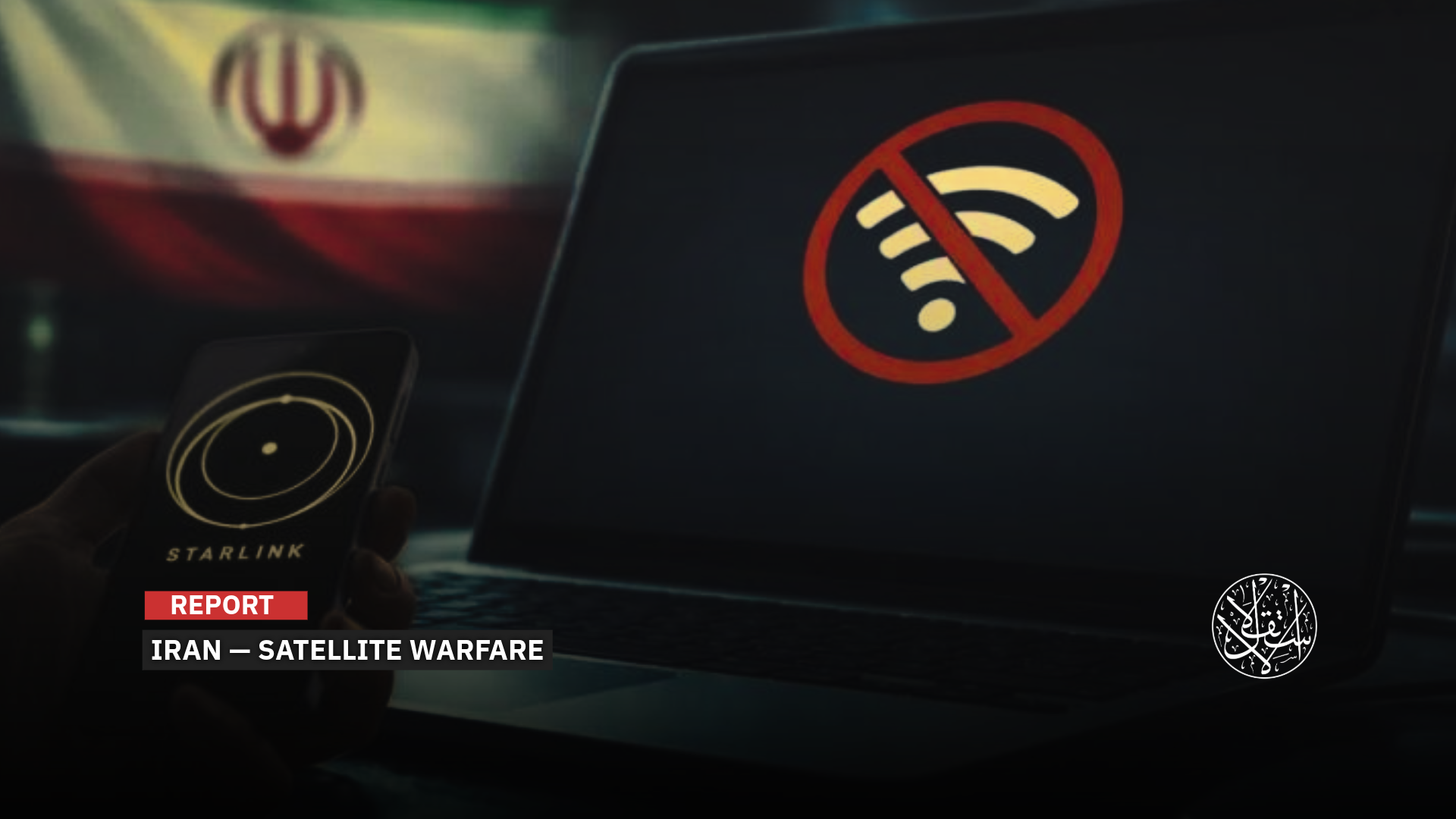
Each Starlink device emits a distinctive radio frequency signature when it connects to the satellites.
The ongoing conflict between Iran on one side, and the United States and “Israel” on the other, is witnessing a fundamental transformation in the nature of warfare, which is no longer limited to conventional weapons, airstrikes, and missile attacks, but has extended to include the realm of information and communications, where control over the flow of data has become a central factor in determining the outcomes of military operations and assessing the capabilities of the adversary.
At the heart of this battle, the satellite internet network “Starlink,” operated by the American company SpaceX, founded by businessman Elon Musk, has emerged as a key player.
This network relies on thousands of small satellites in low Earth orbit to provide high-speed internet, and is distinguished by fast connectivity and near-instant response compared to traditional infrastructure.
In the context of the current conflict, the network has gained significant strategic importance, as it can be easily deployed in areas where ground infrastructure has been destroyed or shut down, giving it a political and military dimension that goes beyond its original commercial purpose.

Smuggling of Devices
The debate over the use of Starlink inside Iran has intensified following a report published by the Wall Street Journal on February 12, 2026, which cited U.S. officials saying that the United States smuggled roughly six thousand Starlink terminals into Iran after the popular protests in late 2025.
According to the report, these devices were brought in through unofficial channels to provide internet access to opposition groups and activists after Iranian authorities imposed strict restrictions on the internet during the protests.
However, Iranian authorities viewed this move as a direct security threat, since having an independent communications network outside their control allows sensitive information to be transmitted quickly abroad, whether images of military sites or videos documenting the results of airstrikes.
In the context of this confrontation, Iran’s Ministry of Intelligence announced on March 10, 2026, the arrest of dozens of people in possession of Starlink devices, on charges of spying and working for the United States and “Israel”.
Additionally, Iranian Police Chief Ahmad Reza Radan announced on March 15 the detention of 500 people over a few days for involvement in leaking sensitive information and coordinates of military sites abroad.
These actions illustrate Tehran’s seriousness in limiting any threats beyond its control, and its concern that satellite networks could become decisive tools in modern cyber and intelligence warfare.
From the Iranian perspective, this step is not only about ensuring access to the internet but also about creating a parallel communications network within the country that operates outside state control.
In modern warfare, communication networks are no longer just a means of transmitting news or connecting individuals; they have become an essential part of the military operations' system.
The information transmitted, whether images of airstrikes, videos showing the extent of damage, or coordinates identifying sensitive locations, can quickly be converted into intelligence data used to assess strikes or identify new targets.

Hybrid Warfare
Iranian concerns about satellite networks and the risk of information leaks increase when placed in the context of the twelve-day war between Iran and “Israel” in June 2025.
That confrontation witnessed a series of precise strikes targeting senior Iranian military leaders inside the country, resulting in significant losses among security commanders.
Among the most notable of these operations was the killing of Major General Gholam Ali Rashid, commander of the Khatam al-Anbiya Central Headquarters of the Iranian Armed Forces, in an airstrike targeting a military site in Tehran on June 13, 2025.
On the same day, Brigadier General Gholamreza Mehrabi, deputy head of intelligence at the Iranian General Staff, was also killed during strikes targeting military facilities in the capital.
Two days later, media reports announced the killing of the head of intelligence of the Islamic Revolutionary Guard Corps, Brigadier General Mohammad Kazemi, and his deputy Hassan Mohaqiq, in an Israeli strike targeting a security headquarters in Tehran.
These operations raised widespread questions within Iran about how “Israel” was able to identify the locations of these commanders with high precision, especially since some of them were operating in locations presumed to be protected and secret.
Experts indicate that such operations typically rely on a complex mix of intelligence sources, including electronic surveillance, communications analysis, and satellite imagery, in addition to information provided by agents on the ground.
According to a report by Reuters on March 10, all of these coordinates shared a common factor, the activity of users on the Starlink network.
In addition to the airstrikes, media reports indicated that “Israel’s” intelligence agency, Mossad, carried out covert operations inside Iran prior to the start of military attacks, noting that Mossad agents used Starlink to establish secret drone bases inside Iran, which were later used to disable missile launch platforms and air defense systems before the Israeli bombardment began.
This type of operation falls within what is known as “hybrid warfare,” where intelligence operations overlap with conventional military attacks and cyber operations within an integrated strategy aimed at weakening the adversary’s capabilities before the start of direct military confrontation.

Jamming Battle
In response to the challenges posed by the use of the Starlink network inside the country, Iran is seeking to limit its impact through several measures, including electronic signal jamming, confiscation of devices, and tracking smuggling networks operating within Iranian territory.
Tehran has also filed a formal complaint with the International Telecommunication Union over the operation of Starlink terminals inside the country without the required official authorization.
Communications experts note that completely disabling the network is extremely difficult, given its reliance on thousands of small satellites constantly moving in low Earth orbit, making comprehensive jamming a highly complex task.
Nevertheless, Iran can use multiple methods to weaken the network’s performance, such as signal interference, tracking device locations, and confiscating them, as part of efforts to limit the spread of the service and its impact on national security.
At the same time, Iran is working to reduce its dependence on Western technological systems that the United States could control or disrupt.
In this context, Tehran has strengthened its cooperation with China and Russia in the fields of communications, navigation, and cyber technologies.
One of the most prominent examples is its reliance on the Chinese BeiDou Navigation System, which provides highly accurate positioning services and enables Iran to partially replace the U.S. GPS system, enhancing its ability to protect military systems from jamming or disruption during wartime.
Reuters reported in January 2026 that Russian officials confirmed Moscow’s readiness to expand technical cooperation with Tehran amid internal unrest and external pressure.
This rapprochement does not necessarily mean that Russia or China are directly managing Iran’s technological warfare, but it reflects Iran’s efforts to reduce its vulnerability to infrastructures that Washington could exploit politically or disable.
In this context, Iran’s battle becomes more complex, as it is no longer limited to conventional weapons, but extends to protecting the infrastructure that guides them, securing communications, safeguarding networks, and reducing exposure to U.S. and Israeli interference.

Shift in Concepts
Engineer Mohamed Sami, a specialist in cloud and wireless network management, believes that the ongoing confrontation over the Starlink network reveals a fundamental shift in the nature of warfare, which is no longer limited to conventional military tools, but has expanded to include the realm of information and communications, where control over the flow of data has become as important as control over territory.
Sami added in a statement to Al-Estiklal that satellite networks such as Starlink have given the United States an unprecedented ability to bypass digital restrictions inside rival states by providing communication channels that operate outside local infrastructure, giving them a strategic dimension beyond being merely an internet service.
At the same time, Sami emphasized that Iran has treated this challenge as a direct security threat, noting that recent developments represent an advanced model of information warfare management.
He explained that Tehran has not attempted to disable the satellites themselves due to the technical complexity involved, but has instead focused on what he described as the real weak point, the ground-based terminal devices.
He clarified that each Starlink device emits a distinctive radio frequency signature when connecting to satellites, allowing the use of advanced techniques to determine its direction and pinpoint its location with high accuracy.
Signal scanning operations can also be used to build comprehensive databases of device locations and potential users.
Sami noted that the disappearance of large numbers of Starlink devices over a short period, if confirmed, reflects a coordinated security operation based on prior data collection followed by simultaneous raids, indicating a high level of integration between security and technical efforts.
He added that the more dangerous dimension does not lie only in confiscating devices, but also in the possibility of exploiting some of them for reverse engineering operations, or repurposing them as surveillance tools after installing modified software, which could allow the collection of data on users and communication patterns within the network.
Sami concluded that this type of operation reflects a shift in the concept of cyber warfare, where confrontation is no longer limited to traditional cyberattacks, but now includes controlling communication infrastructure, penetrating it, and repurposing it for intelligence use.
He also noted that claims about the ability to fully disable or comprehensively control the network remain subject to technical debate, given that Starlink relies on thousands of satellites, making a complete shutdown difficult, although it remains vulnerable to restriction, interference, and targeting at the level of ground devices.
Sami concluded his remarks by stating that what is happening reflects the features of a new phase in international conflict, where technology and geopolitics are intertwined in unprecedented ways, noting that Iran may increasingly rely on its technical partnerships with China and Russia to enhance its cyber warfare capabilities and reduce its dependence on Western systems.
Sources
- Iran Announces Arrest of Suspected Mossad Spies and Others for Possessing Starlink Devices [Arabic]
- Iranians’ Alternatives to Bypass Internet Censorship: From Radio to Starlink [Arabic]
- Iran’s Intelligence Ministry Arrests Foreign Agents, State Media Reports
- Former Intelligence Director: Iran’s Missiles Have Become More Accurate and May Use the Chinese “BeiDou” System [Arabic]
- U.S. Smuggled Thousands of Starlink Terminals Into Iran After Protest Crackdown