How AI Has Become a Key Weapon in US-Israeli Attacks on Iran
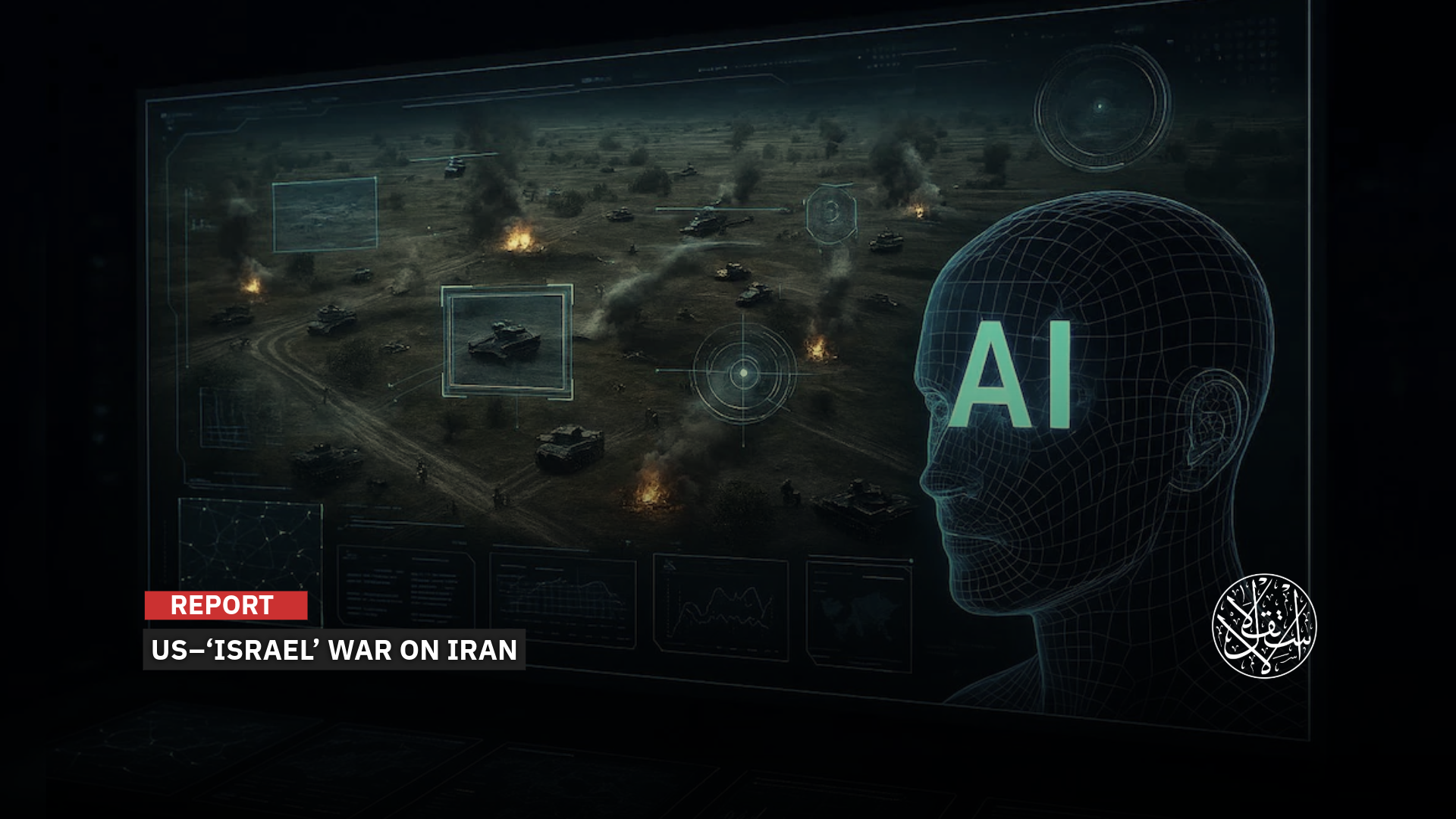
“Trump recently claimed Iran used AI to mislead the public.”
The U.S. and Israeli attacks on Iran were executed with unprecedented speed and precision thanks to months of planning, a massive buildup of military force, and a cutting-edge weapon never before used on this scale: artificial intelligence (AI).
AI tools are helping gather intelligence, pick targets, plan bombing missions and assess battle damage at speeds not previously possible.
AI helps commanders manage supplies of everything from ammunition to spare parts and lets them choose the best weapon for each objective.
The use of AI in the military campaign against Iran comes after years of work within the US Department of War, as well as lessons learned from other battlefields, such as the war in Ukraine and Israel’s genocidal war in Gaza.
Ukraine, with US support, is increasingly relying on AI in its war against Russia, while “Israel” has used this technology in its genocidal war on Gaza.
Military Technologies
On January 16, Washington and Tel Aviv signed a strategic partnership in AI under the Pax Silica initiative.
This agreement was not merely technical cooperation; it was a military marriage of convenience, combining US capabilities in big data processing with Israeli field expertise in algorithmic assassinations, creating a unified front for cross-border digital targeting.
US Secretary of War Pete Hegseth called for accelerating the adoption of AI to create an AI-first fighting force.
The US military’s own AI strategy document puts it with brutal clarity: Speed wins and the risks of not moving fast enough outweigh the risks of imperfect alignment. What this means in practice is that the Pentagon has decided that killing faster matters more than killing accurately.
A recent analytical report revealed that AI technologies are playing a pivotal role in accelerating US and Israeli military operations against Iran.
They are being widely used to analyze massive amounts of intelligence data, identify potential targets, and assist in planning complex military operations, contributing to increased speed and accuracy in strikes, according to a report in The Wall Street Journal.
The report stated that operations conducted during February and March 2026 were carried out with unprecedented speed and precision, the result of months of intensive military planning and extensive use of AI systems. This represents one of the largest applications of this technology in a military conflict to date.
The newspaper explained that AI is not typically used in firing weapons or making the final decision to attack, but rather in non-combat tasks, which constitute about 90% of military operations. These tasks include analyzing intelligence, selecting targets, coordinating strikes, and assessing damage after an attack.
The report indicated that intelligent systems are capable of sifting through massive amounts of data, including hacked cameras and intercepted communications, at speeds far exceeding human capabilities.
Officials estimate that human analysts can only review about 4% of the available data.
These systems also help suggest thousands of potential targets and coordinate complex attacks involving ship-launched drones, advanced fighter jets, and long-range strategic bombers.
According to the report, the United States has conducted more than 3,000 strikes against various targets since the start of the recent attacks against Iran.
The US Army and its partners use a range of advanced technologies, including data analysis platforms, military scenario simulation systems, and machine vision technologies that help identify targets from images and various sensory data.
Advanced language models, similar to chatbots, are also used to summarize and analyze intercepted conversations and communications in an effort to accelerate intelligence gathering and decision-making.
However, the report also pointed out the risks of over-reliance on these systems, as errors in data or analysis could lead to disastrous consequences.
Military officials emphasized that the final decision to use force remains with humans, a principle known as human decision-making, to prevent military operations from becoming entirely automated.
The report concluded that the current war represents a turning point in the use of artificial intelligence in the military, noting that this technology has become a fundamental element in intelligence and military planning.
US War Machine
The complete reliance on artificial intelligence in the 2026 attacks was not a coincidence, but rather the culmination of two decades of profound digital transformation in the military infrastructure of both the United States and “Israel”.
This path began with rudimentary attempts to improve transportation efficiency and ended with the creation of a war machine that relies on data as its primary fuel for killing.
In January 2026, the U.S. Department of War released its AI Acceleration Strategy, which mandated the transformation of the U.S. military into an algorithm-driven force, paving the way for the integration of major language models into combat systems.
By February 2026, Project Maven, built by the data mining company Palantir, had evolved into the core driver of a complex targeting system that connects satellites, drones, and ground-based operators to provide real-time targeting recommendations.
Palantir Technologies is the backbone of modern U.S. targeting operations.
Its AI platform (AIP) and its Gotham 5 product served as the battlefield brain during the attack on Iran, breaking down data silos between the CIA, NSA, and CENTCOM.
According to The Washington Post, the U.S. Army's Maven smart system generates massive amounts of classified data from satellites, surveillance, and other intelligence sources, enabling real-time targeting and prioritization of targets for military operations in Iran.
The US Army integrated Anthropic's Cloud robot with Maven to create a tool used daily by most branches of the military.
During the planning for the attack on Iran, the tool suggested hundreds of targets, precisely pinpointed their coordinates, and ranked them according to importance.
This accelerated the pace of the attack, reduced Iran's ability to retaliate, and transformed weeks-long battle planning into immediate operations.
The Times of London reported that identifying targets during the US invasion of Iraq required an intelligence unit of 2,000 soldiers, while the same task in the current war against Iran required only 20.

Israeli Arsenal
While the U.S. provided the strategic analytical umbrella, “Israel” supplied the tactical lethal machines that transformed the Iranian theater of operations into a laboratory for algorithmic mass killing.
These systems, developed by Unit 8200, represent a complete shift from AI as an assistant to AI as a target designator.
Yedioth Ahronoth reported that “Israel” used AI systems nicknamed The Gospel and Lavender, the same systems used to bomb Palestinians in the Gaza Strip.
According to an investigation by the Israeli magazine +972, The Gospel system issues automated recommendations for targeting buildings and facilities, such as nuclear sites, oil installations, and IRGC headquarters.
The Gospel system processes and verifies satellite imagery, communications data, and human intelligence gathered from thousands of sources to identify buildings and locations used by militants.
The Lavender system focuses on individuals. It is an AI-powered database that scans and processes massive amounts of surveillance data, including social relationships and location histories, to identify potential targets.
The Where’s Daddy? system is the most ruthless in Israel’s arsenal, specifically designed to track targets to their homes.
According to +972, AI systems also helped Israel analyze the cellular and digital communications networks of senior Iranian leaders, leading to the assassination of Iran’s Supreme Leader, Ali Khamenei, and dozens of other Iranian officials in the heart of Tehran.
At the same time, the Financial Times reported this week that Israel hacked into nearly all traffic cameras in Tehran, with their footage transmitted to servers in Tel Aviv.
The war on Iran also marks the first involvement of the Israeli military’s new AI division, known as Bina, which was established just a few months ago and comprises most of the military units previously operating in the field.

Iranian Disinformation
Amid escalating tensions between the U.S. and Iran, US President Donald Trump’s assertion regarding Tehran’s use of AI in disinformation campaigns is neither surprising nor unexpected.
Iran already has a long history of employing information to manipulate public opinion, both domestically and internationally.
However, what we are witnessing today does not reflect a leap in Iranian technological prowess as much as it reflects an evolution in how it employs technology. Iran did not enter the AI race by developing large-scale models, but rather by leveraging existing tools.
Over the past decade, Tehran has relied on relatively traditional methods based on digital deception, identity theft, and exploiting human trust to achieve political and security objectives.
However, the integration of artificial intelligence technologies—including the generation of text and images and the creation of convincing digital personas—has revolutionized these operations.
Tehran can now produce low-cost, widely disseminated content with a degree of realism that makes distinguishing between genuine and fake much more difficult.
The Guardian quoted cybersecurity experts as saying that Iranian external influence operations have escalated significantly as part of a campaign aimed at bolstering its military response and intensifying psychological pressure on the United States and Israel to curb their war efforts.
This involved flooding platforms like X, Instagram, and Blue Sky with posts containing AI-generated videos and images, aimed at influencing public opinion, particularly in the United States where opposition to the war is growing.
This campaign included disseminating disinformation such as videos depicting staged attacks on the USS Abraham Lincoln aircraft carrier, purported damage from bombings of buildings in Tel Aviv, and Israeli soldiers crying in fear of Iranian retaliation.

Analysts described this as an online war of narratives, aimed at justifying strikes across the Gulf or promoting Iranian military power in the face of Israeli and American attacks.
They noted that cyber efforts have become a crucial element of the Iranian regime's survival strategy.
Clips from video games repurposed as Iranian missile strikes, and AI-generated images depicting the sinking of American warships garnered millions of views across social media platforms.
Social media accounts controlled by or sympathetic to Iran also played a role in the propaganda efforts, spreading baseless claims about the killing of high-ranking American and Israeli officials, including Prime Minister Benjamin Netanyahu.