Al-Zaidi’s Government Excludes Factions at Washington’s Direction: Imposing Authority or Yielding to Pressure?
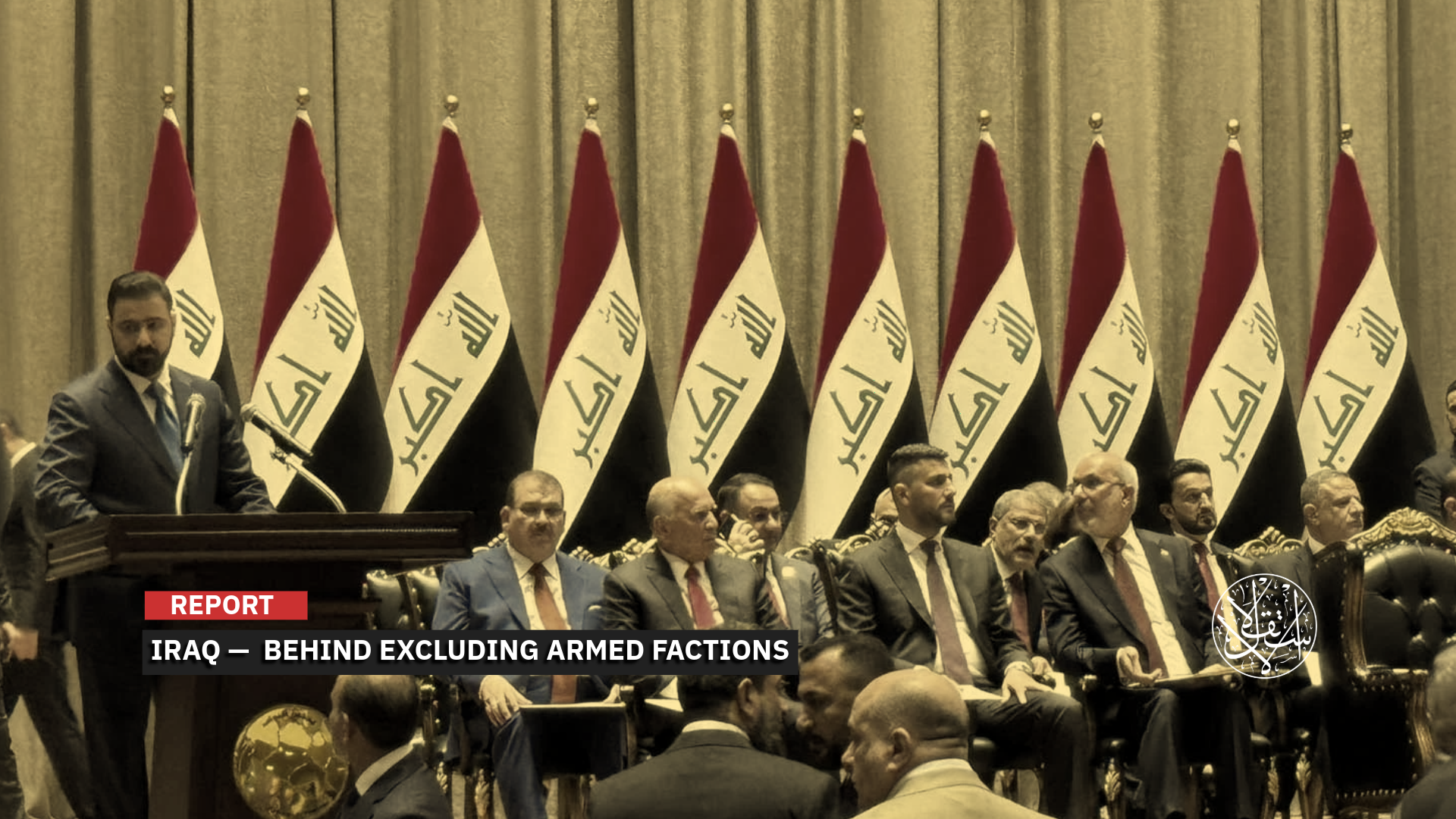
Washington imposed a five-year ban on the factions.
The makeup of Iraqi Prime Minister Ali al-Zaidi’s new government revealed the absence of any figure directly affiliated with armed factions, raising a central question over how far Washington succeeded in pushing those groups out of power as part of its conditions for maintaining ties with Baghdad and continuing political support.
On May 14, 2026, Iraq’s parliament approved 14 ministers in al-Zaidi’s cabinet, giving the government formal legitimacy after more than half of the 22 ministry posts secured parliamentary backing. Voting on the remaining eight ministries was postponed until after the Eid al-Adha holiday in June.
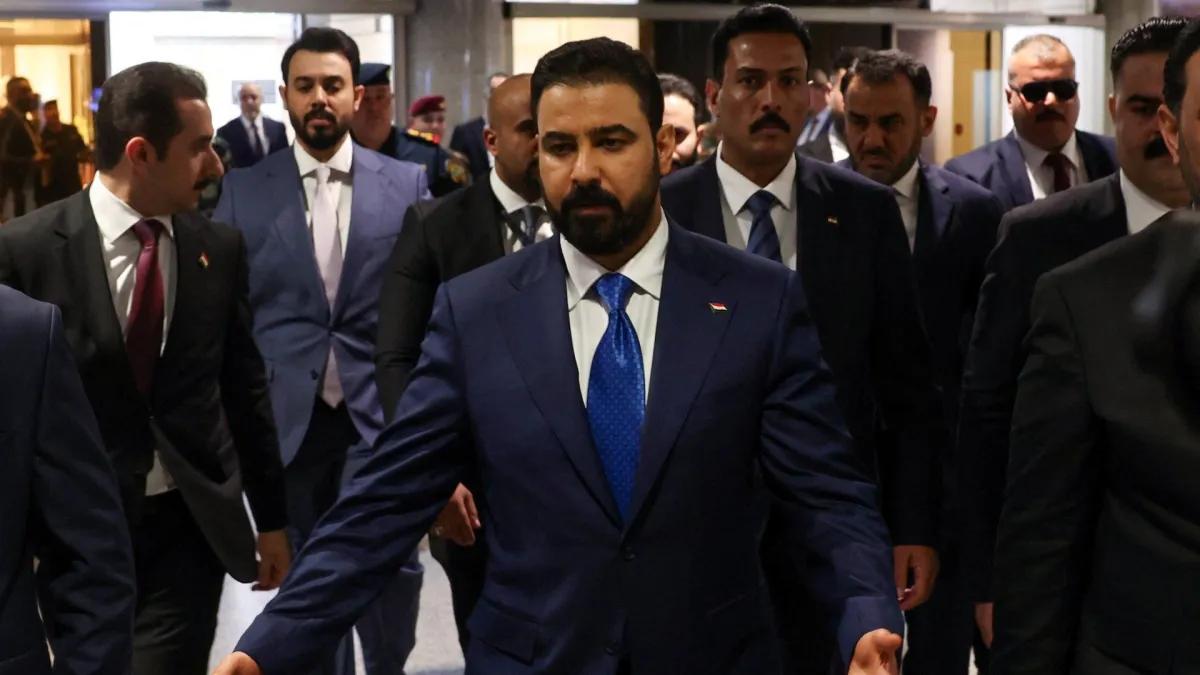
Shiite Coordination Framework (CF) forces backed businessman Ali al-Zaidi, who came from outside Iraq’s established political class, as a compromise candidate after months of political deadlock. The breakthrough came as both Nouri al-Maliki and Mohammed Shia’ al-Sudani refused to withdraw their bids for the premiership.
U.S. Conditions
Iraqi political analyst Aed al-Hilali shed light on the circumstances surrounding the formation of the new government, saying that “the United States has given Ali al-Zaidi one year to prove the performance of his cabinet, with the first six months considered decisive for its future.”
Speaking during a television interview on May 13, al-Hilali said that if al-Zaidi’s government fails to meet at least 50 percent of Washington’s conditions, the United States could push for early elections to be held after another six months.
Al-Hilali also revealed that Washington had presented al-Zaidi with a set of conditions accompanied by a regular evaluation mechanism, with reviews scheduled every two months to assess compliance and implementation.
The former spokesperson for the Shiite CF added that the United States demanded the exclusion of armed factions from the government and from any elections expected to take place within a year.
According to al-Hilali, those groups would effectively be kept out of the political process for five years as part of efforts to ensure they hand over their weapons.
On this specific point, political adviser to the former prime minister Fadi al-Shammari said in a television interview on May 11 that Washington had stipulated that no minister affiliated with armed factions would be allowed to participate in al-Zaidi’s government in exchange for cooperation with it.
Al-Shammari explained that the United States had identified six factions that would be barred from joining the next government, adding that the condition also included handing over weapons in exchange for political participation, a process he described as difficult due to time constraints and uncertainty over which body would oversee disarmament.
On May 14, the U.S.-based Alhurra website quoted a U.S. State Department spokesperson, speaking anonymously, as saying that “Iraq has a choice to make” regarding the participation of armed factions in the next government.
The spokesperson stressed that “Iran-backed terrorist militias should have no role in state institutions, and Iraqi government funds should not be used in any way to support these terrorist militias.”
He added that the United States will “calibrate [its] approach to the new government on that basis.”
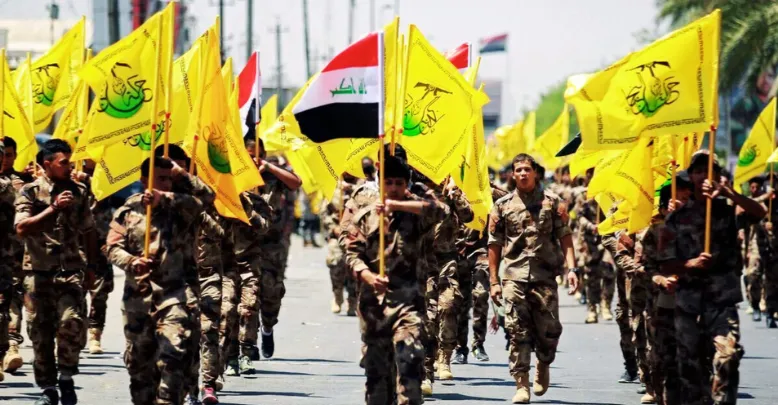
Washington has effectively imposed a veto on the participation of six armed factions in the Iraqi government, believed to form part of what is known as “the Islamic Resistance in Iraq,” including Kata’ib Hezbollah, Kata’ib Imam Ali, Kata’ib Sayyid al-Shuhada, Harakat al-Nujaba, Asa’ib Ahl al-Haq, and Ansar Allah al-Awfiya.
Factional Divisions
Under the U.S.-imposed ban, several armed factions announced they would not take part in Ali al-Zaidi’s government. Some said they could reconsider participation only after the issue of exclusive state control over weapons is resolved, while others rejected the premise entirely, arguing that the new prime minister has no authority over what they describe as “resistance weapons.”
Naeem al-Aboudi, political assistant to Asa’ib Ahl al Haq Secretary General Qais al-Khazali, said the group would not be represented in the cabinet lineup and would keep its “share” reserved, postponing any participation until the new government’s vision on weapons control becomes clearer with backing from the Shiite CF.
In a television interview on May 13, al-Aboudi stressed the group’s willingness to end the duality between resistance and the state and to support regional opening toward the Gulf through a broader security framework linking Iraq, Iran, and Gulf countries.
“Our decision not to participate at this stage applies only to the first part of the cabinet formation. When the government’s vision becomes clear and a national project on monopolizing arms under the state is developed, we will then discuss the matter,” he said.
He added that the group would be open to any decisions provided they are issued by the government, endorsed by the CF, and aligned with religious authorities. At that point, he said, the group would be ready to take steps toward separating from armed structures within the Popular Mobilization Forces (PMF) and support a state monopoly on weapons.
On May 13, Asa’ib Ahl al-Haq political bureau member Hussein al-Shihani confirmed the existence of a U.S. veto on the group’s participation in al-Zaidi’s government, noting that American pressure is a tangible and undeniable reality.
Separately, the parliamentary bloc of Kata’ib Hezbollah, known as Huqooq, announced it would not join the government, while other factions holding seats in parliament, including Kata’ib Imam Ali, Kata’ib Sayyid al-Shuhada, and Ansar Allah al-Awfiya, did not secure any ministerial posts.
Nazem al-Saadi, head of the executive council of Harakat al-Nujaba, led by Akram al-Kaabi, said that the “arms monopoly” clause in the new government’s program does not apply to what he called resistance weapons but only to arms that cause chaos.
Speaking to supporters in Babil province on May 15, al-Saadi said unregulated weapons refer only to those outside state control that contribute to disorder, stressing that this does not include the weapons of those who defended Iraq, its holy sites, and its people during the most difficult periods.
He added that Harakat al-Nujaba has, since its founding, chosen not to participate in political or parliamentary representation, limiting itself instead to monitoring the political process in a way that serves citizens’ interests.
Prime Minister Ali al-Zaidi, after securing parliamentary approval for his cabinet on May 14, pledged to work toward monopolizing weapons under state authority, at a time when Washington continues to press Baghdad to rein in Iran-aligned armed factions.
‘Yielding to Pressure’
On whether the absence of armed factions from al-Zaidi’s government signals a genuine retreat of Iranian influence in Iraq, Iraqi political researcher Ali al-Masari said that “a Shiite will to pass the government was behind the move, and it may even have been encouraged by Iran itself.”
Speaking to Al-Estiklal, al-Masari said the exclusion of factions from the cabinet represents “yielding to the American pressure” more than a real decline in Iranian influence in Iraq, adding that only time will reveal whether these militias are truly moving away from arms and into politics or whether this is only a temporary step.
He argued that Shiite forces in Iraq no longer depend on Iran to the extent they did after 2003, saying they now possess financial power and political influence and have largely consolidated control over the state.
“These actors have also learned from Iran the tactic of temporary tactical retreat, followed by the gradual advancement of their own agenda, with some factions using this approach to sideline rivals and dominate the political landscape.”
“Al-Zaidi’s government will remain weak and lacking real authority, as Shiite blocs effectively manage all decisions, with the prime minister acting more as an administrator executing instructions,” the Iraqi researcher added.
He compared the situation to the tenure of former prime minister Adel Abdul Mahdi, who resigned amid mass protests in 2019.
A report published on May 5 by the American Security Project (ASP) said that the Trump administration’s support for al-Zaidi was aimed at pushing him to end Iranian influence in Iraq.
The report argued that the U.S. strategy of disarming factions through diplomacy, political pressure, and sanctions is more effective than military action, which it warned could strengthen those groups through their backing within ruling coalition parties.
Despite hopes surrounding the new government, the report said al-Zaidi’s cabinet is unlikely to take a confrontational stance toward the factions in line with Washington’s preferences, noting that the PMF is part of the governing coalition and its political wings control 59 of 162 parliamentary seats.
The report recommended that Washington stick to diplomacy and avoid rushing into military strikes, saying they were more effective in 2025 and led to progress, including an arms-seizure plan.
It also called for the appointment of a permanent U.S. ambassador to Iraq following the current vacancy and the withdrawal of the special envoy in January 2025, as well as the continuation of firm diplomacy, including the threat of sanctions.
Sources
- Iraq’s Al-Nujaba: Resistance weapons not covered by state controls
- Asa'ib Postpones Joining al-Zaidi’s Government Pending Weapons Settlement [Arabic]
- Exclusive: Partial Government in Baghdad as al-Zaidi Faces Specific US Demand [Arabic]
- Asa'ib Nominates Laith al-Khazali as Deputy Prime Minister [Arabic]
- Awaiting Resolution of Weapons Issue, As'aib Delays Participation in al-Zaidi’s Government [Arabic]