Inside New Lines Institute: How Ahmed Alwani Built a Network Linking Arab Researchers and an Israeli Conscript
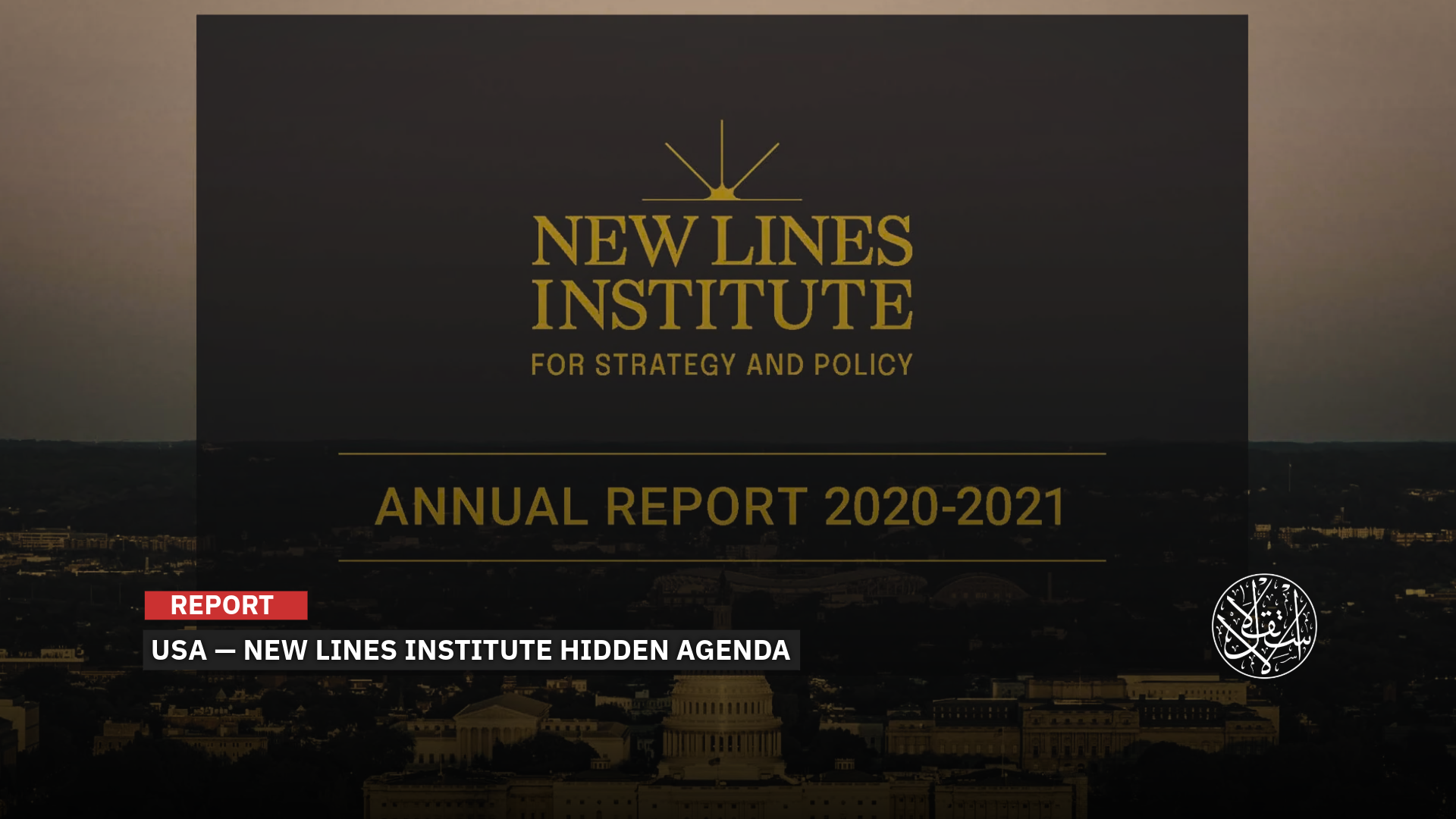
New Lines Institute founder Ahmed Alwani previously served on the advisory council for the U.S. Africa Command (AFRICOM).
On March 4, 2026, the U.S.-based New Lines Institute promoted a virtual briefing on its X account examining regional recalibration across the Gulf (GCC) and the wider region and the strategic implications for Washington.
The event brought together four speakers, including Israeli researcher and conscript Elizabeth Tsurkov, alongside Faysal Itani, Sultan Alamer, and Caroline Rose, and was moderated by Murad Batal Shishani.
That seminar did not feel like a routine item on a Washington think tank’s schedule. It came across more as a condensed portrait of the institute itself: an American platform that claims to be nonpartisan, yet brings together Arab researchers alongside an Arab figure closely linked to U.S. national security circles.
It also featured an Israeli researcher who had said in November 2025 that she had completed mandatory service roughly two decades earlier in the Israeli Military Intelligence Directorate affiliated with the Israeli army.
This is where the story begins: what exactly is the New Lines Institute, who funds it, how was its network built, and why do so many overlapping worlds of research, media, funding, and politics come together around it?
The New Lines Institute!
On its official website, the New Lines Institute presents itself as an organization operating at the intersection of U.S. foreign policy and global geopolitics.
Yet its official documents point to a more layered picture than that of a conventional think tank.
According to the institute’s academic filing for the 2025-2026 master’s program, it is structured as a single-member limited liability company, wholly owned by the Washington Institute for Education and Research, and treated as a disregarded entity for federal tax purposes.
In practice, this means that while it maintains a separate legal identity, its income and tax status effectively pass through to its parent organization.
The same document notes that the institute was established in 2019 as a non-partisan research center in Washington. In August 2023, it began operating as a degree-granting educational institution before renewing its license and relocating to a new site in August 2024.
This legal structure is not a minor technical detail. It is central to understanding how the institute operates. It suggests a research platform anchored within a funded parent umbrella, moving between research and education under a framework that makes tracing financial flows more complex than it would be if it were an independent taxable entity.
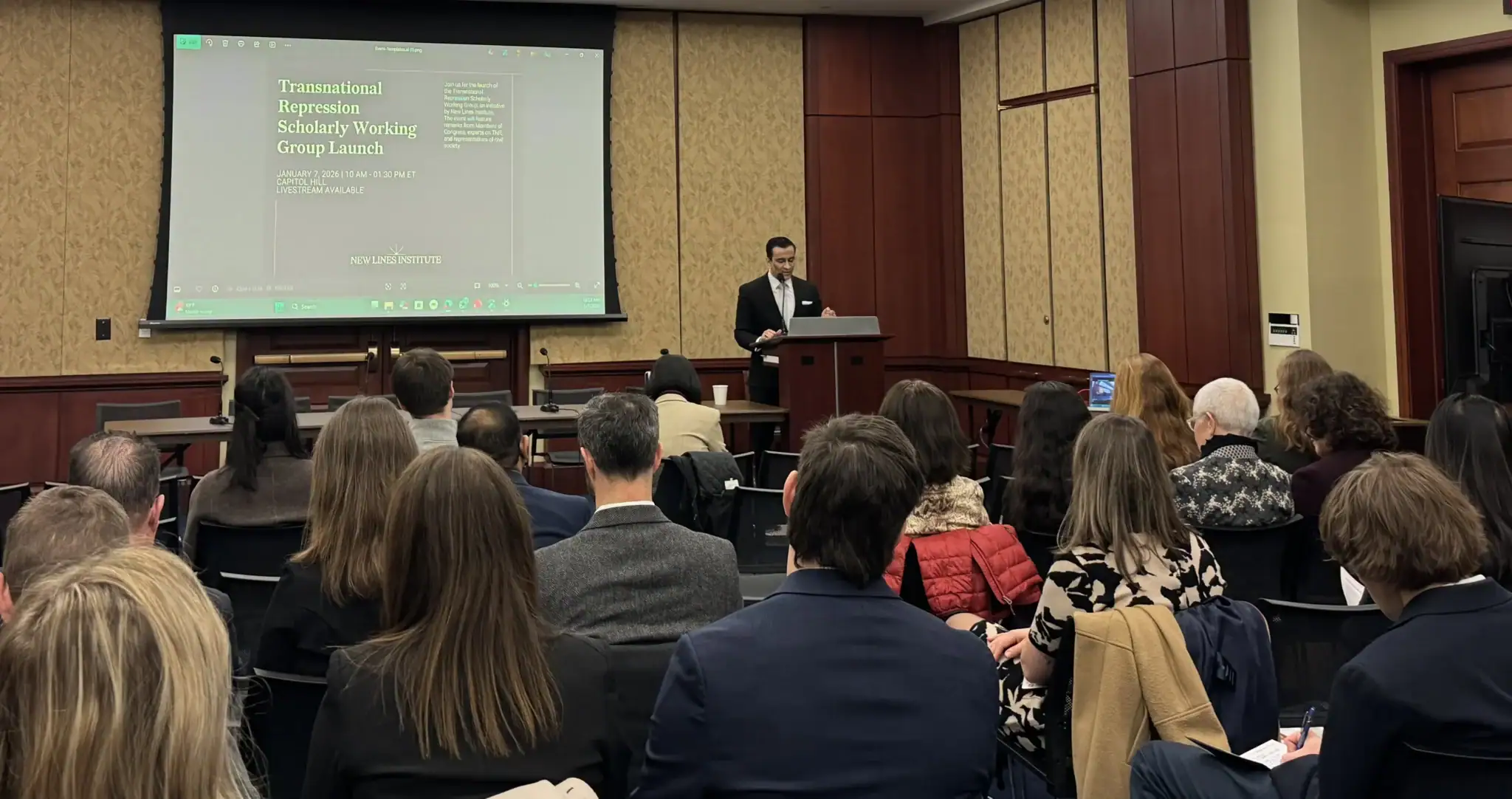
Opaque Funding
When it comes to funding, the picture grows even less clear. The New Lines Institute’s 2022-2023 annual report states plainly that its financing comes from a single source, the Washington Institute for Education and Research, registered as an organization in the District of Columbia.
Yet a closer look at ProPublica filings for that parent body reveals substantial revenues without a matching level of transparency over donor identities.
According to those records, revenues approached $38.5 million in the fiscal year ending December 2024, following roughly $62.5 million in 2023, with donations making up the overwhelming share of income.
Even so, publicly available institutional materials reviewed do not include detailed lists of major donors, nor do they clarify how funding is allocated across projects, portfolios, or affiliated platforms.
The result is a familiar imbalance: an institute operating with multi-million-dollar resources, while the public, based on official disclosures, has limited visibility into the sources sustaining that ecosystem.
The picture becomes more complex when looking further back. The 2020-2021 annual report indicates that funding at the time came not from the Washington Institute for Education and Research but from the Fairfax Educational Foundation.
ProPublica records for that foundation list Ahmed Taha Jaber Alwani as vice president and a member of its board of directors.
This suggests that funding has not flowed through a single, stable channel but rather moved across multiple institutional vehicles within a network where the same names recur.
None of this, in itself, demonstrates wrongdoing or hidden financial flows. It does, however, point to something more telling: the lines separating the institute, its funders, and its previous supporting entities are not sharply drawn but instead operate within a narrow and opaque circle of overlapping organizations and familiar figures.
A Network of Researchers
By its own account, the New Lines Institute traces its origins to 2019, when Ahmed Alwani took over the Center for Global Policy at a moment when it was nearing closure. From that transition, the idea of New Lines emerged.
That acknowledgment matters. It challenges any notion of a clean break or a start from scratch, pointing instead to an institutional handover rather than a wholly independent founding.
Within a year, Alwani, working with Syrian researcher Hassan Hassan, launched New Lines Magazine as a global media arm aimed at telling stories through a local lens.
Hassan had previously worked as a journalist at the Emirati magazine The National, where he specialized in tracking armed groups in Syria and Iraq.
What takes shape here is not simply a traditional think tank but a multi-layered operation spanning research, education, an English-language magazine, and later an Arabic platform, Alpheratz, operating alongside or intersecting with it.
Within this structure, the researcher network and human architecture are not incidental. They are central to how the institute functions.
The official team page reflects a wide spectrum of roles, including core staff, resident senior fellows, non-resident fellows, senior advisers, student fellows, and guest contributors.
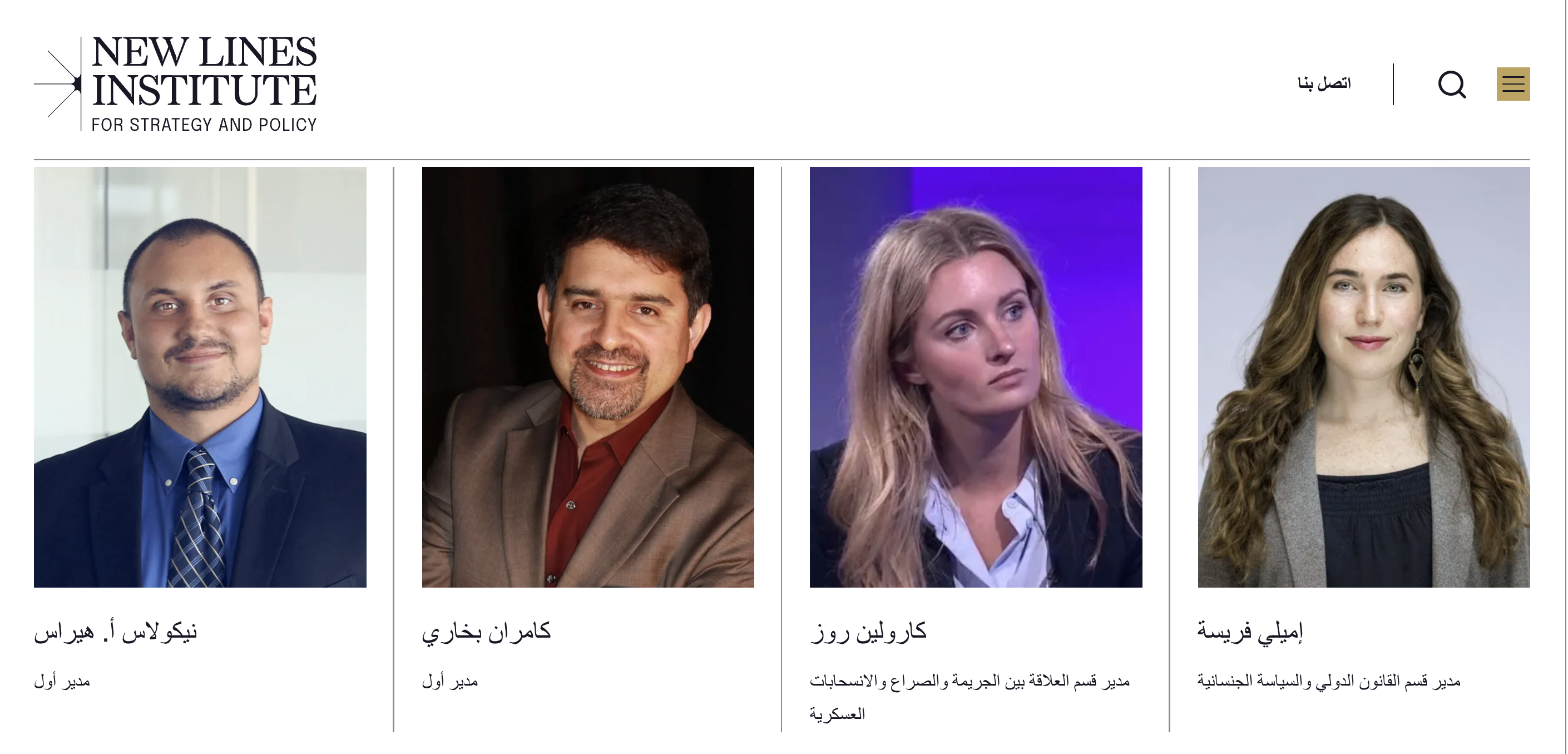
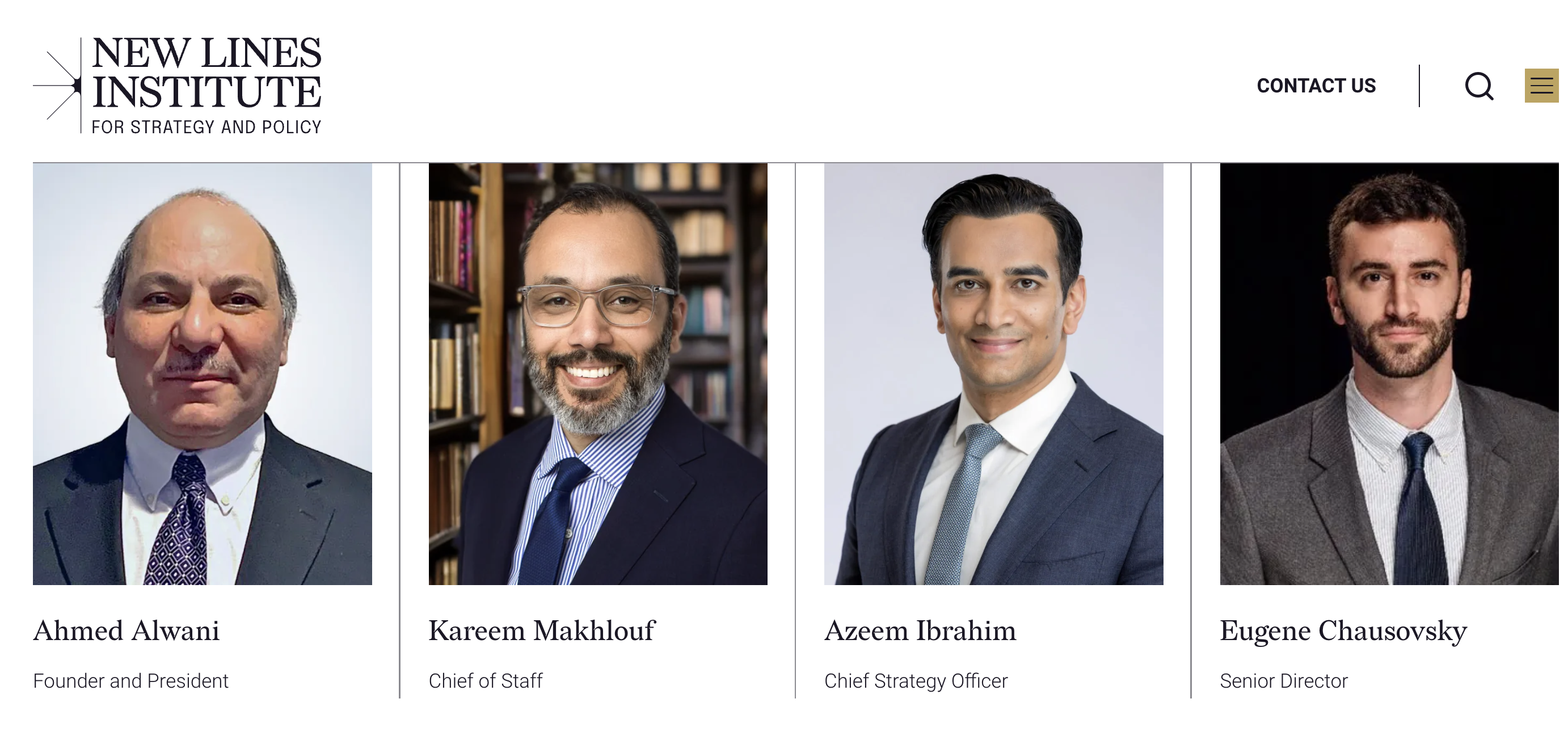
In the 2022-2023 report, the leadership tier includes names such as Ahmed Alwani, Kamran Bokhari, Eugene Chausovsky, Nicholas Heras, Azeem Ibrahim, a non-resident fellow at the U.S. Army War College, Faysal Itani, Kareem Makhlouf, Emily Przybyla, and Caroline Rose.
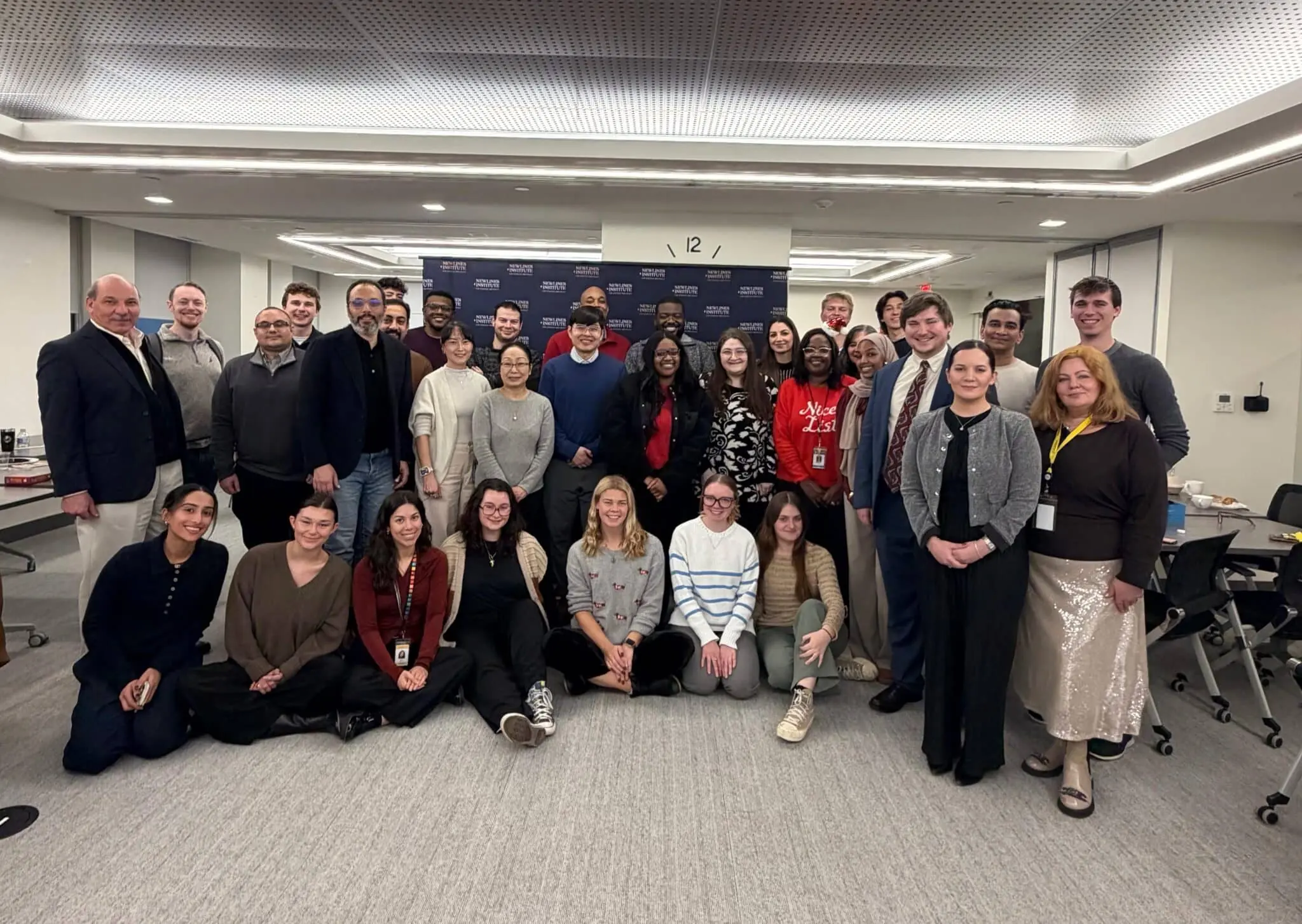
Alongside another layer of non-resident fellows and advisers, this structure suggests that New Lines does not operate as a narrow academic unit but as a composite network. It brings together multiple nationalities, a range of intellectual and political perspectives, and experience that spans administration, national security, regional expertise, and media work.
Arab and Western Presence
At this level in particular, a significant Arab presence comes into view, even if the institute’s official pages do not systematically list nationalities in a way that allows for a precise tally.
Still, several figures can be identified. Faysal Itani, for instance, is described by New Lines Magazine as having grown up in Beirut and now based in Washington. Kareem Makhlouf is presented on the institute’s website as chief of staff, with expertise in nonprofit management and education across the Middle East and North Africa.
Sultan Alamer, a Saudi national and resident fellow in the Middle East Center, also stands out. He is listed as a member of the editorial board of Alpheratz, with contributions to outlets such as al-Hayat, al-Araby al-Jadeed, Okaz, and al-Bilad, and a research focus on the Gulf region.
Other names include Karam Shaar, a Syrian non-resident fellow focused on Syria and Lebanon, as well as Murad Batal Shishani, Bassam Barabandi, also Syrian, and others connected to Syria, Lebanon, and the Gulf.
In practical terms, this suggests that the Arab-facing dimension of the New Lines Institute is not marginal. It forms part of its intellectual and editorial backbone, lending the institute a degree of credibility when it claims insight into the region from within, even as questions around funding and political orientation remain open.
Yet the weight of this Arab presence does not obscure another reality: the structure is closely intertwined with U.S. national security expertise and Washington’s policy ecosystem.
Nicholas Heras, for example, combines his role at New Lines with a leadership position at the Middle East Policy Council, following earlier work with the Institute for the Study of War, the Center for a New American Security, and the Jamestown Foundation.
Azeem Ibrahim similarly bridges his role at New Lines with involvement at the U.S. Army War College through its Strategic Studies Institute.
Kamran Bokhari, for his part, previously coordinated Central Asia studies at the State Department’s Foreign Service Institute.
Taken together, this blend suggests that the institute does not rely solely on regional voices but operates within a wider orbit shaped by Washington’s policy and national security circles.
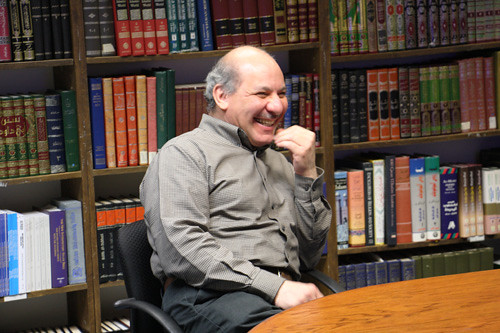
Ahmed Alwani
At the center of this network stands Ahmed Taha Jaber Alwani, an American of Iraqi origin. He is the son of Taha Jaber Alwani, who served as the head of the Assembly of Muslim Jurists of America and became known for a ruling calling on Muslim American soldiers to take part in the invasion of Afghanistan.
The New Lines Institute’s official website describes Ahmed Alwani as its founder and president, as well as a businessman based in Northern Virginia, with investments spanning real estate, poultry, education, and training.
It also notes that he serves as vice president of both the York Foundation and Reston Investments, president of Heritage Education, a board member of the Washington Theological Consortium, and a board member of the Fairfax Educational Foundation.
His profile on New Lines Magazine adds a more sensitive dimension. It states that he served on the advisory council for the U.S. Africa Command (AFRICOM) and has met repeatedly with political and military leaders to provide policy advice.
That detail is significant. It places him, according to his own published biography, in direct proximity to senior U.S. security structures, not solely within the worlds of education and business.
Alwani’s network extends beyond the New Lines Institute. The Middle East Policy Council lists him as both president and board member, alongside Azeem Ibrahim as vice president, Nicholas Heras as acting executive director, and Mustafa Mustafa as treasurer.
Notably, Mustafa Mustafa describes himself as chief financial officer of the Washington Institute for Education and Research, adding that he led financial restructuring and team development for New Lines and its affiliated entities over the previous year and a half.
That single line raises a pressing question: what exactly are these affiliated entities, and where do their institutional and financial boundaries begin and end?
Alpheratz Magazine
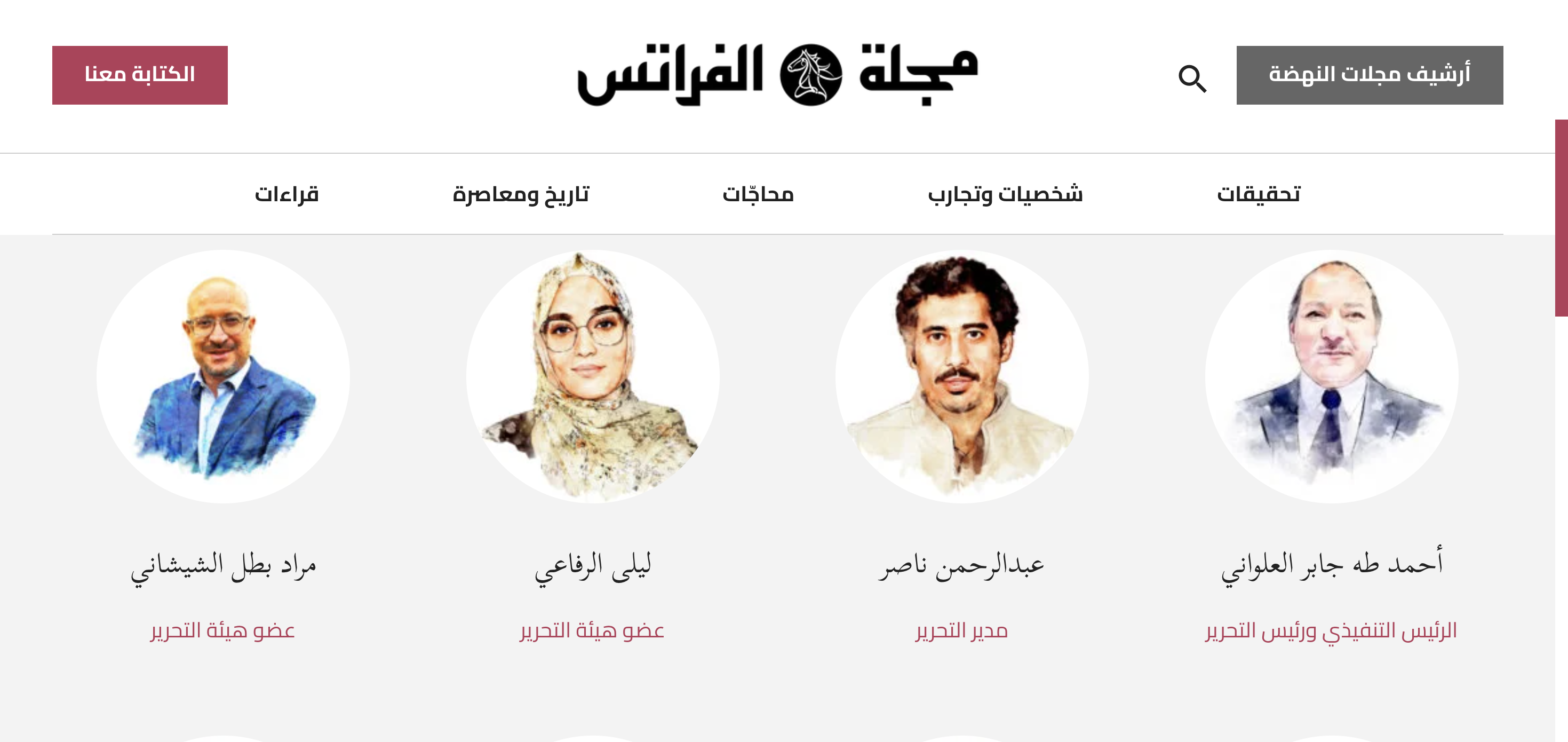
That question leads directly to Alpheratz. On its website, Ahmed Taha Jaber Alwani is described as chief executive and editor-in-chief, with a clear statement that he is also the founder and president of the New Lines Institute and that the institute publishes both Alpheratz and New Lines Magazine.
The Alpheratz team page presents a broad Arabic editorial and staff lineup, featuring names such as Abdulrahman Nasser, Leila Alrefaai, Murad Batal Shishani, Sultan Alamer, Rana Mamdouh, Emad Moussa, Azza Maghazi, Roua Saba, Mohammed Alnaas, Sabrine Bayou, Ibrahim Houdaybi, Abdullah Mishaan al-Enezi, and others.
The complication emerges when this is set against the New Lines Institute’s official website. Under its current list of initiatives, it highlights New Lines, the Middle East Policy Council, its fellowship program, the “New Voices” blog, and the Western Balkans Observatory, without including Alpheratz among them.
This discrepancy does not negate the connection, but it does point to a notable inconsistency. While Alpheratz explicitly defines itself as a publication issued by New Lines, the institute’s own website does not afford it the same level of formal institutional visibility.
As a result, Alpheratz appears to occupy an in-between position. It is neither fully separate nor fully acknowledged as a core initiative. Rather, it functions as an Arabic platform led by the head of New Lines and directly linked to it in its own self-description, while its place within the institute’s publicly declared structure remains less clearly defined than that of other initiatives.
The Israeli Conscript
In this context, Elizabeth Tsurkov becomes more than just another name listed among the institute’s non-resident fellows.
The New Lines Institute describes her as a non-resident fellow and a researcher at the Forum for Regional Thinking, an Israeli-Palestinian think tank based in occupied Jerusalem, as well as a doctoral student in politics at Princeton University.
On September 12, 2025, the institute published a statement noting that she had been affiliated as a non-resident fellow since 2021 and that she was abducted in Iraq in March 2023. Her profile on the institute’s website lists publications dated June 4, 2021, September 21, 2022, and December 7, 2022, in addition to her participation in a May 19, 2021 event titled “After Gaza and Jerusalem: What’s Next for Israel and Palestine?”
Taken together, this suggests that her relationship with the institute is not incidental or symbolic but part of an ongoing institutional connection spanning several years, embedded within its broader research network.
As for her connection to Israeli Prime Minister Benjamin Netanyahu, accused of war crimes in Gaza, available information points to a level of official attention following her release.
A statement issued by the Israeli Occupation government on September 11, 2025, said that Netanyahu spoke with Tsurkov by phone after her release from Iraq and also contacted her brother, David.
This call is not easily dismissed as routine protocol. It suggests that her case was handled at the highest political level, reflecting its sensitivity within Israeli decision-making circles, particularly in light of her background and regional expertise.
In that light, her position takes on added significance. It places Elizabeth Tsurkov at a clear intersection between her research role within the New Lines Institute and direct attention from the Israeli political leadership, reinforcing the implications of her presence both inside the institute’s network and beyond it.
The Normalization File
Elizabeth Tsurkov is not the only Israeli-linked figure to have appeared within the orbit of the New Lines Institute. On May 19, 2021, the institute hosted an event featuring Yossi Klein Halevi, who holds American and Israeli citizenship, and was introduced as a senior fellow at the Shalom Hartman Institute in occupied Jerusalem, alongside Tsurkov, Nicholas Heras, and Caroline Rose.
Within New Lines Magazine itself, an article published on July 7, 2021, by Jonathan Shamir, an editor at the Israeli newspaper Haaretz, asked, “Is Israel’s ‘Government of Change’ More of the Same?”
Taken together, this suggests that Israeli presence within the institute is neither absent nor incidental. At a minimum, it includes a former Israeli military intelligence conscript embedded in its research network, Israeli or “Israel”-affiliated speakers in its events, and contributions from Israeli media within its publishing arm.
It is here that the issue of normalization comes into sharper focus. Within New Lines’ research output, it does not appear as a marginal topic but as a recurring thread since at least 2020.
On April 21, 2021, Hisham Melhem published an article examining the Abraham Accords as part of a broader regional realignment in security and technology.
A year later, on April 27, 2022, Walid Salem, an Egyptian journalist and PhD student in political science, published a report titled “To the ‘Peoples of the Red Sea’: a Warning and a Hope,” with the subtitle “An Israeli marine biologist has an alternative vision for the Abraham Accords.”
On November 23, 2022, the institute published a piece titled “Rise of Israel’s Anti-Arab Party Jeopardizes Regional Normalization,” in which it noted that the Abraham Accords had not gained deep popularity within the Arab societies that had signed them.
These examples indicate that normalization is not treated as an occasional topic but as a structural axis in the institute’s analytical framing.
This trajectory deepened in the following years. On February 13, 2023, the institute published a piece on Israeli-Jordanian climate diplomacy, noting that the UAE’s role in resource exchange had become possible thanks to the Abraham Accords and bilateral normalization between Emiratis and Israelis.
On October 20, 2023, New Lines Magazine published a collective report titled “As the Middle East Reels, a New Option Takes Shape: Expulsion,” which presented Saudi-Israeli normalization as part of the regional landscape being reshaped by the war on Gaza.
On March 25, 2025, normalization reappeared through the lens of economics and major corridors. In a piece titled “India’s Tightrope Walk: Navigating U.S.-Israel-Iran Tensions,” the institute presented the India-Middle East-Europe Economic Corridor as an extension of the geopolitical framework linked to the Abraham Accords, noting that the route reaches the port of occupied Haifa.
Then, on November 18, 2025, the institute published a piece titled “Crown Prince Mohammed’s Visit and U.S.-Saudi-Israeli Engagement,” describing the Abraham Accords as the most significant issue in the U.S.-Saudi relations and noting that Benjamin Netanyahu and Mohammed bin Salman had, prior to the October 7 events, confirmed that normalization talks had reached an advanced stage.
When these pieces are placed along a single timeline, a clear picture emerges: the New Lines Institute has not merely followed normalization as a news topic but has approached it as a comprehensive regional project intersecting with security, trade corridors, climate issues, and the reshaping of alliances in the region.
Hidden Influence
The New Lines Institute appears less like a conventional research body and more like a multi-layered system, where knowledge intersects with funding, and media overlaps with spheres of political influence.
It operates within a legal framework that classifies it as a tax-disregarded entity under a single parent organization, while funding data points to millions of dollars in flows without parallel disclosure of donor identities. At the same time, its funding history suggests movement across a network of institutions tied together by recurring names.
On the human level, the institute is not limited to a purely academic staff. It rests on a composite network that brings together Arab researchers and Western experts, including figures with backgrounds linked to U.S. national security. This structure allows it to produce regional narratives with a local-facing voice while drawing on analytical tools shaped within Washington’s policy environment, at a time when the Middle East remains defined by ongoing conflicts and wars launched by the Israeli Occupation and the United States.
At the center of this network stands Ahmed Alwani, acting as a pivot point that connects the institute to a wider web of educational, media, and funding entities, alongside his proximity to U.S. security circles. His role reinforces his central influence over the direction of the system.
Tracing the institute’s institutional extensions also reveals less transparent areas, such as its relationship with Alpheratz, which defines itself as an output of New Lines without appearing with the same clarity within the institute’s formal structure.
At the same time, the presence of the Israeli researcher Elizabeth Tsurkov, with a background tied to military intelligence, stands out within the institute’s network over several years, coupled with official Israeli attention that reached the highest levels of decision-making. This is alongside the inclusion of Israeli figures and writers across its events and platforms.
At the level of research and analysis, normalization with “Israel” does not emerge as a passing theme. It appears instead as a recurring analytical track within the institute’s output, intersecting with regional security, economic corridors, and the reshaping of alliances.
Taken together, these elements point to an organization engaged not only in academic inquiry but also in broader strategic debates that extend into the realm of shaping regional perspectives and influence.