Trump’s Deranged Behavior: How the War on Iran Sparked Internal American Divisions
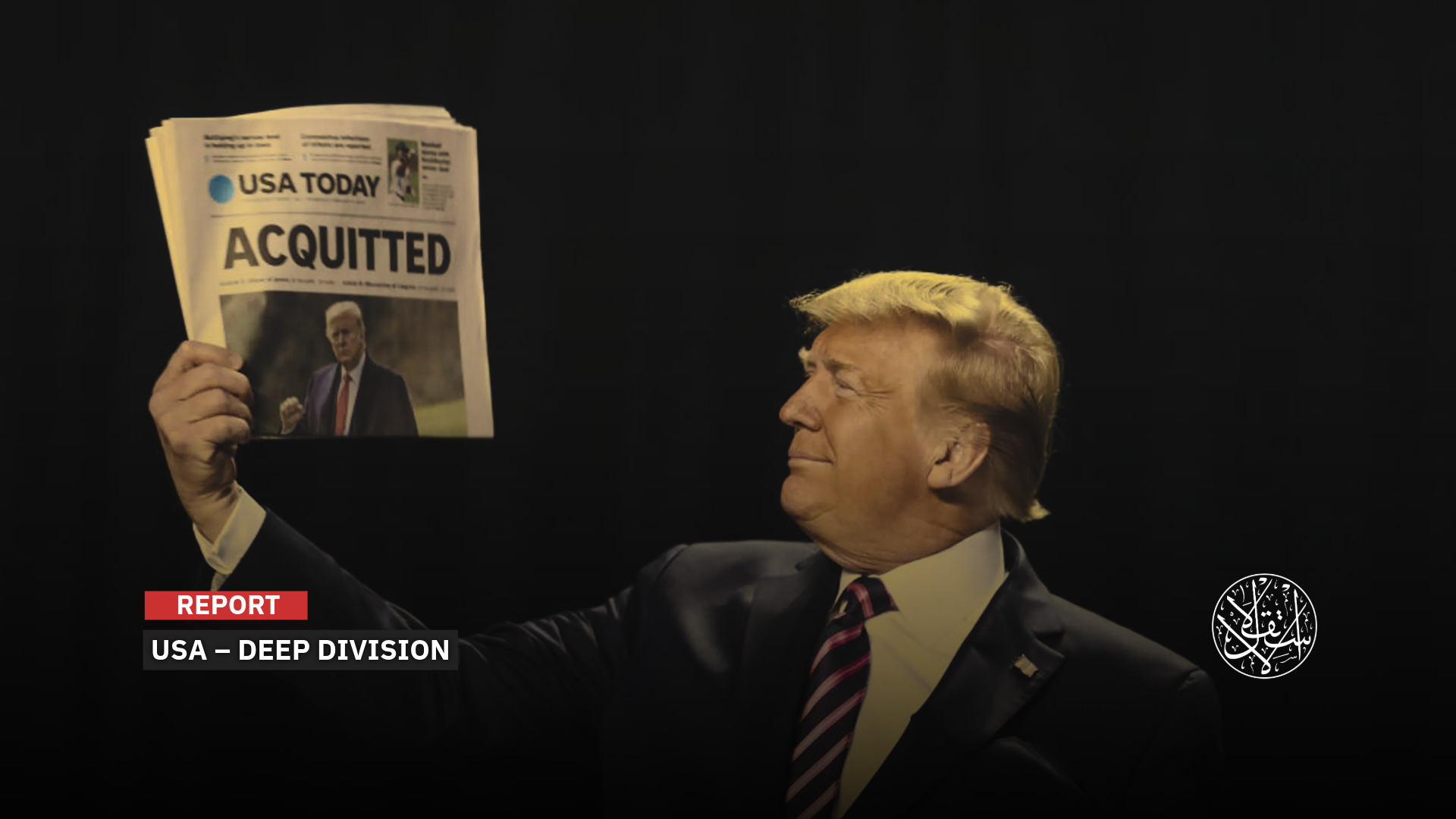
“Some Republicans and other critics have suggested Trump is turning his back on his America First agenda.”
As the US-Israeli war on Iran entered its sixth week, not only did the battlefield expand, but so did the gap within the American political class.
Democrats argued that President Donald Trump had dragged the country into a war without a timetable, while Republicans continued to defend him, though some hinted at constitutional and time limits that could not be exceeded without consequences.
With rising prices and a sharp decline in American support for the war, Democrats rallied and unified their message, focusing on the impact of this war of choice—as they described it—on the lives and cost of living of Americans.
This strategy differs from previous ones, when the party focused its criticisms on Trump himself without addressing the issues that concern the American voter, who is primarily concerned with their livelihood.
Nevertheless, the debate has recently moved beyond the question of the war, its objectives, and its repercussions, to encompass the president's own competence, the limits of his power, and the meaning of leadership in a moment of crisis.
Reports published by The New York Times and Newsweek revealed that a war on Iran would not only ignite a confrontation with the outside world, but also a domestic American clash over decision-making, legitimacy, and the Constitution.
A recent CNN poll showed that 59% of Americans oppose strikes on Iran, with many fearing a long-term war, while others see them as necessary to counter Iran's nuclear ambitions and regional aggression.
Political Division
The New York Times recently revealed that the partisan divide over a war on Iran is no longer merely a difference of opinion, but has become an open confrontation over the very definition and meaning of war.
Democrats portray the war as one in which the administration rushed without clear objectives, an exit strategy, or a vision for containing its economic costs, at a time when polls indicate growing public opposition to it.
Conversely, the newspaper reported that most Republicans continue to adhere to the narrative of necessity and deterrence, arguing that Iran poses a threat that leaves the president no room for hesitation.
But the New York Times also points out that this Republican unity is not as absolute as it seems, especially in swing districts.
The newspaper highlighted the remarks of Republican Rep. Mike Lawler, who described the war as a spectacular operation, but acknowledged that its continuation beyond a certain point would necessitate congressional intervention.
Through this example, the newspaper indicated that concern is beginning to creep into even some Republican support bases.
It also noted that Trump's recent post, which included direct threats to Iran and harsh language, has also triggered bipartisan reactions.
Democrats saw it as further evidence of impulsiveness and erratic behavior, while some Republicans also criticized the language of a president who is supposed to exercise restraint in times of war.
In a related context, new American public opinion polls have revealed a clear picture of a deep political and social divide within the U.S.
Americans want to prevent Iran from acquiring a nuclear weapon, but they refuse to engage in a protracted war that would raise gasoline prices and endanger their troops.
The results show that President Trump still enjoys steady support within his MAGA base, but a majority believe that military escalation against Iran is excessive and are calling for the involvement of allies or a return to diplomacy.

Deranged Behavior
Newsweek observed how Trump's rhetoric and public behavior have fueled renewed calls to invoke the 25th Amendment to the U.S. Constitution, which allows for the removal of the president from office.
Dozens of lawmakers in the U.S. House of Representatives and Senate sharply criticized the president following his post on Truth Social, in which he claimed that Iran's entire civilization would be destroyed that night if no agreement was reached, emphasizing the need to stop the war and the madness.
At least ten lawmakers have called on members of the Trump administration to invoke the 25th Amendment to the Constitution, a clear indication of growing concern within Congress over a rapidly escalating conflict that is reshaping US priorities both domestically and internationally.
Former Vice President and potential 2028 Democratic Presidential candidate Kamala Harris has been vocal, stating she is opposed to a regime-change war in Iran and accusing Trump of dragging the US into a conflict Americans don't want.
Other potential 2028 contenders like Gavin Newsom and Josh Shapiro joined her in unified criticism, labeling it reckless and unconstitutional.
House Minority Leader Hakeem Jeffers warned that Trump is leading the U.S. into World War III.
“Enough is enough. It is time for every Republican to put their national duty above party loyalty and work to stop this madness,” he said.
For his part, Senate Minority Leader Chuck Schumer described Trump as very sick, saying that every Republican who refuses to join Democrats in voting against this war of choice bears full responsibility for all the consequences.
Meanwhile, Democratic Rep. Joaquin Castro warned that Trump's threats suggest he might be considering using a nuclear weapon, or wants Iran to think he might.
Democratic Rep. Ro Khanna stated that “the threat of committing war crimes is not just a passing remark; it is a serious violation of the U.S. Constitution and the Geneva Conventions.”
The Constitution allows the Vice President and members of the Cabinet to remove the President against his will if he is unable to perform his duties due to illness or mental or psychological incapacity. It should be noted that this part of the amendment has never been invoked historically.
According to Newsweek, the President's opponents, along with some commentators and media figures, see Trump's latest threat as justification for reopening the debate about his fitness to remain in office.
Some have called on cabinet members and the vice president to consider the constitutional procedure for incapacity.
The magazine explained that this amendment, originally designed to address the president's physical or mental incapacity, remains, in practice, a highly complex option, more of a last resort than an easily implementable political tool.
It also noted that these calls have not resonated with elected Republicans, and there are no indications that Vice President J.D. Vance or members of the cabinet are willing to adopt it or even participate in legislation that would restrict Trump's powers in the current war on Iran.
However, it suggested that the significance of these calls lies not in their immediate likelihood of being realized, but rather in the fact that they reveal a political climate so polarized that the president's own conduct has become the subject of open constitutional debate.
Thus, while Newsweek deems this scenario unlikely under current circumstances, it demonstrates how the war is no longer merely described in opposition discourse as a political mistake or an economic burden, but has also become a gateway to a far more serious question.

Legal Powers
Another Newsweek report reveals a third front in this division, related to the limits of power itself.
Republican Rep. Mike Lawler, despite his strong defense of the administration's performance, acknowledged that continuing the war beyond 60 to 90 days would necessitate congressional intervention.
He based this on the War Powers Resolution, which grants the president a timeframe for military action before he is obligated to obtain explicit legislative authorization if he wishes to proceed further.
Here, Newsweek reveals a clear paradox: the White House and war supporters insist that the president is acting within his full legal authority and that the military operation is legal and justified.
This dilemma is exacerbated by renewed talk of expanding operations or pursuing more dangerous steps, such as ground incursions or attempting to seize highly enriched nuclear materials.
“I will not support troops on the ground in Iran,” Rep. Nancy Mace (R-SC) said after a briefing, indicating that she could be the third Republican to break with Trump and help pass the War Powers bill that Democrats will lead this month.
Leading House Democrats are currently preparing plans to hold another vote on a resolution that would restrict a U.S. attack on Iran.
But they postponed the vote until Congress returned from its mid-April recess, due to the absence of some members and the need to secure more Republican support after a similar measure narrowly failed earlier this month.
Despite expectations of a close vote, the bill was rejected by a margin of 219 to 212.
This outcome reflects the extent of political support for the US-Israeli military aggression, as well as the level of opposition to it within the legislative branch, and the constitutional debate surrounding the president's overreach of Congress, which alone holds the power to declare war.
The vote was largely along party lines, with most Republicans voting against restricting the president's powers, except for two who expressed concerns about the executive branch overstepping its authority. Four Democrats voted with the Republicans in support of the military strikes.
Observers believe that at this point, only one more Republican vote is needed to pass the War Powers bill.
Election Promises
Although polls show that the MAGA base still fiercely supports Trump's policies, critical voices are beginning to rise from within the right wing, where dissent is growing and accusations against Trump of betraying his America First promises and ending endless wars are escalating.
Prominent conservative voices, such as Tucker Carlson, Megyn Kelly, former Rep. Marjorie Taylor Greene, and others, have spoken out against this war and urged Trump to end it.
Justin Logan, director of defense and foreign policy studies at the Cato Institute, recalled the US president's campaign statements in which he urged voters to support him to avoid US involvement in a war with Iran.
He argued that the administration's justification for launching the war is extremely weak, claiming that Tehran was only two weeks away from acquiring a nuclear weapon. He adds, “I think the president is now trying to find a way out of this predicament.”
But the majority of MAGA’s base does not believe Trump has broken his America First promise, a point underscored by Alex DeGrasse, a consultant to Republican leaders in Congress.
He explained that “I don’t agree with the notion that Trump broke his campaign promise. I think it’s clear that striking Iran, a regime that tried to assassinate our president, was a response to their actions.”
He argued that the U.S. has been at war with Iran since it attempted to assassinate American officials, noting that such actions constitute a declaration of war.
For his part, Malbert Smith, a former official in Joe Biden and Kamala Harris’s presidential campaign, accused Republicans of trying to portray MAGA as united on the issue of war, while ignoring the fact that American public opinion generally does not support such a war.
He cited poll figures showing that more than 50% of Americans did not support the war from the beginning, unlike public opinion at the start of the Iraq and Afghanistan wars, adding that this war has been unpopular since it began.
Sources
- How Democrats and Republicans Are Clashing in Week 6 of the Iran War
- MAGA’s Biggest Megaphones Speak Out Against Trump
- Iran-US War: There’s A Split Over the War Against Iran. Here’s Why
- Trump Dealt New Blow as Impeachment Odds Hit Record High
- GOP Lawmaker Says Congress to ‘Take Necessary Action’ if Iran War Drags On
- How Americans Feel About the War With Iran, One Month In