A Future Threat to Iran: This Is How Bashar Al-Assad’s Regime Fell in 10 Days
“The Assad regime's failure in Syria to its over-reliance on Iran and Russia.”
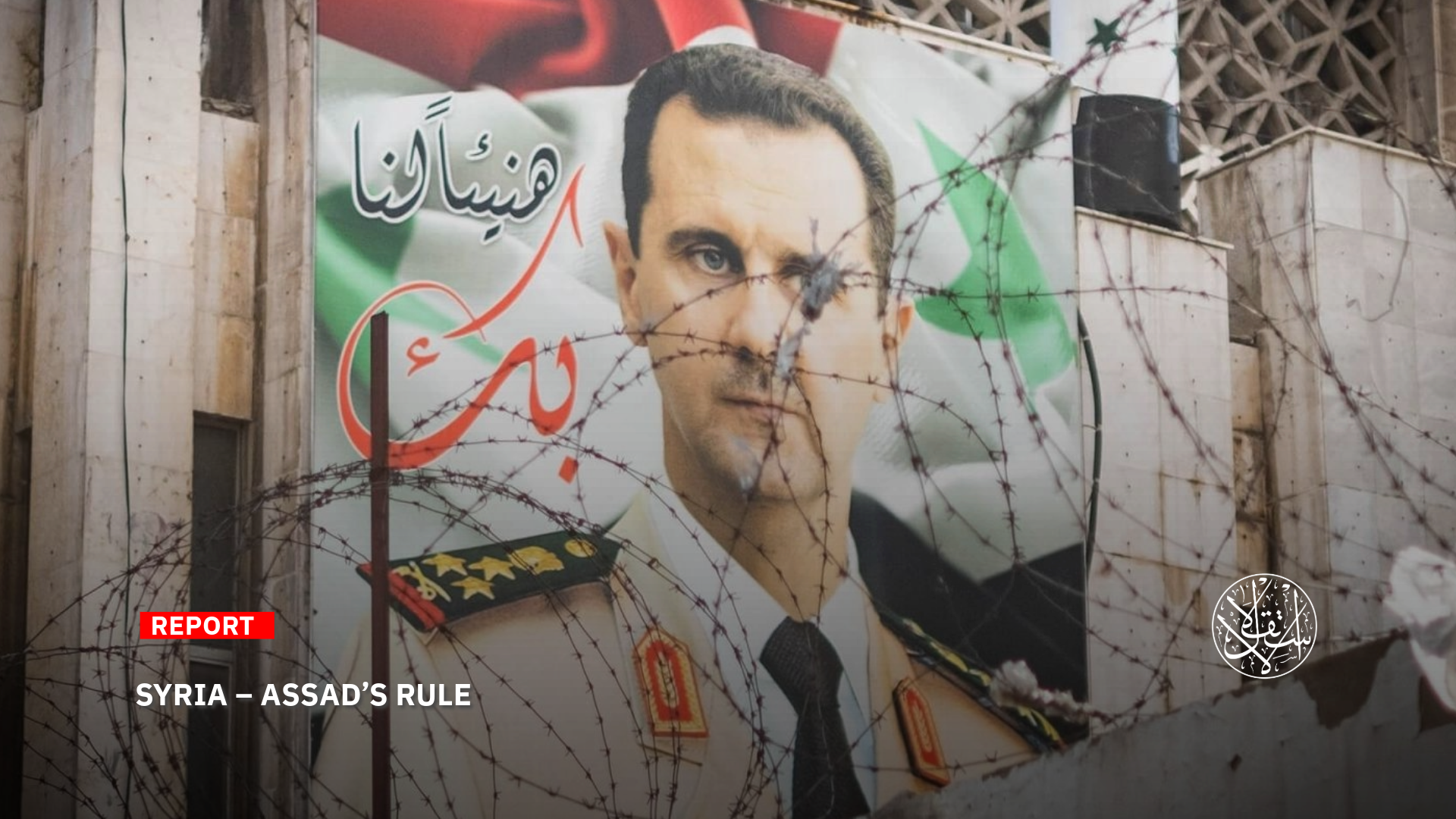
Today, Syria has shaken off the dust of more than 54 years of rule by the Assad family with force and violence, from the era of the father ‘Hafez’ to his son ‘Bashar’.
Reports indicated that armed factions took control of the Radio and Television Corporation building, Damascus Airport, as well as the most important roads and neighborhoods in the capital.
President Bashar al-Assad fled the capital by air to an unknown destination, which means the end of the Assad era in ruling Syria.
Bashar al-Assad is not an ordinary name in the history of Syria and the region, not even at the level of dictatorship.
Over the past years, his decisions have turned Syria into a pile of ruins and the people of the country into displaced persons and refugees.
Assad has killed hundreds of thousands of Syrians with various types of weapons, including chemical weapons, and at the beginning of 2024 he felt safe in his seat, but only 10 days were enough to break all his taboos, turning his slogan upside down, as there is no longer Assad and the country remains.
Bashar became president in 2000 after the death of his father, Hafez al-Assad, which maintained the dominance of the Alawite sect over the Sunni-majority country, and kept Syria an ally of Iran.
Bashar al-Assad's rule in March 2011 witnessed widespread protests coinciding with the events of the Arab Spring, as Syrians took to the streets demanding democracy, but his forces used brutal force against them.
The fall of Assad
Events unfolded quickly and dramatically at dawn on Sunday, as the armed Syrian opposition announced that it had begun entering the capital, Damascus, while Reuters quoted senior Syrian officials as saying that President Bashar al-Assad flew out of Damascus for an unknown destination.
Saturday night began with an exciting development as the opposition succeeded in controlling the city of Homs, joining the cities of Aleppo and Hama, which the opposition had previously controlled, in addition to the entire Idlib province.
The opposition confirmed that it had thus succeeded in liberating four cities within 24 hours, namely Daraa, Quneitra, Sweida and Homs, before beginning to advance towards the capital, Damascus.
At dawn on Sunday, the opposition said it had stormed the Sednaya prison in the Damascus countryside and succeeded in freeing thousands of detainees, while news was circulating in American media outlets, citing informed sources, that the Syrian regime’s military defenses in Damascus had effectively collapsed.
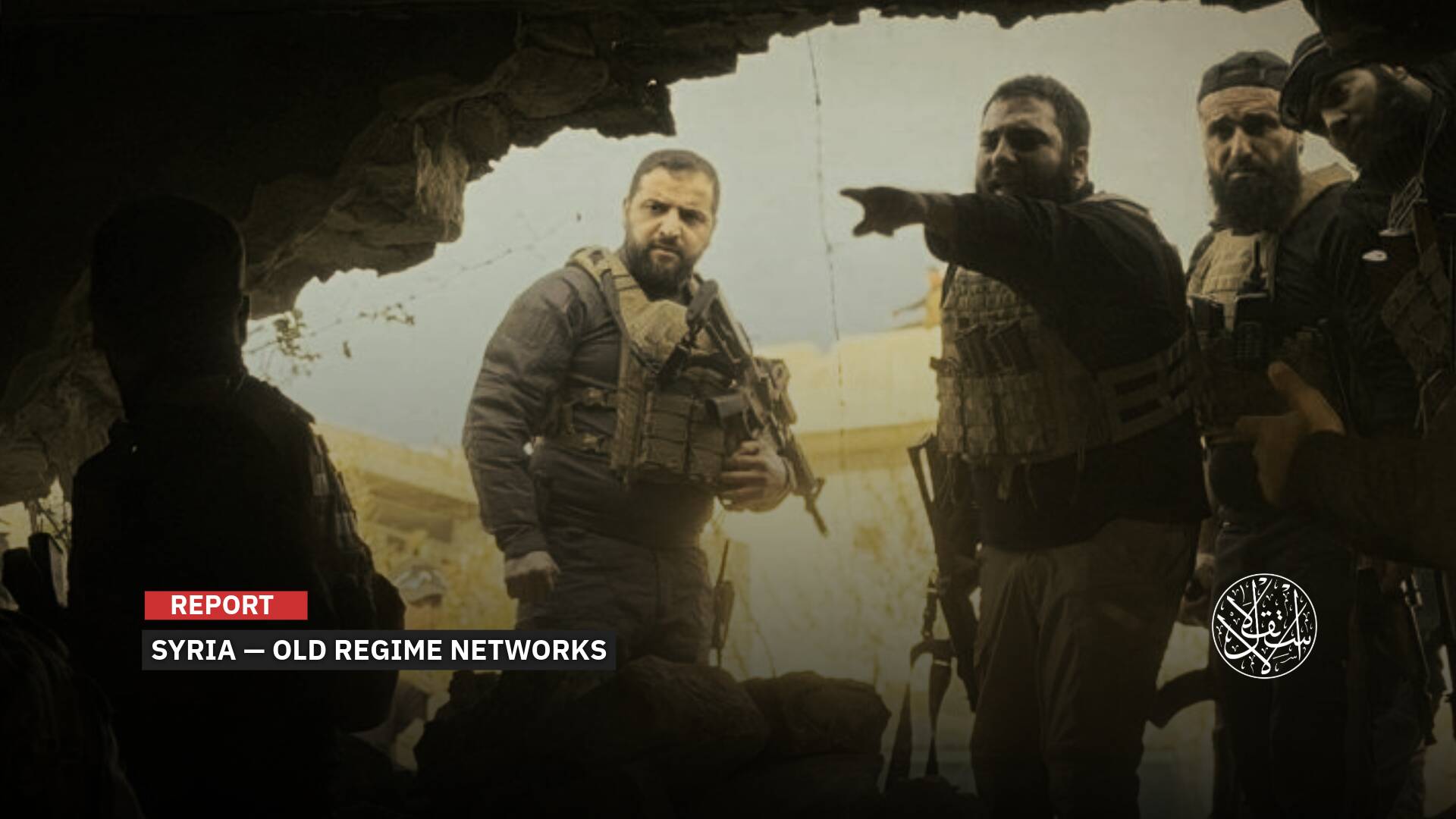
The armed Syrian opposition quickly announced that it had managed to take control of the Syrian Radio and Television building and Damascus International Airport.
In turn, the leader of Hayat Tahrir al-Sham, Ahmad al-Sharaa, nicknamed Abu Muhammad al-Jolani, issued a statement in which he called on his forces in the city of Damascus not to approach public institutions, indicating that they would remain under the supervision of the former Prime Minister Mohammad Ghazi al-Jalali until they were officially handed over.
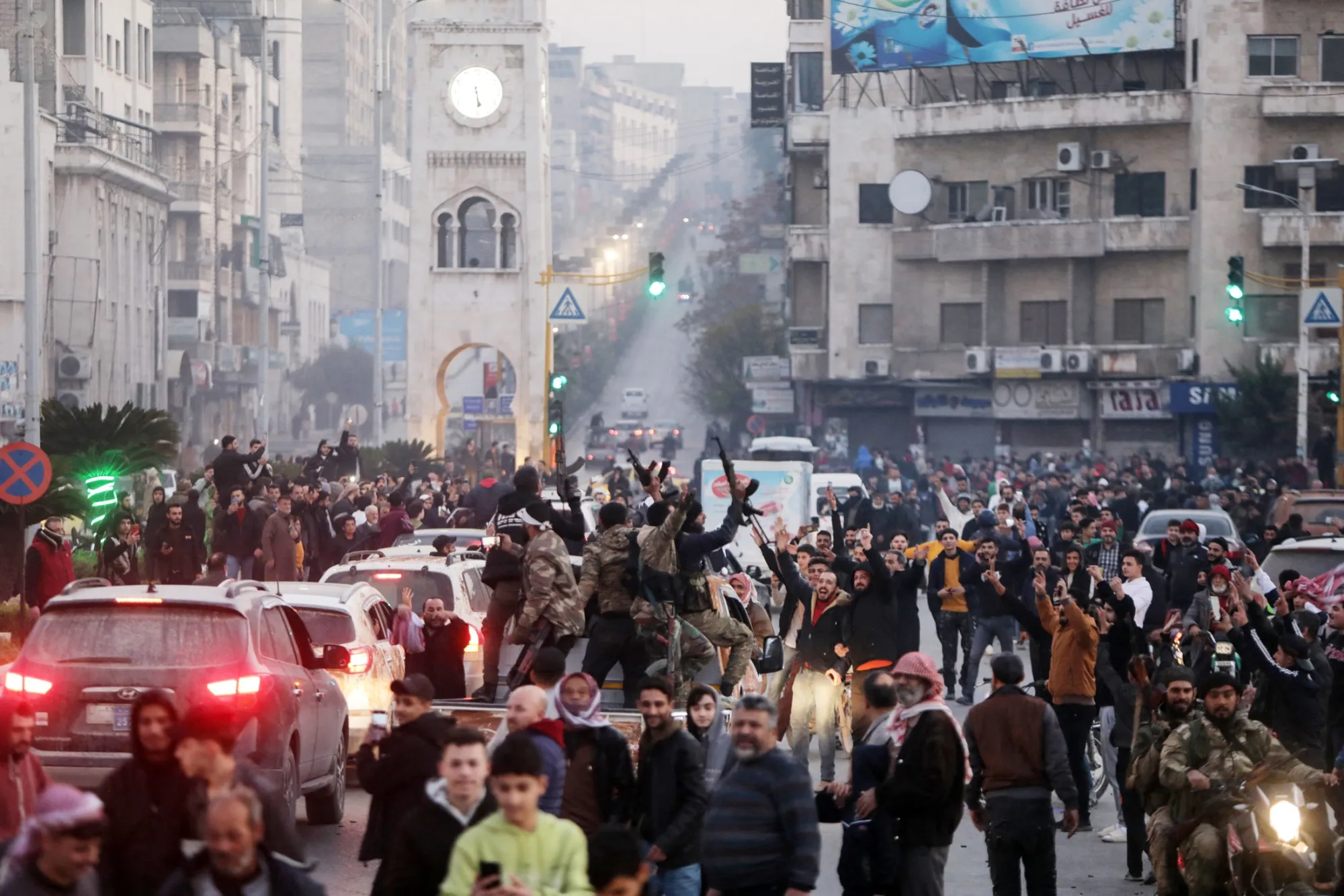
The armed Syrian opposition factions also called on the displaced abroad to return to free Syria after declaring Damascus free.
Takbirs were heard in the mosques of the Syrian capital in celebration of the fall of Assad and the control of the armed opposition factions over Damascus, and the liberation of prisoners from the notorious Sednaya prison.
Military and Political Pressures
It seems that some international consensus has decided the future of Syrian President Bashar al-Assad. Russia did not intervene as happened in 2015, and Iran did not mobilize militarily as happened in late 2011.
Even at the level of political statements, we did not see from the allies of the Assad regime anything that would match the rapid and successive developments and the fall of Syrian cities one after the other.
In recent days, military and political pressures on Bashar al-Assad have increased, in light of the decline in public support from his traditional allies, Russia and Iran.
Press reports confirmed that Moscow and Tehran have become more inclined to arrange their interests in Syria away from the absolute commitment to Assad's survival, which has put them in front of a very complex political and military reality.
In 2016, Bashar al-Assad, with strong support from Russia, Lebanese Hezbollah and Iran, was able to defeat his opponents in the Battle of Aleppo.
But the situation is completely different now, considering that Russia is immersed in the Ukraine war, and Lebanese Hezbollah has suffered heavy defeats in its war with “Israel”.
In contrast, Iran is suffering from a severe economic crisis and a budget deficit, which has made it unable to provide more financial and military support to the Assad regime.
In turn, political researcher Mahmoud Alloush told Al-Estiklal newspaper that the recent events in Syria represent the collapse of Iranian penetration throughout the Middle East.
“The overthrow of Bashar al-Assad came after the elimination of the leadership of Tehran’s main agents in the region (Hezbollah and Hamas) in their conflicts with Israel over the past 14 months,” he said.
Mr. Alloush pointed out that “Tehran did not see an opportunity to save the Syrian regime and continue to rule, so it abandoned Assad, as Russia did, in the hope of negotiating relations with the new Syrian government.”

Iranian Position
Since launching Operation Deterrence of Aggression in late November, Iran has shown no efforts to preserve the Assad regime, which has raised questions about its lack of serious intervention to preserve its interests in Syria.
Its position was not at a level that indicated its intention to support the survival of Bashar al-Assad's regime, unlike previous years, when it provided military and economic support to Assad with the aim of preserving its interests in the region, which amounted to about $50 billion.
While Iran and its media took a clear position in describing all opponents of the Syrian regime, especially the armed factions, as terrorists and takfiris, it recently backed down and described armed opponents for the first time.
The change in the Iranian position towards the Assad regime was in line with the acceleration of military developments on the ground, as Tehran appeared to have abandoned the Assad regime, starting with the statements of its officials, all the way to its official press.
The Sitara Sobh newspaper opened its article titled ‘Bashar al-Assad’s Isolation’ by attacking Hafez al-Assad, accusing him of handing over the occupied Syrian Golan Heights to “Israel”.
On December 6, Iran began evacuating its military leaders and employees, in addition to some diplomatic personnel.
This remarkable shift confirmed that Iran not only appeared to be abandoning the Assad regime, but also everything it had built and fought to preserve in Syria over half a century.
Although Iranian officials publicly pledged to remain fully committed to supporting the Assad regime, they were privately wondering whether events were beyond their ability to turn the tide.
For years, Iran has operated military bases, weapons depots, and missile factories in Syria, using them as a conduit to arm its armed allies throughout the region.
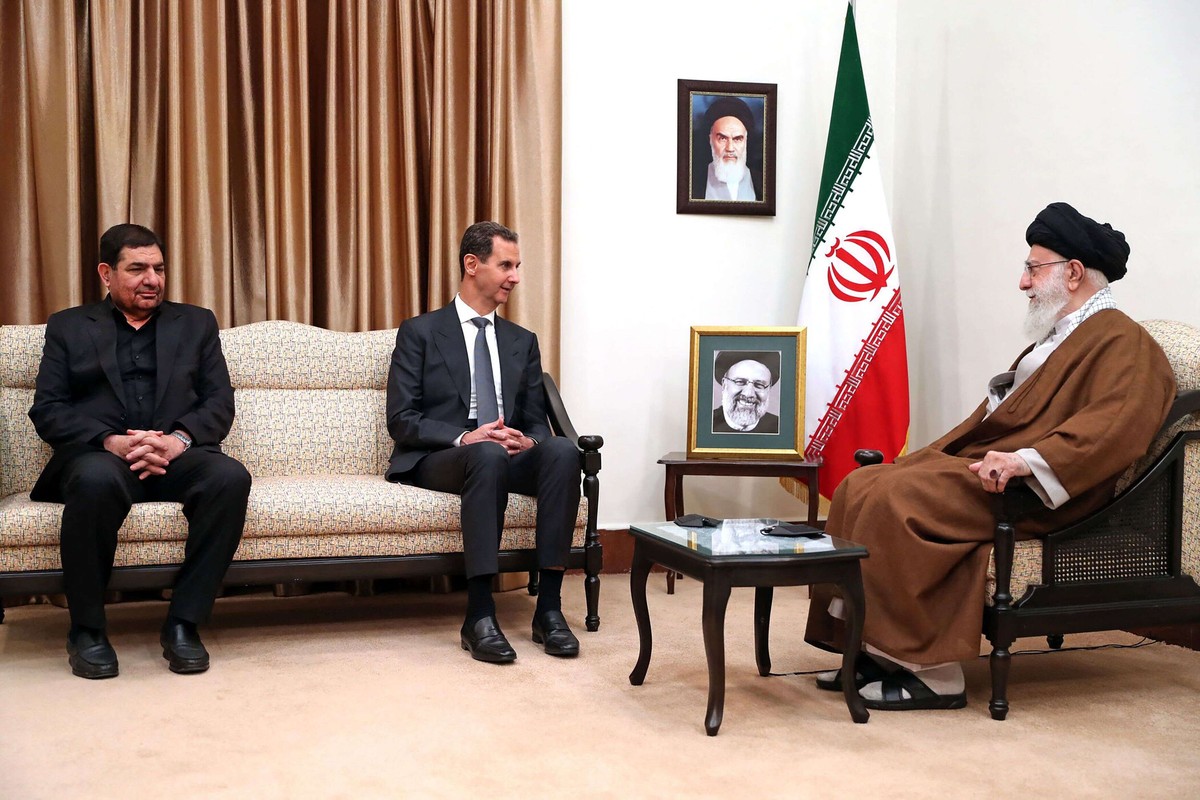
With the fall of the Assad regime, one of the pillars of the Iranian regime's regional policy against “Israel” has collapsed, also posing an existential threat to the militias supported by Iran in the Middle East.
This may also threaten the survival of the Iranian regime itself, because the Assad regime is one of the main pillars of the so-called axis of resistance, which is adopted by Ayatollah Ali Khamenei.
Iranian foreign policy is expected to face a severe crisis in the region, considering that the Assad regime is one of the main pillars in transporting weapons, securing logistics, and providing financial support to Iranian militias.
Because of its geographic strategic importance, Iran invested heavily in Syria over the years spending tens of billions of dollars, securing investment projects like allowing Iran to control phosphate mines and take over 5- thousand hectares of farmland and 1-thousand of oil and gas, according to Reuters.
Sources
- Syrian government appears to have fallen in stunning end to long rule of Assad family
- Syrian Rebels’ Lightning Offensive Zeroes In on Major City
- Exclusive: Iranian Government Preparing for Assad’s Collapse
- Assad’s downfall could trigger a crisis for Tehran
- Syrian rebel gains threaten Iran's regional hegemony