Jerusalem Lawyer: Settlements, Evictions, and Militarization Are Destroying the Dream of a Palestinian State (Exclusive)
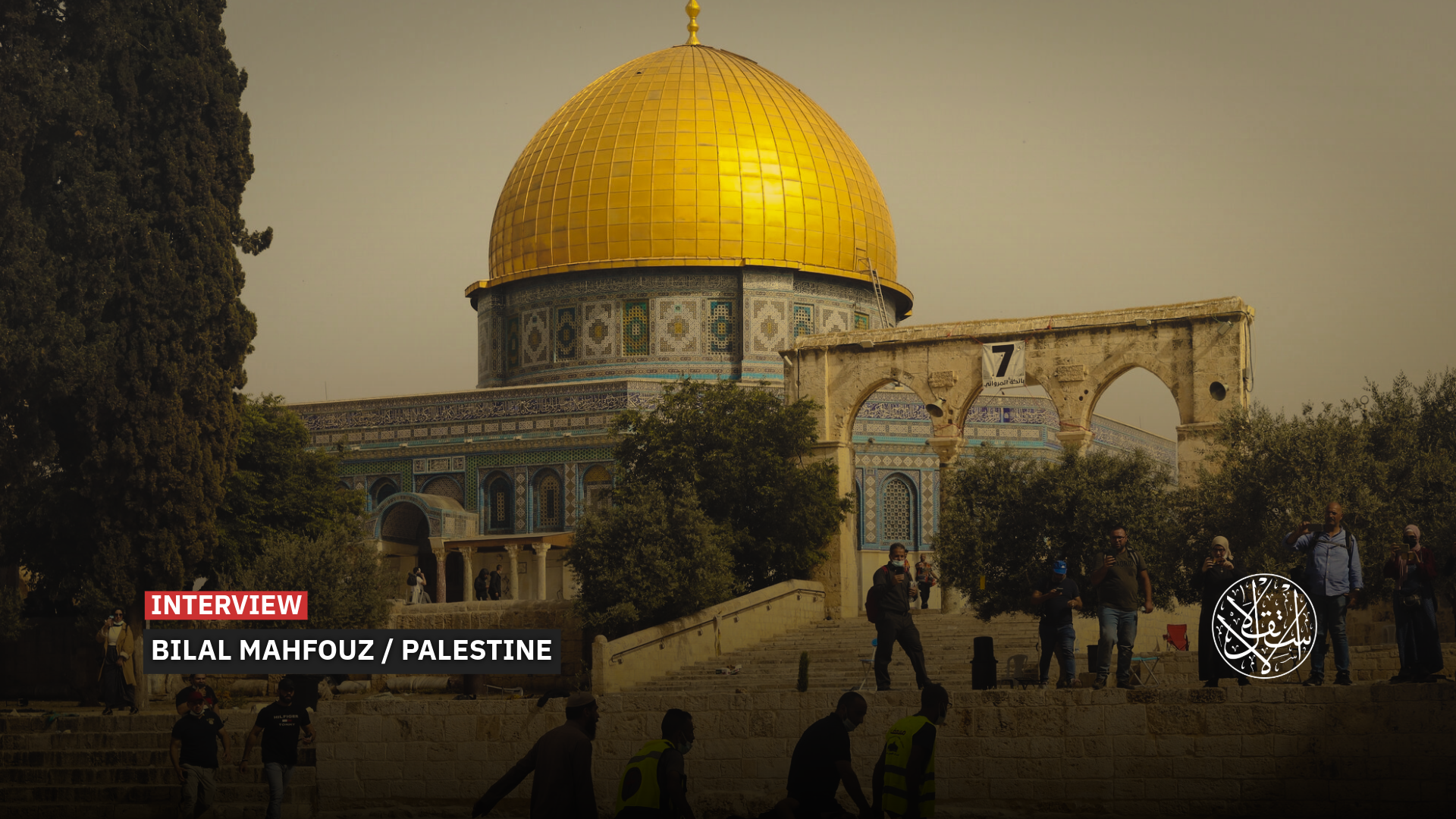
“Jerusalem cannot bear the military infrastructure that has accumulated over the years in Tel Aviv.”
Jerusalem-based lawyer and activist Bilal Mahfouz said that the Israeli occupation's decision to transfer its military headquarters from Tel Aviv to Jerusalem is not merely an administrative or technical security measure, but rather reflects a political agenda to impose Israeli sovereignty over the city and consolidate its status as its alleged capital.
In an interview with Al-Estiklal, he explained that this step is part of a comprehensive system that includes urban, demographic, and security planning, most notably the Jerusalem 2040 plan, which aims to change the city's identity and connect its eastern and western parts in a way that would make any future separation difficult.
He pointed out that the military actions in Jerusalem cannot be separated from the accelerating settlement expansion within and around the city, which forms the backbone of the policy of creating facts on the ground.
He noted that major settlement projects, particularly those built or planned in East Jerusalem, aim to dismantle Palestinian geographical and demographic continuity and transform settlements into massive urban blocs that solidify a reality that would be difficult to reverse politically or legally in any future settlement.
He also warned that the policy of forced evictions in the Silwan neighborhood of East Jerusalem represents the harshest aspect of this plan, as Israeli laws and courts are being used as tools to gradually displace Palestinian residents in favor of ideologically driven settlement associations.
Bilal Mahfouz is a Jerusalem-based lawyer and activist specializing in Jerusalem affairs. For years, he has been working on land, property, and forced eviction cases before Israeli courts, particularly in East Jerusalem neighborhoods.
Militarization of Jerusalem
What are the real objectives of transferring the Israeli military headquarters to Jerusalem?
Given the complex political, economic, and diplomatic reality, the agreement (between the Ministry of Army and the municipality of the occupied city) to relocate the main military headquarters is more a form of asserting sovereignty than a genuine transfer of administrative functions to Jerusalem.
This move can be seen as part of an effort to solidify the existing facts on the ground, especially since official Palestinian discourse views it as an Israeli attempt to increase the number of Jewish settlers in the holy city and restrict Palestinians to eliminate the possibility of East Jerusalem becoming the capital of a future Palestinian state.
To achieve this, the municipality has proposed the “Jerusalem 2040 project”, which aims to establish five new settlement towns and create commercial centers to attract settlers from other Israeli cities to Jerusalem.
This project also includes the development of a network of roads and railways and the integration of residential areas, making it difficult to separate the eastern part of the city from the western part. The resulting reality would then be based on the idea of a single, unified Jerusalem as the alleged capital of “Israel”.
The symbolic and sovereign nature of this move is evident in the fact that the Ministry of Army is currently located in Tel Aviv, the de facto political capital of “Israel”. Even in international dealings, meetings are held in Tel Aviv, not Jerusalem, because the latter is a disputed territory.
Leaders of nations and diplomatic missions do not want to become involved in the issue of Jerusalem to avoid jeopardizing the peace process, as its details are delicate and complex. They also fear that any misstep could lead to official repercussions, media criticism, or public backlash.
Given that Israel's existence is based on the concept of security and a constant fear of its surroundings, and that it is vulnerable to wars in the region, it keeps its military command center very close to, if not directly adjacent to, the political leadership (Tel Aviv), in addition to the economic administration.
What makes Jerusalem practically unsuitable to be a military center of this size?
Jerusalem is a geographically constrained city, bordered to the east by Arab villages in the West Bank, separated by the separation wall. It is a mixed city of Arabs and Jews, prone to frequent uprisings and security incidents, and home to numerous tourist attractions and holy sites visited by tourists and worshippers from around the world.
Despite the presence of old, small military bases, Jerusalem is not large enough to accommodate the military infrastructure that has accumulated over the years in Tel Aviv.
Many countries also refuse to engage in trade or exchange with Jerusalem for the reasons mentioned above. Furthermore, the uprisings and popular protests negatively impact Israel's image as a democratic and diverse nation.
Will this relocation have any direct impact on the lives of Palestinians in Jerusalem?
Regarding the Palestinian residents of Jerusalem, they are under full Israeli sovereignty. The relocation of the Ministry of Army's administration will not affect their daily lives in the same way that municipal plans and other institutions that restrict Palestinians do.
However, it will have a clear impact on the Palestinian dream of establishing a Palestinian state with East Jerusalem as its capital.
Jerusalemites feel that this dream is fading day by day due to Israel's practices, including the imposition of de facto military sovereignty over the holy city.
Settlement Activity
What is the danger of the plan to build a new settlement comprising 9,000 housing units on the land of the old Jerusalem (Qalandia) airport? How will it change the reality of the city?
The plan to build a new settlement in East Jerusalem constitutes a political problem in itself, concerning the future of peace, regardless of the sensitivity of the construction site and the number of housing units, although these two points are also significant.
Building settlements in East Jerusalem, within the separation wall, weakens all attempts to revive the stalled peace process and creates a fait accompli that may extinguish the last hopes for the establishment of a Palestinian state.
The reality is that settlements have deeply penetrated East Jerusalem, transforming into sprawling villages and encroaching upon a significant portion of the already limited area of the city.
What is the significance of the proposed settlement's location on the land of the Qalandia Airport?
Considering the location of the future settlement, it will be built on the land of the Qalandia Airport, which was established during the British Mandate and continued to operate for light aircraft under Israeli occupation until 2002.
It was expected to become the airport of the capital of the State of Palestine. It is located between Kafr Aqab and Qalandia to the north, Ar Ram, Dahiyat al-Barid, and the Qalandia checkpoint to the east, Beit Hanina to the south, and the airport neighborhood to the west, meaning it is situated among several Jerusalem neighborhoods.
The construction of a settlement on this plot of land means seizing more territory and creating a reality that would shatter the dream of a capital city airport should peace be achieved and a state with East Jerusalem as its capital be established.
What political message does this settlement convey? How does it affect Palestinian geographical contiguity?
This settlement carries a special symbolism. Through it, “Israel” sends a clear message that there will be no Palestinian state, no East Jerusalem, and no symbols of sovereignty for the Palestinians.
The number of units also means that the settlement will swallow up the entire area of the airport and its surroundings, and light rail lines and roads will be connected, ensuring the inseparable connection of the two parts of Jerusalem.
The settlement severs the connections between the Palestinian communities located in the West Bank or Area C and the communities located behind and within the separation wall.
This means that the wall will not be removed, and its existence will become an even greater necessity than the current security imperative, affecting the future of the peace process and the chances of its success.
Escalation of Evictions
In the Batn al-Hawa neighborhood of Silwan, we are witnessing an escalation in the forced eviction of Palestinians from their homes in favor of settlement organizations. What is the importance of this area?
Silwan, with its approximately 25 neighborhoods, is one of the most important areas of Jerusalem, and Batn al-Hawa and al-Bustan neighborhoods are among the closest to the Al-Aqsa Mosque.
Geographically, Silwan is a valley surrounded by mountains, the Al-Aqsa Mosque mountain to the north and Jabel Mukaber to the south, creating a difficult geographical reality in terms of construction, especially given the proximity of the houses to each other, the narrowness of the roads, and the difficulty and lack of infrastructure in some parts.
Religiously, the Jewish narrative considers it the City of David, while Muslims see it as the southern extension of the Al-Aqsa Mosque, the site of the Umayyad palaces and the seat of the governorate, in addition to its historical agricultural fertility due to the abundance of water.
How are Israeli laws used to evict the residents of Batn al-Hawa?
The lands of Silwan are not registered in the land registry, and any construction requires a permit, and every permit requires ownership, which is almost impossible to obtain.
In contrast, laws have been invoked that allow any Jew who can prove ownership of a property from which they were dispossessed for political or security reasons to reclaim it and evict the current residents.
Indeed, Israeli courts have begun issuing eviction orders for a number of homes in Silwan, and considering that unified Jerusalem is the claimed capital of “Israel” according to the Basic Law.
What impact will this have on the future of Silwan's residents, both legally and socially?
The accumulation of these decisions will eventually become established laws, increasing the legal risk for Palestinian residents, especially since many of them do not possess official ownership documents but rely on old, informal land divisions.
Furthermore, the costs of lawyers and court fees are beyond the means of the average Jerusalem resident, with legal expenses reaching tens of thousands of dollars.
Eviction through Taxes
In parallel with the evictions, the Israeli municipality is planning to raise property taxes (“Arnona” in Hebrew) on Jerusalem residents. What is the danger of this to the resilience of Palestinian families?
Since Jerusalem and the West Bank came under occupation, “Israel” has imposed various taxes on the population. These taxes are commensurate with the income of Israelis but are disproportionate for Palestinian citizens due to the vast difference in economic infrastructure.
Also, there are laws that grant exclusive rights to obtain work contracts, important jobs, projects, and other opportunities to those who hold Israeli citizenship and have served in the army, creating a class of laborers in the West Bank and Jerusalem (in general) and a class of employers in “Israel”.
Then came the decision to annex Jerusalem to “Israel” and declare it its unified capital, which subjected the Palestinian residents to full Israeli law. However, they refused to obtain Israeli citizenship and did not serve in the army.
This means they did not benefit from the annexation, even though they hold the blue Israeli identity card and have the right to travel within “Israel”.
On the contrary, the annexation subjected them to more laws, most importantly, placing them under the jurisdiction of the Israeli-controlled Jerusalem municipality.
In addition to the existing laws, the municipality began imposing taxes and fees on Jerusalemites, most notably the “Arnona” tax, along with numerous other exorbitant fees, including building permit fees. A permit for a single apartment can cost the equivalent of the price of an apartment in the West Bank, Jordan, or Egypt.
How is the “Arnona” tax calculated? Why is its adjustment considered a direct threat to Jerusalemites?
When the “Arnona” tax was imposed, the classification was based on dividing areas into categories (A, B, C, D) in alphabetical order. The tax rate was highest in areas classified as (A) and lowest in (C). Most Arab areas and suburbs were classified as either (C) or (D).
Residents consistently complained that they paid the “Arnona” tax without receiving services in return, suffered from marginalization, and were excluded from economic development zones, placing them primarily in the working class and low-income brackets.
However, following the Gaza War (2013-2015) and the enormous costs incurred by “Israel”, the government began to review tax laws to prevent evasion and introduce new taxes to compensate for the war's losses.
Among these taxes was the “Arnona” tax. Amendments began to be made toward standardizing the “Arnona” rate across all municipalities and eliminating the (A, B, C, D) classifications, so that everyone would pay a single rate.
Since most Jerusalemites fall under categories C and D, this means that Palestinian residents will pay a higher amount, perhaps equivalent to category A or B, or somewhere in between. This will become apparent in the coming days as municipalities send out property tax (“Arnona”) payment requests, which will reflect the tax difference.
What options are available to Jerusalemites to cope with this new increase? Why are all the proposed solutions risky?
The average Jerusalemite, who is poor and indebted (generally), is forced to pay the increased amount from their limited income to avoid seizures, legal restrictions on bank accounts, and other measures that disrupt their lives.
However, this will make them more vulnerable to poverty, hardship, and accumulating debt, as many families are already struggling and cannot afford these taxes.
Therefore, Jerusalemites will consider several options, all of which are undesirable, such as emigration, which could later lead to the revocation of their residency permits and the loss of their legal right of return, especially for those with children living abroad.
Significant figures indicate that young people from the West Bank and Jerusalem are submitting immigration applications to embassies in the latter city. This poses a considerable threat to Jerusalem's demographic balance.
Alternatively, they might consider moving to smaller accommodations, as property taxes (“Arnona”) are based on size, creating significant social problems amid the acute housing crisis. More importantly, finding rental housing is difficult, especially given the daily price increases resulting from limited construction.
However, the most common option is to relocate to areas outside the separation barrier (essentially in the West Bank) but geographically under the jurisdiction of the Israeli municipality of Jerusalem, such as Kafr Aqab, Anata, and Ras Khamis.
The problem with these areas is that they are considered lawless, falling under neither Israeli nor Palestinian Authority control. They suffer from inadequate services, significant security and social risks, and construction is often illegal.
Another option is to live in the West Bank, which gradually leads to the revocation of permanent residency (blue ID cards) and the exclusion of residents from Jerusalem's population census.
Overall, all these solutions lead to a decrease in the number of Jerusalemites within the wall, an increase in poverty and destitution, and social repercussions such as school dropout, health deterioration, and family disintegration.