How Is Netanyahu and the Zionist Media Elite Pushing Trump Toward the Quagmire of War With Iran?
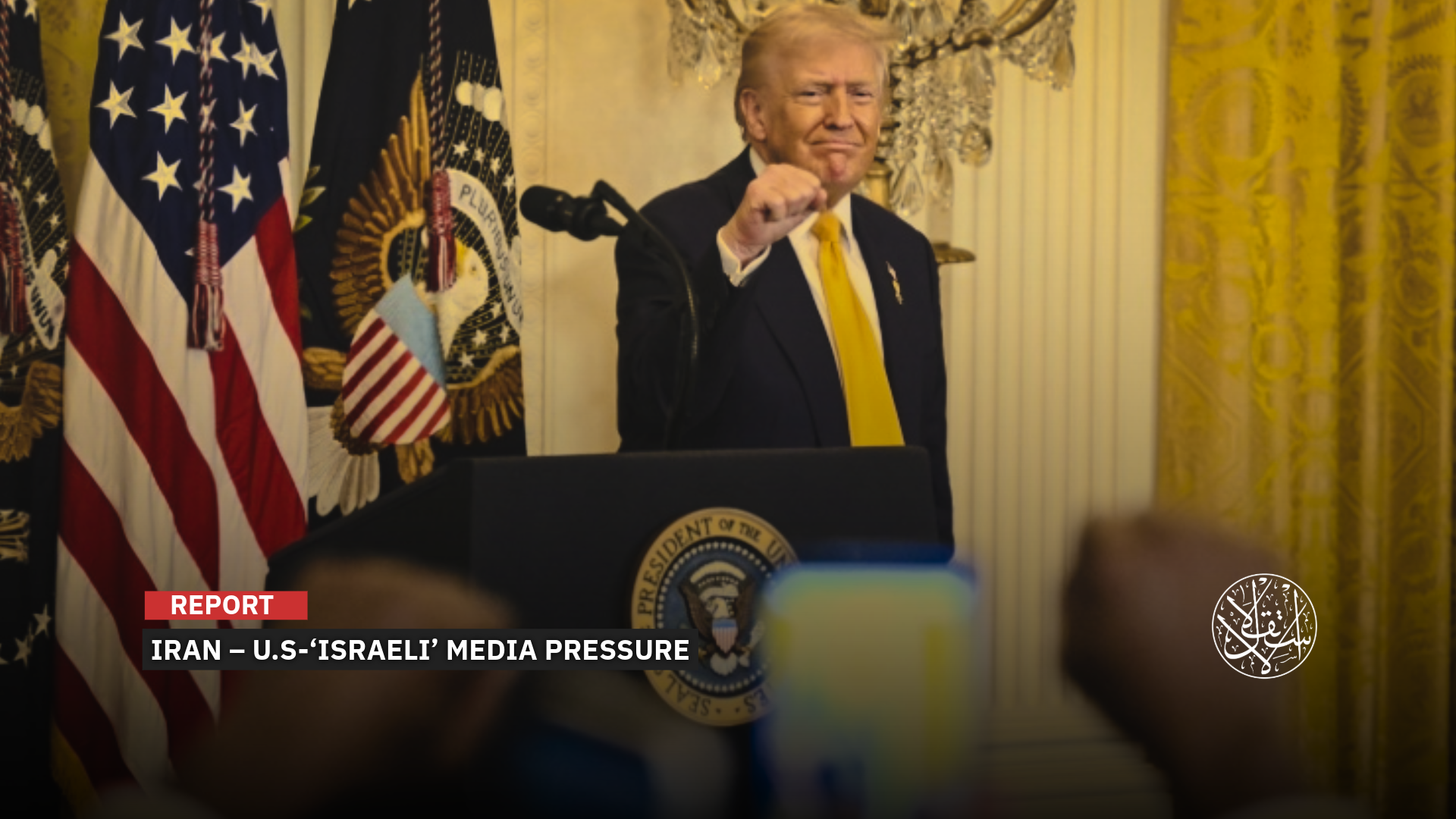
“Whenever Miriam Adelson’s mouthpiece pushes a dramatic claim about Iran, it’s worth asking who it serves.”
Amid an intensive publishing campaign in U.S. newspapers owned by Zionist media magnates, scenarios have circulated about launching strikes against Iran and toppling it through a war lasting several weeks, with complete disregard for the sanctity of the month of Ramadan.
In contrast, other reports and analyses have refuted the likelihood of such a war breaking out, asserting that it would fail and that embarking on it would bring political and military disaster for U.S. President Donald Trump.
Analysts have highlighted the role of “Israel” and its prime minister, Benjamin Netanyahu, alongside the American Jewish media lobby, in planning to ignite the war by exaggerating or promoting inaccurate reports directed at decision-makers in the White House to push them toward the military strike option.
Other reports have stated that not a single American military analyst believes such a war would succeed.
On the contrary, it would result in a genuine catastrophe for the United States, while “Israel” would be its greatest beneficiary.
In this context, Thomas Friedman wrote in The New York Times that Netanyahu’s right-wing Israeli government is deliberately misleading Washington by inflating the “Iranian threat,” harming American interests in the Middle East.
At the same time, social media platforms have seen divergent views on whether Washington would dare to strike Iran during the Muslim holy month of Ramadan.
Analysts and activists have not ruled out the possibility, arguing that such religious considerations do not constitute a deterrent, citing the execution of former Iraqi President Saddam Hussein during Eid al-Adha.
Media-Manufactured War
In timing concurrent with U.S.-Iranian negotiations, American media platforms owned by, or close to, pillars of the American Zionist lobby intensified the publication of reports asserting that Trump is on the verge of making a military decision against Iran.
These reports included newspapers and platforms such as The Wall Street Journal, CNN, The New York Times and Axios.
The most serious was a report by CBS News, which spoke of an “imminent strike” against Iran and specified its timing as February 21, 2026, the third day of the month of Ramadan.
CBS claimed, in a special report dated February 18, that senior national security officials informed Trump that the U.S. military is ready to carry out strikes against Iran, with a timeline ranging between the third and fourth days of Ramadan, although a final decision has not yet been made.
The mechanism of “recycling the news” between Israeli and American media was clearly evident, with the report first leaked in “Israel,” then republished in the United States as confirmed.
This pattern is led by journalists, most notably Barak Ravid, who works for Channel 12 and serves as a correspondent for Axios.
The significance of Axios lies in its proximity to decision-making circles in Washington and “Tel Aviv,” making its reports appear as settled information, especially regarding the Iranian file.
It is viewed as a platform read by the White House, the Pentagon and the United States Congress, granting what it publishes exceptional weight.
The site claimed that Trump chaired a meeting of the U.S. National Security Council on February 18, amid rising prospects of war, and that his administration is “closer to entering a major confrontation in the Middle East than most Americans realize.”
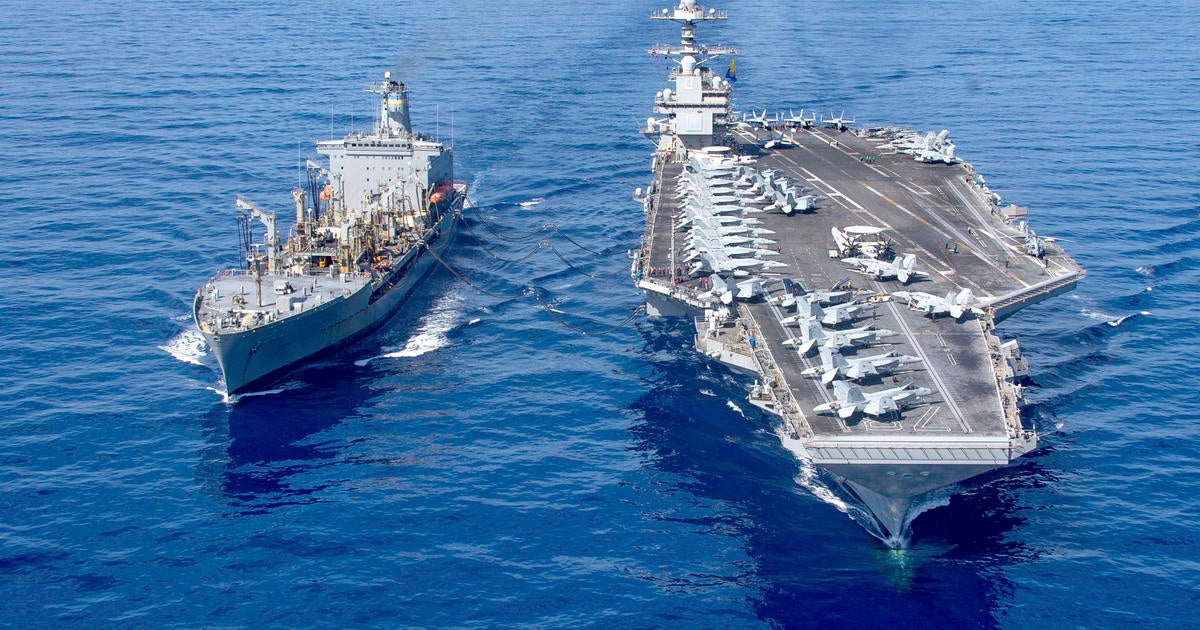
Axios indicated that any military operation against Iran would be a broad campaign lasting weeks, resembling a full-scale war, not a limited operation, especially after the arrival of the aircraft carrier USS Ford and its strike group to the eastern Mediterranean.
Although this does not necessarily mean the information is inaccurate, observers said the media momentum is aimed at exerting political pressure on the U.S. administration, so that retreating from a strike would appear as a personal defeat for Trump.
In the same context, Barak Ravid wrote, “The Trump administration is closer to a major war in the Middle East than most Americans realize. It could begin very soon.”
The channel also reported raising the level of alert in “Israel” over the possibility that Washington would grant a “green light” for an attack, affirming that “Tel Aviv” “will not stand idly by.”
Reuters, as well as CNN and The New York Times, repeated what Axios and CBS reported regarding the readiness of the U.S. military to carry out operations that could last for weeks, warning that this could lead to the most dangerous confrontation in relations between the two countries, with the potential for regional escalation.
The Wall Street Journal confirmed on February 18 that the United States has amassed its largest air force presence in the Middle East since the 2003 invasion of Iraq, but noted that Trump has not yet made a final decision.
American analysts, including Gregg Carlstrom, see the deployment of this scale of military force as signaling an intention to use it, though it may also be an attempt to pressure Iran into concessions.
They consider this a misunderstanding of the nature of the Iranian system, one that could corner Trump into a narrow choice between escalation or an embarrassing retreat, in either case with heavy consequences.
Concerning Loopholes
The specialized strategic and military site, The War Zone, published a report on February 18 confirming that the readiness level of the E-3 command-and-control aircraft fleet for confront the Iranian crisis shows worrying gaps, which it considers a strong indicator of the ambiguity and seriousness of the U.S. threat to wage war on Iran.
The report noted that the United States has deployed more than two-thirds of its available E-3 aircraft to Europe and the Middle East, which are critical.
This plane, resembling a large passenger jet, is equipped with a rotating radar disk mounted above its fuselage, enabling the monitoring of airspace and the direction of fighter jets and land- and sea-based missile interception systems against Iranian missiles and drones.
The report explained that the United States Air Force possesses only 16 E-3 aircraft, and that deploying six of them is in itself an achievement.
However, the operational readiness rate does not exceed 55 percent, meaning that only seven or eight aircraft may be fit for operations.
It affirmed that the Air Force does not deploy nearly all its available E-3 aircraft except in cases of extreme necessity, as these planes are not dispatched in large numbers unless there is an actual need to use them, which may indicate the possibility of a decision to strike Iran.
In the same context, other strategic military reports spoke of the completion of what they described as a “bridge of fire,” through the deployment of 46 refueling aircraft and seven communications centers.
They also confirmed that Washington is massing about 240 attack aircraft for a “War of Long Weeks,” noting that the question is no longer, “Will war occur?”, but rather “When will the first wave begin?”
Israeli Media’s Involvement
Since Iran announced its intention to present a detailed offer to the United States in the next round of negotiations, aimed at narrowing the gap between the parties’ demands, Israeli media have escalated their incitement campaign, promoting the impression that the talks have effectively failed and that war is imminent, within days or even hours.
In this context, the site Nziv, which specializes in publishing intelligence reports focused on Iran, claimed that threats by Iran’s supreme leader, Ali Khamenei, coinciding with the arrival of two U.S. aircraft carriers, are based on a “secret weapon.”
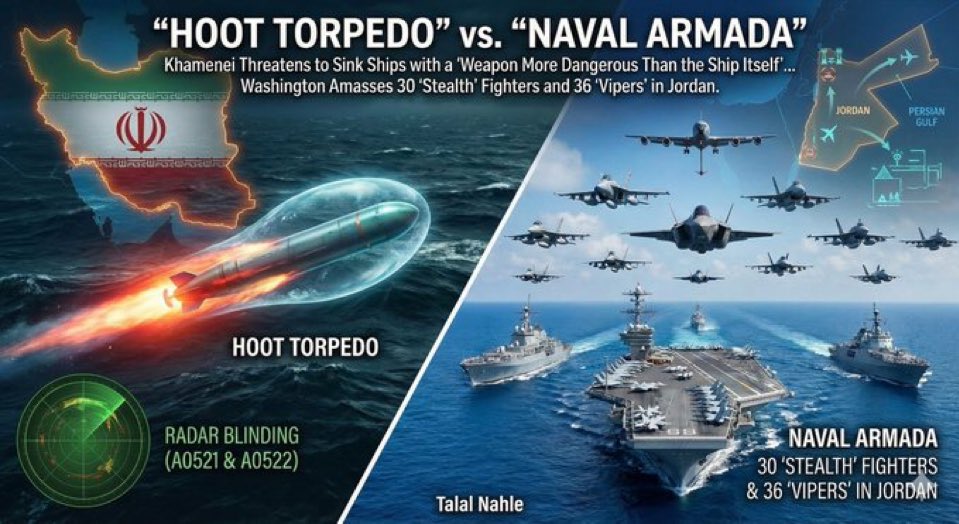
The site alleged, on February 17, that the reference was to the super-fast “Hoot” torpedo, capable, according to its claim, of neutralizing U.S. naval power and turning the depths of the seas into a graveyard for warships.
Khamenei had said, addressing Washington, “The weapon capable of sinking the ship is more dangerous than the ship itself. The aircraft carrier is dangerous, but more dangerous is the weapon that can sink it.”
In interpreting this statement, Nziv claimed that Khamenei was alluding to an asymmetric Iranian weapon capable of effectively neutralizing American naval superiority, namely the “Hoot” torpedo.
According to the site, the torpedo relies on “cavitation” technology, enabling it to penetrate heavy armor by concentrating explosive energy into a high-speed thermal jet, precisely directed to breach the hulls of large vessels.
It added that the “Hoot” moves within a gas bubble that reduces friction with water, allowing it to reach speeds approaching 360 kilometers per hour, four times the speed of conventional torpedoes.
The site also claimed that the torpedo is equipped with a warhead weighing about 210 kilograms of explosives and is designed to penetrate the structures of massive ships.
In another report, the site claimed that Iran, years ago, converted a container ship into a floating naval base equipped with ballistic missiles, which would be used to target U.S. and Israeli ships.
To further incite and intimidate Washington, Nziv published a war scenario between the United States and Iran, designed using an artificial intelligence model.
Meanwhile, Israeli reports on February 18 and 19 spoke of rising estimates of the likelihood of a U.S. attack on Iran within days, amid what was described as “stalled negotiations” and the acceleration of U.S. military deployments.
Israeli newspapers confirmed that “Tel Aviv” would participate in any potential war but noted that “despite raising the level of readiness and close coordination with Washington, no final decision has been made yet.”
The Israeli public broadcaster Kan11 quoted an Israeli source saying there is a “high level of preparedness for the possibility of a near-term U.S. strike,” confirming that the decision has not yet been finalized by U.S. President Donald Trump, with continued close coordination between the two sides and an enhanced U.S. military presence in the region.
The broadcaster added that Washington informed “Israel” it would grant it a “warning period lasting several days” before any potential strike, emphasizing that “there will be no surprise attack,” while noting the possibility of a joint operation.
Meanwhile, Haaretz newspaper, on February 19, reported that Israeli security agencies estimate that the likelihood of a U.S. attack “increased in recent hours,” following the latest round of talks between Washington and Tehran.
The newspaper explained that major disagreements remain, primarily the U.S. demand to halt nuclear enrichment inside Iran, which Tehran considers a sovereign matter.
Haaretz added that “Israel” does not rule out actual participation by its military if an attack occurs, amid close coordination between the two countries in intelligence, communications, and air defense.
However, Israeli military sources emphasized that no instructions have yet been issued to change the level of readiness on the home front, nor specific directives for critical institutions, including hospitals and the energy sector.
Yedioth Ahronoth newspaper noted that the prevailing impression in “Israel” is that Trump “leans toward acting soon,” and that the U.S. administration sees Iran “trying to gain time,” warning that American patience may run out faster than Tehran expects.
Israeli military analysts confirmed that “Tel Aviv” is pushing for a war waged by the United States against Iran, with Israeli participation, and they see ongoing negotiations as aimed at exhausting the diplomatic track in preparation for a broad attack.
In this context, the military analyst in Israel Hayom newspaper, Yoav Limor, said that visits by Chief of Staff Eyal Zamir and the head of military intelligence, in addition to Mossad chief David Barnea’s visit to Washington, aimed to “ensure alignment between the two security institutions.”
“Israel wants to see the Americans enter a war whose outcome is clear,” Limor added.
Meanwhile, military analyst Alon Ben David, in Maariv newspaper and Channel 13, said that Israeli security officials told Washington that “a localized military operation will not topple the Iranian regime and will lead to an Iranian response targeting U.S. allies.”
Negotiations Unsettle Them
The course of U.S.-Iranian negotiations points to the possibility of reaching an agreement, seen as the best option for Donald Trump to escape the escalation impasse, according to American reports.
However, this path raises concern in “Israel,” which prefers to entangle Trump in a war with Iran to eliminate what it considers a direct threat.
Contrary to reports of an imminent war, Reuters to submit a written proposal outlining a mechanism to resolve differences with the United States following the second round of talks held in Geneva.
The official added that Tehran agreed during the Geneva talks to present a “written proposal” to address U.S. concerns, noting that Washington is “currently waiting” for this proposal from the Iranian side.
The White House spokesperson, Karoline Leavitt, said on February 18 that the talks had achieved “limited progress,” but noted that the two sides “remain very far apart on some issues,” expecting the Iranians to return with additional details over the next two weeks.
In the same context, the Israeli public broadcaster reported on February 17 that “Israel” fears Washington and Tehran could reach an agreement limited to the nuclear file and is waiting to be briefed on the details of the negotiations.
The channel explained that progress in the talks, as reflected in optimistic statements, could put “Tel Aviv” in a dilemma if any deal does not include restrictions on the ballistic missile program, which it considers a major threat.
In an article for The New York Times, Thomas Friedman wrote that Israeli Prime Minister Benjamin Netanyahu “plays Trump and American Jews for fools — again” and seeks to ignite a war between Washington and Tehran.
He added that Netanyahu misleads the U.S. administration to push it toward a military confrontation with Iran, despite the fact that this harms American interests in the Middle East and aims to cover up his policies and crimes in the West Bank.

Iran Thwarts Their Incitement
In contrast to the media campaign led by outlets owned by Jewish billionaires in the United States, Tehran, at the highest levels, has repeatedly countered these narratives, with Iranian Foreign Minister Abbas Araghchi responding multiple times to what he described as lies in American newspapers and the media of the occupation.
While newspapers owned by American Jews published reports of preparations for an imminent war, including the deployment of strategic bombers and the movement of warships and aircraft carriers to the region, Iran announced strong indicators of progress in negotiations with the United States, while simultaneously affirming its readiness and warning Washington that any war would not be in its interest.
When “Israel-aligned” newspapers, owned by Jewish billionaire Miriam Adelson, published reports described as false, claiming that Iran had executed dozens of citizens to pressure Donald Trump into carrying out his war threats, the Iranian foreign minister personally intervened to refute these allegations.
Araghchi wrote on X, “Whenever Miriam Adelson’s mouthpiece pushes a dramatic claim about Iran, it’s worth asking who it serves.”
“The facts: no executions have taken place, no court process has been concluded, and more than 2,000 prisoners have been pardoned,” he added.
Miriam Adelson is considered very close to President Trump and one of the largest donors to his election campaigns. She was born in “Tel Aviv” and runs a vast empire of hotels and casinos in Las Vegas.
Sources
- Trump Has Discussed Timeline for Iran Strikes — Including as Soon as This Weekend — But No Decision Yet
- U.S. Gathers the Most Air Power in the Mideast Since the 2003 Iraq Invasion
- Trump Meets With Top Iran Advisers as War Threat Grows
- US Military Prepared to Strike Iran as Early as This Weekend, But Trump Has Yet to Make a Final Call, Sources Say
- Iran Expected to Make Written Proposal for Resolving Standoff With US, Senior US Official Says
- Major Deployment of Rickety E-3 Sentry Fleet for Iran Crisis Highlights Worrisome Gaps
- As Trump Signals Strike on Iran to Ignite Prolonged Conflict, Israel Ramps Up Defense
- Netanyahu Plays Trump and American Jews for Fools — Again