A Deepening Crisis: How an Extraordinary Wave of Protests Over Living Conditions Swept Through Iran
“Iranian President Pezeshkian pledges banking reforms and orders talks with protesters.”
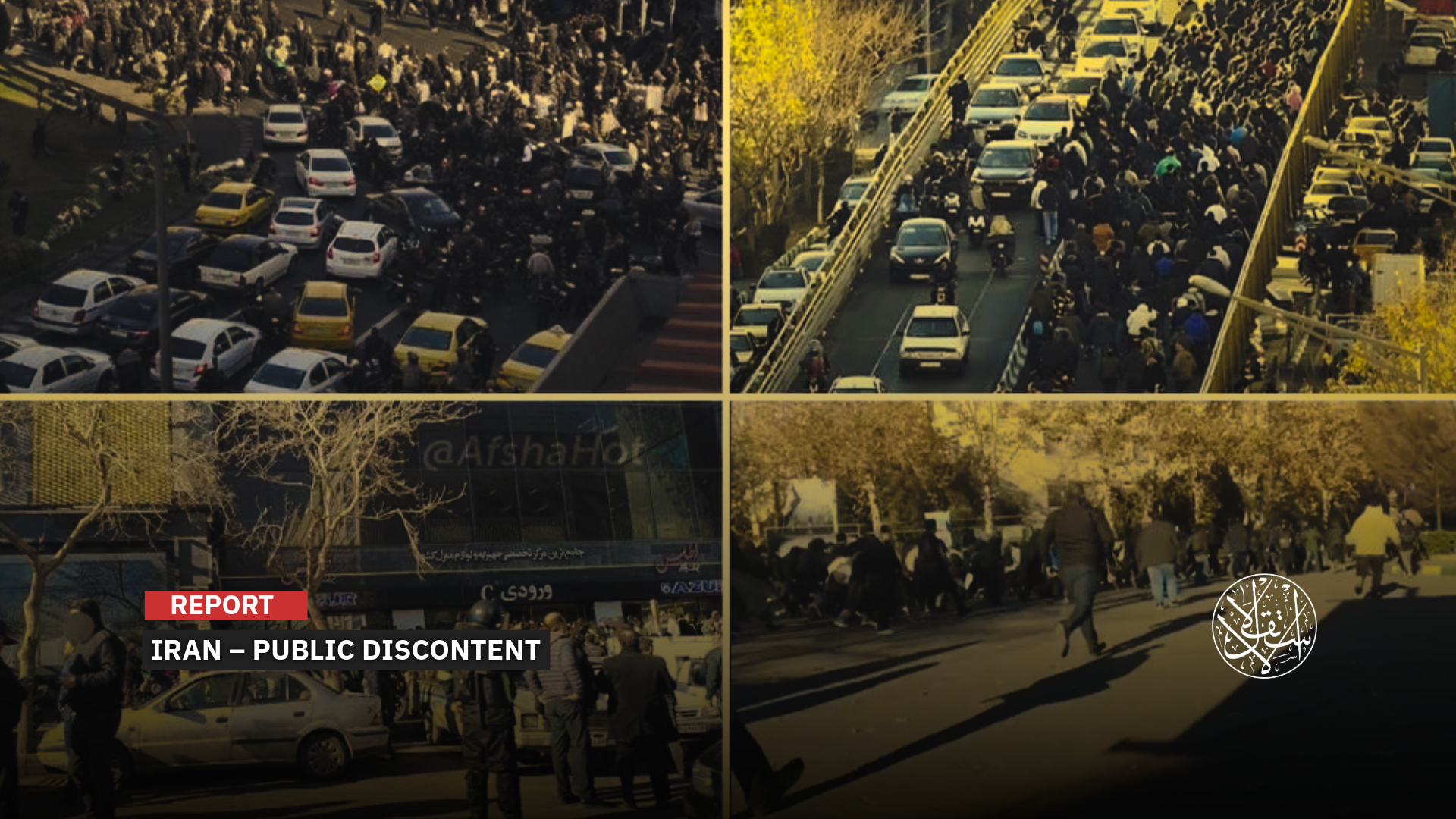
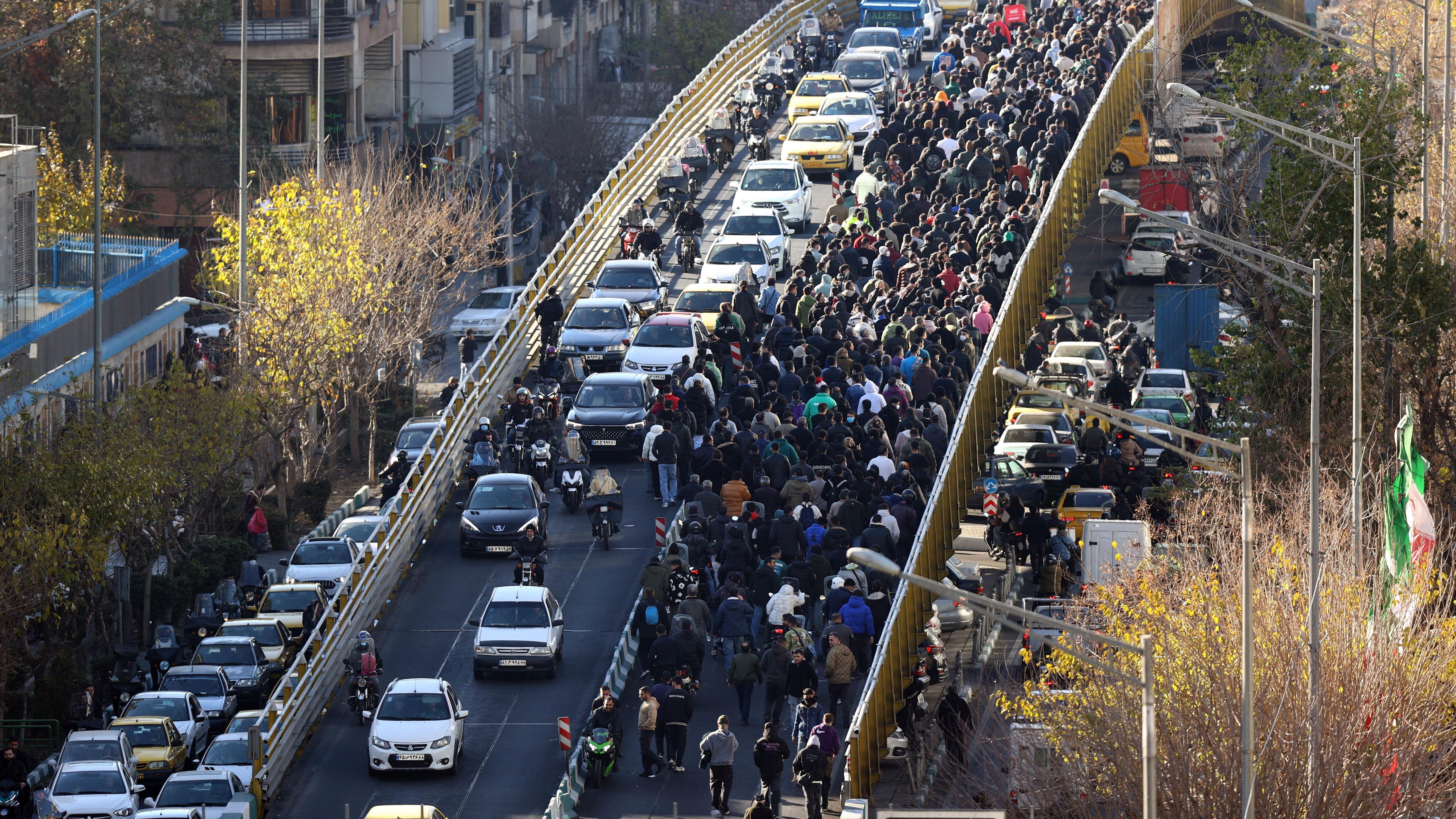
Since late December 2025, Iran has witnessed a wave of protests, the most intense in recent memory, resulting in seven deaths and numerous injuries.
The public anger began in Tehran in response to the collapse of the local currency, soaring inflation, and declining purchasing power, and then spread to cities and universities across the country, fueled by growing divisions within Iranian society.
These demonstrations come against the backdrop of a series of accumulated economic crises that have driven public discontent, presenting the ruling political regime in Tehran with a new test as it enters the new year, following a year fraught with internal and external tensions.
On January 2, 2026, US President Donald Trump warned Iranian authorities against firing on protesters, threatening military intervention.
For his part, Ali Larijani, a senior advisor to Iran's Supreme Leader, stated that US intervention in the protests would spread chaos throughout the region.
Ali Shamkhani, an advisor to the Supreme Leader, warned against any potential US role in the ongoing protests inside Iran, emphasizing that such intervention would be considered an unacceptable transgression and would lead to a direct response.
Ongoing Protests
The first spark of the protests ignited on December 28, 2025, in Tehran's commercial markets, when jewelry, currency exchange, and mobile phone shops closed their doors in response to the plummeting value of the national currency, the decline in living standards, and rampant inflation.
According to the unofficial black market rate, the Iranian rial hit a new record low against the dollar, exceeding 1.4 million rials per dollar, compared to around 820,000 rials a year earlier.
The protests then spread to wider areas of the capital, as merchants continued to close their shops and organized small gatherings to express their discontent with the rapid devaluation of the rial under the weight of Western sanctions.
The protests quickly extended to universities, where students organized gatherings and demonstrations at more than 10 universities in Tehran, Isfahan, and other cities, indicating that social anger was spreading to youth groups that had not been the focus of previous movements.
The protesters also chanted slogans criticizing Iran’s regional policies, particularly its involvement in regional conflicts, reflecting the link of economic crises and broader political issues.
In an unusual development on the Iranian domestic scene, the Israeli Mossad intervened directly, declaring its support for the Iranian protesters by broadcasting messages urging demonstrators to intensify their social activism and take to the streets.
The Mossad statement, published in Persian, employed inflammatory language, asserting its support for the protesters not only in words but also on the ground, implicitly indicating active backing for the Iranian street movement against the ruling authority in Tehran.
This intervention has sparked mixed reactions. The Iranian government has accused foreign entities, particularly “Israel”, of attempting to exploit public anger for political gain and to reshape the domestic landscape to serve hostile agendas.
Iranian authorities have long accused “Israel” of carrying out sabotage operations within Iran, targeting its nuclear facilities, and assassinating scientists, military personnel, and politicians on Iranian soil.
However, many protesters reject this characterization, asserting that their participation in the protests is primarily driven by their difficult living conditions and not by external motives.
Iran's economy has been hit hard by the reimposition of US sanctions in 2018 and is at risk of recession, with the World Bank forecasting GDP will shrink by 1.7% this year and 2.8% next year.
According to the state statistics centre, Iran's inflation rose to 42.2% this month from the same period last year, and is 1.8% higher than last month.
Food prices rose 72%, and health and medical items were up 50 per cent from December last year.
Reports in official Iranian media that the government is planning to increase taxes in the Iranian new year, which begins on March 21, have heightened concern.
Economic Exploitation
In a significant development, the Iranian government officially acknowledged the existence of popular protests stemming from the deteriorating economic situation, considering them an understandable reaction to the cost-of-living pressures faced by citizens.
In statements by the government, the vice president, and other officials, they emphasized that the protesters' demands are legitimate and must be addressed through dialogue.
For his part, Iranian President Masoud Pezeshkian stated on his social media accounts that he had instructed the Minister of the Interior to listen to the protesters' legitimate demands through dialogue channels.
He indicated that the people's livelihoods are his daily concern, affirming that the government is prioritizing fundamental measures to reform the monetary and banking system and preserve purchasing power.
Government spokeswoman Fatemeh Mohajerani said a dialogue mechanism would be launched, including talks with protest leaders.
According to the semi-official Mehr News Agency, Pezeshkian met with union officials and proposed a number of temporary tax measures intended to help businesses for a year, in an attempt to alleviate economic pressures.
The Pezeshkian government took further measures to try to quell the public's demands without resorting to security solutions, such as replacing central bank officials and appointing new economic officials, and declaring some public holidays to reduce the intensity of the demonstrations.
The government had submitted the 2026 budget to parliament, declaring reducing inflation a top priority, but a group of MPs demanded adjustments to monetary policies within the new year's budget.
In a letter to the Speaker of Parliament, the MPs stated that raising the exchange rate might address the budget deficit on paper, but would have inflationary effects on the economy and citizens' livelihoods.
Meanwhile, Prosecutor General Mohammad Movahedi-Azad warned that the authorities would take decisive legal action if the protests turned violent or were used to implement scenarios orchestrated from abroad.
Parliament Speaker Mohammad Bagher Ghalibaf warned against attempts to exploit the protests, saying that enemies were trying to drag the people's demands into chaos.
Basij commander Gholamreza Soleimani accused the United States and “Israel” of trying to exploit the economic discontent.
Media outlets close to the Islamic Revolutionary Guard Corps (IRGC) presented a balanced narrative, acknowledging the existence of protests while warning against their politicization.
Tasnim News Agency discussed the pressure of rents and the inability of some shop owners to pay them due to decreased sales, urging protesters to act responsibly to prevent the demonstrations from being exploited and turning into a security issue.
Fars News Agency stated that these protests could provide fertile ground for the activities of riot cells that would raise slogans beyond basic economic demands.

Legitimate Demands
On the political front, the Freedom Movement (Nehzat-e Azadi) issued an open letter criticizing the government's performance, arguing that overcoming the challenges without structural reform would be nothing but an illusion.
The letter stated that the government's record over the past year and a half is largely indefensible and inconsistent with the people's demands.
Mostafa Tajzadeh, a former deputy interior minister, described the protests as a right of the citizens, asserting that the roots of the crisis lie in the ruling political structure.
Reza Pahlavi, the son of Iran's last Shah, publicly expressed his support for the protests, stating that the economic situation would continue to deteriorate as long as the current regime remains in power.
In a message published on X, he called on various segments of society to join the protests and appealed to the security and military forces not to confront the protesters, lest they stand in the way of a regime on the verge of collapse.
The Narges Foundation, founded by Iranian Nobel laureate Narges Mohammadi, expressed its support for the protests in Iran, emphasizing that standing with the people is not a political choice, but a humanitarian and moral obligation.
For its part, the US State Department, through its Persian-language X account, announced its support for what it described as the voice of the Iranian people, considering the protests a reflection of widespread discontent with failed policies and economic mismanagement.
It called on Iranian authorities to respect the fundamental rights of citizens and respond to their legitimate demands, affirming that the United States is closely monitoring developments.
In subsequent posts, the US State Department shared videos from several Iranian cities, stressing that Washington's position is consistent with its stated support for human rights and fundamental freedoms.
Mike Waltz, the US ambassador to the United Nations, said that the Iranian people want freedom and have suffered for years under the rule of the clerics.
Former Israeli Prime Minister Naftali Bennett also commented on the ongoing protests in Iran in a video message posted on X, saying that the Iranian protesters deserve a better future and a more stable Middle East.
He considered the events a reflection of the failure of economic and political policies in Tehran, addressing his remarks directly to the protesters.
Widespread Discontent
These protests come at a time when Iranian authorities are intensifying their efforts to suppress dissent through arrests and executions, aiming to contain any widespread popular movement.
Despite these repressive measures, the continuation of current policies without a comprehensive approach to addressing the economic and social crises could lead to widespread protests and deepen the country's political and social crisis.
The market strike of 1905 served as the spark that ignited the Iranian Constitutional Revolution, and the market protests of January 1978 paved the way for the 1979 Iranian Revolution.
This historical background underscores that markets are not merely economic spaces, but rather a political force capable of conveying messages and effecting real changes in the structure of the ruling regime.
There is a growing sense of unease about the possibility of renewed conflict following the 12-day war between Iran and “Israel” last June, amid fears of a wider confrontation that could draw in the United States, further unsettling the markets.
US President Donald Trump said last week that he might back another round of Israeli airstrikes if Tehran resumed work on ballistic missiles or any nuclear weapons programme.
In September, the United Nations reinstated nuclear-related sanctions on Iran through what diplomats described as a Snapback mechanism. This led to the re-freezing of Iranian assets abroad, a halt to arms deals with Tehran, and the imposition of sanctions related to Iran's ballistic missile program.

Political analyst Ibrahim Khatib told Al-Estiklal that “although the recent protests in Iran began as a result of economic reasons, the slogans raised by the demonstrators have shifted from demands for improved living conditions to deeper political demands, criticizing the ruling political regime and calling for broader reforms that include public freedoms.”
“The protests were not limited to specific groups, such as students or the political elite, but extended to sectors not traditionally involved in major protests, such as merchants, private sector employees, and the middle class,” he added.
“This expansion indicates that the crisis is no longer simply a protest against rising prices or the collapse of the Iranian rial, but has become an expression of widespread discontent with the economic and social policies of the ruling regime in general,” he noted.
He concluded that “with the involvement of new segments of society, particularly traders, the protests become more impactful on the country’s basic economic activities, increasing pressure on the government and making any attempt to suppress the protests by force alone more difficult and dangerous.”
Sources
- Inside the massive protests sweeping Iran
- ‘We want the mullahs gone’: economic crisis sparks biggest protests in Iran since 2022
- Tehran Bazaar Protests Erupt as Rial Plunges to Record Low
- Deadly clashes between protesters and security forces as Iran unrest grows
- Iran protests hit deadliest day as unrest spreads to clerical stronghold Qom