How Religious Obsession Intertwined With US-Israeli Military Operations Against Iran
“Netanyahu referenced a Torah command comparing the Iranian regime to the Amalekites.”
It is clear that the US-Israeli attack on Iran is not limited to military and geopolitical dimensions, but extends to include a distinctly religious dimension from the moment operations began.
This dimension, which is emerging through testimonies from within the US military establishment, reveals a contradiction between the declared motives for the war on Iran, based on the rhetoric of deterrence and national security, and the undeclared motives that invoke narratives of a divine battle to accelerate towards Armageddon or bring about the biblical end of times.
The Military Religious Freedom Foundation (MRFF) has recorded more than two hundred complaints from US soldiers regarding the use of extremist religious rhetoric to justify the attacks, highlighting the ideological and political nature of mobilizing public opinion and legitimizing the operations.
Biblical Right
Just days after US Ambassador to Tel Aviv, Mike Huckabee, spoke of Israel’s biblical right to large parts of the region, war broke out against Iran.
This entanglement of religion and politics is not new to the Zionist project, but it is more pronounced in this latest war against Iran.
It is noteworthy that the timing of the military operation coincided with Purim, the Jewish holiday commemorating their victory and deliverance from a plot to annihilate them.
The choice of this timing reflects the evocation of historical and religious symbolism, lending the operation a mobilization and strategic dimension, and linking it to the narrative of survival and the defense of Jewish existence.
From the very first moment of the war on Iran, religious symbols were employed in its description. It was initially called Judah’s Shield, a reference to the tribe of Judah in the biblical narrative, before the name was later changed to Roar of the Lion.
The lion symbol in Hebrew tradition is associated with the tribe of Judah, one of the tribes of “Israel”, which represents strength and sovereignty according to the biblical narrative. Similarly, the name Roar of the Lion evokes an image of irresistible force.
Thus, the name appears not merely as a military description, but as an invocation of religious symbolism, presenting the war as an extension of a historical narrative of power and dominance.
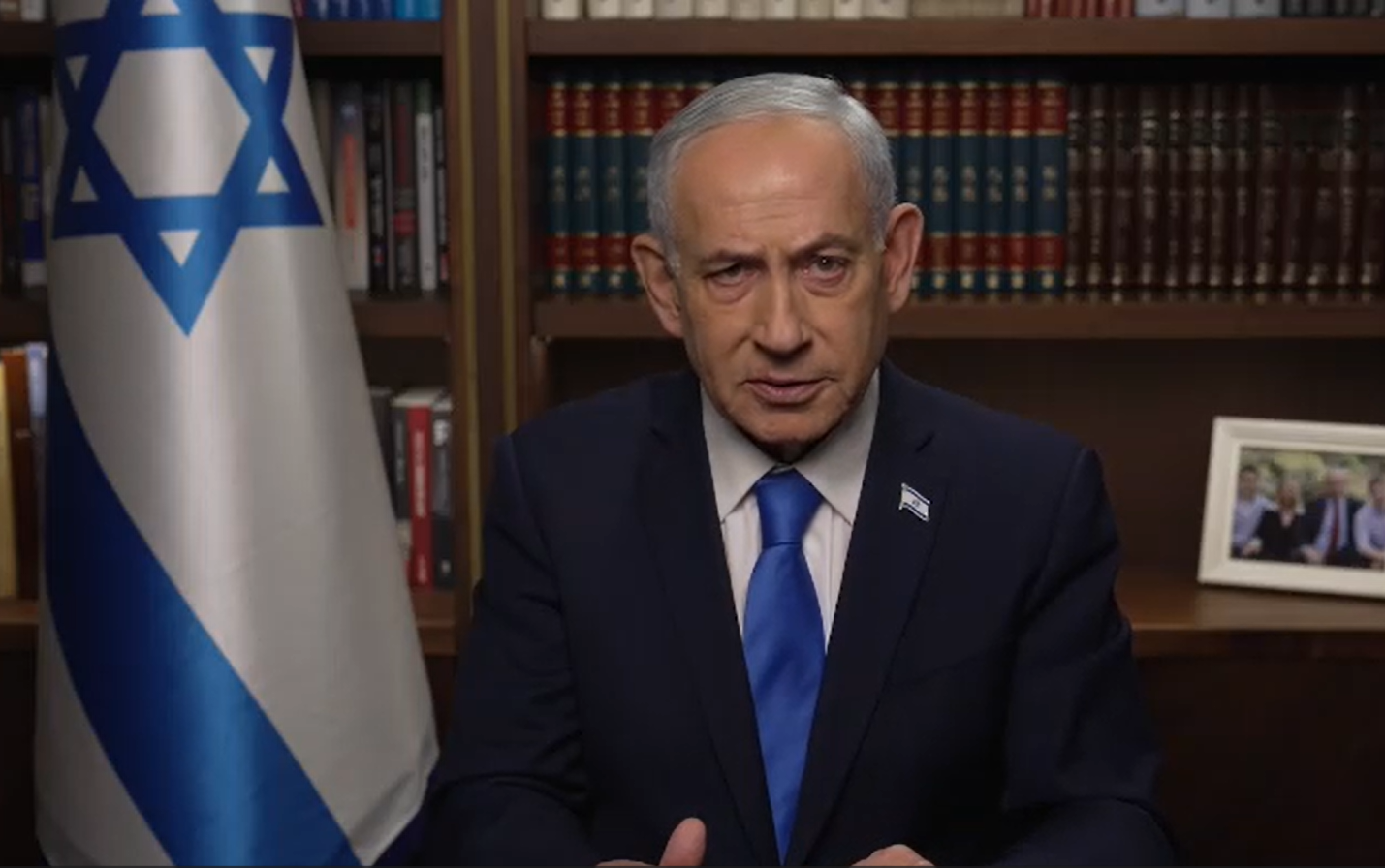
This rhetoric is not limited to linguistic symbols or the names of operations; it also appears in the political discourse of Israeli leaders, most notably Benjamin Netanyahu, who is considered one of the Israeli politicians most frequently employing religious references in his political rhetoric.
A day into the attack, Netanyahu referenced a Torah command comparing the Iranian regime to the Amalekites, an ancient biblical foe representing pure evil.
At the beginning of the 2023 Gaza war, Netanyahu invoked biblical narratives of the Jewish people’s existential battles, presenting the confrontation as an extension of a long historical conflict between Israel and its enemies.
Israeli President Isaac Herzog was also seen reading passages from the Book of Esther, a powerful symbolic reference in Jewish religious consciousness, as the biblical narrative recounts the Jews’ survival of a plot to exterminate them in Persia.
In this context, invoking this story appears to be more than just a devotional act; it is a reframing of the current confrontation as an extension of a historical conflict between the Jews and Persia, meaning present-day Iran.
In other descriptions, Israeli Air Force Commander Major General Tomer Bara referred to the squadrons of warplanes carrying out the raids as Genesis, a direct reference to the first book of the Torah.
Such a name lends the military operation a foundational dimension, suggesting the beginning of a new phase or the creation of a new reality, according to a Torah-based religious narrative that intertwines theological symbols with political discourse.
“Israel” seeks to present its operations against Iran as an existential battle that cannot be postponed, a strategic necessity dictated by national security considerations and the equations of deterrence in the region.
Divine Plan
On the American side, this discourse is fueled by the ideological background of the conservative evangelical movement, which constitutes one of the most important pillars of political support for “Israel” within the United States.
This movement views the establishment and expansion of “Israel” as part of the fulfillment of biblical prophecies linked to end-times prophecies.
Therefore, it was not surprising that the war was accompanied by religious blessings from evangelical leaders for President Donald Trump, as the confrontation was presented in some of their speeches as part of a cosmic struggle between good and evil, or a step on the path to fulfilling the divine promise.
It is worth noting that the book ‘Nuclear Iran and the Future of Israel and the Middle East: The Confrontation with Iran’ by the American evangelical writer Mark Hitchcock provides a clear model for how to interpret the conflict with Iran within this theological framework.
The book does not treat Iran merely as a political or strategic adversary, but rather connects its regional rise to biblical prophecies about an alliance led by a people referred to as Persia against Israel in the end times.
In this interpretation, the confrontation with Iran is not understood solely within the context of power balances in the Middle East, but rather as a link in a broader historical trajectory linked to what the evangelical movement calls end-day prophecies.
In this sense, the geopolitical conflict becomes part of a larger religious narrative, where political and military shifts in the region are interpreted as indicators of the approaching fulfillment of biblical prophecies.
From this perspective, one can understand how evangelical religious discourse converges with the Zionist narrative at a single point: transforming “Israel” into the center of global events and presenting regional confrontations—including the conflict with Iran—as part of a historical trajectory with a theological dimension that transcends the boundaries of traditional politics.
For his part, political analyst Ismail Masalmani explained to Al-EstiKlal that “the recent war on Iran reveals a profound overlap between the Zionist colonial project and a transnational theological discourse that finds common ground in the alliance between the Israeli right wing and the American evangelical movement.”
“In this context, biblical, Talmudic, and Gospel texts are invoked during times of war not merely as spiritual references, but as tools of political and psychological mobilization that imbue the conflict with a meaning transcending its geopolitical boundaries, sometimes even presenting it as the fulfillment of a religious promise,” he said.
Holy War
According to The Guardian, American soldiers said their commanders told them the war on Iran was aimed at achieving what they called salvation, as interpreted in the Bible.
This has raised renewed concerns about the intrusion of religious discourse into military operations and its potential impact on military discipline and national security.
An unauthorized officer explained in an email to the Military Religious Freedom Foundation (MRFF) that their commander urged them to tell other soldiers that what was happening was part of a divine plan, citing several passages from the Book of Revelation that refer to the resurrection and the imminent return of Jesus Christ.
He noted that his commander also said that Trump was anointed by Christ to trigger a signal in Iran that would lead to the resurrection and return of Christ to Earth.
The Guardian added that the officer's letter was one of more than 200 letters received by the MRFF from over 50 military units since February 28, when President Trump announced the start of a large-scale strike against Iran as part of a military campaign involving the United States and “Israel”.
The MRFF believes that this type of rhetoric can put moral pressure on soldiers who do not share these beliefs and can create a sense of exclusion within the armed forces.
While the Pentagon remains silent regarding these constitutional violations, concerns are growing that the US military doctrine is shifting from protecting national interests to waging a transnational holy war, escalating tensions with Iran and making it more difficult to find political solutions to a conflict viewed through an apocalyptic lens.
In turn, Mikey Weinstein, MRFF's president, stated that since taking office, US Secretary of War Pete Higseth has removed several traditional barriers between the military and religion within the Pentagon.
He explained that this included introducing religious practices, such as prayer sessions and Bible studies aligned with a messianic theology that is extreme in its support for “Israel”, which he considered an indication of the growing presence of religious discourse within the military establishment.
He warned that this religious intrusion within a multi-ethnic and multi-religious military could pose a threat to US national security.
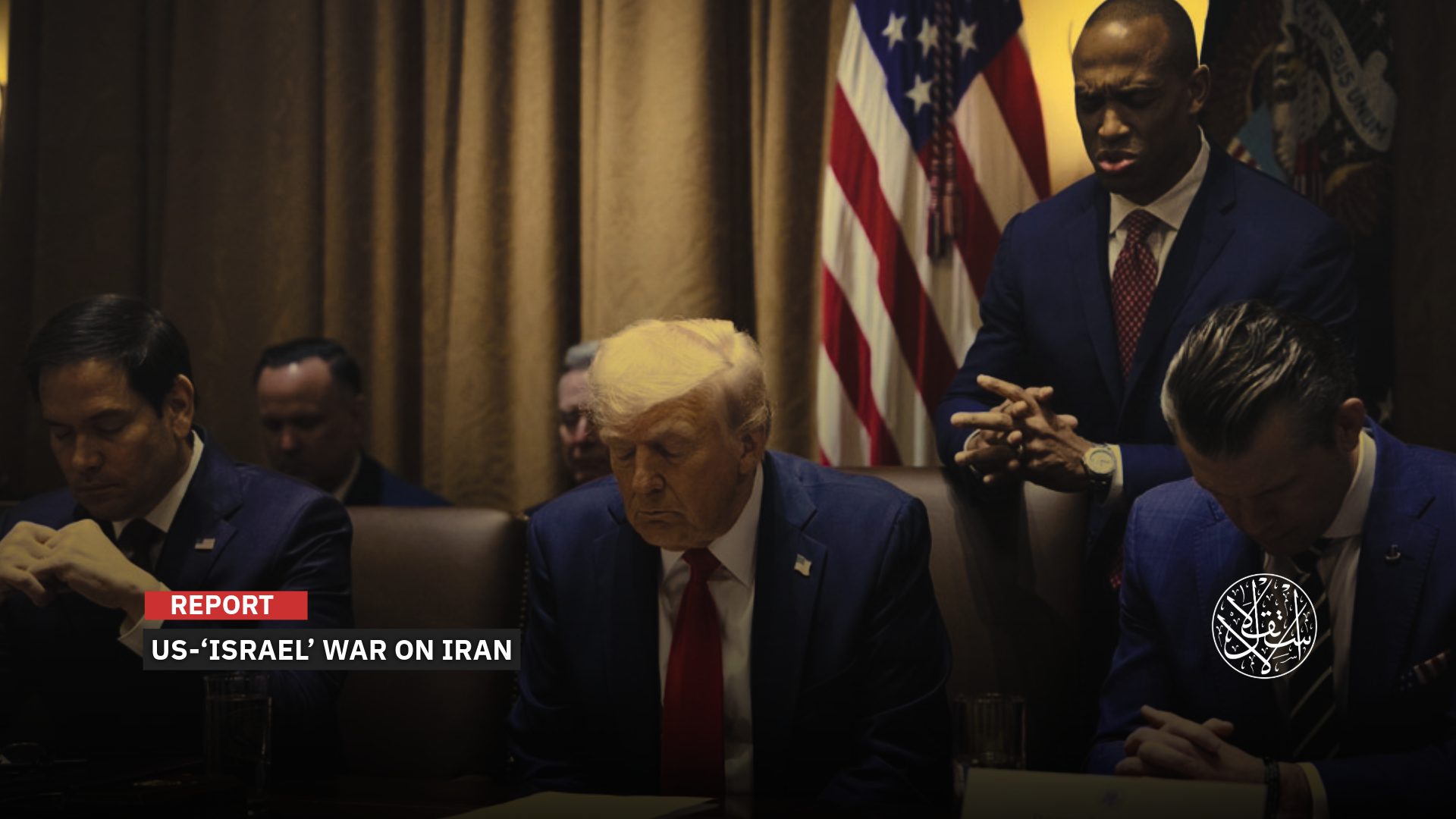
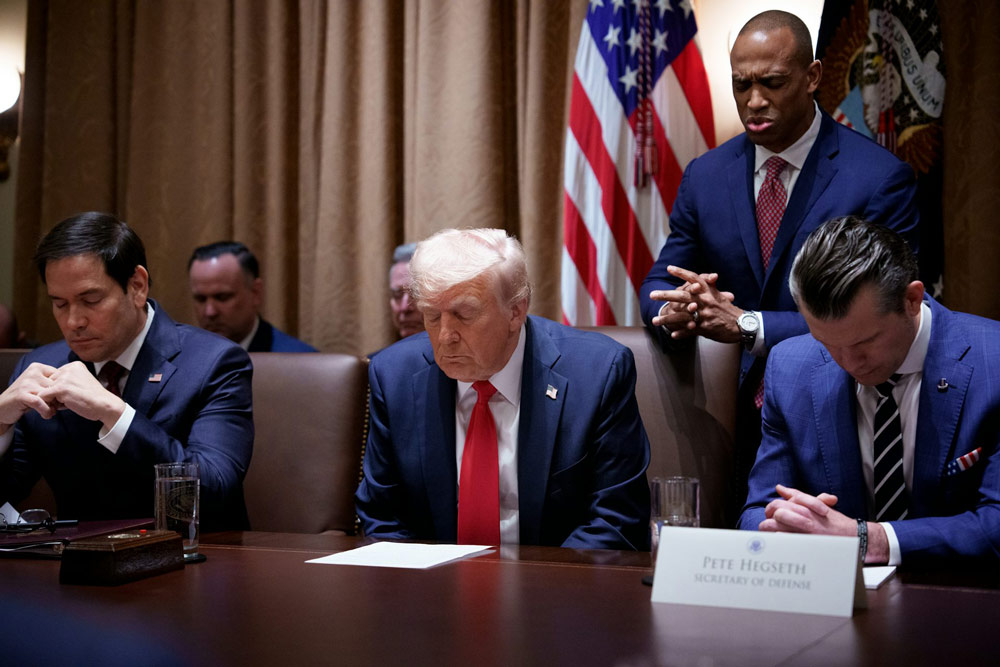
In a related development, President Trump met with a group of pastors and evangelical church leaders at the White House to hold a prayer service for the U.S. military in its war on Iran.
Among those present were Paula White, a close spiritual advisor to Trump; Franklin Graham, son of preacher Billy Graham; Jack Graham, pastor of Preston Wood Baptist Church; Robert Jeffress, pastor of a large church in Texas; and others.
This event clearly highlighted the Trump administration's approach of integrating religious discourse into its political and military rhetoric.
Observers noted that a segment of Trump's political base views his leadership of the nation as part of a religious agenda, and that the strong support from the conservative Christian movement has doctrinal dimensions.
Analysts argued that Trump's use of this type of rhetoric reflects a two-pronged strategy: to bolster loyalty within his conservative Christian base and to construct an ideological framework that grants military action moral and religious legitimacy in the eyes of this segment of the public.
Sources
- US troops were told war on Iran was ‘all part of God’s divine plan’, watchdog alleges
- Why are the US and Israel framing the ongoing conflict as a religious war?
- Is the US-Iran war a religious war? US troops were briefed of Armageddon, return of Jesus
- Operation ‘Roaring Lion’: Here is why the planet’s second-largest cat is a recuring motif in Judaism
- Biblical use of Israel's war on Iran [Arabic]