Saudi Arabia and the UAE on the Brink of a Clash in Yemen: Is the ‘Little Sparta’ Dream Fading?
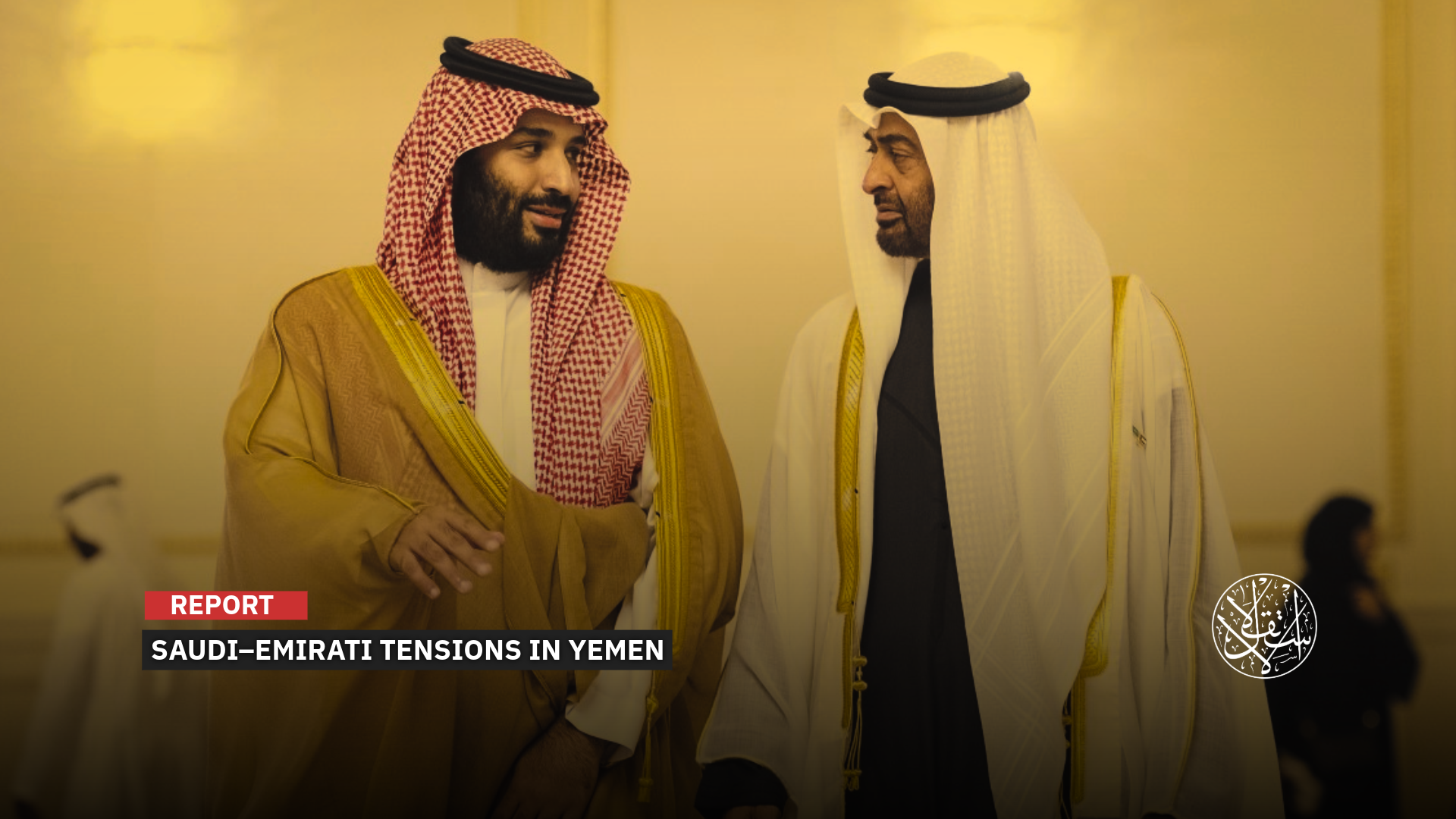
What started as a Saudi-Emirati alliance in Yemen has unraveled into an open standoff between the two partners.
Yemen has become the stage for a series of sharp and dangerous shifts that suggest Saudi Arabia’s patience has finally run out. In a marked departure from years of cautious containment, Riyadh appears to be drawing explicit red lines in its dealings with the United Arab Emirates—moves that raise the prospect of a confrontation sliding from quiet rivalry fought through proxies into something far more direct, should Abu Dhabi persist with policies Saudi officials see as encroaching on their national security and destabilizing other Arab states, notably Egypt, Sudan, and Libya.
The first and most dramatic signal came on December 30, 2025, when Saudi warplanes struck military equipment reportedly bound from the UAE to the Southern Transitional Council, the Emirati-backed militia seeking to entrench its control over large swaths of southern Yemen. The message was unmistakable: Riyadh was no longer willing to look the other way.
A second escalation followed swiftly. Yemen’s Saudi-backed Presidential Leadership Council announced the cancellation of a joint defense agreement with the UAE, while President Rashad al-Alimi formally demanded that Abu Dhabi withdraw all its forces from Yemeni territory within 24 hours. It was an extraordinary ultimatum between erstwhile partners.
The third step raised the stakes even higher. Saudi Arabia’s foreign ministry issued an unprecedented official warning to the UAE, calling for the immediate withdrawal of its troops and a halt to any military or financial support for armed actors inside Yemen.
Taken together, these moves point to a clear Saudi decision to curb what it views as an Emirati project of expanding influence that now cuts directly against the kingdom’s core security interests. The approach echoes earlier efforts by Arab states—Egypt foremost among them—to push back against Emirati ambitions in other arenas, including Sudan.
The timing was deliberate. The Saudi airstrikes on Emirati-linked weapons shipments toward separatist forces in Hadramawt coincided with the foreign ministry’s warning and the scrapping of the joint defense pact. The combined measures carried a blunt political message: Riyadh will not tolerate attempts to impose a de facto partition of Yemen or undermine its territorial unity.
Describing Saudi national security as a “red line” marks the toughest language Riyadh has yet used toward Abu Dhabi, according to Reuters on December 30, 2025. It also raises an uncomfortable question: what happens if the UAE and its allied militias continue to brush off Saudi warnings, as they have in the past?
That uncertainty deepened when, just days earlier on December 26, Abu Dhabi had publicly affirmed its support for Saudi efforts to restore stability in Yemen following an initial, indirect warning from Riyadh. Yet within 24 hours, developments on the ground told a different story. On December 27, the UAE reportedly dispatched two ships loaded with weapons from Fujairah to the port of Mukalla—an act Saudi officials viewed as a direct blow to Yemen’s security and a test of the kingdom’s resolve.

Red Lines
Saudi Arabia had previously relied on indirect signals, including airstrikes on positions linked to the UAE-backed Southern Transitional Council militia, while carefully avoiding any public accusation against Abu Dhabi. That restraint ended on December 30, 2025. The latest Saudi strike marked a clear shift in tone, as the kingdom explicitly named the UAE for the first time.
Riyadh said it had targeted what it described as foreign military support that entered Yemen illegally, through deceptive methods and without the required authorization from the leadership of the Arab Coalition, at the port of Mukalla in eastern Yemen. While the initial statement stopped short of naming the source, Saudi officials later made an unprecedented clarification, stating that the support had come from the United Arab Emirates.
The accusation was reinforced with video footage released by the Saudi military, showing aerial surveillance of two ships arriving at the port loaded with weapons, ammunition, and military vehicles. One vessel was identified as the Greenland and traced back to its departure point at the Emirati port of Fujairah, leaving little ambiguity about where Riyadh believes the line was crossed.
In parallel with these developments on the ground, Saudi-owned al-Arabiya launched a calibrated media escalation against the UAE, accusing it of seeking to encircle Saudi national security by backing separatist forces inside Yemen.
Soon after, Yemen’s Saudi-backed Presidential Leadership Council moved to cancel the joint defense agreement with the UAE and formally demanded the withdrawal of all Emirati forces from Yemeni territory within 24 hours. The decision was followed by an unusually blunt warning from Saudi Arabia’s foreign ministry.
The statement amounted to a clear drawing of red lines toward Abu Dhabi. It expressed the kingdom’s “regret over the UAE’s practices” and stressed that Saudi national security was non-negotiable. “In this context, the kingdom stresses that any threat to its national security is a red line, and the Kingdom will not hesitate to take all necessary steps and measures to confront and neutralize any such threat,” the statement said, language widely read as signaling readiness to escalate beyond diplomacy, potentially including military options in Yemen and other arenas such as Sudan and Somaliland.
Riyadh also held the UAE responsible for pressuring the Southern Transitional Council to launch military operations in Hadramawt and al-Mahra, arguing that such moves run counter to the principles on which the Saudi-led coalition in Yemen was founded and pose a serious risk to regional stability.
The statement concluded by calling for an immediate halt to any military or financial support for armed actors inside Yemen and urged the UAE to comply with the Yemeni government’s demand to withdraw its forces within 24 hours, warning that tougher measures would follow if current policies continued.
This moment marks the sharpest military and political escalation between Saudi Arabia and the UAE in years, pushing the two partners into a direct confrontation over influence in Yemen. It comes as rivalry between them deepens across other regional files, from Sudan to the Horn of Africa.
While Saudi-Emirati competition is hardly new, the latest rupture is driven by Riyadh’s sense that the threat has moved uncomfortably close to home. Saudi officials see Emirati-backed militias and secessionist projects in Yemen as an attempt to engineer a new reality on the Kingdom’s southern border, one that could replicate the Sudanese model and produce a “new Hemedti” on its doorstep.
For that reason, this is the first time Saudi Arabia has raised the tone of its warnings to such an explicit and confrontational level in the Yemen crisis. According to the Saudi Gazette on December 30, 2025, Riyadh has effectively drawn firm red lines and made clear that its national security is not open to negotiation.
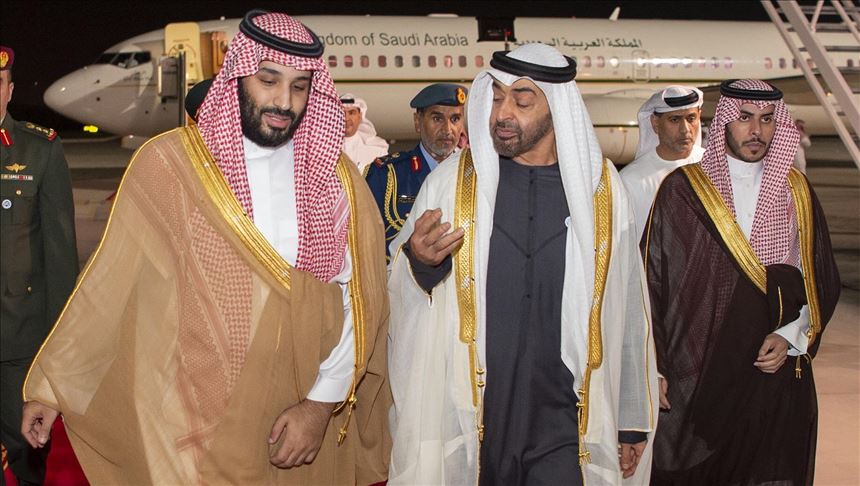
What Comes Next?
Saudi Arabia’s decision to raise its warnings and escalate militarily stems from the territorial expansion of the UAE-backed Southern Transitional Council, which has seized new cities and regions in Yemen, most notably Hadramawt and al-Mahrah, and moved closer to the Saudi border. Riyadh views this expansion as a direct threat to its national security due to the geographic proximity to its southern frontier.
Gulf and international analysts suggest that Yemen is heading toward a clear split within the Gulf alliances, with rising tension between Saudi Arabia and the UAE potentially undermining the cohesion of the “Arab coalition” in Yemen following recent Saudi military strikes. Other forecasts warn that if UAE-supported separatist forces continue advancing, either directly or indirectly, it could further destabilize Yemen and challenge Saudi efforts to maintain the country’s unity.
Saudi concern is heightened by overlapping regional issues, particularly Israeli Occupation’s attempts to expand influence via the “Land of Somaliland,” involving Abu Dhabi in regional alliances that risk turning Southern Arabia and the Horn of Africa into a hotspot of conflict. Observers expect the Saudi escalation to have wider strategic repercussions, deepening the regional power struggle, affecting Red Sea security and maritime navigation, and potentially spreading tensions to other fragile areas such as Sudan.
Economic consequences for the UAE are also plausible if the conflict intensifies, given the country’s investment- and tourism-driven “trade hub” economy, which is highly sensitive to regional instability.
This latest escalation marks a tangible step beyond verbal threats, following Saudi strikes on UAE-linked sites and the interception of weapons shipments from Fujairah port, setting the stage for increasingly complex and sensitive scenarios.
Mohammed al-Basha, a Yemen specialist and founder of the Basha Report Risk Advisory, told the Associated Press on December 30, 2025, that both sides are likely to pursue “a calibrated escalation.” He predicted that the Southern Transitional Council would reinforce its territorial gains, while the UAE would likely scale back arms transfers after Saudi strikes on key supply routes, especially given Saudi air superiority.

The ‘Little Sparta’ Dream
In 2020, Western political and media circles began dubbing the UAE as “Little Sparta,” a label notably used by former U.S. Defense Secretary James Mattis to highlight the country’s growing military role and outsized regional influence, despite its small population and geographic footprint. The nickname reflected Abu Dhabi’s intensive military and economic activity across various regional and international theaters, from Afghanistan to Yemen, alongside massive investments in defense and geopolitical reach, according to the BBC on September 24, 2020.
The comparison to ancient Sparta stemmed from the UAE’s direct involvement in overseas military operations and interventions in unstable regions, echoing Sparta’s historical reputation for martial dominance despite limited resources. Analysts noted that Abu Dhabi leveraged its economic power to support political and military objectives, extending its influence beyond the Gulf into the Horn of Africa, Yemen, and Libya, becoming a significant regional player over the last two decades.
However, the label began to shift. By September 2021, The Washington Post reported that the UAE was attempting to transition from a “Little Sparta” model to a “Little Singapore” approach, aiming to combine hard power with global economic influence. U.S. diplomat Martin Indyk reportedly compared then-Crown Prince Sheikh Mohammed bin Zayed to the Kissinger of the Arabs, emphasizing his pragmatic reading of power balances rather than emotional calculations.
A detailed study by Neil Quilliam and Sanam Vakil from Chatham House, published in Foreign Affairs on December 29, 2023, analyzed this transformation. They highlighted that under Mohammed bin Zayed, the UAE shifted from being known mainly for Dubai’s real estate and consumer allure to a country investing billions in modernizing its military—earning Mattis’s “Little Sparta” label—while establishing itself as a regional financial hub and forging ties with major powers, including “Israel” and the U.S.
The UAE’s ambitions, the researchers argue, go beyond regional influence; it aims for a Singapore-style model, projecting global economic and diplomatic power that offsets its geographic and demographic limitations. The analysts compare the ruling family’s strategy to the Medici dynasty of Florence, which turned a small city-state into a major economic, cultural, and political force through trade, banking, and smart alliances.
Critics, however, view the “Little Sparta” approach as a risky path. They argue that Mohammed bin Zayed departed from the UAE’s founding neutral and mediating legacy under Sheikh Zayed, opting instead for military intervention and aggressive influence. The UAE has become one of the world’s largest arms importers, spending over $30 billion annually, and is directly or indirectly involved in wars in Afghanistan, Libya, Yemen, and Sudan.
Abu Dhabi has also sought control over strategic locations—ports, islands like Socotra, Mayun, and Aden, and military bases in the Horn of Africa, such as Assab in Eritrea and Berbera in Somaliland—pushing beyond its natural capacity. Reports accuse the UAE of employing foreign mercenaries from Colombia and Russia, fighting either in UAE uniforms or in militias it backs, as well as hiring private companies for targeted assassinations of political opponents.
Critically, journalist Abdelmoneim Mahmoud described the UAE as a “skyscraper on thin soil,” warning that the “Spartan” model is an expensive illusion: a massive military structure lacking domestic depth, reliant on fragile external pillars. Observers caution that, like ancient Sparta, overreliance on military might over sustainable governance could eventually lead to collapse, raising fundamental questions about the sustainability of the UAE’s hard-power-focused, interventionist growth model.
Sparta, an ancient Greek city-state, emerged as an independent political entity around the 10th century BCE. It became famous for its rigid militaristic culture, a hallmark of many Greek city-states.
Historically, Sparta’s story did not end in lasting success. In 480 BCE, just before the Greek–Persian War, Spartan leaders consulted the Oracle of Delphi for guidance and received a chilling prophecy: “Either Sparta will fall, or one of its kings must die.”
This fate unfolded at the Battle of Thermopylae, where King Leonidas and 300 of his soldiers sacrificed their lives facing the invading Persian armies. While their heroism became legendary, Sparta’s economy was devastated, and the city suffered greatly despite its valiant resistance.
Reflecting on this history, many analysts see the UAE’s “Little Sparta” approach as carrying an implicit warning. Excessive military ambitions and intensive external interventions, they argue, could produce unpredictable consequences, potentially exposing the state to both internal and external challenges that threaten long-term stability.
Sources
- UAE to pull remaining forces from Yemen in crisis with Saudi Arabia
- Saudi Arabia bombs Yemen port city over weapons shipment from UAE for separatists
- The Medicis of the Middle East?
- The United Arab Emirates: How It Emerged as a Regional Power [Arabic]
- Saudi Arabia reveals details of Yemen bombing, as UAE set to withdraw