From Blocking to Information Flooding: The UAE’s Tools for Controlling the Digital Space
X has a regional office in Dubai Media City, effectively placing the platform under UAE jurisdiction.
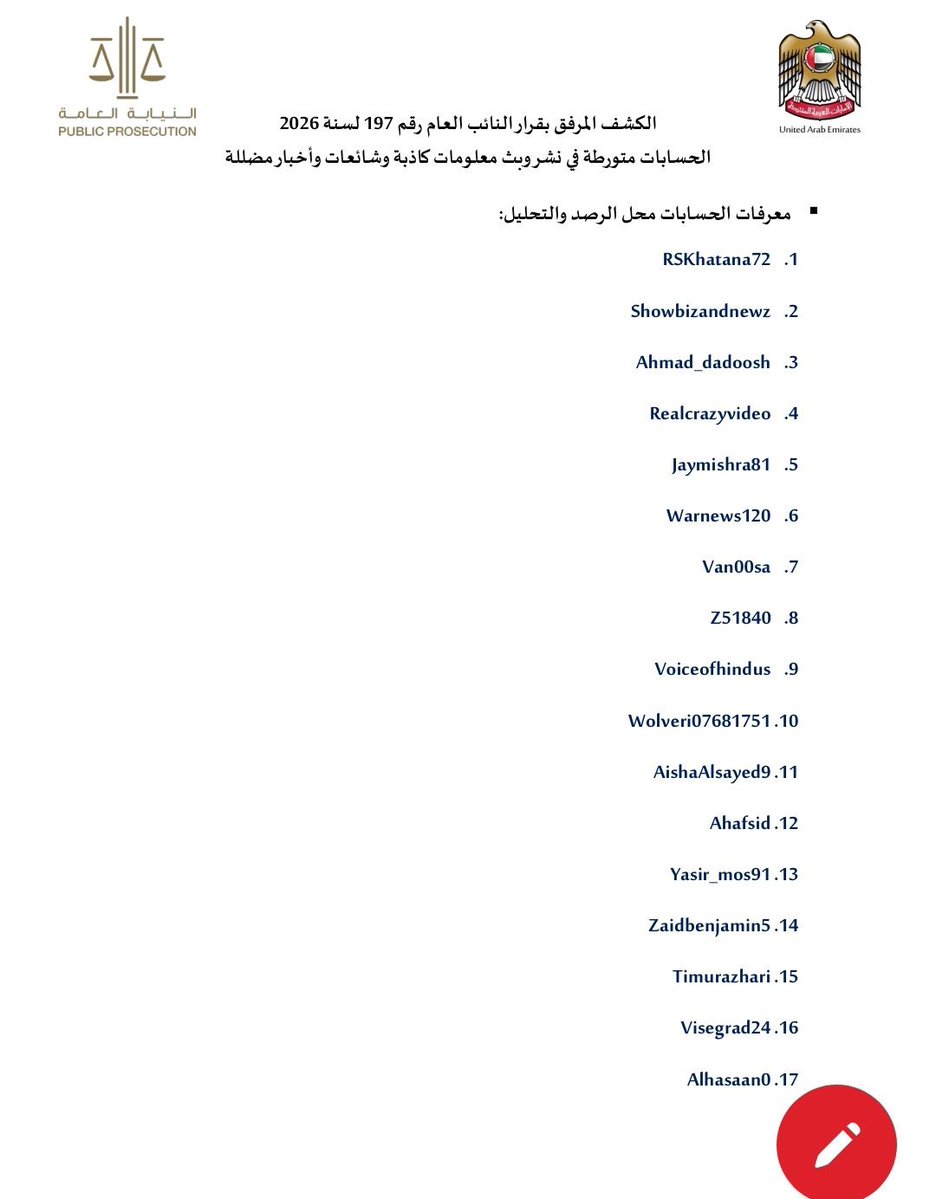
On March 2, 2026, the United Arab Emirates Federal Public Prosecution ordered the blocking of several accounts on X inside the country, accusing them of publishing illegal content and insulting the state and its leadership.
The decision, assigned for enforcement to the Telecommunications and Digital Government Regulatory Authority, was not just a routine technical measure. It came at a politically charged moment, as regional tensions surged following the U.S.-Israeli war on Iran, while a separate political and media dispute simmered between Abu Dhabi and Riyadh.
At the same time, users inside the UAE began noticing that a number of prominent Arab and Saudi accounts had suddenly become inaccessible. Outside the country, however, those same accounts continued to function normally.
Attempts to open them from within the UAE produced a short message: the account was “withheld in this country in response to a legal demand.”
The phrase is brief, but it captures an entire system of digital control. A government request is issued, the platform complies, and the content disappears from the local feed, effectively sealed off from audiences inside the country while remaining visible to the rest of the world.
The incident raises a bigger question: how the UAE uses geo-blocking, digital laws, and X’s Dubai office to control the digital space at home.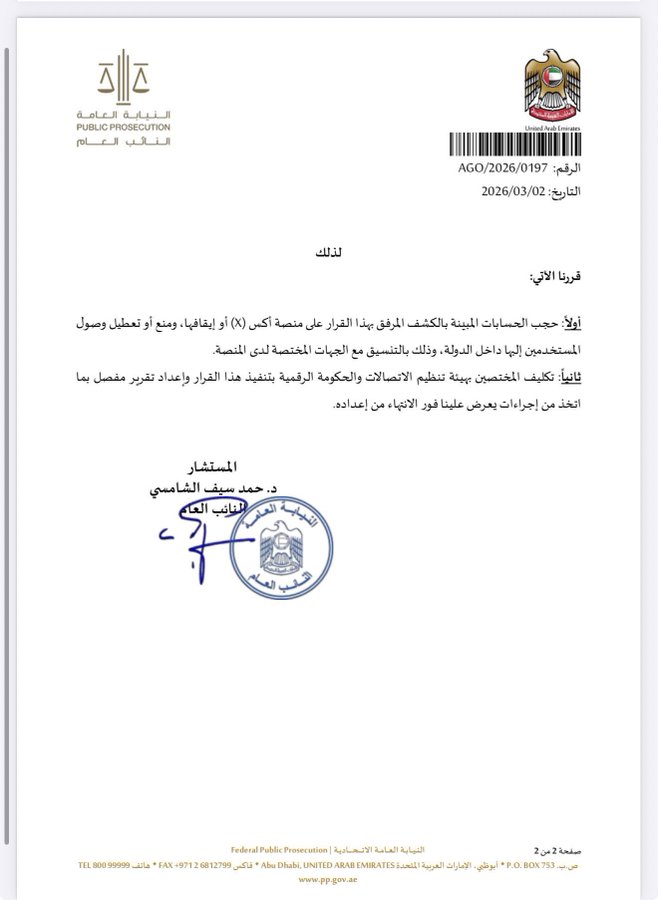
The Latest Decision
The latest order did not pass quietly through the Arab digital sphere. The accounts affected were far from marginal; many of them are followed by millions and play a visible role in shaping the Arab media landscape online.
Among those blocked inside the UAE was the breaking news account of al-Arabiya, along with the account of Saudi activist Iyad Al-Humoud, who has more than five million followers and is known for sharing global news and widely circulated public information.
The restrictions also hit the account of Saudi journalist Malik Alrougui, as well as other accounts, including Emirati opposition figure Maryam al-Hammadi and Misbar, which specializes in verifying news.
The list extended further, including the economic account of Asharq Business, the account of Saudi strategic analyst Hesham Alghannam, and the British-based outlet Middle East Eye.
The variety of accounts affected suggests the issue is not tied to a single type of content. Instead, it touches a wide spectrum of digital voices that share one common thread: influence over the Arab public debate or criticism of Emirati policies.
The move also comes at a highly sensitive political moment, with the blocking measures unfolding as regional tensions rise following exchanges of strikes between Iran on one side and the United States and “Israel” on the other, while the Gulf enters a new phase of sharp media polarization.
At the same time, relations between Saudi Arabia and the United Arab Emirates (UAE) were showing signs of strain, reflected in opinion columns, digital campaigns, and mutual criticism across traditional media and social platforms.
In that context, blocking accounts no longer looks like a simple legal or technical measure. It has become part of a wider battle over narratives in the digital space.
Emirati authorities rely on a legal framework built over recent years to monitor and regulate the digital sphere, particularly the platform X, which remains widely used across the Gulf.
At the center of this framework is the UAE’s 2021 law on combating rumors and cybercrimes, a piece of legislation that has become the backbone of the country’s digital regulatory system.
The law grants authorities broad powers to act against online content they consider illegal or harmful to the state, the political order, or the national economy.
Among the most significant tools it provides are so-called “access blocking” orders. These directives are issued to internet service providers, requiring them to prevent users inside the country from accessing specific websites or accounts.
It also gives the public prosecutor the authority to order the blocking of websites or accounts if their content is deemed unlawful or viewed by officials as a threat to national security—a justification that appears frequently in such decisions.
These wide-ranging powers allow authorities to intervene quickly, especially during political or security crises, and particularly when information about regional events begins circulating widely online.
The approach has drawn criticism from international rights groups such as Freedom House and Human Rights Watch, which have warned in multiple reports that such laws can sometimes be used to restrict freedom of expression on the internet, noting that terms like “misinformation” or “threats to national security” can be interpreted broadly.
For Emirati authorities, however, the stated aim of these laws is to protect society, particularly during periods of political or security tension.
Critics argue the opposite: that the same legal tools give the government sweeping power to narrow the digital media space, sideline critical voices, and in some cases silence them altogether.
Dubai, Where the Decisions Are Made
Yet the most sensitive part of the equation is not the law alone, but geography. The platform X maintains a regional office in Dubai Media City, effectively placing the company within the legal jurisdiction of the UAE.
That physical presence simplifies direct communication between local authorities and the platform’s management, cutting through procedures that might otherwise take longer if the company operated from abroad.
In the world of digital platforms, the distance between governments and companies often determines how quickly decisions are carried out.
When a company operates inside the same country, legal requests can be delivered quickly, and their implementation followed up more directly.
The regional office in Dubai gives Emirati authorities an additional advantage in that regard. The company functions within a local regulatory environment and is subject to UAE laws governing media, telecommunications, and cybercrime.
In practice, that means any legal request issued by a government body can move rapidly through the company’s internal channels.
Over the past several years, a number of rights groups have raised concerns about how this geographic proximity might affect the platform’s independence, particularly when it comes to accounts belonging to opposition figures or activists critical of Emirati policies.
Critics argue that hosting the regional headquarters of a global platform in a country with strict media laws may create indirect pressure on the company to respond quickly to requests for blocking accounts or restricting content.
Even in cases where platforms do not comply immediately, the UAE retains additional technical tools to control access to information.
Authorities can implement blocks through local internet service providers, using measures such as disabling direct links to specific accounts or filtering traffic heading toward certain pages.
These systems rely on advanced digital firewalls capable of preventing specific pages from loading or redirecting users to warning screens.
In some cases, traffic inspection technologies can also be used to detect requests directed at certain websites or accounts and block them altogether.
This technical layer makes it possible to isolate specific content inside the UAE even while it remains accessible in the rest of the world.
In that sense, geo-blocking becomes a precise instrument for managing the flow of information within national borders without confronting global platforms head-on.
What gives these measures a sharper political edge is the regional context in which they appeared.
Relations between Saudi Arabia and the UAE have swung in recent years between cooperation and friction. But the past few months have revealed a noticeable rise in tensions, whether over economic competition or differing positions on several regional issues.
That strain has spilled clearly into the digital sphere, where social media platforms have become an open arena for debate between writers, journalists, and influencers from both sides.
In such an atmosphere, controlling the flow of information inside the UAE becomes a politically sensitive matter.
From the perspective of critics of Emirati policies, blocking prominent Saudi or Arab accounts inside the country reflects an attempt to shape the media narrative at a time when political and media tensions between the two states are running unusually high.
For the UAE, however, managing the digital space is no longer seen as a purely technical task. It has become part of a broader effort to manage regional influence, at a time when media narratives play an increasingly powerful role in shaping public opinion and steering political debate.

Drowning the Truth in Data
A study published by the Emirates Center for Studies and Media, EMASC, on February 17, 2022, argued that the UAE ranks among the most restrictive systems in how it uses the digital sphere to advance political agendas.
According to the study, authorities have used social media platforms—particularly X—not only as tools for communication but also as instruments of repression, spreading hostile rhetoric, shaping public opinion, and promoting misleading narratives about the country’s domestic and foreign policies.
The report noted that many people like to describe the modern world as a “global village.” In that world, social media platforms resemble open windows between homes, allowing different and sometimes conflicting voices to be heard.
But in the Emirati case, that open space has gradually become a tightly managed arena under strong state supervision.
Researchers say Abu Dhabi has relied on a mix of strict internet legislation and the manipulation of social platforms to steer online discussions in ways that serve those in power. This includes what the study calls “bot armies,” or automated accounts allegedly overseen by security officers within interior ministry and intelligence structures, used to guide digital debates and influence their direction.
The study also suggested that the UAE—after passing wide-ranging laws on digital surveillance and monitoring to regulate a society of roughly ten million people—has viewed social networks as an additional opportunity to extend its reach, not only at home but also in the international media sphere through commentary and opinion pieces appearing in foreign newspapers.
In that context, platforms such as YouTube and X have provided fertile ground for expanding this digital influence. Their open architecture allows authorities, the study said, to cultivate a favorable image of the country’s human rights record and promote narratives supportive of its domestic and foreign policies, both to local audiences and abroad.
The report also highlighted the phenomenon of anonymous accounts active on X, which it said are often linked to official entities.
It further points to opinion pieces appearing in some foreign newspapers under unfamiliar or unclear author identities, along with the use of online influencers to promote positive portrayals of the UAE or defend its policies on regional and global issues.
According to the study, Abu Dhabi has taken deliberate steps to influence conversations on X and YouTube through organized digital campaigns designed to promote its positions in unconventional ways.
At the same time, while Emirati law imposes strict penalties on citizens who criticize authorities on social media, thousands of anonymous accounts—according to the report—fill the gap by speaking as if on behalf of society, creating the impression of broad public support for government policies.
The study cited several incidents to support this conclusion. In 2019, X announced the removal of 4,258 fake accounts traced back to the UAE that had been spreading propaganda and misleading narratives related to the war in Yemen and other regional issues.
In the same year, the platform disclosed another network of 271 coordinated accounts originating from the UAE and Egypt. According to the platform, the accounts were linked by common goals and tactics within a broader information operation primarily targeting Qatar.
What many of these accounts share, the study noted, is the absence of real identifying information. They often lack real names, personal photos, or biographies and rarely publish diverse content, focusing instead almost entirely on political messaging and propaganda.
Typically, they also have very small numbers of followers—sometimes none at all—and generate little engagement.
The study said the goal is not to build a genuine audience, but to flood the space with comments, accusations, and promotional content, effectively burying factual information beneath a steady stream of repetitive messages.
The strategy also relies on pushing hashtags into X’s trending section—the list of topics gaining the most attention in a particular country.
When coordinated campaigns succeed in placing their messages there, they can give casual observers the impression that public opinion inside the UAE strongly supports government policies, including controversial foreign policy moves such as normalization with the Israeli Occupation.
This digital image may differ from the realities described in reports by international rights organizations, yet it can still shape perceptions among audiences both inside the country and abroad.
Sources
- UAE Blocks Prominent Saudi and Arab Accounts on X: How It’s Done [Arabic]
- Study Reveals How the UAE Manipulates Social Media Networks [Arabic]
- Twitter’s Dubai Office Becomes a Hub for Emirati Intelligence [Arabic]
- UAE Public Prosecutor Blocks Dozens of Accounts on X [Arabic]
- UAE Cybercrime Law: A Tool to Crush Dissent and Curb Digital Freedoms [Arabic]