From the Middle East to Washington: How the War on Iran Is Reshaping the Balance of US Politics
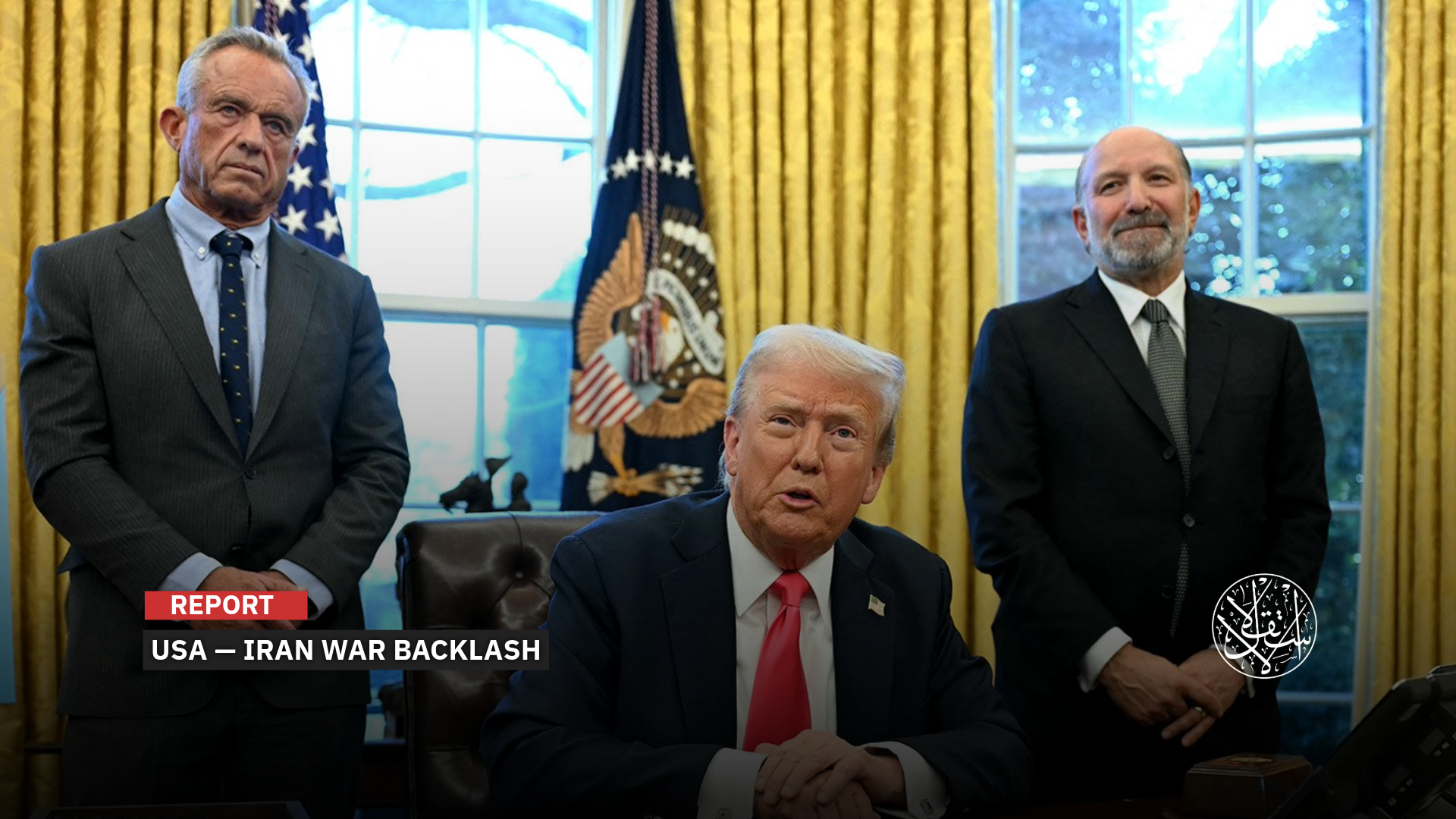
The congressional midterm primaries have begun against a backdrop of pronounced political polarization.
After the United States became involved in the war against Iran, in what critics view as the use of the conflict to serve Israeli interests, estimates have risen within the United States about the possibility that the governing Republican Party could lose the congressional midterm elections, whose preliminary stages have already begun and are set to conclude in November 2026, amid a climate of domestic political debate.
Political and media circles in the United States are witnessing growing discussions about the internal repercussions of this external engagement, particularly regarding the future of the Republican Party in the upcoming elections.
This comes as U.S. President Donald Trump faces criticism that his policies contradict the “America First” slogan that formed one of the pillars of his political rhetoric, in contrast to what his opponents see as giving strategic priority to Israeli interests at the expense of U.S. national security considerations.
The debate has also extended to the Republican Party’s own base, including some circles within the Make America Great Again (MAGA) movement, where questions have been raised about the cost of the war, the limits of U.S. commitment to conflicts in the Middle East, and the potential effects on the national economy.
Primary election campaigns have begun against a backdrop of pronounced political polarization, with some Republican candidates associated with the administration’s choices facing criticism over the usefulness of military involvement and its impact on the United States’ economic and human resources.
Historically, the party of the sitting president tends to lose seats in U.S. congressional midterm elections, particularly during periods of foreign wars, especially if these coincide with domestic economic pressures such as slowing growth, rising inflation, or unemployment.
Estimates by a number of research centers and public opinion polls suggest that any prolonged military involvement could negatively affect the governing party’s electoral prospects, in light of historical patterns that link foreign wars to declining electoral performance by the incumbent administration.
The impact of military conflicts is not limited to a single electoral cycle, but can extend to subsequent elections if economic repercussions persist or if the conflict becomes prolonged.

America First or ‘Israel’?
Because of what critics described as a preference for “Israel First” at the expense of his party’s “America First” slogan, and amid rising criticism inside the United States, including from some circles within the “MAGA” movement, the primary election campaigns have begun to witness attacks by some Americans on Republican candidates associated with U.S. President Donald Trump.
Republican candidates have faced uncomfortable questions about the nature of the United States’ relationship to “Israel’s” war against Iran, the extent to which Americans benefit from this war, and accusations directed at Washington that “Israel” may influence decisions within the Trump administration and employ U.S. military capabilities to advance its own interests.
Despite Trump’s repeated statements during his election campaign about ending wars and avoiding new conflicts, debate has intensified over the cohesion of his popular base, especially after the United States became involved in the war against Iran within military and political alliances with “Israel.”
Critics within the conservative movement warned of potential repercussions for the Republican Party, noting that Trump pledged during his 2024 election campaign to focus on the economy and avoid foreign wars.
However, statistics indicated that he has become one of the U.S. presidents who issued the most orders to use military force, which opponents described as a contradiction of his campaign promises.
Prominent voices within the “Make America Great Again” movement expressed opposition to the attack on Iran, warning that the continuation of the conflict could harm Republicans in the congressional midterm elections in November 2026.
The news agency Reuters described the U.S. attack on Iran on February 28, 2026, as a move aimed at testing the cohesion of the “MAGA” front ahead of the midterm elections.
A number of prominent Trump supporters, including conservative host Tucker Carlson, businessman Erik Prince, and Congresswoman Marjorie Taylor Greene, also warned that the continuation of the conflict could violate campaign promises and potentially cost Republicans losses in the 2026 elections, according to the news site Axios in a report published on March 2, 2026.
Carlson described the war as one that could reshape the balance of power within the “MAGA” movement, while Greene questioned the situation, saying, “Our campaign promised not to fight wars, so what is happening now?”
Right-wing political commentator Nick Fuentes went further, accusing Trump of “betraying the MAGA movement” and the “America First” slogan by launching what he described as a “war of aggression for Israel.”
A poll conducted by The Economist in cooperation with YouGov showed that 32 percent of Americans support, to varying degrees, the use of military force to overthrow the Iranian government, while 45 percent oppose it.
Several lawmakers also joined in criticizing current U.S. policies, questioning the fate of the “America First” slogan and accusing Trump of becoming an “instrument” in the hands of Israeli Prime Minister Benjamin Netanyahu, according to their statements.
At the same time, the continuation of the war has led Trump to lose some of his most prominent supporters within the right-wing movement, including Tucker Carlson, who strongly criticized him, as well as right-wing media figure Megyn Kelly, who said in press statements that she had supported Trump and participated in his election campaign.
Kelly added that belonging to the conservative movement or to the “MAGA” movement does not mean accepting entry into a new war in the Middle East without discussing its consequences, criticizing the potential sacrifice of American lives and money in foreign conflicts.
In a post on X, Republican congresswoman Marjorie Taylor Greene, who shifted from supporting U.S. President Donald Trump to criticizing him, said that the president, his vice president J. D. Vance, and the director of national intelligence Tulsi Gabbard built their election campaigns on the slogan of avoiding foreign wars and rejecting regime change by force, yet American soldiers, according to her, are now falling during this war.
Greene strongly criticized the Trump administration over the war against Iran, saying, “My God, these poor military members and their poor families. I’m sorry for them and praying for them. This was absolutely unnecessary and is unacceptable. Trump, Vance, Tulsi, and all of us campaigned on no more foreign wars and regime change. Now, America[n] soldiers are dead.”
Democratic Senator Chris Van Hollen also wrote that Trump’s attack on Iran was not consistent with the “America First” principle, in his words.
He added, in the context of his criticism of U.S. policy, that Israeli Prime Minister Benjamin Netanyahu had exerted influence over the decisions of the U.S. administration, which he described as reflecting a political position he opposes.
Following a session held by Congress to brief lawmakers on the objectives of the war on March 3, 2026, several members emerged expressing that the picture remained unclear regarding the justifications for the war and the future plans of the U.S. administration, including reports about the possibility of launching a ground invasion of Iran in the context of supporting Kurdish groups, according to internal discussions during the session.
U.S. Senator Elizabeth Warren, a Democrat, said after leaving a classified congressional briefing on the war against Iran that “it is so much worse than you thought, you are right to be worried.”
She added that the administration of U.S. President Donald Trump does not appear, in her assessment, to have a clear plan regarding the war in Iran.
She described the conflict as “illegal and based on misleading information,” and said that no clear and specific reason has yet been presented to justify going to war. She also noted the absence of any publicly outlined vision for how to end the military operations or manage their consequences.
The debate reached Democratic Senator Mark Warner, who expressed an angry stance, saying that he does not see a direct threat to the United States from Iran at the present time.
He added, in the context of his criticism of the logic linking threats to “Israel” with threats to U.S. national security, that expanding the concept of a threat to include risks to “Israel” as an imminent threat to the United States could spark broad domestic political controversy.
Iran also played a role in fueling debate and internal divisions within the United States, as Iranian Foreign Minister Abbas Araghchi said on the platform X that U.S. President Donald Trump had turned the slogan “America First” into “Israel First,” which, in his words, meant “America Last.”
For years, Trump had criticized previous U.S. military policies in the Middle East, describing them as “reckless military adventures” that imposed heavy economic and political costs on the United States.
Before the 2024 presidential election, he repeatedly stated that he would be the first president since Jimmy Carter not to involve the United States in a new armed conflict, pledging after his victory, “I will not start wars, I will end them.”
However, research reports, including estimates issued by Chatham House on March 4, 2026, indicated that Trump authorized the use of military force in seven countries during his second term, sparking domestic political controversy.
As the war continued, discussion intensified about a split within the Republican Party, as well as within the conservative wing associated with the “Make America Great Again” (MAGA) movement, between an isolationist faction opposed to prolonged foreign wars and a hawkish faction supporting military confrontation with Iran.
Congress also witnessed a clear division over the war after senior Trump administration officials presented a series of shifting justifications for the conflict, amid warnings from some Republicans that the continuation or expansion of the war could erode the president’s political support within the party.
Notably, some opponents of the war criticized the idea that “Israel” was determining the timing of U.S. military operations, seeing it as reflecting political influence over American decision-making, as reported by The New York Times on March 4, 2026.
In the context of the diplomatic debate, U.S. Secretary of State Marco Rubio was attributed with remarks suggesting that “Israel” had pushed the United States to act against Iran, before later retracting and denying that he had made such a statement, asserting that U.S. strikes were part of a policy of “preemptive and preventive strikes.”
Rubio explained in a press statement that the United States struck Iran preemptively after assuming that Tehran might target US forces if “Israel” began military operations, which prompted Washington to participate in military moves alongside “Israel.”
In an attempt to contain the fallout from the debate, Trump said during a meeting in the Oval Office with German Chancellor Friedrich Merz, “(Israel) didn't pressure me to strike Iran — maybe I was the one who pressured them.”

The Midterm Curse
Historical experience in the United States indicates that the party holding the presidency often loses seats in congressional midterm elections, with limited exceptions, as these elections reveal the effects of government policies and their alignment with campaign promises, in addition to the impact of domestic and foreign crises.
Over the course of roughly eighty years, the president’s party has almost invariably lost seats in the House of Representatives during midterm elections, which makes political forecasts for 2026 lean toward the possibility of the Republican Party, led by U.S. President Donald Trump, losing seats, according to The Conversation on January 19, 2026.
Since 1946, 20 midterm elections have been held, and the president’s party lost seats in 18 of them, equivalent to about 90 percent of midterm elections over the past eight decades.
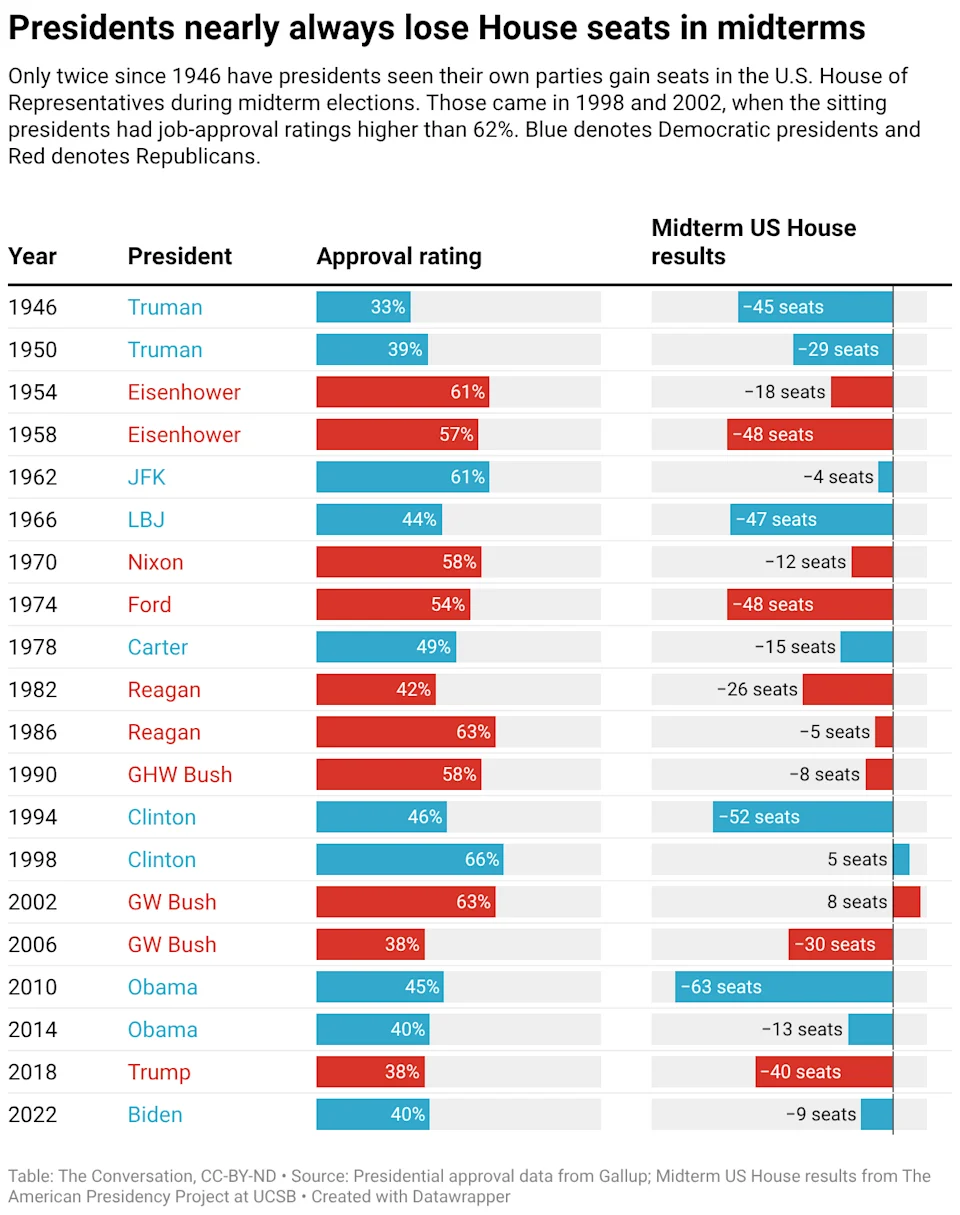
Historical data indicate that the chances of the Republicans retaining their slim majority in the House of Representatives during the 2026 elections appear limited, especially given that some current policies conflict with the campaign promises made during the presidential race.
American analysts expect that the Republican Party could lose its majority in both the House and possibly the Senate as well, which could turn the president into what is politically known as a “lame duck,” a president who lacks a parliamentary majority to pass his legislative agenda.
Historically, the governing party loses an average of dozens of seats in the House during the first midterm election after a president takes office, particularly if this coincides with costly foreign crises, rising inflation, and declining overall popularity.
All three of these factors are present in the current political landscape, as the United States has recently become involved in military conflicts in Iran, Venezuela, Gaza, and Yemen, while the core inflation rate in the United States has risen above expectations, alongside an increase in the consumer spending price index.
A poll conducted by CNN on February 23, 2026, showed Trump’s approval rating falling to about 32 percent.
Since his return to the White House in January 2025, Trump has held a slim Republican majority in both the House and Senate, which enabled him to achieve a number of legislative victories, while simultaneously reducing the level of parliamentary oversight that had been a source of political concern for his administration.
If the Republicans lose control of either chamber of Congress in the 2026 elections, the effective legislative phase of Donald Trump’s presidency could face a significant political setback, as oversight pressures would increase through hearings and congressional investigations.
All members of the U.S. House of Representatives are elected every two years, while only one-third of Senate seats are contested in each electoral cycle.
Academic estimates indicate that Republicans will face greater difficulty defending their slim House majority, currently holding only 220 seats, just two above the minimum required for a majority, since the 2024 elections.
In the Senate, Republicans will defend 22 seats in the November 2026 elections, compared with just 13 seats for the Democrats, who would need a net gain of four seats to take control of the chamber, currently dominated by Republicans with 53 seats to 47.
Acknowledging the sensitivity of this political reality, Trump said in an interview with Reuters on January 15, 2026, “We shouldn’t even have an election,” expressing his frustration over what he described as the political risks facing his party in the midterm elections.
He added that the phenomenon of the president’s party losing seats in midterms has deep psychological and political roots, emphasizing that winning the presidency does not necessarily mean winning in the midterm elections.
He had previously mentioned the idea of canceling elections, although the U.S. constitutional system mandates that these elections take place and grants no president the authority to cancel them, as Congress sets the dates for federal elections while state and local authorities manage and oversee the voting process.

Presidents Who Entangled Their Countries
A study issued by the Brookings Institution on August 28, 2025, confirms that historical experience in midterm elections indicates that a U.S. president’s involvement in foreign wars can negatively affect his party’s electoral performance.
The study cites historical examples, such as former President George W. Bush’s involvement in the Iraq War, as well as the repercussions of the terrorist attacks on September 11, 2001, showing that major security crises can increase the likelihood of the governing party losing elections.
The impact of these factors is amplified when military conflict coincides with economic instability, as wars often lead to higher prices and greater economic uncertainty, which in turn negatively affects the popularity of the incumbent administration, according to reports from The Wall Street Journal, Financial Times, and The Economist.
American voters often punish the governing party when fuel prices rise.
According to economic estimates, the war in Iran has led to higher global energy prices and increased inflationary pressures within the United States, at a time when the rising cost of living remains a top concern for the American public.
Conversely, opinion polls indicate that foreign policy issues captured a significant portion of political attention during the first thirteen months of U.S. President Donald Trump’s second term.
Several Republican leaders in Congress fear that they could face electoral penalties from angry voters in the November 2026 elections, according to various American political estimates and analyses.
Sources
- Congress Splits Over Iran War as Senate Faces a Vote
- Trump’s Attack on Iran Tests MAGA Cohesion Ahead of Midterm Elections [Arabic]
- What History Tells Us About the 2026 Midterm Elections
- For 80 Years, the President’s Party Has Almost Always Lost House Seats in Midterm Elections, a Pattern That Makes the 2026 Congressional Outlook Clear
- Scoop: Iran Strikes Inject Chaos Into Dem Primaries