Deep State: How the Revolutionary Guards Seized Power in Iran
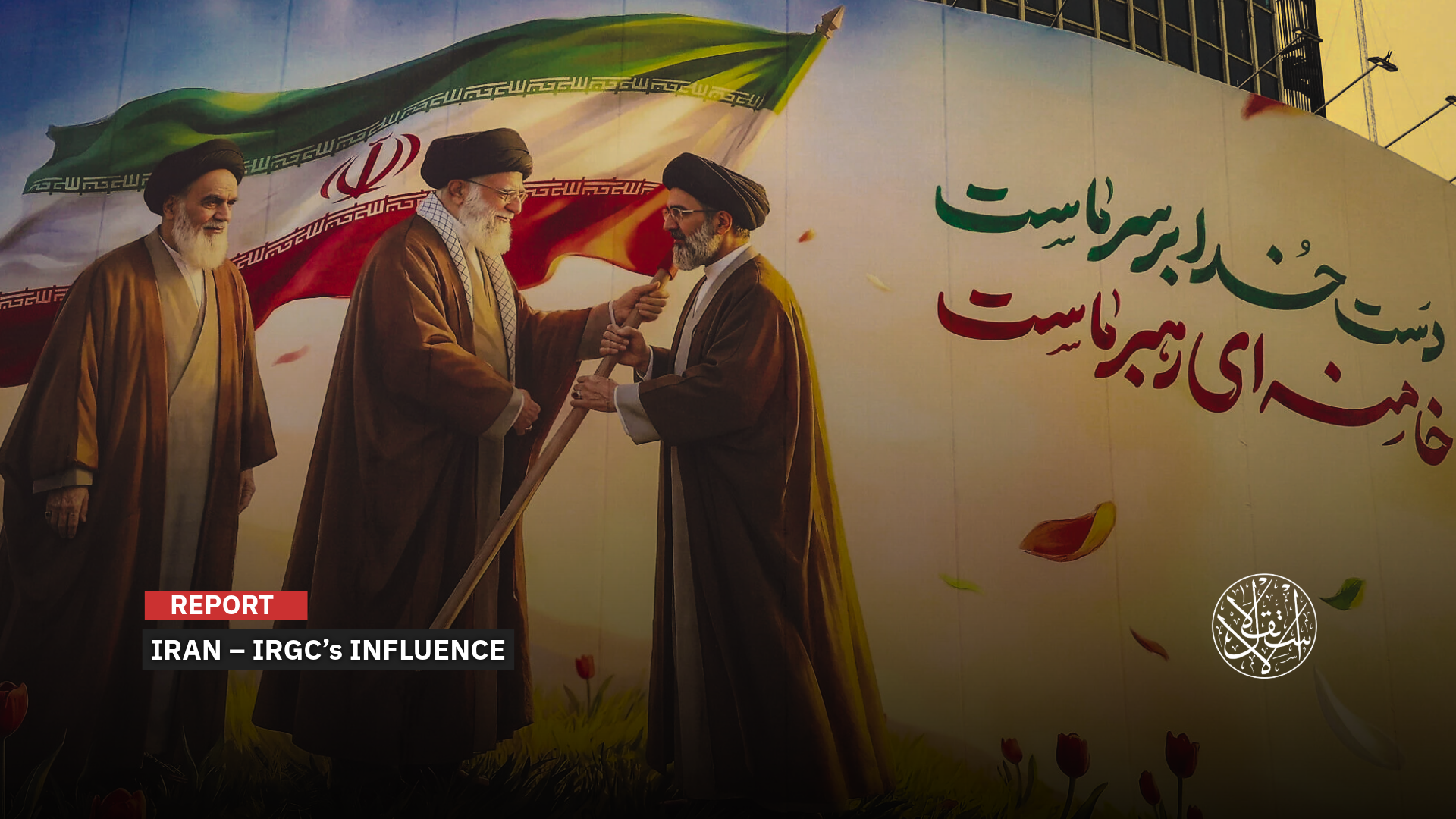
“IRGC has tightened its grip on wartime decision-making despite the deaths of its top commanders.”
Amid the missile explosions in Tehran and the images of destruction emanating from military and oil facilities inside Iran, a deeper and more intense struggle is unfolding behind the scenes.
This struggle revolves around who truly holds the reins of power in the Islamic Republic following the assassination of Supreme Leader Ali Khamenei and the appointment of his son, Mojtaba, as his successor in an atmosphere of open warfare.
While Iranian authorities quickly pledged allegiance to the new Supreme Leader, Western reports continue to describe a wounded and absent leader, and an Islamic Revolutionary Guard Corps (IRGC) filling the void and pushing for a regional escalation of the conflict.
Furthemore, a near-division has emerged in the management of the war crisis in Iran, particularly following President Masoud Pezekchian's speech aimed at de-escalating tensions with the Gulf states and containing the conflict's expansion.
However, this speech was met with sharp criticism from hardliners within the IRGC and some religious and political institutions, forcing the presidency to partially backtrack and adopt a more hardline tone.
Observers interpreted this as an indication that the balance of power within the Iranian regime is shifting further toward the IRGC, reinforcing its security role in managing the war.
Broad Powers
High-level sources say that Iran’s IRGC has tightened its grip on wartime decision-making despite the deaths of its top commanders.
The military establishment is currently pushing for a hardline strategy that relies on intensifying drone and missile attacks across the region in response to mounting military pressure.
The IRGC had already delegated broad powers to lower ranks before the February 28 U.S.-Israeli attack, in a strategy to bolster resilience, granting mid-ranking officers the authority to launch attacks on neighboring countries.
Inside Iran, the IRGC’s central role at all levels of the regime and its repressive security approach may make it difficult for protests to erupt, undermining any hopes the United States or “Israel” might have that their attacks will trigger an uprising and regime change.
Kasra Aarabi, head of IRGC-related research at United Against Nuclear Iran, a U.S.-based political organization, said that the selection of the next Supreme Leader, following the death of Ali Khamenei, may significantly increase the IRGC’s role.
Mojtaba Khamenei enjoys extremely close ties with the IRGC, wielding considerable control over them and garnering widespread support, including from the most hardline lower ranks.
Regional sources confirmed that the IRGC is now involved in all major sovereign decisions, bypassing traditional political structures.
The sources explained that Ahmad Vahidi, who recently assumed command of the IRGC, attends all high-level meetings to ensure the regime’s survival and the achievement of its strategic objectives under the current circumstances.
Iran’s Deputy defence minister and Guardsman Reza Talaeinik revealed the special forces’ efforts to build resilience, stating that every figure in the command structure has designated successors up to three ranks below them to be ready to replace them.
Israeli airstrikes last year killed the IRGC commander and the heads of its intelligence, aviation, and economic units.
On February 28, an airstrike killed IRGC Chief Commander Mohammad Pakpour.

Deep State
The IRGC was established shortly after the 1979 Iranian Revolution to defend the new republic against internal and external enemies and to serve as a counterweight to the regular armed forces.
With its direct link to the Supreme Leader, it emerged as a state within a state, combining military power, an intelligence network, and economic power—all factors aimed at maintaining the authority of the Islamic regime in Iran.
This role was tested when Iraq invaded Iran months after the revolution, triggering an eight-year war of attrition that proved a formative experience for many of Iran’s current generation of leaders.
Among the prominent Iranian figures who served with the IRGC during the war, three non-clerics have held key positions in Iran since Khamenei’s death.
Iranian President Masoud Pezeshkian was a field surgeon on the battlefields, while Parliament Speaker Mohammad Bagher Ghalibaf fought on the front lines before heading the IRGC’s air force unit. Ali Larijani, Khamenei’s top advisor, was a staff officer operating behind the front lines.
Since the early 2000s, as the war generation has assumed more leadership roles and the long-running confrontation between Iran and the West has intensified, the IRGC’s role in the Iranian state has also grown.
The IRGC was then tasked with managing Iran’s nuclear program, a project Tehran has consistently maintained is for purely peaceful purposes, but which Western countries believe is a cover for developing a nuclear bomb.
Amid tightening sanctions imposed over the nuclear program, the IRGC has taken on an additional role in the economy, with its construction arm, Khatam al-Anbiya, winning major contracts, including in the vital energy sector.
The IRGC also played a major role as a link to Shiite proxies throughout the Middle East, while employing the Basij, a paramilitary force comprising thousands of volunteers, to suppress internal unrest.
Over the past 47 years, the IRGC has grown from a small force into a complex intelligence network integrating ideology, military power, politics, and economics, with operations and proxies extending far beyond Iran to the Middle East, Africa, South America, and Europe.
Strategic Risks
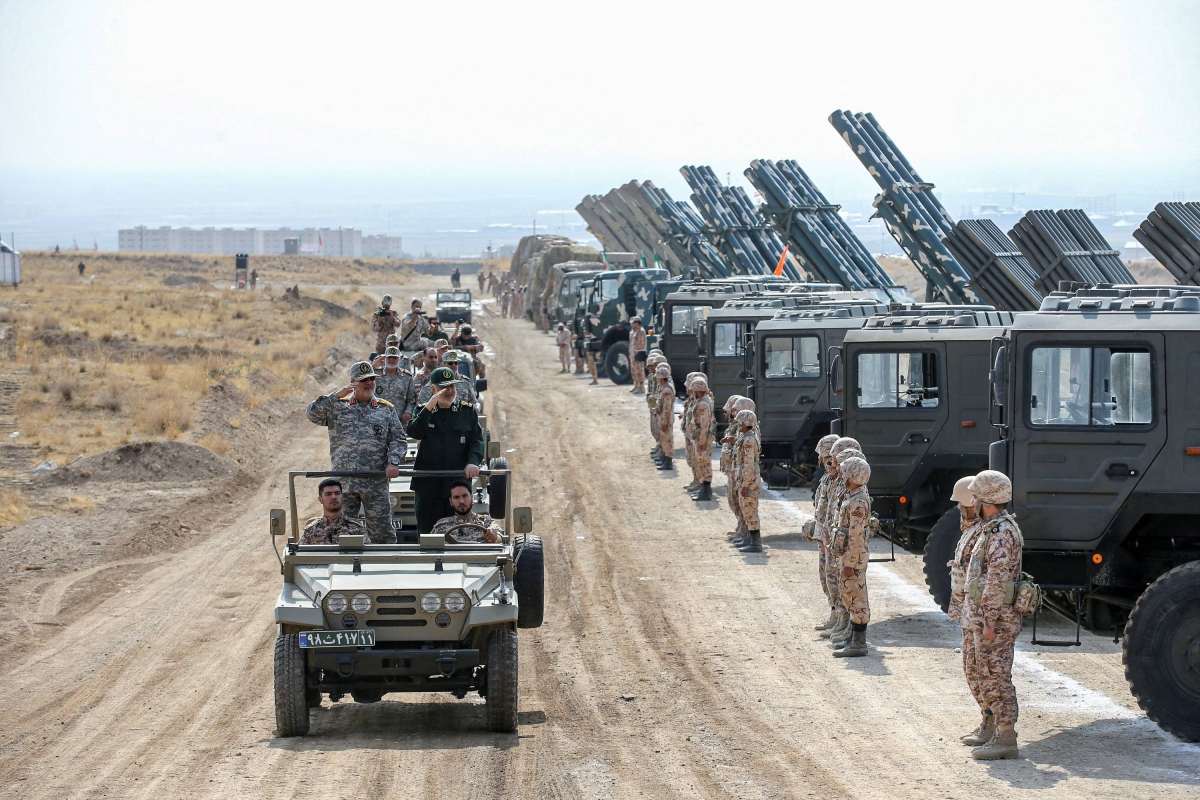
In light of the state of war and air strikes targeting vital installations in Tehran, the IRGC found the perfect pretext to complete the complete seizure of power.
The IRGC imposed the appointment of Mojtaba Khamenei as the country's new supreme leader, in a move that reflects increasing military control over decision-making joints amid the current war.
While the hard-line wing of the IRGC pushed for the position to be inherited to ensure security continuity, this trend aroused the ire of religious authorities in the city of Qom, who saw in the move a transformation of the regime from a guardian of the jurist to a hereditary kingdom.
What increased the fears of opponents of Mojtaba Khamenei’s appointment as supreme leader was that no statement was issued until the evening of March 9, nearly 48 hours after his selection.
This appointment puts Iran at a critical juncture that may lead to more stringent policies at the internal and external levels, amid ongoing speculation about the health status of the new leader and his ability to unify the institutions of a regime facing increasing pressure.
High-ranking Iranian sources said they feared that the IRGCs’ takeover of the regime would turn the Islamic Republic into a military state with only superficial religious legitimacy, undermining an already shrinking support base and reducing the scope to address complex threats.
This is also indicated by an analysis issued by the Washington Institute for Near East Policy, which sheds light on the serious strategic risks resulting from the rise of Mojtaba Khamenei at this sensitive time.
It indicates that its deep ties to the IRGCs may push the regime towards adopting more extreme and adventurous options, whether in dealing with external crises or managing internal tension.
Researcher Karim Sadjadpour, from the Carnegie Endowment for International Peace, confirmed that the leadership is using the current war as an effective tool to silence opposing voices, unite ranks by force, as well as narrow the available political space to its lowest limits.
On the Iranian side, observers believe that the IRGCs’ support for Mojtaba Khamenei did not come in vain or by chance.
The IRGC views the new supreme leader as a strategic safety valve for the next stage, says Iranian journalist and researcher Mehdi Barghchi, editor-in-chief of Iran International Magazine.
The current scene reveals a new balance of power within the Iranian regime. The IRGC and the Office of the Supreme Leader - known as the House - have real power that goes beyond the formal bureaucracy.
This dominance became clear last week, when President Masoud Pezeshkian was forced to retract his apology to the Gulf states over previous attacks, after pressure from senior IRGC commanders.
According to the analysis of the Geopolitical Futures Center: The IRGC acts as an unruly military force without ruling political direction, it takes advantage of the prevailing state of vacuum to exercise the role of military force and decision-maker at the same time.
This makes the government’s haste to offer apologies seem like a desperate attempt to contain the disastrous repercussions of this monopolization of sovereign decision-making.

In turn, political analyst Ibrahim Khatib explained in a statement to Al-Estiklal that “Iran is going through one of the most complex historical junctures since the 1979 revolution, where the flames of open regional war intersect with an internal political earthquake triggered by the choice of Mojtaba Khamenei as the new supreme leader.”
“This appointment, which came at a sensitive military time, was not just an administrative measure to fill the void, but rather turned into a fuse that ignited hidden conflicts between the pillars of power, and opened the door wide for the IRGC to monopolize the joints of the state,” he added.
“Mojtaba Khamenei is historically viewed as a shadow man close to the leadership of the IRGC, and his appointment represents a complete victory for this wing,” he said.
He revealed that “the IRGC is currently carrying out a silent purge within the state apparatus, excluding pragmatic figures or those who tend to calm down with the West.”
He concluded, “With the expansion of the confrontation with Israel and Washington, the IRGC has turned into a supreme authority that exceeds the authority of Parliament and the government, justifying this by the necessities of national security and the undeclared state of emergency.”
He pointed out that the absence of Mojtaba Khamenei from the scene, in parallel with the overwhelming presence of the IRGCs on all fronts, and the coincidence of diplomatic messages of apology with the directing of military strikes, suggest that what is happening now is an extremely costly attempt to save a new leader.