Why the U.S. Classified the Muslim Brotherhood as a ‘Terrorist Organization’ in Lebanon, Egypt, and Jordan

“The decision serves to distort the image of influential political and social forces.”
It was noteworthy that the decision taken by the US State and Treasury Departments on January 13, 2026, to designate the Muslim Brotherhood as a terrorist organization, was limited to the three Arab countries bordering Israel: Egypt, Lebanon, and Jordan.
This demonstrates that the decision aims to serve “Israel” and isolate supporters of the Islamic Resistance Movement, Hamas.
US assessments indicate that it will harm charitable work and fundraising for the resistance, as has already occurred in Jordan and Egypt through confiscations and asset freezes.
There is speculation that the decision will establish a legal basis for scrutinizing the funding, licenses, and membership of associations, and will support the consolidation of authoritarianism in both the Middle East and the United States.
An informed American researcher told Mada Masr on January 14 that Trump attempted to designate the Muslim Brotherhood as a terrorist organization during his first term (2016-2020), but was unsuccessful due to objections from several of his advisors citing insufficient evidence.
However, this changed in his second term after he managed to overrule the Justice Department, the State Department, and other official US institutions. This allowed Trump to fulfill his desire and respond to long-standing pressure from Israel, Egypt, and the UAE to implement this designation.
Special Designation
In a statement, the US State Department designated the Muslim Brotherhood in Lebanon as a Foreign Terrorist Organization (FTO) and a Specially Designated Global Terrorist (SDGT), and the group’s leader Muhammad Fawzi Taqqosh as an SDGT.
The Muslim Brotherhood branches in Egypt and Jordan were designated as SDGTs by the Treasury Department because the primary charge against them is providing material and logistical support to Hamas, without directly participating in attacks against “Israel”.
This means that this indirect support did not fully meet the criteria for designating them as Foreign Terrorist Organizations (FTOs), the most serious category.
The implications of designating them as SDGTs are far less severe in the US assessment than designating them as FTOs, which suggests the Trump administration's refusal to designate the group in Egypt and Jordan as the most serious category for unknown reasons.
However, the decision issued by the Department of Justice included exaggerated details, considering attacks on “Israel”, a US ally, as well as support for Hamas, to be the focal point.
In the case of Lebanon, factions affiliated with the Muslim Brotherhood (the Islamic Group – Fajr Forces) participated in launching rockets against “Israel”, so the Lebanese branch was designated as FTOs, the most serious category.
The US State Department report accused the Islamic Group in Lebanon of directly participating in acts of military terrorism through its Fajr Forces affiliate, which launched rockets from Lebanon towards “Israel”.
During the Al-Aqsa Flood waged by the Palestinian resistance on October 7, 2023, the Fajr Forces announced several attacks on Israeli positions with rockets. A previous report by Al-Estiklal addressed their role in the war.
The Islamic Group, the Lebanese branch of the Muslim Brotherhood, issued a statement declaring itself a licensed Lebanese political and social entity operating openly and within the bounds of the law, and that the American decision has no legal effect within Lebanon.
It clarified that the decision is a political and administrative American one, not based on any Lebanese or international judicial ruling, and therefore has no legal consequences within Lebanon.
It is believed that the decision will not significantly affect the group in Lebanon due to the limited scope of its activities and the difficulty for the Lebanese government to engage in a confrontation with an Islamic faction, especially given its ongoing conflict with Hezbollah.
The group emphasized that the American designation serves the interests of the Israeli occupation and aims to sow confusion and tarnish the image of influential Lebanese political and social forces at a critical juncture for the region.
American Motives
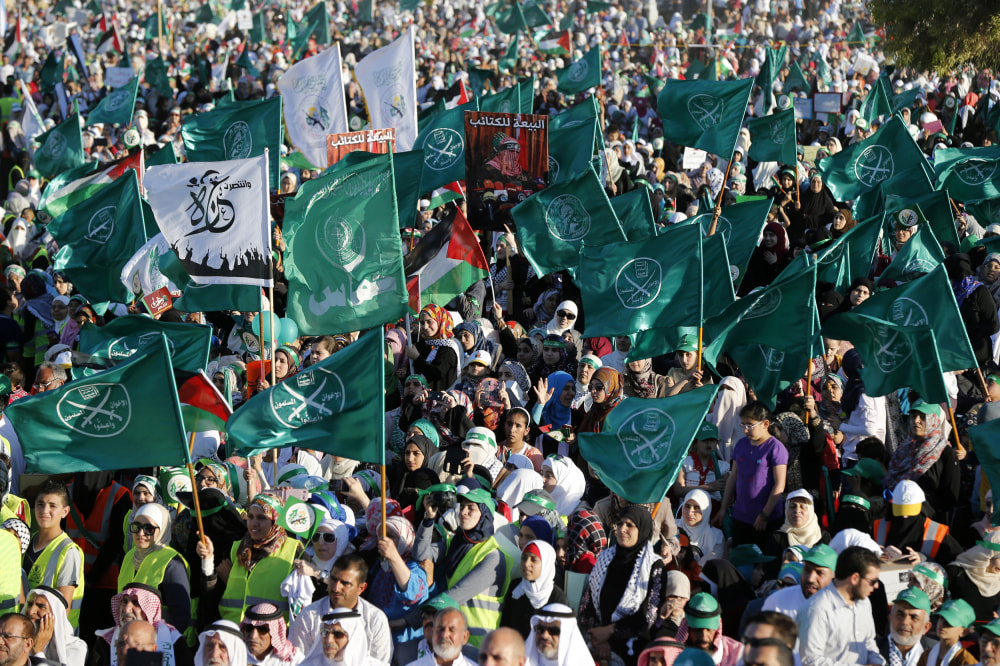
A reading of the statements from the US State Department and Treasury indicates that the goal is to punish all those who supported Hamas in its war with the Israeli occupation and to label them as terrorists, just like the Islamic Resistance Movement.
It was noteworthy that the American designation was limited to the three Arab countries surrounding Israel (Egypt, Lebanon, and Jordan), which confirms that the goal is to protect Israel and punish those in these countries who supported Hamas during the war on Gaza.
Perhaps this is why Trump's blacklist did not include the Muslim Brotherhood in Yemen (Islah), Sudan, Syria, North Africa, or Asia, from the terrorism designation.
The list also did not include American entities such as the Council on American-Islamic Relations (CAIR), which was designated as a terrorist organization by the governors of Florida and Texas.
Palestinian analyst Yasser al-Za’atra described the American decision as a Zionist classification and a necessary prelude to lumping the entire Islamic movement into the camp of terrorism.
“The goal is to strike at the vital forces within the nation, to pave the way for their new project of expansion and hegemony,” he said.
Politicians and analysts believe that designating the Muslim Brotherhood as “terrorist” simply for supporting the resistance in Palestine and Hamas will increase the group’s popularity.
This might open doors for the Muslim Brotherhood to assume leadership of the region and resume the betrayed Arab Spring, according to Dr. Rafik Abdessalem, affiliated with the Tunisian Ennahda Islamist party.
Egyptian analyst Maher Farghaly, a critic of the Muslim Brotherhood, acknowledged that Washington has adopted a middle ground approach, and that there are American motives behind the proposed designation of the Brotherhood as a terrorist organization only in its three branches (Egypt, Jordan, and Lebanon).
The most important of these motives are: the events in Gaza, the Brotherhood's ties to Hamas in those countries, the student demonstrations in support of Gaza in America, and the difficulty of proving the affiliation of several organizations within the U.S. in court.
Following the Al-Aqsa events, reports and studies proliferated in America and Europe, many authored by Jewish researchers, calling for the Brotherhood to be designated a terrorist organization for two reasons:
First, Hamas, which attacked “Israel”, is the Palestinian branch of the Muslim Brotherhood; therefore, the focus should be on the ideological infrastructure that spawned it, namely the Muslim Brotherhood.
Second, political groups and parties affiliated with the Muslim Brotherhood ideology in the Arab world praised Hamas's actions.
Accusations Without Evidence
It was striking that the US State Department and Treasury Department reports, in classifying the Muslim Brotherhood in Egypt, relied on allegations made by the Egyptian authorities against the group since the July 3, 2013 coup, allegations which had already been refuted by Western newspapers themselves.
Under Secretary of the Treasury for Terrorism and Financial Intelligence (TFI), John Hurley, stated: “The Muslim Brotherhood has inspired, sponsored, and funded terrorist groups like Hamas, which pose a direct threat to the security and safety of the American people and our allies.”
He alleged that, beginning in 2025, the Egyptian Muslim Brotherhood and Hamas coordinated potential terrorist activities against Israeli interests in the Middle East.
The Treasury Department explained its designation of the Egyptian branch by stating that in 2023, a member of the group (an Egyptian national) in Saudi Arabia raised funds and sent them to Hamas before returning to Egypt.
It also noted that in 2024, members of the group in Egypt provided support to individuals attempting to travel from Egypt to Gaza to fight for Hamas—vague accusations without naming any known suspects.
It further alleged that the group regularly informed Hamas of the location and timing of fighters being brought in, and that once these individuals arrived in Egypt, potential fighters contacted the group to arrange entry into Gaza.
Egypt has not officially provided any details regarding the Egyptian Muslim Brotherhood's facilitation of the entry of any fighters Palestinians in Gaza, and the group's active members are either in detention or outside Egypt.
Furthermore, there is a heightened state of alert and security measures in place along the Egyptian border, which “Israel” itself has complained about.
These reasons refute the possibility of fighters entering Gaza from Egypt, as Washington claims, according to observers.
The US Treasury Department alleged that in 2025, the Muslim Brotherhood in Egypt and Hamas coordinated on potential attacks against Israeli interests in the Middle East.
It noted that Hamas military wing leaders sought to cooperate with the Muslim Brotherhood in Egypt to undermine and destabilize the Egyptian government, receiving funding from the movement.
These are the same old accusations leveled by the Sisi regime against the Muslim Brotherhood following the January 2011 revolution, including claims that Hamas members entered Egypt to break into prisons and undermine the regime of former President Hosni Mubarak. However, linking these accusations to the year 2025 confirms that they were fabricated by the Americans.

Hidden Funding
The US designation of the Jordanian Muslim Brotherhood was based on Jordanian accusations against ten of the group's leaders in July 2025, alleging “they managed a financial network... from which funds were disbursed for the activities of the banned group and its affiliates.” However, Washington claimed the funding was directed to Hamas.
The Treasury Department stated that the Jordanian group provided material support to Hamas, then reiterated official Jordanian accusations that, since the beginning of 2025, elements linked to the Muslim Brotherhood in Jordan have been involved in terrorist activities.
It spoke of members of the group in Jordan, in cooperation with external entities, being involved in the manufacture of missiles, explosives, and drones, as well as recruitment operations.
These are the same accusations made by the Jordanian authorities against the group, without specifying the connection to Hamas.
Members linked to the group in Jordan and abroad facilitated these activities by raising funds through illicit means.
Jordanian sources indicate that the US accusation against the group of raising funds will also bolster the authorities' security measures against charitable organizations and institutions under the pretext of collecting money to support Hamas.
The official news agency Petra claimed in mid-July 2025 that the group and its affiliates had collected approximately 413,000 Jordanian dinars under the guise of relief efforts.
This move followed a campaign by Jordanian authorities against charitable organizations, accusing them of collaborating with the Muslim Brotherhood and collecting donations, as part of a policy to cut off their funding sources.
These organizations included the Women and Children's Training and Empowerment Forum, the Green Crescent Charitable Society, Al-Urwat Al-Wuthqa Charity Society, and the Sawaaed al-Ataa Initiative.
Also in July 2025, Jordanian authorities launched a political campaign against those they accused of concealing Muslim Brotherhood assets, aiming to dismantle the group's hidden funding and financial infrastructure.
The Public Prosecutor summoned individuals allegedly concealing Muslim Brotherhood assets and gave them until June 14, 2025, to settle their affairs before referring the case to the courts.
Expected Repercussions
The consequences of being designated a terrorist organization with a special classification are primarily financial and commercial, including freezing assets or any entities owned by the group or any listed individual who owns more than 50% of its shares, prohibiting financial and commercial transactions, and imposing sanctions on violators.
Therefore, the United States' designation of Muslim Brotherhood affiliates as terrorist organizations could harm charitable work associated with the group, or ordinary individuals under the pretext of their affiliation with the group, particularly in the area of fundraising, and civil society institutions in the U.S. and abroad.
Nathan Brown, a professor of political science and international affairs at George Washington University, believes that some of the United States' allies are likely to welcome this designation because it supports their plans to cut off funding sources for the group's affiliates.
He told the Associated Press on January 13 that for other governments that tolerate the Muslim Brotherhood, this will be a thorn in bilateral relations, referring specifically to Qatar and Turkiye, which have been the focus of Emirati media reports.
He explained that the designation of the affiliates could have repercussions for visa and asylum applications for individuals entering not only the United States, but also Western European countries and Canada.
The designation could have direct political, security, and economic repercussions for Europe.
On the security level, these designations have increased pressure on European agencies to tighten oversight of the group’s financing and logistical support networks.
Many members of the group from the three designated countries operate within European capitals under legal frameworks, which could prompt European governments—under American pressure—to update legislation to expand surveillance powers, as well as intensify intelligence sharing.
This designation could also lead to broad banking and trade restrictions, making European banks more cautious in dealing with institutions or individuals affiliated with the group, for fear of American sanctions.
For his part, Egyptian activist Murad Ali saw that designating the Muslim Brotherhood branches in Egypt, Lebanon, and Jordan as terrorist groups will not have a significant impact on the ground, but rather carries political and symbolic weight.
He explained that, practically speaking, the group is already banned in Egypt and Jordan and subject to stifling security and legal surveillance. In Lebanon, it is not an influential player on the political scene, and therefore the decision does not impose any new restrictions of real consequence.
He noted that, unlike groups such as Hezbollah, the Brotherhood does not have a military wing, nor does it manage major economic institutions or complex financial networks that require massive funding flows that can be stifled by such designations.
“The group relies on its members’ subscriptions and limited donations, not on a parallel, cross-border economy,” he said.
“Therefore, the designation will only add international cover to existing domestic policies, without any tangible change in the balance of power or the group’s organizational structure,” he noted.
However, human rights activists asserted that the US accusation of raising funds and financing Hamas implicitly supports the decision to seize the funds and assets of Muslim Brotherhood members in Egypt.
This will allow those authorities to continue with the same measures and perhaps confiscate more funds under the pretext of supporting the Muslim Brotherhood and terrorism.
Treasury Secretary Scott Bessent said, “We are working diligently to isolate the group from the financial system, and this administration will use the full extent of its authority to disrupt, dismantle, and defeat terrorist networks.”
The US Treasury Department stated that it will freeze all assets of the designated individuals or entities subject to sanctions, whether they are located in the U.S. or are in the possession or control of U.S. persons.
Any entities owned, directly or indirectly, individually or jointly, by 50% or more by one or more designated individuals or entities will also be subject to sanctions.
The Office of Foreign Assets Control (OFAC) may prohibit or impose strict conditions on the opening or maintenance of a correspondent or payment account through a foreign financial institution that knowingly conducts or facilitates any significant transaction on behalf of a designated individual or entity.
OFAC may also impose civil penalties for violations of sanctions based on absolute liability.
Consequently, cooperating with, funding, or being a member of the group becomes a federal criminal offense, and any member is barred from entering the U.S.
Therefore, concerns are being raised in America, particularly that some members of the Muslim community there may stop donating to Islamic organizations for fear of legal repercussions under the designation.