Saudi Arabia’s Fiber-optic Project: What Signals Are Being Sent by Choosing Syria Over ‘Israel’?
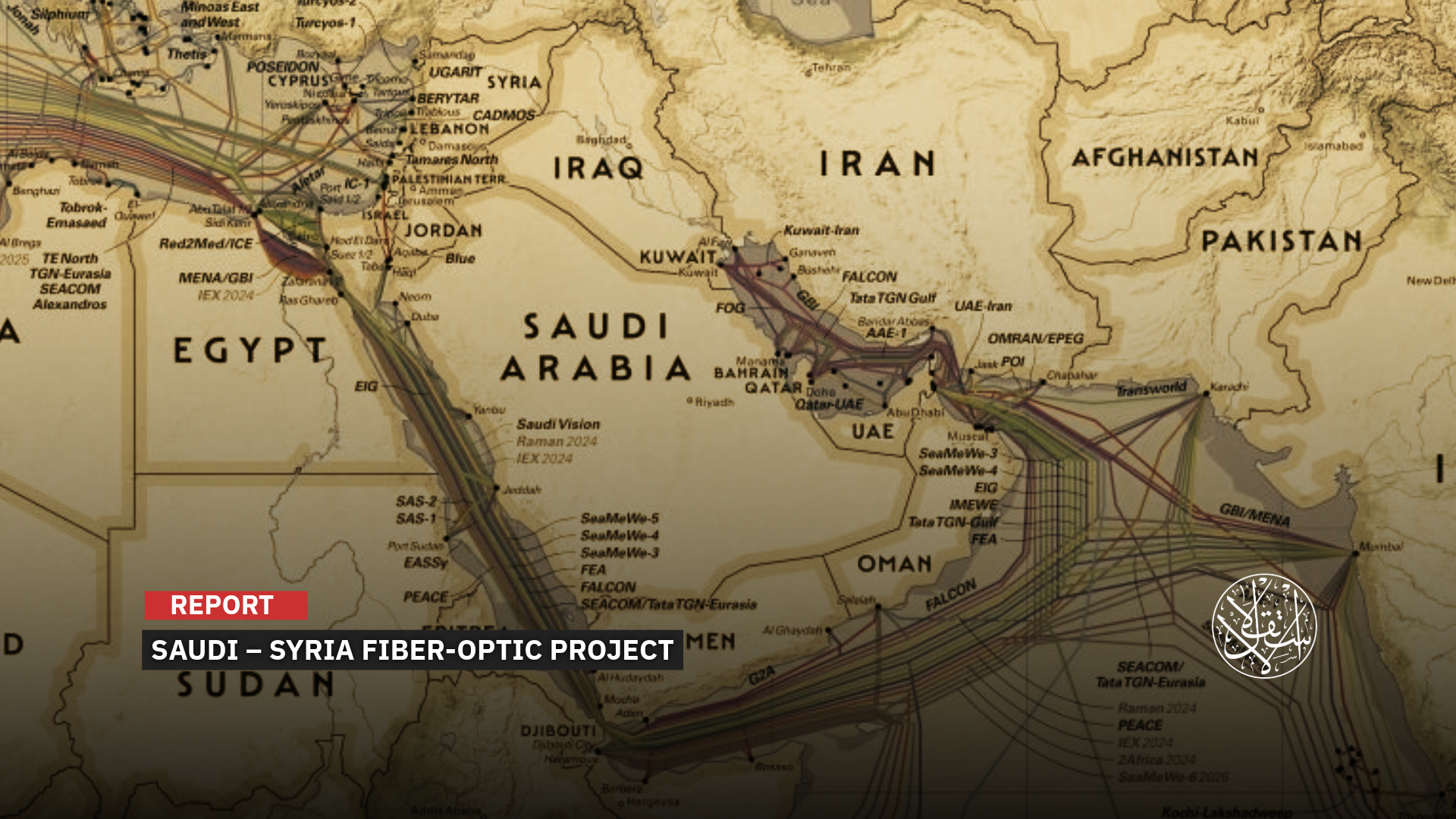
The new route carries a dual message: distancing ties with “Israel” while reintegrating Syria.
In the restless Eastern Mediterranean, maps of influence are no longer drawn by warships alone, nor settled solely through disputed gas lines and maritime borders, optical cables have also become part of the contest for status and positioning.
The fiber-optic cables, meant to transmit data between the Gulf and Europe in fractions of a second, are now taking on a political significance, signaling deeper trends: who is joining the new networks? Who is being excluded? Who is being reintegrated after years of isolation?
A report published by Middle East Eye on February 19, 2026, opened a window onto these shifts, revealing that Riyadh is seeking to alter the route of a cable project linking Saudi Arabia to Greece across the Mediterranean, so that the terrestrial segment passes through Syria instead of “Israel,” which had been part of earlier discussions.
This is not merely a technical adjustment to a geographic path, but reflects a new political equation emerging after the Gaza war, amid the Saudi-Emirati rift, the stalling of Saudi-Israeli normalization, and the return of Damascus to the center of regional connectivity projects under the umbrella of major Saudi infrastructure investments.
In the background, the Eastern Mediterranean emerges as a competitive arena for Europe’s digital gateways, from Athens to Ankara and “Tel Aviv,” and from the Gulf to European hubs seeking safer and more diverse routes after years of geopolitical crises, alongside the rising reliance on data and artificial intelligence centers.
The East-to-Mediterranean data corridor, known as EMC, was announced as a framework for a Greek-Saudi partnership in 2022, at a moment when the region was experiencing a surge in regional connectivity projects, from energy to transport and telecommunications.
At that time, discussions of potential normalization between Riyadh and “Tel Aviv” were at their peak, and the project was built on a partnership including the Saudi telecom company, the Greek electricity provider PPC, Greek telecom firms, and a satellite applications company called TTSA.
The core idea is for Saudi Arabia to become a central hub for data flowing between Asia and Europe, leveraging its geographic location and digital infrastructure, while Greece provides a gateway into the European continent.
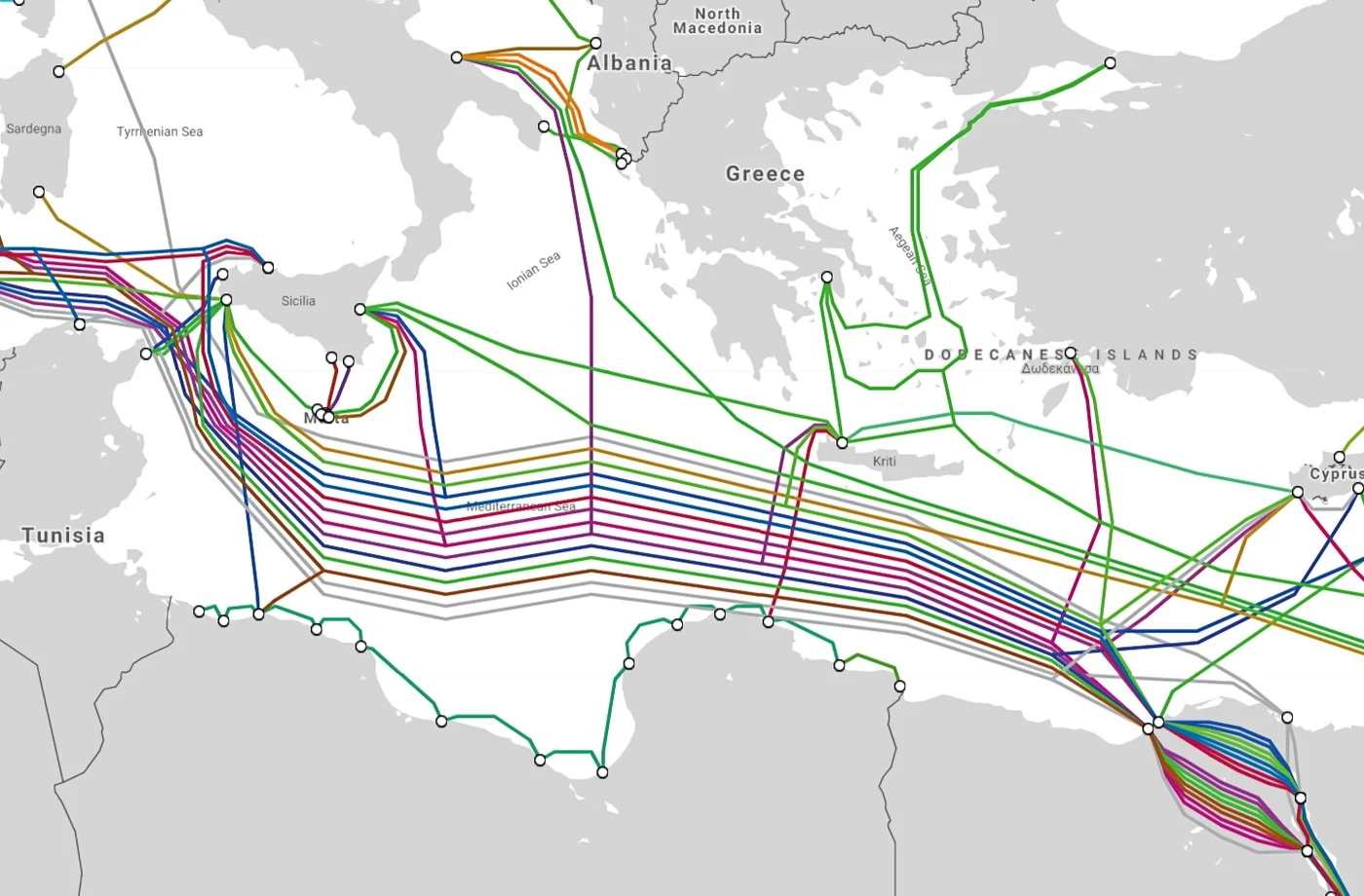
This comes at a moment when cable landing ports are shifting eastward into Europe, after cities such as Marseille in France and Genoa in Italy had served as traditional reception points for decades, as the drive to diversify routes pushes the telecommunications sector to seek new and more secure access points.
The Earlier Framework
In the previous widely circulated plan, the proposed terrestrial segment of the cable project would have run from Saudi Arabia northward through Jordan, then Israel, before reaching the Mediterranean and from there to Greece.
This route aligned with a wave of Eastern Mediterranean projects shaped within anti-Turkiye alliances, which at various stages bet on trilateral partnerships including Greece, Cyprus, and “Israel,” whether in energy, electricity interconnection, or even gas pipeline concepts.
In November 2025, the Greek company PPC presented a proposal to the Saudi side. Syria did not appear in the EMC project network at that stage, with the corridor clearly directed through Israel and its maritime waters, reflecting the prevailing geopolitical thinking of the time.
The economic and technical significance of fiber-optic cables lies in their ability to transmit essential digital services between countries using pulses of light at extremely high speeds with minimal latency, making them the backbone of the global digital infrastructure.
This factor is crucial in the era of artificial intelligence, cloud computing applications, and the massive flow of data between processing centers worldwide, where superiority is sometimes measured in fractions of a second in access and response times.
The importance grows as Gulf countries seek to build massive data centers and present themselves as regional hubs for AI and cloud services, making seamless and secure access to European markets a strategic consideration that extends beyond digital commerce to influence and geopolitical positioning.
Moreover, the EMC project was not merely a theoretical concept, but had already entered concrete contractual and financing phases.
According to an official announcement published by the Submarine Networks platform, which specializes in submarine cable systems, on May 31, 2023, a supply contract was signed to construct two maritime and terrestrial phases of the East Mediterranean data corridor, connecting Saudi Arabia to Europe.
This agreement was concluded between Center3, a subsidiary of the Saudi Telecom Group, and the French company Alcatel Submarine Networks, which specializes in manufacturing and deploying submarine cables.
The project’s profile on the platform describes the system as a new maritime and terrestrial infrastructure linking Europe to Asia via Greece and Saudi Arabia, placing the two countries at the heart of a data transmission, storage, and generation corridor across Eurasia, reflecting an ambition that goes beyond mere technical connection to redraw the maps of digital passage between the continents.
Why Syria?
The central question emerges here: not only why change the route, but why Syria specifically, and why now?
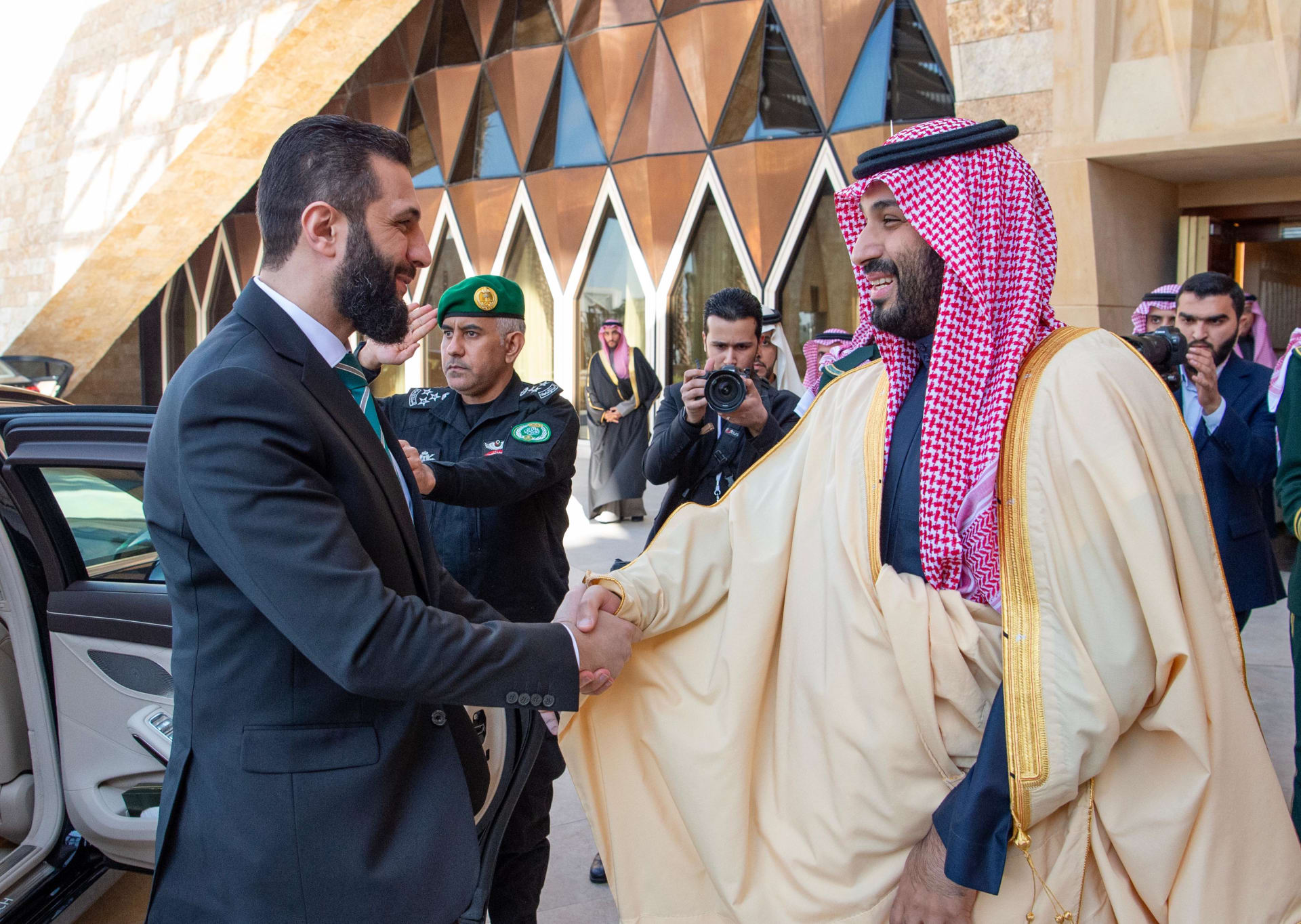
Middle East Eye places Damascus at the heart of a broader Saudi vision for reshaping regional connectivity maps, noting a striking phrase that Saudis want roads, cables, and railways to pass through Syria.
This formulation reflects a perspective that goes beyond a single cable project to a more comprehensive plan for redistributing regional transit routes.
This approach is first linked to the shift in the political climate following the Gaza war, when Saudi Crown Prince Mohammed bin Salman openly accused “Israel” of committing genocide in the Strip.
That context made the normalization path politically and publicly more costly within the kingdom and across the Arab world, opening the door to alternatives that bypass “Israel” and deny it additional strategic gains in major infrastructure projects.
Within this framework, the route adjustment carries a dual message: reducing tangible links with “Israel” in sensitive regional projects while simultaneously reintegrating Syria as a potential hub in the political economy network of the region.
Christian Koch, a Gulf affairs expert at the Baker Institute at Rice University, underscored this point, observing that including Syria instead of “Israel” aligns with Saudi efforts to reintegrate Damascus into the regional framework and limit ties with “Tel Aviv,” marking a clear shift from 2022, when discussions of Saudi-Israeli normalization were at their peak.
The report also situates this move within a broader reality: the region is seeking additional land routes connecting the Indian Ocean to the Mediterranean amid growing sensitivity to geopolitical chokepoints.
In this context, Julian Rawle, a U.S.-based submarine cable consultant, noted that Syria could become a practical option if investors felt sufficiently confident about the development of its political situation.
In this sense, Syria is not merely an alternative path on the map, but a political and economic bet on relative stability that could transform it from a war-weary geographic margin into a regional transit hub, gradually reintegrated into energy, data, and transport networks, within a new web of balances taking shape in the Eastern Mediterranean.
The Saudi–Syrian route cannot be understood apart from the scale of Riyadh’s investment in Syrian infrastructure.
Saudi Telecom Group has announced an investment approaching $800 million in Syria’s telecommunications sector, aiming to connect the country regionally and internationally through a fiber-optic network exceeding 4,500 kilometers in length.
These figures are not mere news details, but a fundamental condition for turning Syria into a marketable transit hub for cable companies and data network operators, effectively a pivot point in new connectivity maps between Asia and Europe.
Several sources have described the deal as a strategic project named “SilkLink,” symbolically evoking Syria’s historical role as a transit corridor in trade and communication routes.
The Zawya economic platform reported that the project is valued at around 3 billion Saudi riyals, to be implemented in partnership with a Syrian sovereign fund, with a majority stake held by Saudi Telecom Group, reflecting long-term investment weight rather than a temporary initiative.
In a report from Damascus published by the Associated Press on February 7, 2026, Saudi-Syrian investment agreements were discussed, including a massive telecommunications project worth nearly $1 billion, intended to position Syria as an international communications hub through cables spanning thousands of kilometers to strengthen connectivity between Asia and Europe.
The project is set to be implemented in phases over 18 months to two years, giving it a practical dimension beyond theoretical ambitions.
When announced investments are paired with clear implementation schedules, the Syrian route becomes more than a political idea, emerging as a strategic option being built on the ground, opening the door to redefining Syria’s position in regional transit equations.

Athens’ Role
After Damascus, Athens emerges as a key player, seeking to position itself as a regional hub connecting Europe to the Middle East across energy, real estate, and artificial intelligence sectors.
In this context, Greece has in recent years worked to attract investments from Qatar, the UAE, and Saudi Arabia, pursuing a vision that leverages its geographic location as a strategic advantage in the cross-border connectivity economy.
At the same time, Greece maintains a close relationship with “Israel.” Decision-makers in Athens view “Tel Aviv” as an important ally in countering Turkiye and as a guarantee of continued U.S. political and security engagement in the Eastern Mediterranean.
This is not a minor detail, as much of the Eastern Mediterranean’s projects over the past decade have been built on trilateral balances involving Greece, Cyprus, and “Israel,” whether in energy, defense, or electricity interconnection.
In the defense sphere specifically, Reuters reported in November 2025 that Greece was negotiating with “Israel” to purchase missile and artillery systems as part of a wide-ranging military modernization program, aimed at deterring threats, particularly along its eastern border with Turkiye, highlighting the depth of the bilateral partnership.
Yet the record of Eastern Mediterranean projects is not without setbacks.
The EastMed gas pipeline, which aimed to link “Israel” and Cyprus with Greece and onward to Europe, faced doubts about its economic viability and political opposition, with a turning point coming as U.S. reservations grew amid Turkish objections, noticeably weakening its momentum.
In electricity interconnection, the Great Sea Interconnector project, intended to link Greek and Cypriot grids and later “Israel,” has encountered delays, investigations, and questions about costs and feasibility.
Reuters noted that European prosecutors were investigating criminal allegations connected to the project, adding another layer of uncertainty.
In February 2026, the Cyprus Mail reported that the European Union had reaffirmed its support for the project despite these delays.
Within this complex context, rerouting the Saudi–Greek data cable toward Syria adds pressure on Athens’ equation: how can it maintain its strategic partnership with “Israel” while also securing the opportunity to consolidate its position as a gateway for Gulf data flows and investments into Europe?
Turkiye remains a constant presence in these calculations, given its maritime disputes with Greece and overlapping interests in the Eastern Mediterranean.
Any route passing through Syria theoretically and practically opens possibilities for interaction with Turkish geography, whether through overland connections from the Levant to Anatolia and onward to Europe, or through considerations of security, tariffs, and infrastructure.
Even if not officially part of the project, bringing connectivity networks closer to Syrian territory creates new possibilities in a regional environment where Ankara invests heavily in communications infrastructure and transit corridors, making every new cable a factor in a broader balancing game that extends beyond technology into politics and strategy.

New Alliances
While data cables may seem at first glance to be silent infrastructure, they in fact speak a clear language of influence; whoever controls a transit gateway holds a measure of decision-making power.
A cable is not merely a fiber-optic conduit for data, but a sovereign pathway where economic, security, and technical interests intersect.
In this context, bypassing “Israel” in a route linking the Gulf to Europe signals a Saudi desire to redistribute the benefits of regional connectivity, turning Damascus from a battlefield into a transit hub, while leaving “Tel Aviv” outside certain new platforms that will serve the artificial intelligence economy and transcontinental data flows.
This dynamic, however, cannot be separated from broader tensions within the Gulf and beyond.
Riyadh is at odds with Abu Dhabi over issues such as Yemen, Sudan, and the Red Sea, at a time when the United Arab Emirates remains Israel’s closest Arab partner under post-normalization arrangements.
Against this backdrop, the Syrian route can be read as part of a wider competition over shaping new connectivity maps: should routes pass through nodes that give Israel and the UAE additional influence in the data and energy economy, or will Saudi Arabia create an alternative path through Syria, opening possibilities for other intersections that could include Turkiye, Iraq, or Jordan under different arrangements?
According to Turkiye Today on February 20, the Saudi plan is not limited to a data cable. It also encompasses a high-voltage electricity interconnection project with Greece that bypasses “Israel” in favor of Syria via a high-voltage direct current (HVDC) link.
The existence of such a plan reinforces the idea that this could be part of a broader connectivity package, in which the Syrian corridor becomes a platform for both data and energy projects.
In this sense, Damascus is being redefined in the Eastern Mediterranean through an economic lens, not merely political alignment; rather than a crisis node, it is presented as a transit hub within a new regional network.
Greece, meanwhile, remains a sensitive balancing point. On one hand, it seeks to attract Gulf investments and enhance its position as a European gateway for cables, while on the other, it maintains close security and political ties with “Israel” within the tense Eastern Mediterranean environment.
With numerous regional projects stalling, Athens may be betting on the feasible rather than the ideal. The “East Mediterranean Data Corridor” project appears, according to some industry experts, to be more implementable compared with ambitious infrastructure dreams that have been hampered by political calculations, especially if funding hurdles and initial payments, key indicators of seriousness in the submarine cable industry, are successfully addressed.
Sources
- Exclusive: Riyadh Wants to Replace Israel With Syria for Greece Fibre-Optic Cable Route
- Saudi Arabia Eyes Syria Route for Greece Fiber Link
- Center3 and ASN Sign Supply Contract for EMC Subsea Cable
- Greece in Talks to Buy Anti-Aircraft, Artillery Systems From Israel
- EU Reaffirms Support for Great Sea Interconnector