What’s Behind the Rising Debate Over Equality Between Men and Women in Algeria?
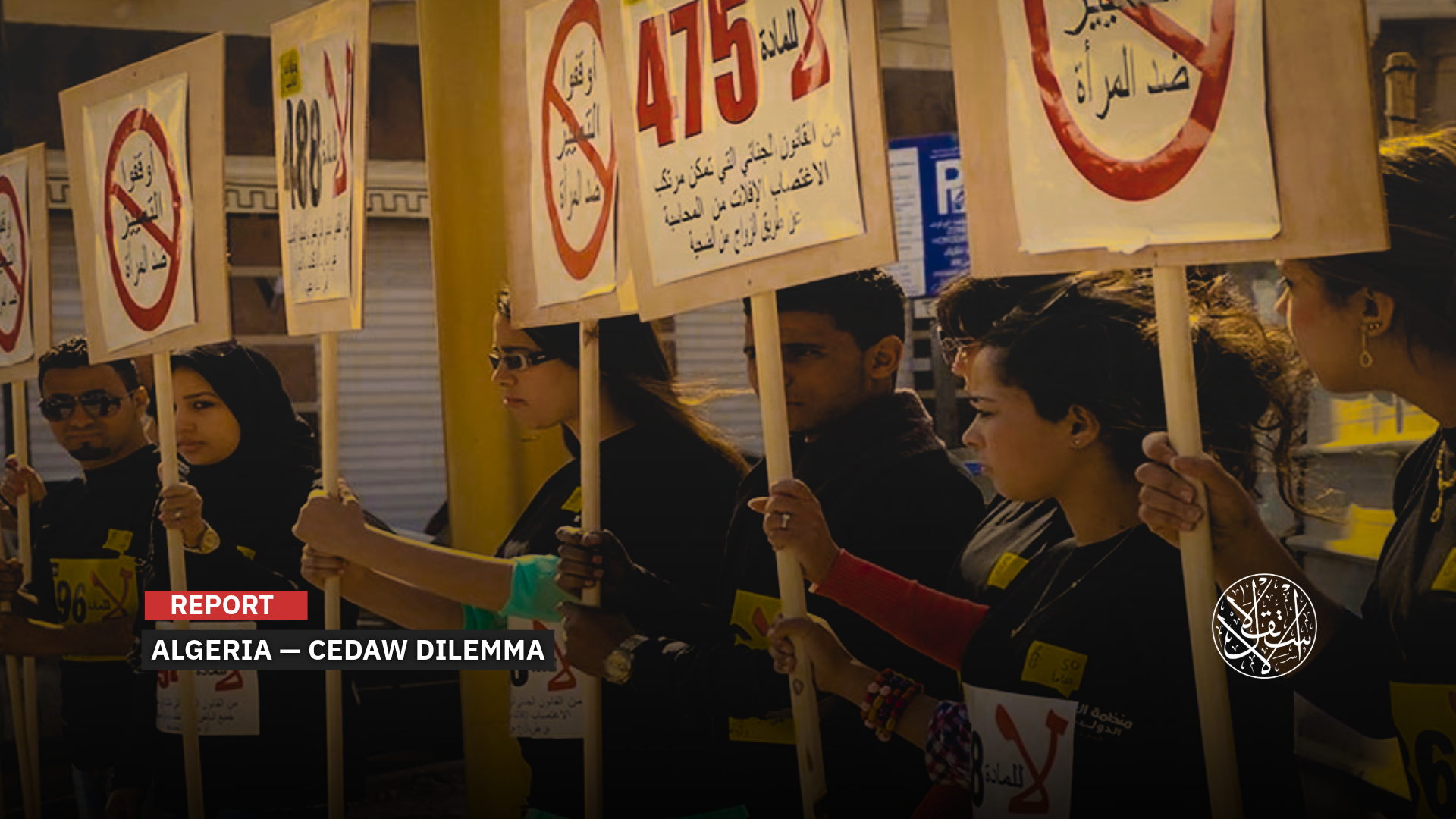
“The divorce rate in Algeria has risen to 40%.”
Algeria has entered a political and legal debate following the government’s announcement that it would formally lift its reservation on Article 15, paragraph 4, of the Convention on the Elimination of All Forms of Discrimination Against Women (CEDAW).
The decision came through a presidential decree signed by President Abdelmadjid Tebboune and published in the Official Journal No. 25-218 in August 2025, nearly three decades after Algeria ratified the convention with multiple reservations.
Under the decree, Algeria no longer maintains its reservation on the provision granting women equal rights with men regarding freedom of movement and the choice of residence.
The announcement sparked widespread opposition from Islamist groups, including the Movement of Society for Peace, Algeria’s largest Islamic party, which issued a statement on August 24, 2025, denouncing the decision.
Against Sharia
The movement announced “legal and substantive objections” to lifting the reservation on the relevant clause, suggesting that the step is “inconsistent with natural legislative principles.”
It said that lifting the reservation should have received parliamentary approval for the presidential decree.
On a “substantive” level, the movement noted that Algeria had reserved certain provisions of the convention in 1996 and argued that “the country exercised full sovereignty in the face of the globalization of Western laws.”
The movement warned of the dangers of “continuously being drawn into agreements with international treaties that conflict with religious or social norms and yield to international pressures.”
It also cautioned that lifting the reservation could have social consequences “from a practical, realistic, and societal perspective, as it could be exploited to further dismantle the family structure.”
Islamic leader Abdelrazak Makri voiced his opposition to Algeria’s decision to lift the reservation.
In a Facebook post on August 23, Makri described the Convention on the Elimination of All Forms of Discrimination Against Women as “one of the most dangerous conventions aimed at dismantling the family and building societies that follow a single reference, namely the secular, capitalist, colonial framework.”
He also voiced concern that lifting the reservation would be followed “by enacting legislation that protects deviant cases of women’s rebellion against men and expands instances of marital disobedience.”
Also opposing the decision to lift the reservation is the Nahda Movement, an Islamist party, which described it as “a dangerous step for the future of the Algerian family and national identity security.”
“This move comes at a time shrouded in uncertainty and suspicion given the generally harmful effects of this treaty on human nature, the family, and society,” the party said in a statement on August 27, 2025.
It urged the country’s top authorities to review the decision, citing its “negative consequences,” and called on them “not to compromise the pillars of identity, especially the rules governing family and society, and not to yield to international pressures pursuing agendas aimed at dismantling the family and society.”
It emphasized the need for careful review of any action in this regard, broader consultation, and informing citizens of the details of any step to avoid confusion, misunderstanding, or misuse.
Supportive Voices
In contrast to the Islamist current opposing the lifting of the reservation on the mentioned article, other organizations and figures expressed their support for the move, praising its human rights dimensions.
The Voice of Women Facebook account, one of Algeria’s leading feminist platforms, called the lifting of the reservation more than a legal step, framing it as a symbolic milestone.
The platform argued that “women’s rights are no longer negotiable between national legislation and international obligations.”
“The Algerian reservation reflected a social and cultural structure that entrenched the husband’s authority as head of the family, granting him decision-making power over residence and housing, and its removal today represents a reassessment of women’s autonomy within the family.”
“The decision is the result of accumulated efforts by feminist associations and civil society organizations that exerted continuous pressure through parallel reports and awareness campaigns,” it added.
“Equality will only be truly achieved if the decision is accompanied by comprehensive family law reform and the integration of gender justice concepts into public policies and societal culture.”
At the party level, the Democratic National Rally (RND), a supporter of the president, stated that lifting the reservation on Article 15, paragraph 4 of the CEDAW is a sovereign, constitutional step consistent with a proper understanding of Islam’s objectives.
According to a party statement, lifting the reservation strengthens Algeria’s international standing and enshrines the rights of its citizens without gender discrimination while ensuring family stability and preserving state sovereignty and international stature.
The statement added that “agitation and attempts to divide public opinion against such a move are only a desperate effort to block Algeria’s progress in reform.”
Regarding the legal argument that lifting the reservation should follow formal procedures—either parliamentary approval before or after issuing a presidential order—the statement stressed that “the president has the constitutional right to legislate through presidential orders between parliamentary sessions.”
“Lifting the reservation aligns with Islamic principles, noting that Islamic law has honored women and granted them rights for centuries, including rights to housing, mobility, ownership, and decision-making. Granting these rights is not an external imposition but central to Islam’s objectives of justice and dignity,” it added.
“The decision does not undermine family privacy or family law but allows for legislative adjustments consistent with the spirit and objectives of Sharia.”
“Fears of family disintegration are unfounded because the Algerian family is grounded in family law and established customs, and the decision balances these with international obligations,” the statement concluded.

Legal Debate
Beyond the social and political controversy, the decision sparked a legal and constitutional discussion. Constitutional law professor Moussa Boudhan said that lifting the reservation on the relevant paragraph is a “normal and routine measure that does not conflict with the constitution.”
Boudhan told the press that the country’s constitution explicitly states in Article 2 that “Islam is the state religion, and therefore there is no threat to the country’s religious or identity framework.”
He added that the issue of women’s freedom of movement and residence “was settled in the amended Family Code of 2005 and imposes no legal or procedural restrictions on Algerian women in this regard.”
“Lifting the reservation will introduce nothing new and will not lead to any further legal amendments,” he concluded.
In contrast, lawyer Toufik Haicheur argued that the step raises deep questions about its compatibility with the national legislative framework, particularly the Family Code.
Haicheur told the press that the 2020 constitution gives priority to international human rights treaties, which obliges Algerian lawmakers to amend national laws, including granting women equal rights with men in choosing their residence.
He noted that this equality could generate new disputes in courts, whether in matters of custody, divorce, or family conflicts, as a wife could claim independent residence against her husband’s wishes.
Haicheur also stressed that the decision’s effective implementation will hinge on lawmakers’ willingness to align domestic laws with international obligations and on judges’ ability to apply these new standards.

Legitimate Concerns
Political activist Kharchi Noe warned that lifting the reservation on the contested article could have negative social consequences, including an increase in divorce rates in Algeria, which currently approach 40%.
“Adopting this article will inevitably create additional factors that could further increase the divorce rate in the country,” he told Al-Estiklal.
“Society has the right to question why authorities raised concerns about the article in 2014 and are lifting the reservation now.”
The activist also called on responsible authorities to disclose any pressures applied on the government that might prioritize pleasing the West over local traditions, customs, and religious norms.
“The West, which has long interfered in family structures at home, now seeks to spread this influence worldwide, particularly to Muslim societies,” Noe said.
Meanwhile, amid the heated national debate over the presidential decision, Algeria’s Press Service cited unnamed sources saying the move was simply a technical adjustment, prompted by the disappearance of the reason for reserving Article 15, Paragraph 4 when the convention was ratified in 1996.
The agency explained that Algeria had originally reserved five provisions for conflicting with national laws, particularly the Family Code and nationality law.
It noted that, alongside gradual national legal developments, Algeria has lifted several of these reservations, such as in 2005 when it removed its reservation on provisions granting mothers the right to pass nationality to their children following an amendment to the nationality law.
Regarding the recently lifted reservation, the source said it concerns Article 15, Paragraph 4 of the convention, which guarantees equality between men and women in choosing their residence.
The agency clarified that Algeria had reserved this article in 1996 based on Article 37 of the Family Code at the time, which was later repealed in 2005. Consequently, the reservation no longer had a legal basis in national law.
It stressed that lifting the reservation will not result in changes to national laws, noting that Algeria’s approach to such conventions involves first adjusting domestic legislation before removing international reservations.
Keeping the reservation had been exploited by groups hostile to Algeria to claim before human rights organizations that the country discriminates between men and women in matters of mobility and residence, despite Algerian law imposing no such restrictions, according to Algeria’s Press Service.
But the clarification failed to quell public and stakeholder reactions on social media, signaling that the decision’s impact remains unsettled, especially if family laws are amended following the reservation’s removal.
Sources
- Lifting the Reservation on CEDAW Article 15, Paragraph 4: Facts and Interpretations [Arabic]
- RND: Lifting the Reservation on CEDAW Article 15 Is a Constitutional Step in Line with the True Objectives of Islam [Arabic]
- Movement of Society for Peace Criticizes Algeria’s Lifting of CEDAW Reservation [Arabic]
- Algeria Lifts CEDAW Reservation: Could It Threaten Family Stability? [Arabic]