What Is Behind the Increasing Russian Military Momentum in Northeastern Syria?
The Russian moves in northeastern Syria indicate that it is dealing with the region as a new piece of military influence that it has become affiliated with.
This is evidenced by the acceleration of Russian rapprochement with the Syrian Democratic Forces (SDF), which controls most of the geography of the north-east of the country, which made way for Moscow to increase its military arsenal there.
It is noteworthy that Moscow has increased its military influence in the border areas with Turkey, it comes amid Ankara's readiness to launch a large-scale military operation against strategic cities controlled by branches of the terrorist Kurdistan Workers Party (PKK), represented by the People's Protection Units (YPG), the backbone of the SDF backed by the international coalition.
The YPG is the armed wing of the Kurdistan Democratic Union Party, the latter is the Syrian branch of the PKK, located in southern Turkey and northern Iraq.

Military Momentum
Within the framework of demonstrating the Russian military power in northeastern Syria, Moscow deployed Su-35s fighters for the first time at the Kamishly civil airport on October 28, 2021.
Russia takes the Kamishly civil airport base in northeastern Syria, which belongs to the border province of al-Hasakah with Turkey, as a center for its forces, it is the largest, most logistically and efficient there is.
Su-35s have the ability to destroy targets in the air, on the ground and in the water, it has the ability to carry up to 8 tons of missiles and bombs of various classes with laser and satellite guidance.
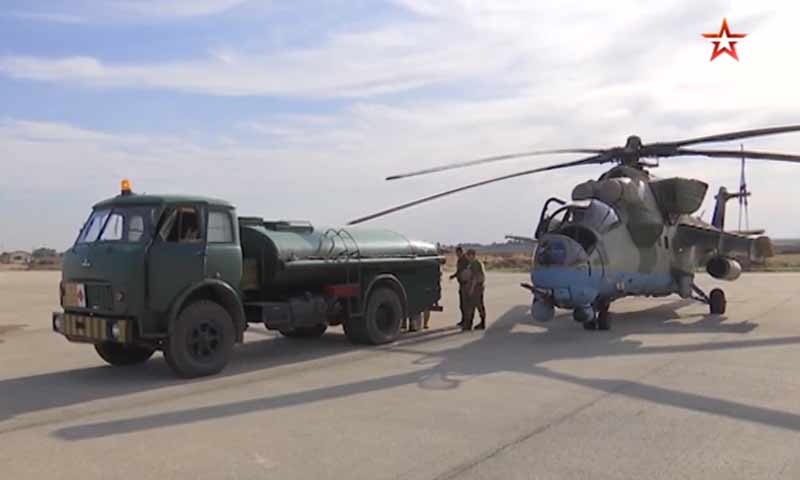
According to the Russian Anna agency, the Moscow forces will deploy twelve Mi-8 helicopters, in addition to five Ka-52 aircraft at the airport of the village of Mitras.
The village of Mitras belongs to the Sarin district, 30 km south of Ayn al-Arab in the Aleppo countryside, which is controlled by the SDF.
Also, twelve Su-34 bombers will be redeployed to the Kamishly Airport, according to the same source.
Currently, the Kamishly base is Russia's third large base in Syria, along with the Hmeimim Air Base and Tartus Naval Base.
There was information about Moscow's renting from the Syrian regime of the airport, which is located a few kilometers from the border with Turkey, this is for a period of 49 years, i.e., the same terms for the time period of the two aforementioned bases.
At that time, observers explained that renting the airport was part of Moscow's strategy for long stay in Syria, and its future geopolitical interests in the Middle East.
Message To Turkey
The second Russian move recently near the Turkish border, Russian army combat helicopters conduct intensive military maneuvers and training with the Syrian regime forces, early November 2021, in the Tal Tamer area northwest of al-Hasakah.
The Russian maneuvers, which were coordinated with the PKK branches in Syria, focused on combating attack drones, according to the Anna news agency.
The air military exercises came as part of Russia's efforts to maintain a state of de-escalation, in the areas of contact between the SDF and the Turkish-backed Syrian National Army.
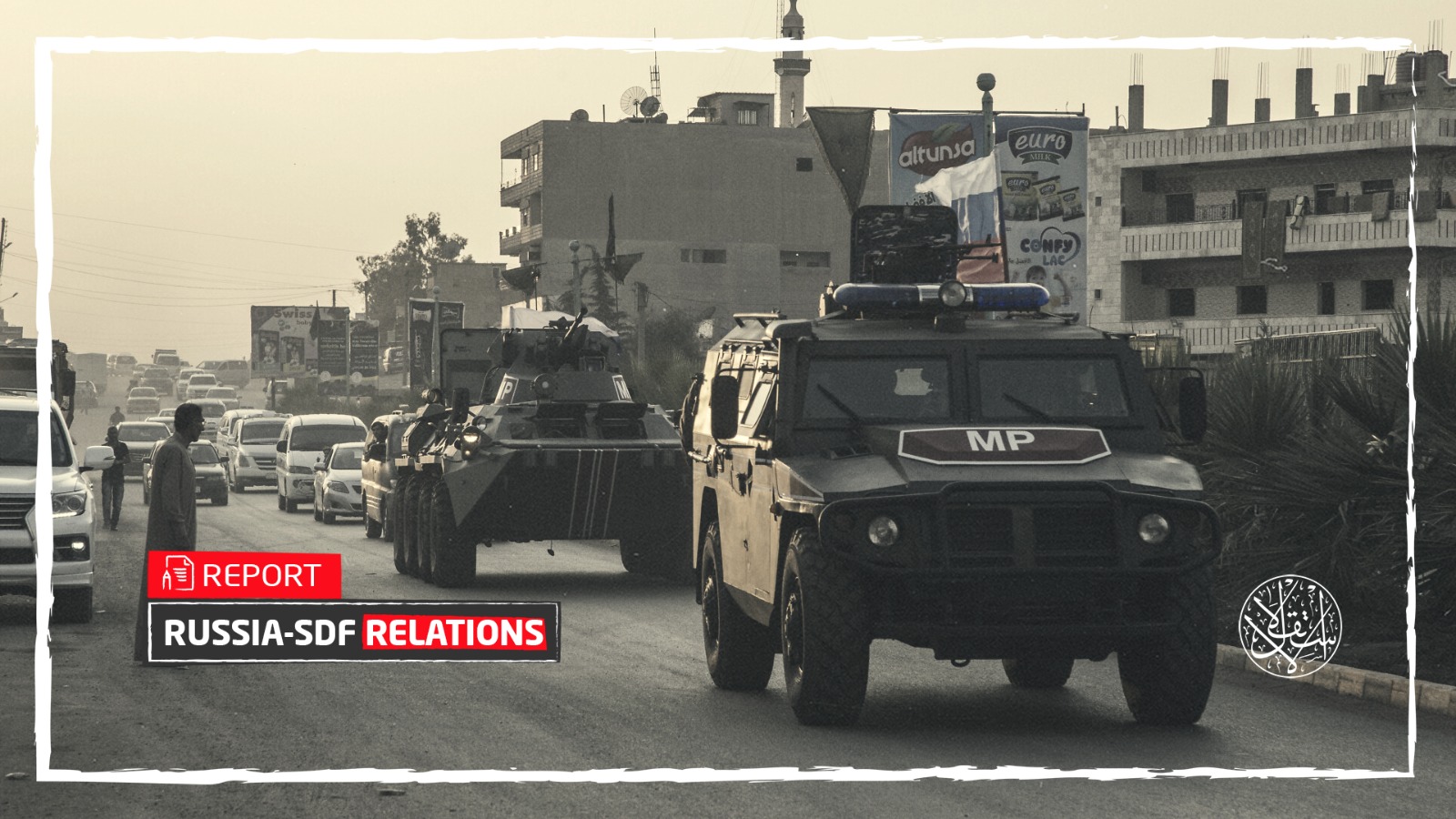
It was preceded by the implementation of Russian military police armored vehicles along the international road al-Hasakah-Aleppo known as (M4), in the part extending from the city of Kamishly to the town of Tal Tamer in al-Hasakah countryside.
The town of Tal Tamr, which is controlled by the SDF, previously reported by the Turkish media, as one of the potential areas of the Turkish military operation, in addition to each of the cities of Manbij, Tal Rifaat and Ayn al-Arab in the countryside of Aleppo, and Ain Issa, in the countryside of Raqqa.
The importance of Tel Tamer, which is about 64 kilometers from the border strip with Turkey, it is inhabited by a majority of Assyrian Christians, as it is located on the international road M4 coming from Aleppo to the Iraqi border at the Rabi'a crossing through Raqqa and al-Hasakah.
As for the city of Ayn al-Arab, it is controlled by Turkey, it means cutting the Kamishly-Manbij road belonging to the PKK branches and ensuring a direct connection between the two cities of Ras al-Ain and Tal Abyad, which are controlled by the National Army factions with the latter’s areas in Aleppo countryside as part of Operation Euphrates Shield.

The researcher at Jusoor Center for Studies, Wael Alwan, provided an analytical reading of the Russian maneuvers, he considered it as “a message to Turkey that Russia has become fully present in the Syrian scene, especially since the maneuvers came in the vicinity of the Operation Peace Spring area.”
On October 9, 2019, Turkey launched Operation Peace Spring, which was concentrated in the governorates of al-Hasakah and Raqqa, the Kurdish YPG forces were removed 30 km from the Turkish border.
Alwan saw in a recorded paragraph published by the Center on November 4, 2021, that “the maneuvers may amount to a warning that the military operation that threatens Turkey cannot be launched if it does not coordinate fully with Russia, militarily and security, as well as political coordination.”
“The Russian maneuvers are also a message to the SDF forces, as Moscow sponsors its understandings with the Syrian regime, which aim to build comprehensive understandings that benefit the regime,” the researcher also hinted.
“The SDF is the biggest loser of what is happening east of the Euphrates, but this is the price of the American retreat in the Syrian file, which the SDF fears, and one of its leaders announced the acceptance of negotiations with the Syrian regime unconditionally,” Alwan pointed out.
Strategic Partnership
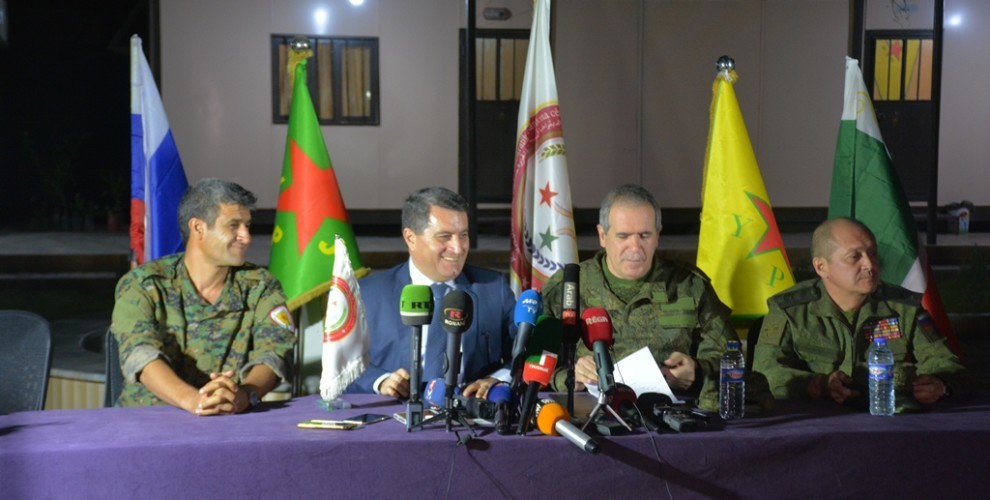
Military experts believe that the existence of a strategic partnership between Russia and SDF, especially at the military level, will become clear in the event of regular Russian maneuvers near the Turkish border later.
The SDF sought to deal with all possible scenarios that would affect its areas of northeastern Syria in the event of any sudden US withdrawal, or limiting it to fixed military bases, perhaps far from cities, which explains the Russian moves on more than one level.
In this context, the Syrian analyst, Hassan al-Sharif, explained to Al-Estiklal that: “There are currents within the SDF whose positions differ on the issue of the Russian presence in eastern Syria.”
“Some of them see it as an alternative to the Americans and are working on that, including the leader of the SDF, Mazloum Abdi, another is not opposed to the Russian presence, but wants to work with them with prior US approval and acceptance,” according to him.
“Many areas in eastern Syria will be handed over from the SDF to the Russians. Currently, there is a gas line extending from the Konico field, east of Deir ez-Zor, where American forces are present, to the city of al-Shaddadi, south of al-Hasakah,” al-Sharif said.
Negotiations are underway around the gas pipeline for Moscow to assume the task of supervising its protection through local militias, in order to benefit the Syrian regime in order to feed its Homs refinery.
“The second part is the oil fields that are under the control of the SDF in Deir ez-Zor, a goal secured by the Russians, there is an American green light on the condition not to approach Washington's major military bases in the region, such as the al-Omar oil field, the largest of the Syrian fields,” he added.
“The Russian moves in eastern Syria, it is the result of periodic meetings between SDF and Russian officers at the Hmeimim Air Base in Latakia countryside, what is being agreed upon is being implemented, including discussing the formation of a Fifth Corps with Russian support, with the aim of protecting the oil pipelines,” the analyst pointed out.

“The SDF is looking for official recognition by Russia as a force, even if it is in partnership with the regime in its areas, but so far, Moscow is dealing with it as an existing reconciliation file, just like the files of Daraa, Homs and Eastern Ghouta, which were previously implemented slowly,” al-Sharif pointed out.
“Although the SDF coordinated more security efforts with the Russians, the only objection facing Moscow is the people who reject the presence of the Russians in their areas, because it will eventually lead to the return of the Syrian regime to it again,” the Syrian analyst concluded his statement.