Rather Than Terrorism, Europeans Are Realizing That Russia Is the Greatest Security Threat
For two decades, the Western media promoted terrorism as the biggest threat to the security of Europeans. Yet, the Russian invasion of Ukraine pushed the Europeans to shift their perception of threats. They realized that the Russian threat is more dangerous to Europe's security than terrorism. This is what was described by many observers as a geopolitical awakening.
Opinion polls showed in recent months, even before the Russian invasion of Ukraine, that Europeans from different countries agreed that Russia poses a threat to the European continent as a whole. This awareness of danger was not prevailing a year ago when terrorism was at the top of the list of European fears in various countries. Did Putin succeed with his attack on Ukraine in pumping the Europeans' awareness of the real dangers that threaten them?
A survey conducted by the European Council on Foreign Relations (ECFR) issued on February 9, 2022, revealed that Europeans of different countries agree that the Russian threat is not only problematic for Ukraine but for the security of the continent as a whole.
Despite the Kremlin denying at the time any intention to invade Ukraine, the Europeans trusted that Russia was indeed plotting to do so. They also expressed that they want NATO and the European Union to intervene to stop Russia.
The latest survey by Spain’s Elcano Royal Institute revealed that Spaniards consider Russia the biggest external threat to Spanish security.
While terrorism was the biggest concern of Spaniards last year, it ranked third in this year's report. The institute conducted its research between October and November 2021 and published the report on February 18, 2022.
The report stated that nowadays, Spaniards widely consider Moscow as the biggest threat (34%), Morocco in second place (20%), and terrorism to third place (14%).

Misleading Propaganda
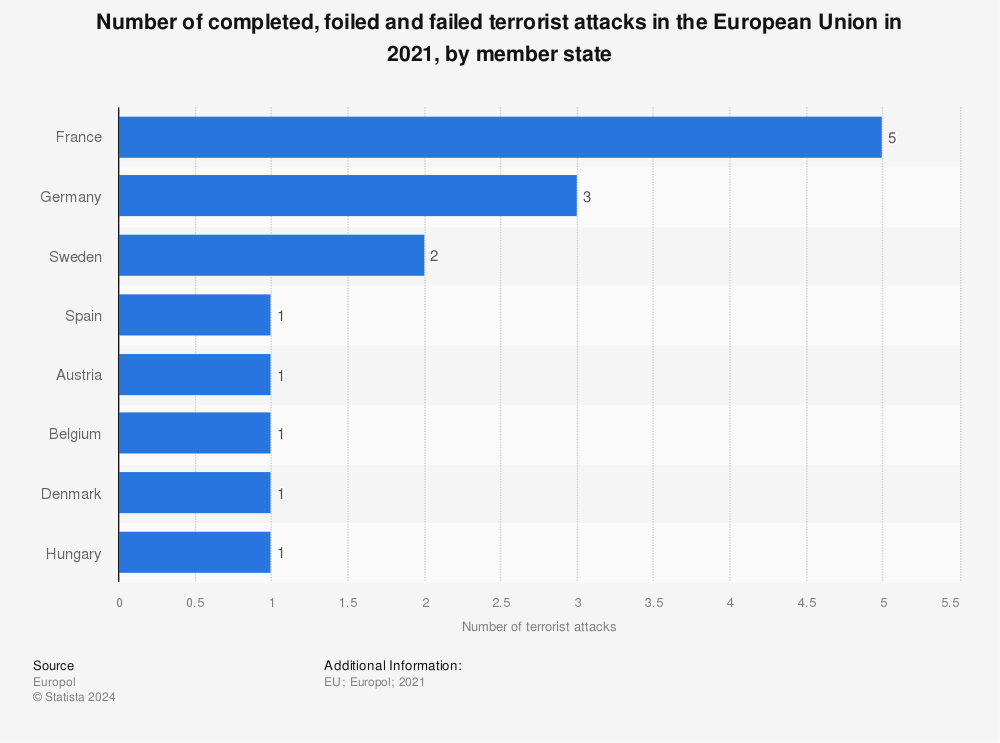
Since 9/11, terrorism was promoted as the greatest security threat putting European and American’s lives in danger. However, statistics show that the number of fatalities caused by terrorism since 1980 till 2021 is not huge as they were depicted. Most worldwide terrorist acts claimed lives in the Middle East countries, Syria and Afghanistan in particular, not in the Western countries.
In December 2021, the Statistica research department issued the results of statistics revealing that since 1980 the total number of fatalities from the ten worst terrorist attacks in Europe is less than 1000 death. A number that seems really small compared with the one-day 993 deaths of Coronavirus in Italy for instance. Moreover, the 1000 deaths in 40 years look even smaller if we compare it with the number of fatalities after 3 days of the Russian invasion of Ukraine.
On the 27 of February, the United Nations announced that it has confirmed at least 240 civilian casualties, stressing that it believed the “real figures are considerably higher” because many reports of casualties are not yet confirmed.

Geopolitical Awakening
Before its invasion of Ukraine, the Russian military exercises around the Ukrainian border caused a dramatic change in the Spaniards' view of Moscow. Within months, the number of people in the kingdom, who view Russia as a threat, rose from 5% to 34%, a dramatic 29-point increase that made the Eurasian giant the number one security problem in Spain, according to the official Spanish report.
The sharp difference between last year’s survey results and today’s data disclosed the remarkable change in Spanish public opinion. Last year, terrorism was at the top of the list of the perceived foreign threats with 54%, while Russia’s choice was very marginal.
The survey conducted by the European Council on Foreign Relations in late January 2022 showed that Europeans in the north, south, east, and west agree that Russia is a threat to European countries.
The poll participants were from 6 countries: Finland, France, Germany, Italy, Poland, Romania, and Sweden. Together they account for almost two-thirds of the European Union’s population.
Russian aggression triggered a geopolitical awakening among Europeans and succeeded in putting the question of the European security order on the table.
Mark Leonard, director of the ECFR pointed out: “The data suggests something of a geopolitical awakening in Europe.”
He added: “EU states have been portrayed as divided, weak and absent on Ukraine, but European citizens are united: they agree Vladimir Putin may pursue military action, and that Europe, together with its NATO partners, should ride to Ukraine’s aid.”
The Guardian commented on the study results by saying: “The crisis could end up dramatically changing the way Europeans view their security.”

Destructive Arsenal
According to the Global Firepower website, which monitors the military capabilities of countries, the Russian army is the second most powerful in the world after the United States, while the Ukrainian army ranks 22nd out of 140 countries.
The Russian army is also ranked second in the world in terms of its air force, as it owns 4,173 aircraft in 2022, including 1,543 attack helicopters, compared to 3,000 combat aircraft last year.
There is a variety of equipment at Moscow's disposal. Such as, the sea-launched Kalibr missiles, ground-launched Iskander-M 9M728 missiles, and air-launched cruise missiles.
Russia has a large arsenal, some of which it uses to attack Ukraine such as the BM-30 Smerch missile, Kh-31 anti-radar missiles and various types of Grad missile launchers, as well as the TOS-1, a missile launcher mounted on a tank chassis.
From a wild force perspective, the number of soldiers in the Russian army is 1,014,000. As for the ground forces, Russia has 15,500 tanks and owns more than 27,600 armored vehicles. It has about 6,500 self-propelled guns and more than 3,800 rocket launchers.
As for naval power, the Russian Navy has more than 600 naval units, including one aircraft carrier, 11 destroyers, 11 frigates, and 85 submarines.
With its huge arsenal and its willingness to engage in war to defend its interests, it has become strongly evident for Europeans that Russia is a real threat to their security.
Sources
- Most Europeans want to stand with Kyiv against Moscow, poll suggests
- The crisis of European security: What Europeans think about the war in Ukraine
- Varying military capabilities: Learn about the arsenal of the Russian and Ukrainian armies [Arabic]
- Number of terrorist attacks in the European Union (EU) in 2020, by member state
- Why Do the Spaniards Consider Morocco the Second Top External Threat?
- Ten worst terrorist attacks in terms of fatalities in Europe from 1980 to 2021