Kufra: The Libyan Airstrip That Changed the War in Sudan and Fueled Hemedti’s Gains
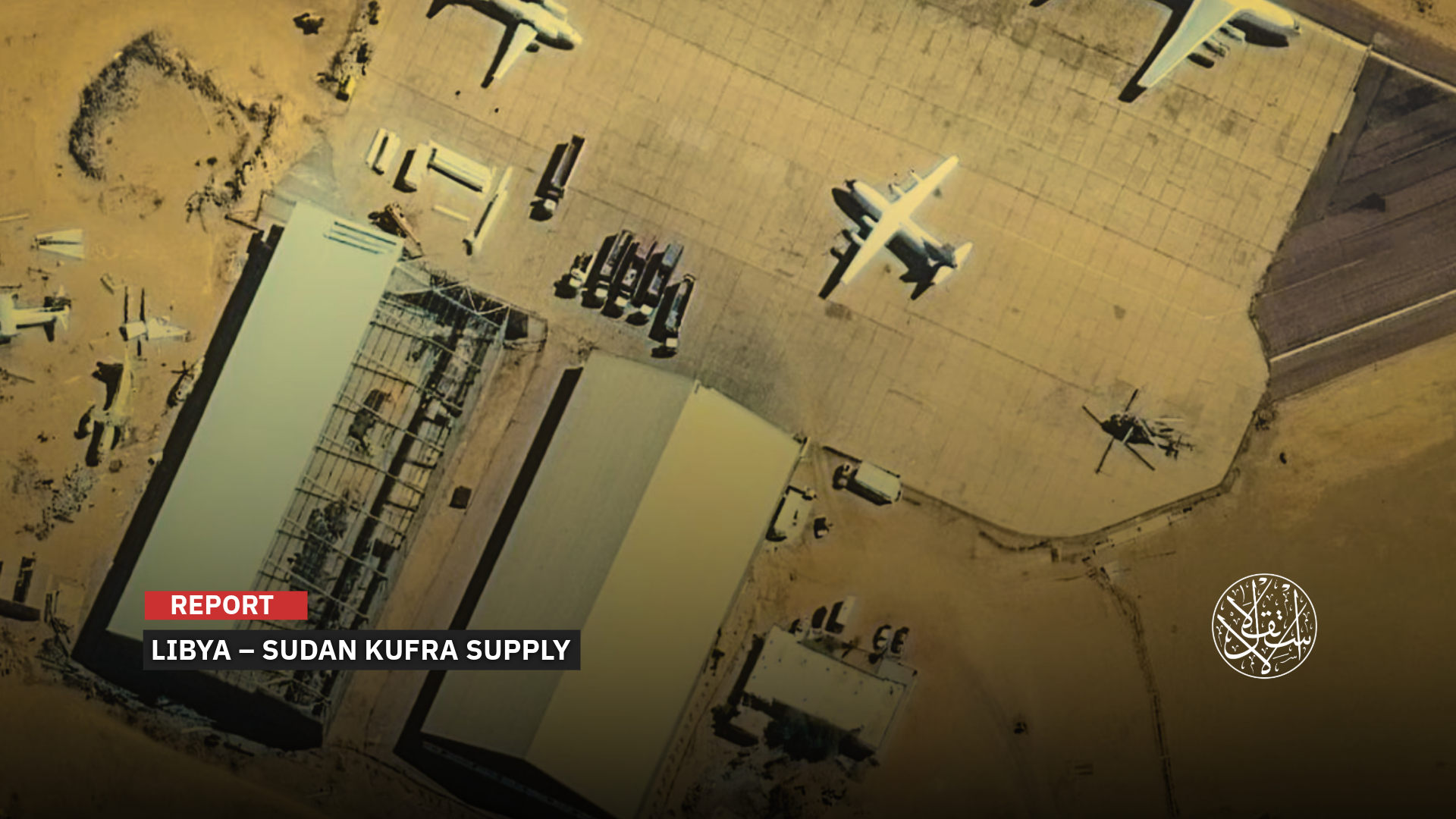
Amid the expansion and redevelopment of Kufra International Airport, announced recently by eastern Libya’s unrecognized government, international reports have revealed the airport’s prominent role in facilitating the transfer of weapons to Sudan’s Rapid Support Forces militia in western Sudan, led by Mohamed Hamdan Dagalo, known as Hemedti.
The airport has reportedly been leveraged by the separatist general Khalifa Haftar as a central hub in a wider arms supply network.
The United Arab Emirates has emerged as a key actor in backing Hemedti’s militia forces with weapons and equipment, opening multiple land and air routes to channel supplies to the Rapid Support Forces (RSF) militia.
These routes run west, north, and south from Libya through Chad, alongside preparations for a new airport in the Benishangul region near Sudan’s border.
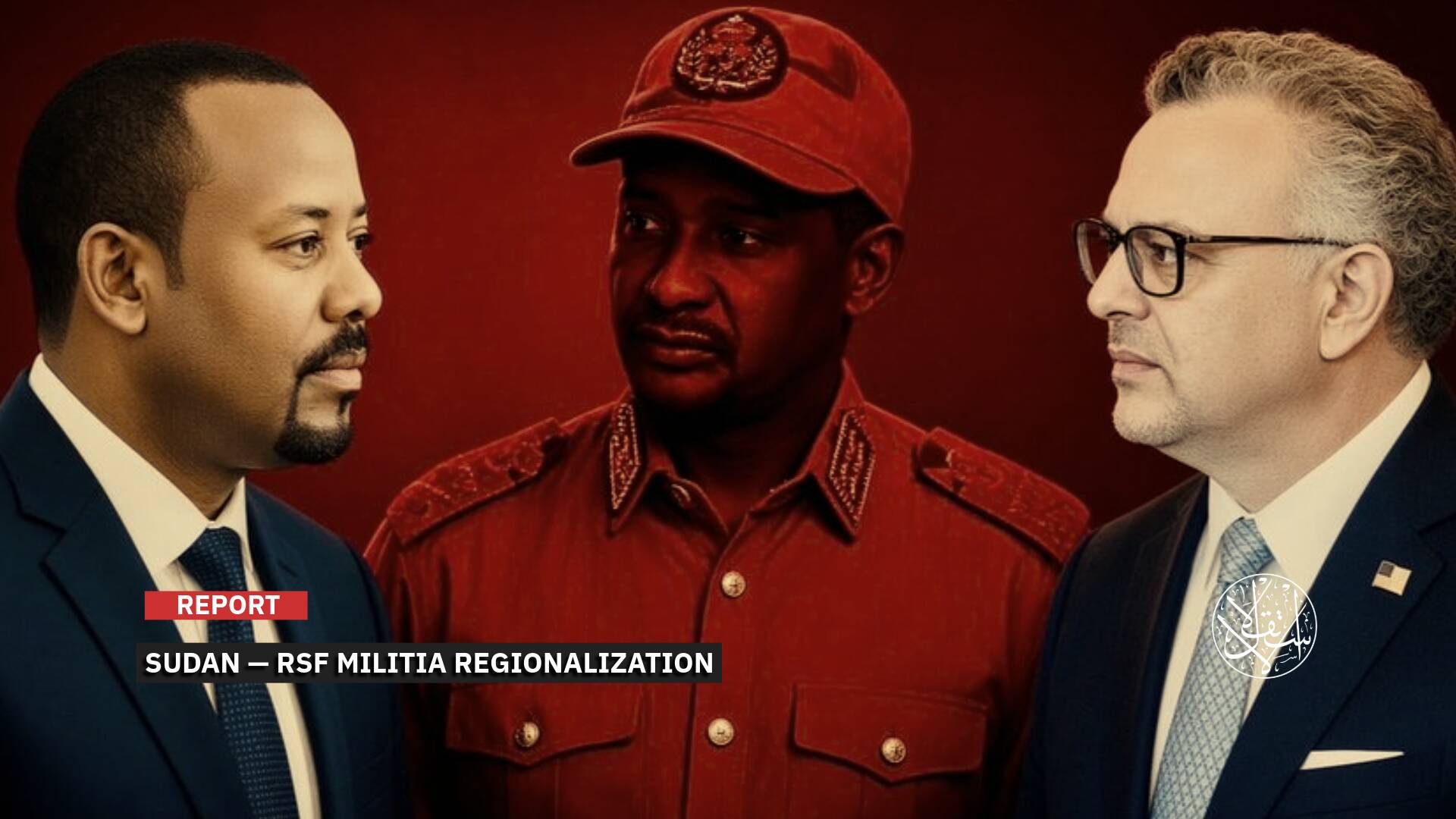
On December 24, 2025, the French intelligence website Africa Intelligence disclosed the existence of a Rapid Support Forces militia training base inside Ethiopian territory.
The site reportedly includes ground facilities and aircraft landing strips, as well as two new hangars believed to be designated for drones, located directly adjacent to the Sudanese–Ethiopian border.
These developments have heightened concerns in Khartoum over Ethiopia’s growing role, particularly in light of the deepening ties between Addis Ababa and Abu Dhabi, and the presence of militia groups in the area. Together, these factors raise the prospect of a new supply corridor for Hemedti’s militia forces across the border.
The use of Kufra airport, however, goes beyond merely easing the flow of weapons. It is described as the linchpin that has enabled the Rapid Support Forces militia to expand its influence and seize control of additional cities and strategic sites inside Sudan, including el Fashir, Babanusa, and Heglig, by ensuring a steady influx of arms, fighters, and mercenaries arriving from Colombia.

Kufra Airport
When General Khalifa Haftar split from Libya and established a breakaway government, parliament and army in the east, Kufra airport, located in a vast desert region in the country’s south-east, was little more than a remote auxiliary airstrip, no more than a modest transit point.
But as Haftar consolidated his grip over eastern Libya with direct backing from Egypt and the United Arab Emirates, the airport underwent extensive expansion during 2024.
It was subsequently rebranded as “Kufra International Airport” and became a base for Haftar’s air force operations, before evolving into a critical node in the UAE’s support network for Sudan’s Rapid Support Forces militia, led by Mohamed Hamdan Dagalo, known as Hemedti.
Over the past year, dozens of foreign aircraft reportedly landed at the airport carrying weapons and mercenaries. From Kufra, arms are flown directly to Nyala airport, which is under Rapid Support Forces militia’s control in Sudan’s Darfur region, or transported overland across Libyan territory into Sudan.
As the Sudanese army stepped up its air strikes on Nyala airport, the Rapid Support Forces militia shifted to sending truck convoys south through the tri-border area toward their strongholds in Darfur, making these convoys frequent targets for aerial bombardment.
The entry of Kufra airport into the logistical equation, however, altered the dynamics of the conflict. It became a central hub reshaping the course of the war in Sudan and played a direct role in enabling the Rapid Support Forces militia to sustain its military operations in Darfur.
The airport has effectively turned into a vital supply artery for the Rapid Support Forces militia, particularly as traditional supply lines through eastern Chad became increasingly constrained by political pressure and Sudanese attacks on procurement routes.
This left the Libya–Rapid Support Forces militia corridor, under Emirati control, as a primary channel through which weapons are flown in to support the militia.
The vital arms supply line linking Kufra airport in Libya to Sudan’s Darfur region is closely tied to a visit by Hemedti to Libya, where he met in April 2023 with Saddam Haftar, the son of General Khalifa Haftar.
The meeting also brought together an Emirati intelligence officer and several senior commanders from Haftar’s militia forces.
Discussions focused on mechanisms to secure the delivery of military supplies into Sudan, including support from Russian mercenaries of the Wagner Group and the United Arab Emirates.
The participants reportedly agreed on the parties responsible for implementing and overseeing transport operations through the Kufra military zone.
According to a source close to Saddam Haftar, the Egyptian outlet Mada Masr reported in November 2025 details of this logistical cooperation, describing it as the backbone of the newly established supply routes.
As the center of the conflict shifted from Khartoum to Darfur following the militia’s retreat from the capital and the army’s reassertion of control over Khartoum, reopening the supply line from Libya became an urgent military necessity to sustain the Rapid Support Forces militia in Darfur, according to Reuters in December 2025.
This shift in supply routes underscores the depth of regional and international cooperation in safeguarding the interests of the warring parties.
It also highlights how remote airports and isolated regions have been transformed into pivotal nodes in modern warfare, exerting a direct influence on the balance of power on the ground.

A United Nations official familiar with the operations of the Rapid Support Forces militia described the militia’s use of Kufra airport as having “changed the entire game”, turning the facility into the main logistical hub for supplying Hemedti’s militia forces deployed deep inside areas under the control of Haftar’s army in Libya.
Arms deliveries to Hemedti’s militia via Kufra airport began at the request of the United Arab Emirates, particularly after the Sudanese armed forces recaptured Khartoum in March 2025, as the Rapid Support Forces militia retreated and suffered battlefield losses in the fight for the capital.
By June 2025, satellite imagery revealed intensified activity involving heavy cargo aircraft arriving from the UAE into Libya, and onward into Sudan, providing logistical and military support to Hemedti’s militia forces.
Kufra airport had by then emerged as a principal gateway for the flow of weapons and equipment.

Rescue Attempt
Satellite imagery from the Copernicus program, alongside flight-tracking data, has revealed a sharp increase in cargo aircraft activity at Kufra airport since April 2025.
Such aircraft had not been present before that point, with activity peaking shortly before the fall of the city of el Fashir.
A report published in July 2025 by the Centre for Information Resilience, CIR, a UK-based non-profit organization, documented and tracked the movement of vehicles and fighters belonging to the Rapid Support Forces militia from camps toward Darfur, underscoring the group’s heavy reliance on airlifted supplies.
Sudanese analysts say the Rapid Support Forces militias’ recent string of battlefield gains would not have been possible without sustained air transport and resupply operations through Kufra airport, which has surpassed the UAE supply hub in Chad in strategic importance.
The corridor helped the militia regain its footing after losing control of the capital, Khartoum, in March 2025.
The same logistical line proved decisive in the violent seizure of el Fashir in October 2025, enabling the Rapid Support Forces militia to consolidate their grip on Darfur and paving the way for further advances across western and southern Sudan.
A separate report by the Global Initiative Against Transnational Organized Crime, a cross-border organization, highlighted how the shift in the war’s center of gravity from Khartoum to Darfur made the reopening of supply lines from Libya an indispensable strategic necessity.
Reuters, in an investigation drawing on testimony from 30 officials, military experts and diplomats, as well as UN reporting and independent analysis, said the air corridor was used to transport weapons, fuel, and fighters that sustained the 18-month siege of el Fashir and enabled the Rapid Support Forces militia to entrench their control and secure subsequent territorial gains.
The report linked cargo flights into Kufra airport to airlines previously named in UN reports for their alleged role in transporting weapons from the UAE to Haftar’s forces in Libya, including Sapsan Airlines and FlySky.
It also documented the arrival of Ilyushin-76 aircraft from Dubai and from Somalia’s Puntland region, where the UAE is linked to the training and funding of local security forces.
As the risks posed by the corridor intensified, Sudanese army forces stepped up air strikes in December 2025 on the Darfur–eastern Libya route to the Mediterranean, seeking to cut off the flow of arms financing to Hemedti’s forces along this vital line.
The Sudanese analyst Makkawi Elmalik described the bombardment as “a deep strike against the militia’s most important strategic artery”, explaining that the Kufra–Darfur route directly connects the militia to maritime supply lines for importing heavy machinery, equipment and fuel, supplies that smaller Emirati aircraft are unable to transport.
Justin Lynch, managing director of the data analysis firm Conflict Insights Group, recorded at least 105 cargo aircraft landings at Kufra airport between April 1 and November 1, 2025, documenting the activity through satellite imagery and flight-tracking data.
Lynch said the “pattern, location and type of aircraft” involved in flights to Kufra airport were directly linked to Emirati support for the Rapid Support Forces militia, turning Kufra and southern Libya into a critical logistical hub for the paramilitary group led by Hemedti.
Flight-tracking data from the website FlightRadar24 showed that some of the cargo flights arriving in Kufra were operated by airlines previously accused in various reports of involvement in smuggling weapons from the UAE to Haftar’s militia forces.
The data, along with posts circulating on social media platforms, showed the landing of Ilyushin ll-2 aircraft operated by the Kyrgyz carrier FlySky Airlines, which was named in a UN report on the transfer of weapons from the UAE to Haftar militia’s forces in Kufra.
In addition, the analyst Rich Tedd published reports supported by satellite images captured by the Sentinel-2 satellite of the European Copernicus program.
The images showed two Russian-made IL-76TD strategic transport aircraft at Kufra’s military airfield, located near the strategic tri-border area where Libya, Egypt, and Sudan converge.
In July 2025, Al-Basha Tibeaq, an adviser to the Rapid Support Forces militia commander Mohamed Hamdan Dagalo, told the news agency Agenzia Nova that the militia had secured full control over the border triangle linking Sudan, Egypt, and Libya.
He said supply routes for the Rapid Support Forces militia extended from Kufra airport eastward to Jebel Uweinat, passing through what is known as the “triangle”, a development that at the time triggered deep concern in Egypt.
In October 2025, the Wall Street Journal cited U.S. officials as saying that the United Arab Emirates had intensified its arms supplies to the Rapid Support Forces militia through supply lines running via Libya and Somaliland.
Ring of Fire
The Observer newspaper published a report on November 9, 2025, outlining Abu Dhabi’s role in fuelling the war in Sudan through supply lines running from Chad, Libya and elsewhere to the Rapid Support Forces militia.
The paper described this role as imposing a “ring of fire” around Sudan as part of a “deadly proxy power game”.
It quoted Cameron Hudson, the former chief of staff to successive U.S. presidential special envoys to Sudan, as saying: “Without this enormous effort by the UAE to support Hemedti, Sudan’s war would have ended.” He added, “The UAE has ignited something resembling a ring of fire around Sudan during the war.”
Sudanese sources said the acquisition by Hemedti’s militia forces of highly expensive weaponry underscored the UAE’s role as a principal proxy in the conflict. Advanced arms, including drones, have increasingly appeared in the hands of the Rapid Support Forces militia.
Al-Sadiq al-Amin, Sudan’s ambassador to the UK, said, “Only a very small number of extremely wealthy countries can afford the cost of this kind of weaponry used by these forces, such as strategic drones, advanced jamming systems and heavy artillery.”
He pointed to images and video documented by Amnesty International showing Chinese-made GB50A guided bombs and 155mm AH-4 howitzers.
The organization said, “It is highly likely that the UAE re-exported these weapons to Sudan.” A Bulgarian ammunition crate was also found in Darfur in 2024, with authorities confirming that the ammunition had been exported to the UAE.
Alongside this evidence, the open-source intelligence analyst Ted Risch revealed the types of weapons supplied by the UAE to the Rapid Support Forces militia, saying, “The UAE has provided the RSF with firearms, ATGMs, OWA drones, armoured vehicles, howitzers, CH-95 drones, etc. It has also deployed hundreds of foreign mercenaries recruited directly by the UAE.”
“All of this clearly points to Emirati involvement,” Risch added.
Radio France Internationale, RFI, reported on November 9, 2025, that the weapons used by the Rapid Support Forces (RSF) militia, under the command of Hemedti, in their assault on the Sudanese city of el Fashir, were transported through Libyan territory.
The broadcaster said that on November 5, 2025, a convoy of more than 800 armed vehicles, including 300 armored vehicles, was spotted in the Libyan region of Kufra heading toward Sudan’s Darfur region.
The reports said the Rapid Support Forces militia maintains bases and camps in Kufra, where their fighters rest, receive supplies and repair their vehicles.
They added that the militia received around 1,500 motorcycles before the fall of el Fashir and used them, according to multiple accounts, in attacks on civilians attempting to flee the city.
Satellite-based tracking systems also recorded more than 64 flights between Abu Dhabi and Kufra during October 2025, in addition to 10 further flights in early November after el Fashir fell.
This brought the total to roughly 600 flights over a six-month period, most of them operated by Ilyushin IL-76 military transport aircraft.
Cameron Hudson said this Emirati support, which contributed to the Sudanese army’s defeat, alarmed countries including Egypt, Turkiye and Saudi Arabia.
He said it prompted them to draw a “red line” over any further advance by the Rapid Support Forces militia and the prospect of a paramilitary militia controlling Sudan’s outlet to the Red Sea.
Egypt’s warning about red lines and the possibility of military intervention in Sudan was therefore directed primarily at the UAE, as a previous analysis by the Al-Estiklal website has argued.
Axis of Evil
The United Arab Emirates’ military backing for the Rapid Support Forces militia led by Mohamed Hamdan Dagalo, known as Hemedti, is rooted in substantial economic interests in Sudan.
Before the war erupted, Abu Dhabi had been planning investments worth billions of dollars in a Red Sea port and vast tracts of agricultural land.
The UAE has cultivated close ties with Hemedti, who sent thousands of fighters to battle alongside Emirati forces in Yemen and has been involved in commercial arrangements that include transporting gold from mining areas under his control in Sudan to Abu Dhabi.
Isabel Coles, international editor of the Observer, said the rationale behind the “ring of fire” imposed by the UAE lies in its ambition to break into Africa’s emerging industrial revolution driven by artificial intelligence.
The UAE has become a major economic and security partner for many African states, ranking as the continent’s fourth-largest investor, after the United States, China, and the European Union.
Between 2019 and 2023, Emirati companies invested more than $110bn in projects across Africa, spanning ports and logistics hubs, supply chain infrastructure, renewable energy, technology, and security cooperation.
Along Africa’s eastern seaboard, DP World is the largest private port operator. In 2022, the UAE signed a $6 billion deal to build and operate a Sudanese port on the Red Sea.
In the breakaway region of Somaliland, the UAE has invested heavily in Berbera port, which hosts an Emirati military base, while an Emirati company has also refurbished Berbera airport.
The overthrow of Sudan’s former president Omar al-Bashir in 2019 presented an opportunity for the UAE to expand its influence in a country rich in gold reserves and agricultural land, and strategically located on the Red Sea.
According to Volker Perthes, the former UN special representative for Sudan, the UAE chose to invest in the leader of the Rapid Support Forces militia on the grounds that “the army had fallen under Islamist control”.
The support also reflects a personal relationship between Abu Dhabi and Hemedti, forged through their earlier cooperation within the Saudi-led coalition fighting the Houthis in Yemen since 2015.
There was a clear financial incentive as well. Hemedti’s control over gold mines has made him one of Sudan’s wealthiest figures, and the UAE has provided a thriving market for that gold.
On July 22, 2025, the U.S. Treasury Department imposed sanctions on seven Emirati companies and one individual, accusing them of enabling the Rapid Support Forces militia to obtain military equipment and financing.
It said one of the companies had been purchasing gold from Sudan and transporting it to Dubai on behalf of Hemedti’s militia forces.
Sources
- How a remote airstrip in Libya reshaped Sudan’s civil war
- Port Sudan conveys warnings amid rumours of an RSF military base in Ethiopia
- How the UAE put a ‘ring of fire’ round Sudan in a deadly proxy power game
- Libya: Two Russian cargo planes in Kufra, suspicions of new supplies to Sudanese militias RSF
- RFI: 600 flights between Abu Dhabi and Libya’s Al-Kufra transported weapons to RSF in El-Fasher
- The Four-Sided War [Arabic]