Ceasefire in Lebanon: Has ‘Israel’ Succeeded in Dismantling ‘Unity of Fronts’?
Netanyahu stated that one goal of the ceasefire is to separate the fronts and isolate Hamas.
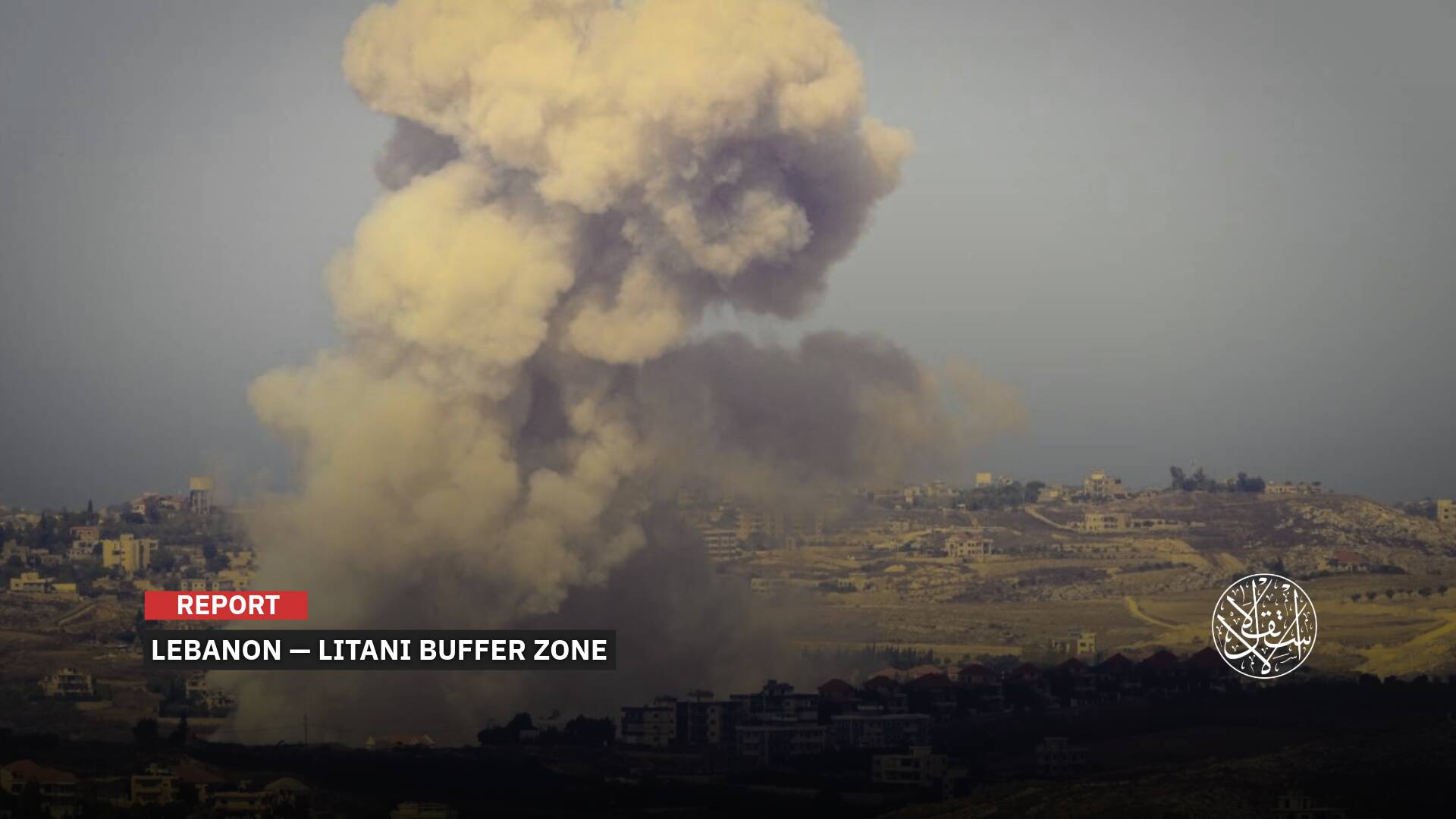
Under the agreement to cease-fire with Lebanon’s Hezbollah, questions arise over whether the Israeli Occupation has succeeded in dismantling what is known as the “Unity of Fronts,” isolating the northern front without halting its aggression on Gaza.
The term “Unity of Fronts” gained prominence following the Palestinian resistance’s launch of Operation al-Aqsa Flood on October 7, 2023. Iran and its allies—after much hesitation—opened several fronts against “Israel,” notably Hezbollah in Lebanon and armed factions in Yemen and Iraq.
‘Separating the Fronts’
In his speech announcing the War Cabinet’s approval of the ceasefire in Lebanon, which took effect on November 27, Israeli Prime Minister Benjamin Netanyahu asserted that “Israel” reserves the right to take military action if Hezbollah breaches the agreement.
“If Hezbollah violates the agreement or rearms, we will strike. If they rebuild infrastructure near the border, we will strike. If they fire rockets, dig tunnels, or transport missiles, we will strike.”
In his November 26 address, Netanyahu said, “The first reason is to focus on the Iranian threat, and I won't expand on that.”
“The second reason is to give our forces a breather and replenish stocks. And I say it openly, it is no secret that there have been big delays in weapons and munitions deliveries. These delays will be resolved soon. We will receive supplies of advanced weaponry that will keep our soldiers safe and give us more strike force to complete our mission.”
“And the third reason for having a ceasefire is to separate the fronts and isolate Hamas. From day two of the war, Hamas was counting on Hezbollah to fight by its side. With Hezbollah out of the picture, Hamas is left on its own. We will increase our pressure on Hamas and that will help us in our sacred mission of releasing our hostages,” he added.
“I am determined to do anything needed to prevent Iran from obtaining a nuclear weapon. That threat has always been my top priority and is even more so today, when you hear Iran's leaders state over and over again their intention to obtain nuclear weapons. For me, removing that threat is the most important mission to ensure the existence and future of the State of Israel.”

The Syrian regime leader was also warned in Netanyahu’s speech, “In Syria, we are systematically blocking attempts by Iran, Hezbollah and the Syrian army to transfer weapons to Lebanon. Assad must understand that he is playing with fire.”
The ceasefire agreement stipulates that Hezbollah and all other armed groups in Lebanese territory will not conduct any offensive operations against “Israel.”
In return, “Israel” will refrain from conducting “military operations” against targets in Lebanon, whether by land, air, or sea.
Both “Israel” and Lebanon acknowledge the importance of UN Security Council Resolution 1701, and the commitments do not negate either party’s natural right to self-defense.
The agreement specifies that Lebanon’s official security forces and military will be the only armed groups allowed to carry weapons or operate forces in southern Lebanon. Any sale, supply, or production of weapons or related materials in Lebanon will be under the supervision and control of the Lebanese government.
According to the agreement, all unauthorized facilities involved in producing weapons or related materials will be dismantled.
All unlicensed infrastructure and military sites will be dismantled, and all unlicensed weapons that do not comply with these commitments will also be confiscated.
Lebanon will deploy its official security forces and army along all borders, crossing points, and the southern boundary line as outlined in the deployment plan.
“Israel” will gradually withdraw from the southern Blue Line within 60 days, as reported by Yedioth Ahronoth on November 26.

Dismantling the Fronts
Regarding Israeli “success” in dismantling the so-called “Unity of Fronts,” Iraqi academic and researcher Maythem Saheb said, “The Israeli Occupation has indeed managed, according to the ceasefire agreement in Lebanon, to isolate the Lebanese front from Gaza, which was the initial spark of the war.”
“The interim advantage will be with the Israeli Occupation on the Lebanese front, and Iran is forced to remain silent because its security and the future of its state are priorities that cannot be compromised,” he told Al-Estiklal.
“Iraq is currently appealing to the United States to protect it from any Israeli military strike, and that while Hezbollah has not been fully defeated, its influence has become limited.”
On November 22, Channel 12 reported comments from Amos Yadlin, former head of Israeli military intelligence, who spoke about a “significant opportunity for settlement” in Lebanon, pointing out the considerable differences between Lebanon and Gaza.
“We conduct negotiations with a legitimate government, and there are no hostages in Lebanon,” referring to Israeli prisoners held by Hamas.
“It is true that Hezbollah is an important player, but it has suffered a severe blow to its leadership and firepower.”
Yadlin claimed that after “Israel” killed Hamas political bureau chief Yehya Sinwar, “it became possible to eliminate the notion that there is a multi-front war.”
“The Iranians are scared and did not respond to the highly successful Israeli attack in October 2024. The Lebanese will withdraw, leaving Hamas isolated.” “The most important achievement of the settlement with Lebanon is the dismantling of the Unity of Fronts,” he added.
Security and strategic expert Ahmed al-Sharifi, from Iraq, pointed out that “there was an unresolved issue that made the truce unfeasible because Hezbollah believes it should be comprehensive across the fronts in Gaza and Lebanon.”
“Israel sees it as crucial to separate the two fronts, with Gaza being a negotiation line and Lebanon being another,” al-Sharifi explained to Times Arab.
“Israel adopts the option of isolating the fronts, while Hezbollah advocates for their unity.”
On October 15, Hezbollah Secretary-General Naim Qassem said in a televised speech that “Hezbollah called for a ceasefire in Gaza to complete the truce in Lebanon,” stressing, “Israel and its allies are fighting and committing massacres, and we are in a position that requires us to take a stand.”
“Lebanon and the entire region cannot be separated from Palestine,” he added.

‘A Lifeline’
Palestinian writer Abdel Bari Atwan launched a sharp critique against Lebanese parties that accepted the ceasefire agreement in Lebanon without ending the war on Gaza, accusing Hezbollah of abandoning the legacy of its former leader, Hassan Nasrallah.
On YouTube, he stated that “the ceasefire agreement is like offering Israel a lifeline from its greatest defeat in history,” describing the agreement as a conspiracy by Amos Hochstein, the U.S. envoy to Lebanon.
“The Israelis rushed the ceasefire because they realized they were defeated, but why are the Lebanese rushing into it? Why are we rewarding [U.S. President Joe] Biden and Netanyahu for the massacres in Gaza and Lebanon?”
Atwan accused what he called “Lebanese brokers” of hastening the signing of the ceasefire agreement, describing what happened as a betrayal of the principles and legacy of Hassan Nasrallah, who insisted in his last speech on the need to end the war on Gaza in exchange for the return of Israeli settlers in the north.
In the same context, Palestinian political analyst Ibrahim Hamami posted on X, “Speculations are over, Hezbollah is moving to the north of the Litani River with its infrastructure dismantled, its armament prohibited, and Lebanon effectively besieged both by the army and internationally by UNIFIL and the United States.”
“The supposed unity of the battlefronts has ended. The presumed axis of resistance has ended. But the war has not ended, neither in Lebanon, nor Gaza, nor the entire region.”
In the same vein, Mustapha Allouch, Lebanese politician and a former member of the Lebanese Parliament, stated that “the unity of the battlefronts” has disintegrated, and the participation from Yemen, Iraq, Syria, and Iran all confirm that Hezbollah fought alone, and that Lebanon and Gaza were receiving missiles on their own.
“Those who dismantled the unity of the battlefronts were the ones who decided there was a unity of battlefronts [Iran]. However, [Ali] Khamenei [the Iranian Supreme Leader] still speaks of that, insisting Palestinians and Lebanese must fight to the end,” Allouch said in an interview on November 27.
“The truce in Lebanon will be temporary unless Hezbollah abandons its military nature.”
For its part, the Iraqi Hezbollah Brigades issued a statement on November 27, saying, “A pause by one faction of the axis of resistance will not affect the unity of the battlefronts; rather, new factions will join to strengthen the arena of sacred struggle against the enemies of God, His Messenger, and the believers.”
In the lead-up to the agreement for a ceasefire in Lebanon, “Israel” made significant efforts to separate the battlefronts. According to a research paper published by al-Masar Studies on November 13, 2024, Israeli officials communicated with Russia and the United States regarding this matter.
The paper noted that Israeli Minister of Strategic Affairs Ron Dermer led negotiations aimed at reaching a settlement to end the war between Lebanon and “Israel,” representing Netanyahu.
Israeli media reports confirmed that several prominent Israeli ministers, including Dermer, opposed expanding the war on the northern front with Lebanon.
Based on this, recent days have witnessed diplomatic movements between several global capitals, including Moscow and Washington, led by Dermer on the Israeli side. This indicated an Israeli intention to de-escalate tensions with Lebanese Hezbollah, as per the paper.
Sources
- Israeli Ministry of Strategic Affairs: History, Roles and Policy Formulation in Light of al-Aqsa Flood [Arabic]
- Will Israel dismantle the arenas in its war in the Middle East? [Arabic]
- Israeli media: The most important achievement of the settlement with Lebanon is the dismantling of the unity of fronts [Arabic]
- Netanyahu announces cabinet's approval of ceasefire in Lebanon [Arabic]
- The most important provisions of the ceasefire agreement between Israel and Lebanon [Arabic]
- Statement by PM Netanyahu
- What to Know About the Israel-Hezbollah Cease-Fire
- Yedioth Ahronoth details Victory Day: A special ceasefire between Israel and the Lebanese Hezbollah [Arabic]
- Will Hezbollah accept separating the Gaza track and negotiate with Israel? The answer in 7 points [Arabic]
- Biden announces ceasefire between Lebanon and Israel starting at dawn [Arabic]