Between Consolidating Power and Military Decisiveness: A Look at al-Burhan’s Reshuffle Within the Army
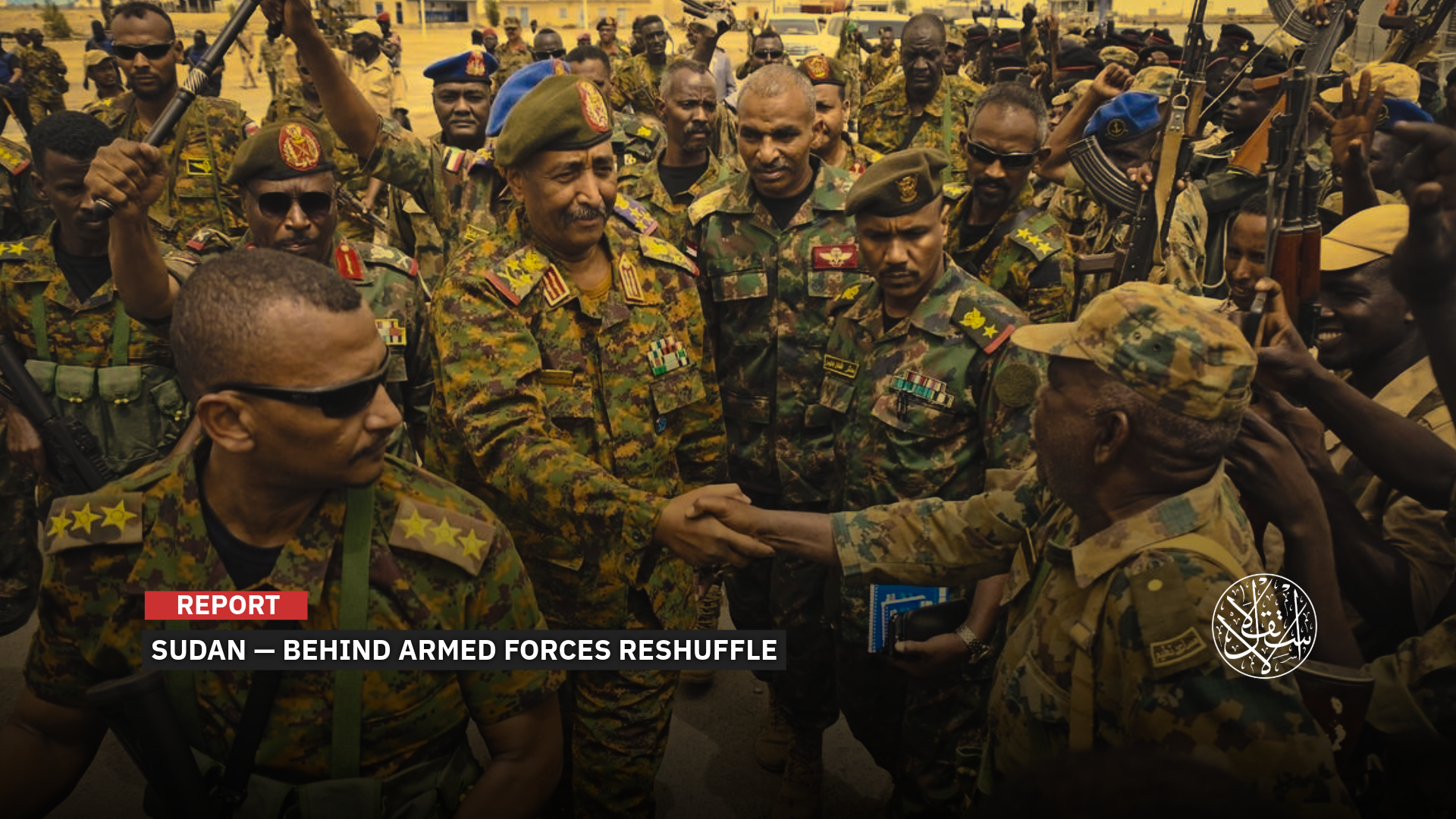
Al-Burhan reshuffled the General Staff and appointed close allies to key positions.
A sweeping reshuffle ordered by Sudan’s Transitional Sovereign Council (TSC) chief and army commander, Abdel Fattah al-Burhan, on April 2, 2026, has triggered questions over its timing, intent, and broader implications for the country’s shifting power balance.
Al-Burhan overhauled the army’s General Staff, placing trusted allies in key positions, promoting a number of officers, and sending others into retirement. He also abolished the post of deputy commander, effectively sidelining his deputy, Shams al-Din Kabbashi, who was reassigned as an assistant.
In a parallel move, he appointed General Yasser al-Atta, one of his close aides, as chief of staff. Al-Atta is known for his hardline positions, including hostility toward the UAE over its support for the Rapid Support Forces (RSF) led by Mohamed Hamdan Dagalo (Hemedti), as well as his insistence on a military victory and rejection of negotiations, alongside backing continued military control of the state.
Some Sudanese analysts view the shake-up, which follows earlier changes in August 2025 that removed several senior generals linked to Islamist currents or the former al-Bashir regime, as part of Burhan’s effort to consolidate authority and potentially position himself for a future presidential role.
Others argue the reshuffle is primarily operational, aimed at injecting new leadership into the army and tightening command structures in preparation for a decisive push against the RSF in Kordofan and Darfur.
A third interpretation sees the appointments of relatively low-profile officers as an attempt to counter accusations of politicizing the military and the influence of Islamist networks within its ranks, particularly in the wake of U.S. moves to designate the Sudanese Muslim Brotherhood as a terrorist organization.

Wide-Ranging Signals
The changes carried out by al-Burhan mark the third major reshuffle in the military leadership since the war broke out on April 15, 2023. The most notable move was the effective sidelining of his deputy, General Shams al-Din Kabbashi, through the abolition of the deputy commander post altogether.
Al-Burhan set the stage for this shift on March 2, 2026, as part of a broader restructuring of the armed forces, when he formally scrapped the position Kabbashi had held. The move stripped him of his official standing before he was reassigned as an assistant to the commander, a post widely seen as largely ceremonial.
Under the new arrangement, Kabbashi was appointed to a newly created role titled “Assistant to the Commander for Construction and Strategic Planning,” a step analysts view as part of a gradual effort to expand al-Burhan’s authority and tighten his control over both political and military decision-making.
The second major decision saw General Yasser al-Atta appointed as chief of staff, moving him from his previous role as assistant commander of the armed forces. He replaced former chief of staff Mohamed Osman al-Hussein, who was retired, further reducing the presence of rival power centers within the army.
The reshuffle is among the most significant since the war between the Sudanese Armed Forces (SAF) and the RSF began nearly three years ago, and it could signal shifts in military strategy, including the possibility of opening a new front in the Blue Nile state in the southeast, according to Reuters.
Al-Atta’s public statements, which are believed to have bolstered his position, reflect a vision of the army as a governing force rather than a transitional institution. He has repeatedly argued that the military should not hand power to civilians without elections and that the army chief should remain head of state throughout the transition period, casting the armed forces as a unifying alternative to political parties.
In September 2024, during an inspection of the Third Infantry Division in Shendi, he went further, stating that even after a transitional period and elections, and for several subsequent terms, the army chief would remain head of state with full sovereign powers.
With more than four decades of military service, al-Atta is also known for his sharp criticism of the UAE, which he accuses of supporting the RSF, as well as for accusing some civilian factions of backing the militia.
Following the U.S. Department of State’s designation of the Sudanese Muslim Brotherhood as a Specially Designated Global Terrorist (SDGT) organization in March 2025, al-Atta issued a defiant response, rejecting labels linking him or his forces to the Brotherhood or remnants of the former regime and insisting that they could not be defined in such terms. The remark was widely seen as a direct challenge to U.S. pressure.
Emirati media and Sudanese opposition accounts, however, interpreted his comments as an implicit acknowledgment of ties to the Brotherhood and its battlefield networks, underscoring the extent of controversy surrounding his role both domestically and internationally.
Because of statements by General Yasser al-Atta, his support for the participation of Islamist-leaning popular forces alongside the army in the fight against the Rapid Support Forces, and his defiance of the U.S. decision to designate the Muslim Brotherhood in Sudan as a banned organization, some Emirati media outlets portray him as part of the Islamist current and, more specifically, as aligned with the Muslim Brotherhood.
Yet the irony is that al-Atta himself served on the “Committee for Dismantling the June 30, 1989 Regime and Removing Empowerment,” also known as the “Committee for Dismantling the Muslim Brotherhood’s Empowerment in Sudan,” which was formed under the government of Abdalla Hamdok.
The committee oversaw the dismissal of officials linked to the National Congress Party and the broader Islamist movement from the army and state institutions, as well as the confiscation of their assets. However, following General Abdel Fattah al-Burhan’s coup against Hamdok’s government, he suspended the committee’s work on October 25, 2021, and ordered a review of its decisions.
According to the Progress Center for Policies, an independent London-based think tank, in a report dated April 4, 2026, the profiles of officers included in the retirement decisions, along with informal assessments, suggest that several of these figures are associated with Islamist backgrounds or networks of influence linked to earlier periods of rule.
This indicates that part of these decisions can be read as an attempt to rebalance ideological currents within the military institution, whether in response to internal calculations aimed at tightening control or as an adaptation to a regional environment increasingly sensitive to such affiliations.
Responding to the reshuffle, al-Burhan said the latest changes in the army leadership and General Staff were part of a standard transition process within the military hierarchy, rooted in the long-standing practice of generational rotation and aimed at improving performance through renewed leadership.
During the handover ceremony for the General Staff in Khartoum, al-Burhan said the appointment of General Yasser al-Atta as chief of staff was based on his battlefield competence and his role in breaking the siege of the army headquarters on January 25, 2025, as well as his contribution to boosting morale, rejecting any suggestion that regional or political considerations played a role in the decision.
He also praised outgoing chief of staff General Mohamed Osman al-Hussein, describing him as one of the pillars of the armed forces in what he called the “Battle of Dignity,” and credited him with key military successes.
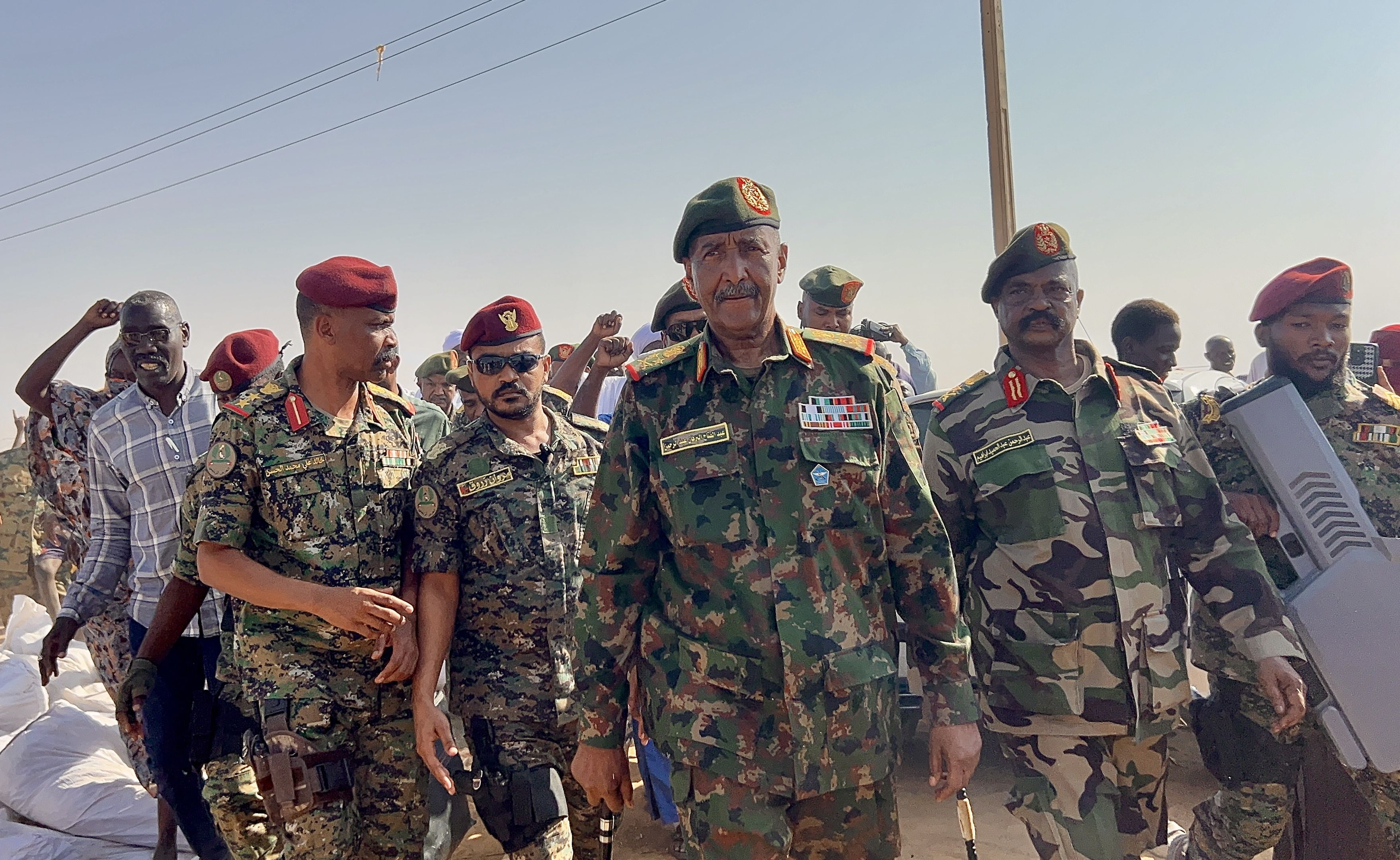
Consolidating Burhan’s Power
A series of decisions by Sudanese army chief Abdel Fattah al-Burhan under the banner of “military restructuring” has been read by Sudanese analysts as part of a broader effort to consolidate his authority, shield himself from potential internal challenges, and potentially reshape the country’s power structure, including speculation about dissolving the TSC and positioning himself as head of state.
In this context, some Sudanese politicians, including Khalid Omer Yousif, see the moves as part of an accelerating trend toward centralizing power within the military establishment.
The Progress Center for Policies argues that the recent changes reflect a possible shift toward concentrating authority within the core military hierarchy. It notes that the redistribution of senior roles, including the rise of Yasser al-Atta to chief of staff and the growing executive influence of senior officers, could reduce the practical relevance of the existing TSC framework.
The report adds that this trajectory could pave the way for broader changes in the transitional system if decision-making continues to be reorganized along these lines, further strengthening a narrow circle of military leadership.
It describes the restructuring not as a technical adjustment but as part of an internal struggle over influence and an attempt to reshape the military institution both politically and ideologically.
According to the same analysis, the changes have reached core areas of the armed forces, including operations, intelligence, and logistics, suggesting a comprehensive overhaul of the command structure rather than a limited administrative reshuffle.
The report also argues that the changes reflect growing recognition of weaknesses in the previous leadership structure in managing a prolonged and complex war, while at the same time opening the door to greater concentration of power within a tighter leadership circle.
Although Yasser al-Atta’s appointment as chief of staff was welcomed by soldiers and allied forces, including popular formations and armed movements, due to his strong rhetoric and battlefield reputation, as well as his public accusations that the UAE supports Hemedti’s forces, the removal of other senior officers has raised questions about al-Burhan’s intentions and the possibility of a drift toward more personalized rule.
In late March 2026, analysts began linking al-Burhan’s moves to the U.S. decision to designate Sudan’s Muslim Brotherhood as a “terrorist organization.” Researcher Willie Fautre, writing in Eurasia Review on February 18, 2026, suggested this may be part of a strategy to reduce Islamist influence within the military.
Other analyses, including comments attributed to Cameron Hudson of the Center for Strategic and International Studies, describe the relationship between the Sudanese army and Islamist factions as a tactical alliance led by al-Burhan in his confrontation with the RSF.
Hudson also noted growing indications that al-Burhan may have indirectly supported efforts to label the Brotherhood as a terrorist organization, possibly in response to international pressure or as part of informal understandings aimed at avoiding further sanctions or securing political and security guarantees.
Some observers believe these dynamics also reflect emerging fractures between al-Burhan and Islamist-aligned militias he has relied on amid efforts to rebalance internal military alliances.
At the same time, the integration of Islamist-leaning elements within the armed forces under Yasser al-Atta is seen as sending a dual message: reassuring international actors concerned about Brotherhood influence while signaling to domestic Islamist currents that they still have a place within the military’s vision for the country’s future.
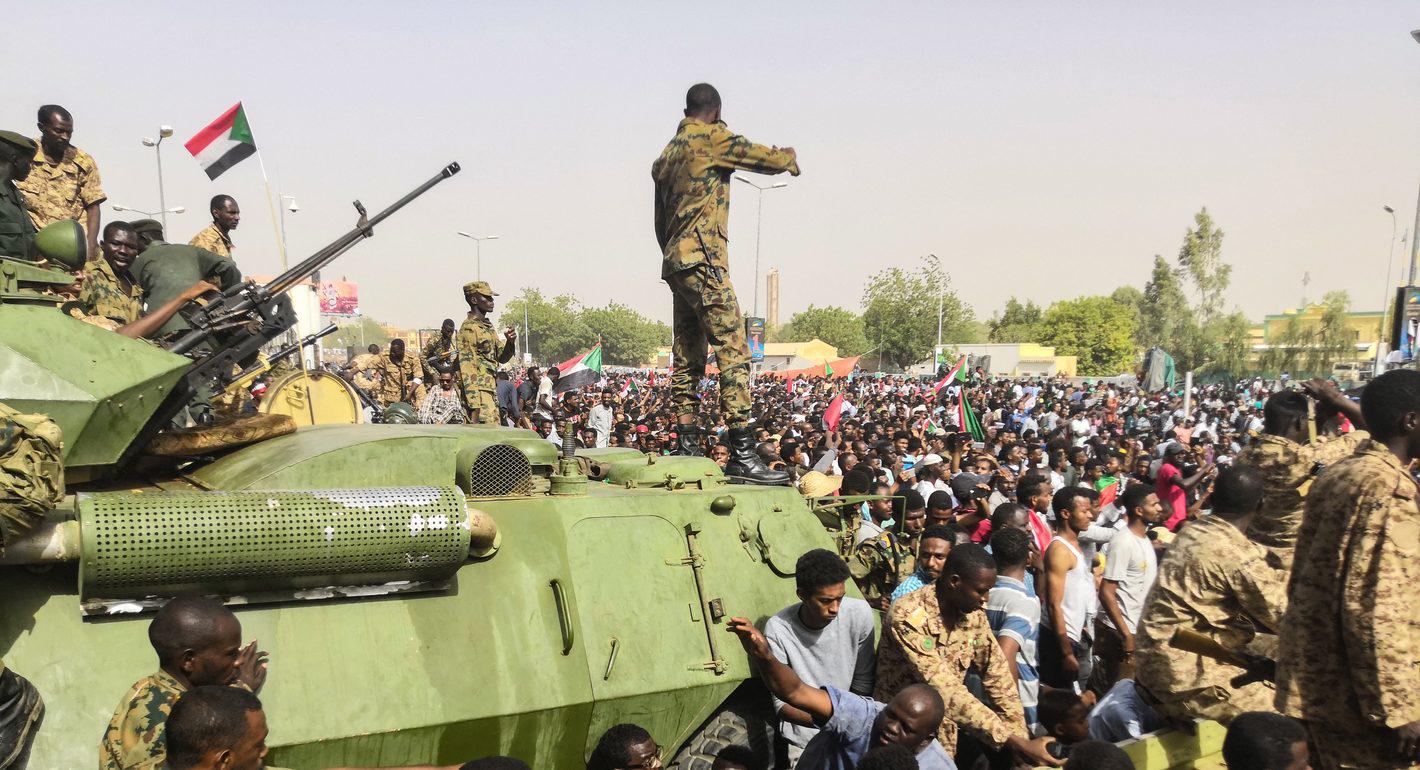
What Do These Changes Signal?
According to Sudanese experts, the latest reshuffles within the army point to several possible trajectories and calculations ahead.
The first is that al-Burhan is moving to consolidate his authority by sidelining rival military figures, with speculation that this could eventually lead to the abolition of the TSC formed after the ouster of Omar al-Bashir and possibly pave the way for al-Burhan to formally assume the presidency he already holds in practice.
The second is that the changes are seen as an implicit acknowledgment of the strength of Islamist currents, both within the regular army and among allied popular forces that have supported the military in its war against the RSF, helping it regain ground in Khartoum and push RSF units back toward Darfur and Kordofan.
This is reflected in the promotion of figures seen as close to or accommodating of Islamist influence, such as Yasser al-Atta’s appointment as chief of staff, despite his shifting rhetoric—ranging from rejecting Islamist affiliations to, at times, invoking them in a provocative context toward the United States—alongside the removal of senior Islamist-leaning generals who had supported the war effort.
On August 18, 2025, al-Burhan had already dismissed five senior long-serving generals associated with Islamist currents or the former al-Bashir regime as part of a broader restructuring of the army’s command structure and the appointment of a new general staff.
Third, analysts point to a growing effort to integrate Islamist-aligned and popular militia forces into the formal military structure, in an attempt to avoid repeating the experience of maintaining powerful parallel armed groups such as the RSF. Al-Atta’s appointment, in this reading, reflects his focus on this integration agenda.
On March 7, 2026, al-Atta himself stated that the coming phase would see all supporting forces integrated into the regular institutions without exception.
On March 16, 2026, al-Burhan denied any link between the armed forces and political movements or parties, including the National Congress Party and the Muslim Brotherhood.
Speaking during a Ramadan iftar in al-Jazira, Nile River State, he said, “We have no ties with the Muslim Brotherhood, National Congress or communists—our concern is the Sudanese people.”
His remarks appeared to respond to a report by Emirati Sky News Arabia, which aired a clip featuring Osman Mohamed Youssef Kibir, head of the dissolved National Congress Party’s Shura Council, discussing alleged ties between al-Burhan and Islamist factions. Kibir later denied the channel’s account, accusing it of manipulating the video.
Political forces accuse military leaders of relying on Islamist networks, arguing that their influence within the armed forces shapes decision-making and undermines prospects for stability, especially amid repeated rejections of peace initiatives and insistence on continuing the war.
Fourth, analysts argue that the appointment of commanders who favor military victory over negotiations—contrary to calls from the United States and the UAE—signals al-Burhan’s preference for a battlefield resolution in the near term, likely foreshadowing an escalation in attack operations.
In this reading, the message is directed more at external actors, particularly the Sudan Quartet, than domestic audiences, reinforcing the view that there is little room for negotiation in the foreseeable future.
On March 16, 2026, al-Burhan said the “battle of dignity” was continuing toward its objectives of “eradicating the rebellion and cleansing the country of the filth of the insurgents,” adding, “There will be no truce, no ceasefire, and no reconciliation with the militias until they lay down their arms.”
On April 6, 2026, the army broke the siege of the town of Dilling and retook control of al-Tukma, reopening the road linking Dilling in South Kordofan with North Kordofan after heavy fighting against an alliance of the RSF and the Sudan People’s Liberation Movement (SPLM). The advance was seen as part of ongoing gains in Kordofan and a push to contain the rebellion within the region.

Earlier, on February 3, 2026, the Sudanese army announced that it had broken a siege lasting several years on the city of Kadugli, the capital of South Kordofan, saying the move had saved tens of thousands of residents from a fate similar to that of besieged cities in Darfur aligned with the army, where famine has taken hold—signaling a shift in the course of the war.
Fifth, some analysts suggest that al-Atta’s rising profile may be al-Burhan’s way of challenging Washington and signaling that decisions of war and peace in Sudan are no longer subject to U.S. mediation efforts driven by Emirati requests, especially after a series of American punitive measures and the continuation of sanctions despite al-Burhan’s normalization steps with the Israeli Occupation.
The U.S. Department of State has designated the Sudanese Muslim Brotherhood (SMB), including the Sudanese Islamic Movement and the al-Baraa bin Malik Brigade, as SDGT organizations, with the decision set to take effect on March 16, 2026.
Sudanese assessments point to two main drivers behind the unexpected designation: first, some Sudanese support for the U.S.-Israeli War on Iran; and second, what is seen as President Donald Trump’s effort to offer a political “gift” to the UAE amid narratives of waning U.S. commitment to protecting its allies, as well as attempts to ease pressure over accusations of Emirati involvement in violence in Sudan through proxy militias.
Sixth, the appointment of al-Atta—the UAE’s fiercest adversary—as chief of staff is seen as a signal of continued confrontation with Abu Dhabi and its allied militias. A veteran officer with nearly 40 years of service, he is known for his outspoken criticism of the UAE, which he accuses of supporting the RSF and being involved in the crimes committed in Sudan.
Sources
- Al-Burhan: We Deal With Sudanese Citizens Only
- Sudan army chief centralizes command, sidelines social media officers
- Sudan: SAF Commander-in-Chief Inspects Third Infantry Division
- Sudan to integrate allied groups into military, al-Atta says
- Al-Burhan: We Have No Ties With the Muslim Brotherhood, National Congress or Communists — Our Concern Is the Sudanese People
- Sudan: Can Burhan Concede On The Muslim Brotherhood? – OpEd
- Reshaping Sudan’s Military Leadership: A Reading of the Official Statement [Arabic]