Akhannouch Faces Backlash Over Desalination Deal and Conflict of Interest

The Prime Minister threatens the stability of the state as a whole.
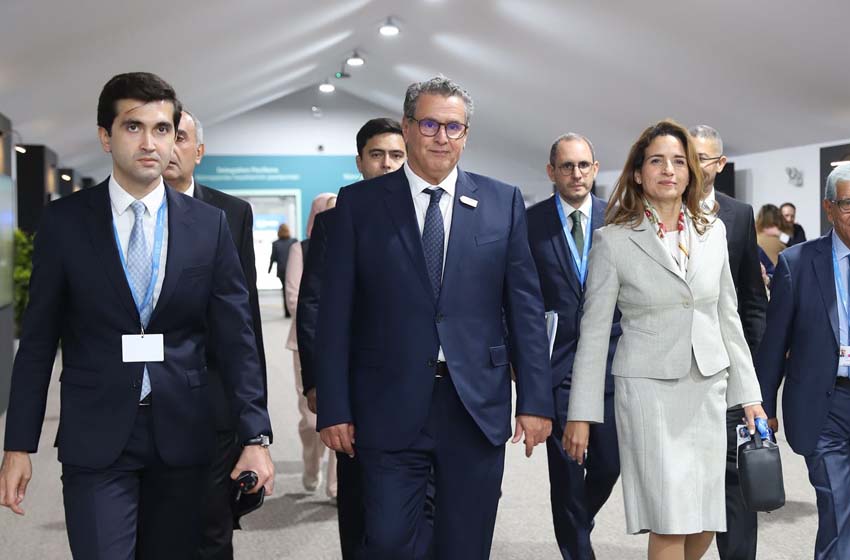
Morocco’s Prime Minister Aziz Akhannouch did not expect the controversy his recent comments in parliament would stir, nor the calls for his resignation due to conflicts of interest.
During his monthly session in the House of Representatives on December 16, 2024, Akhannouch proudly declared that he had won, "with full transparency," the contract to build Africa’s largest seawater desalination plant, which is set to be located in Casablanca.
Public Outrage
The deal, awarded to the Aqua Group (owned by Akhannouch) through its companies Africa Gas and Green of Africa, in partnership with the Spanish firm Acciona, was defended by Akhannouch, who claimed it had “presented the best offer and the lowest price” among the other contenders.
In his remarks, Akhannouch stressed that the deal represented a significant risk, particularly as the winning bidder would invest $650 million directly into the project without any public funding.
He dismissed critics who questioned this, accusing them of “lying.”
In response, Abdelilah Benkirane, the Secretary-General of the opposition Justice and Development Party and former Prime Minister, called for Akhannouch’s resignation, condemning his actions as a flagrant abuse of power and a disgrace.
Speaking at a press conference held by his party on December 18 in Rabat, Benkirane emphasized that the Prime Minister "threatens the stability of the state as a whole by eroding public trust in the government, parliament, and state institutions."
He further warned that Akhannouch’s control over the seawater desalination contract sent "extremely negative signals" to both domestic and foreign investors, potentially driving them away from Morocco and undermining investment in the country.
"This will have significant economic repercussions," Benkirane asserted, adding that such behavior was "unacceptable."
Benkirane also stressed that the Prime Minister should exemplify the highest standards of integrity in handling public funds.
In his view, “Akhannouch is failing to do so. His actions are destructive, and it is crucial that efforts be made to replace him and remove him from power, as the situation has reached dangerous levels of abuse of office.”
A large number of politicians and activists have expressed strong criticism of the statements made by Moroccan Prime Minister Aziz Akhannouch, warning of the potential consequences if he continues down this path.
In this regard, parliamentarian Abdel-Samad Haiker described the session as a "scandal of epic proportions," stating that Akhannouch addressed members of the House of Representatives in his capacity as a businessman rather than as head of government.
According to Al-Estiklal, Haiker stressed in a Facebook post on December 16 that "Akhannouch has committed a serious political blunder by flagrantly falling into a conflict of interest, especially following the awarding of a contract to one of his companies to build and operate a seawater desalination plant in Casablanca."
What is even more troubling, according to Haiker, is that "the Prime Minister did not hesitate, in the days following, to prepare a file requesting state support for the project, and submitted it to a national committee he himself chairs."
Haiker emphasized that Akhannouch “should never have competed for this contract in the first place; he should have allowed companies to engage in fair competition. Moreover, he should not have requested state support, as this reflects a breach of the ethics that should govern public administration.”
In response, Abdellatif Soudou, former deputy mayor of Sale and president of the Justice and Development Engineers’ Association, argued that Akhannouch’s admission of winning the contract in parliament should compel him to resign.
“It is unacceptable for the Prime Minister to win public contracts, as this constitutes a clear conflict of interest. The Prime Minister is also the head of the public administration that reviewed and adjudicated the bids,” Soudou posted on Facebook.
Activist and politician abdelmouniem Boudouri pointed out that after his appointment by King Mohammed VI, Akhannouch had announced, in an official statement on September 13, 2021, his decision to begin a complete withdrawal from all management roles within his family’s holding company.
In a Facebook post on December 17, Boudouri added, “Today, three years later, Akhannouch is defending, from the floor of parliament, the award of the most expensive desalination contract in Morocco to his own company.”
Historical Scandal
Commenting on the recent controversy, academic and former member of the House of Representatives Finance Committee Abdelaziz Aftati described the events during the Prime Minister’s monthly session as yet another chapter in the ongoing saga of "the comprador alliance" — a term used to describe the collusion between the bourgeoisie and foreign capital to dominate national markets.
Speaking to Al-Estiklal, Aftati argued that the Prime Minister’s continued immunity from institutional accountability — whether through constitutional councils, parliamentary investigations, or fact-finding committees — was essentially designed to preserve the 2021 electoral coup, with Akhannouch at its helm.
“If we were in normal circumstances, one of his many scandals would have been enough to bring him down and dismantle the cartels of big capital and rent-seeking interests threatening Morocco’s vital national interests,” Aftati noted.
“Anyone observing the prime minister's performance during the session would discover a disoriented and broken figure, reciting political nonsense written for him, but exposed in an absurdly obvious conflict of interest, He has now demonstrated to the world that he was following the details of the infamous water desalination deal,” he said.
“What he claims was an effort to 'defend' the state only exposes what everyone around him in government offices and business circles knows: his incessant anxiety and desperate attempts to track every minor detail of his various activities in the government.”
“This was openly confirmed in parliament, where he revealed that he had been closely monitoring the desalination deal (the one involving the controversial corporation), which will later involve the sale of desalinated water for hydrogen energy production. This sets the stage for long-term deals aimed at supplying water and energy, which will be sold to struggling citizens for decades to come,” Aftati added.
“He should never have even entered the competition for this contract. He should have left it open for fair competition,” Aftati continued. “And the fact that he sought state support for the project shows an unchecked greed that knows no bounds.”
The former MP emphasized that, had Akhannouch possessed even a shred of decency, he would have taken the initiative himself, following the public outcry, to establish a parliamentary fact-finding committee on the scandalous deal.
Aftati also asserted that Akhannouch's actions undermined the legal framework that governs the Moroccan government, specifically the Organic Law 065.13 on government management, and once again exposed his involvement in a flagrant conflict of interest and how he amassed an enormous fortune from the desalination deal, while simultaneously heading the very authority in charge of it.
In a similar vein, former lawyer and ex-member of the House of Representatives’ Justice and Legislation Committee, Reda Boukmazi, described Akhannouch’s statements in parliament as both a political and ethical scandal that, in any self-respecting nation, would have led to the Prime Minister’s resignation or the closure of parliament.
“Akhannouch has exposed what we have consistently warned about—the dangers of conflating money and power, and how it harms both the state and society. He has also unveiled the true face he has repeatedly sought to conceal, by using his position as prime minister to serve his role as CEO of a powerful business conglomerate,” Boukmazi told Al-Estiklal.
"Akhannouch, who is supposed to respect the office of the prime minister and the platform of the House of Representatives during constitutional accountability sessions, turned that platform into a podium to defend his company and its right to win the Casablanca desalination contract, as well as the scale of the investment he allocated to it."
"This privilege that Akhannouch, the businessman, granted himself—will the House of Representatives extend the same privilege to other competitors, allowing them to present their bids and explain why they didn’t win such a major contract?"
"Akhannouch is telling all traders and entrepreneurs that defending private interests and securing large contracts goes through holding public office, and that anyone who wants to win a public contract or receive public support must follow the easy path that the public office opens to serve private interests."
"Akhannouch is violating all the rules and norms that have built up over time regarding respect for the position of the prime minister and its role within the constitutional framework, and is attempting to reduce this office to its lowest levels."
"He also seeks to contribute to greater despair and loss of trust, as he has found the roadmap to power and is convinced that the more despair spreads and people abandon politics, the easier it becomes for him and others like him to rise to positions of responsibility. He’s like a businessman who invests with little capital, hoping to achieve limitless profit," Boukmazi noted.
Blatant Exploitation
Journalist and columnist Younes Masskine argued that the image of the Prime Minister taking the parliamentary podium to defend his own businesses was "one of the most disgraceful and shameful scenes."
“The prime minister did not present himself as a politician accountable to the public, but rather as a defender of his own economic empire, trying to reconcile his role as a political authority with that of a businessman benefiting from the massive Casablanca desalination project,” Masskine noted.
"When the Prime Minister becomes a principal participant in a deal managed by his own government, the notion of transparency seems more like mockery than reality," Masskine added.
Meanwhile, Mohammed Elghaloussi, president of the Moroccan Association for the Protection of Public Funds, noted that “this contract, won by the prime minister, raises constitutional, political, and ethical questions, grounded in Article 36 of the Constitution and the provisions of Article 245 of the Penal Code, as well as the ethical charter the king called on parliament to adopt.”
In a post on Facebook on December 19, Elghaloussi stressed that "the equality Akhannouch spoke of cannot be achieved when the same person is both the head of the administration and its chief executive, holding positions of privilege and power, and also having the ability to legislate."
"Yet, despite this, he has failed to enact the law criminalizing conflicts of interest, in line with Article 36 of the Constitution. This same article mandates public authorities, including the government and its prime minister, to prevent any form of misconduct related to public administration activities, the use of public funds, and the awarding and management of public contracts."
"what is happening now bears no relation to equality among competitors in securing public contracts. It is a flagrant manifestation of the marriage between power and wealth, a clear exploitation of positions of privilege and authority," Elghaloussi concluded.
Journalist Taoufik Bouachrine penned a scathing response to Prime Minister Akhannouch’s recent admission in parliament that his company secured the largest public contract in Morocco’s history — a $1.6 billion deal for seawater desalination.
In an article published on Facebook on December 19, Bouachrine detailed how Akhannouch’s company had also secured 50 hectares of land for free, exceptional tax breaks, generous public funding, and a 30-year contract with the state to buy desalinated water without interruption.
Akhannouch, Bouachrine argued, seems to "reject the very concept of a conflict of interest." He added that discussions about the constitution, legal provisions, or ethical codes appeared to be foreign concepts to the Prime Minister.
“Akhannouch hasn’t grasped that the new constitution prohibits conflicts of interest, because, as a businessman, he has been blending politics with business long before the 2011 constitution came into effect. The lack of accountability and oversight in the country — whether institutional, media, or parliamentary — means that for Akhannouch, the phrase 'linking responsibility with accountability' is nothing more than a weak and meaningless rhetorical flourish,” Bouachrine continued.
“In Akhannouch’s view, there is no conflict of interest, only harmony — and the interests always find a way to align,” Bouachrine added.
Bouachrine warned that Akhannouch had "carved his name into history as the most powerful Prime Minister in Morocco’s history."
“Akhannouch had managed to wield significant influence by participating in government with two parties — his own Rassemblement National des Independants (RNI) and the "party of the company.”
“Through his wealth and connections, he has consolidated his control over the government, parliament, regional authorities, municipalities, governance institutions, and key administrative posts, all while exploiting the current political climate," Bouachrine concluded.