Why Did Khamenei’s Funeral Turn into a Political Event That Transcended Iran’s Borders?
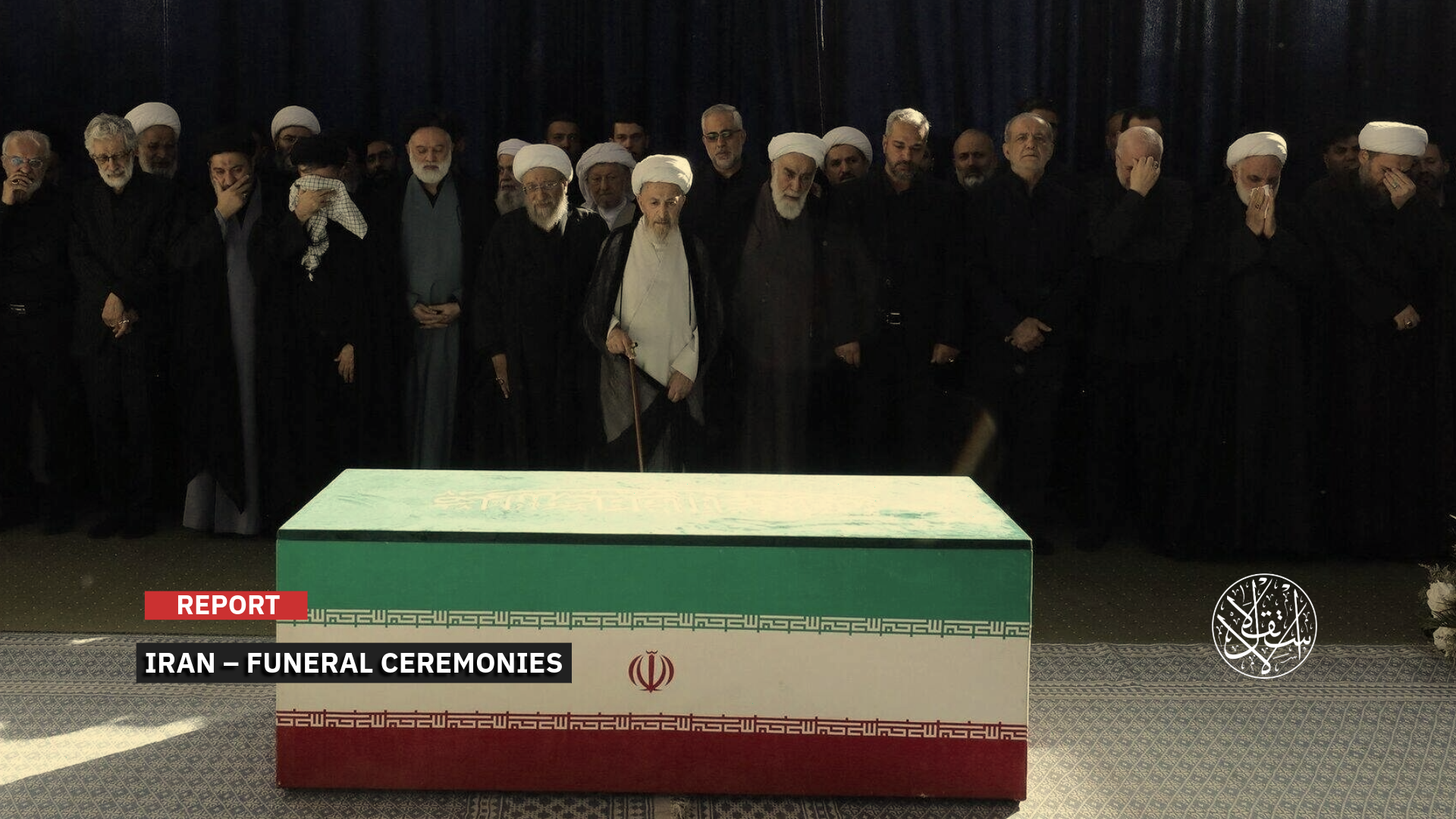
"Coded political messages were directed to each delegation according to its position on the map of alliances and rivalries."
The funeral of former Iranian Supreme Leader Ali Khamenei, with its week-long ceremonies and special protocols, was not devoid of political exploitation. It served as a platform to send numerous political messages to countries in the region and the world, following a war waged against the United States and Israel.
Khamenei, who was killed in a surprise US-Israeli airstrike on February 28, 2026, after a 36-year rule, had his funeral procession begin in Iran on July 4. Four days later, his body was transferred to the Iraqi cities of Karbala and Najaf before being returned to Iran for burial in the city of Mashhad.
New Protocol
On July 4, the Iranian committee for the funeral of Supreme Leader Ali Khamenei implemented a unique protocol for the ceremony, unprecedented in the region.
This protocol involves reciting specific Quranic verses as each delegation arrives at the Tehran prayer hall, where the body is placed in a coffin in a high location.
Saudi Arabia's delegation: "There was a sign for you in the two parties that met. One party fighting in Allah’s way, and the other disbelieving. They saw them twice as many, with their own eyes. But Allah supports with His help whomever He wills. There is a lesson in this for those who have insight."
Qatar's delegation: "So that Allah may forgive you your sins—past and future—and complete His favor upon you, and guide you along a straight path."
The Turkish delegation: “Allah favors the strivers with their wealth and their lives above the inactive, by a degree. But Allah has promised good to both. Yet Allah favors the strivers, over the inactive, with an excellent reward.”
The Lebanese government delegation: “Had We decreed for them, lay down your lives, or, leave your homes, they would not have done it, except for a few of them.”
The Iraqi and Omani delegations: “Muhammad is the Messenger of Allah. Those with him are firm against the unbelievers, yet kind amongst themselves. You see them kneeling, prostrating, seeking Allah’s blessings and His approval. Their marks are on their faces from the effects of prostration.”
The Pakistani delegation: “O you who believe! Be patient, and advocate patience, and be united, and revere Allah, so that you may thrive.”
The Sulaymaniyah delegation in the Kurdistan Region of Iraq: “When Allah’s Victory and Conquest come. And you see the people entering Allah’s religion in crowds. Then celebrate the praises of your Lord, and seek His forgiveness. He is the Acceptor of Repentance.”
The Iraqi tribal sheikh's delegation: “O Prophet! Reverence Allah, and do not obey the unbelievers and the hypocrites. Allah is Knowing and Wise.”
Hezbollah delegation: “And do not waver, nor be sad. You are the superior ones—if you are believers.”
Hamas delegation: “Among the believers are men true to their pledge before Allah. Some of them have fulfilled their vows, and some are still waiting, and never wavering.”
The Houthi delegation recited: “How many a prophet fought alongside him, numerous godly people? They did not waver for what afflicted them in Allah’s path, nor did they weaken, nor did they give in. Allah loves those who endure.”
Although the Iranian method of selecting Quranic verses for each delegation's visit sparked widespread controversy on social media, authorities in Tehran have not commented on whether this was intentional.
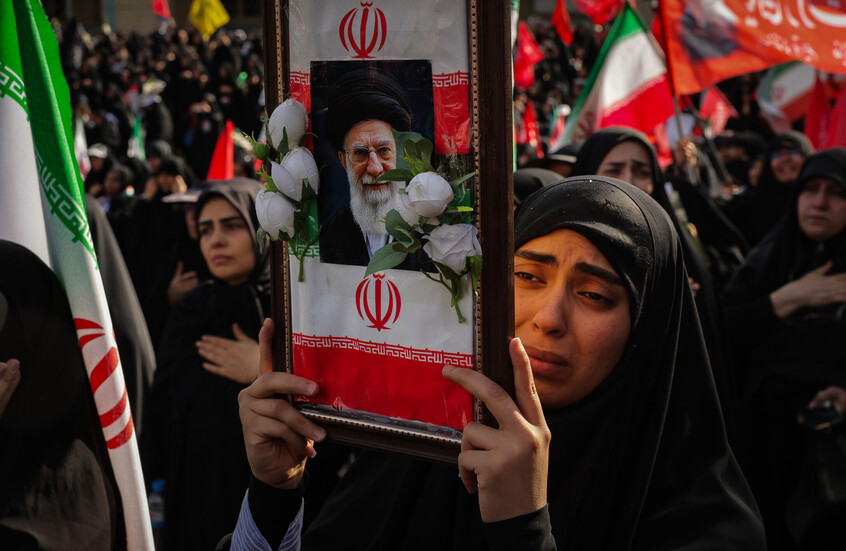
In the same context, CNN reported that Iran is commemorating the anniversary of Khamenei's death, four months after his assassination at the outset of the US-Israeli war against it, with week-long funeral and mourning ceremonies in five cities across Iran and Iraq, with millions of mourners participating.
On July 3, CNN reported that despite the repercussions of the war with the United States and Israel, and decades of economic pressure, Tehran is proceeding with large-scale ceremonies of a religious and symbolic nature, coinciding with the 250th anniversary of US independence.
CNN quoted Iranian authorities as saying they had launched one of the largest logistical operations in the country's history, involving government employees, universities, labor unions, firefighters, soldiers, and rescue teams, along with religious mourning groups, to organize the funeral ceremonies and manage the movement of millions of pilgrims between cities and holy sites in Iran and Iraq.
It also noted that Iraqi authorities expect millions of mourners to participate in the ceremonies to pay their final respects to Khamenei.
It pointed out that Iranian media outlets have intensified their coverage of the ceremonies for more than ten days, with elegies and documentaries about Khamenei's life dominating the media landscape, overshadowing news of the talks with the United States, which had previously dominated headlines.
It concluded that this massive spectacle aimed to send a message to the world and to Iran's adversaries: that the Iranian regime had not only survived the war but also sought to solidify Khamenei's image as a symbol of the Iranian state's resilience.
For his part, Iraqi politician and former parliamentarian Misha'an al-Juburi observed that "Iranian influence and its militias did not end with the war on Iran, and that Khamenei's funeral procession in Karbala and Najaf represents a display that surpasses even the displays of weapons in Iraq."
In a televised interview on June 30, al-Juburi explained that Iran wanted to convey a message to the West that its influence in Iraq had not ended, as demonstrated by the large crowds that turned out for Khamenei's funeral.
Iraqi authorities have approved Iran's request to hold a funeral procession for former Iranian Supreme Leader Ali Khamenei on July 8, according to Iraqi government spokesman Haider al-Aboudi.
The ruling Shiite coalition in Iraq also urged its supporters to participate widely in the funeral procession for Khamenei on Iraqi soil, describing him as a loss to the Islamic nation.
Political Messages
Similarly, Iraqi researcher Latif al-Mahdawi observed that the Quranic verses recited as delegations arrived at Khamenei's funeral in Tehran's prayer hall appeared to be coded political messages directed at each delegation according to its position within the map of alliances and rivalries.
Mr. al-Mahdawi explained to Al-Estiklal that "the funeral turned into a diplomatic platform, because in Iran, even funerals are not devoid of politics. As the delegations approached Khamenei's body, verses from the Quran were used to delineate the messages: one verse for adversaries, another for allies, and a third for fighters."
For his part, writer Ali Mamouri said that Iran is using Khamenei's funeral as an act of political mourning. Any ritual aimed at renewing collective identity across its regional network, reaffirming loyalty, and sending a message that continuity remains.
In an article published on the British website Amwaj Media on July 3, the writer argued that political leaders, even after their death, may continue their political lives. Their funerals, tombs, and commemoration ceremonies become tools for generating legitimacy, mobilizing supporters, and shaping historical memory.
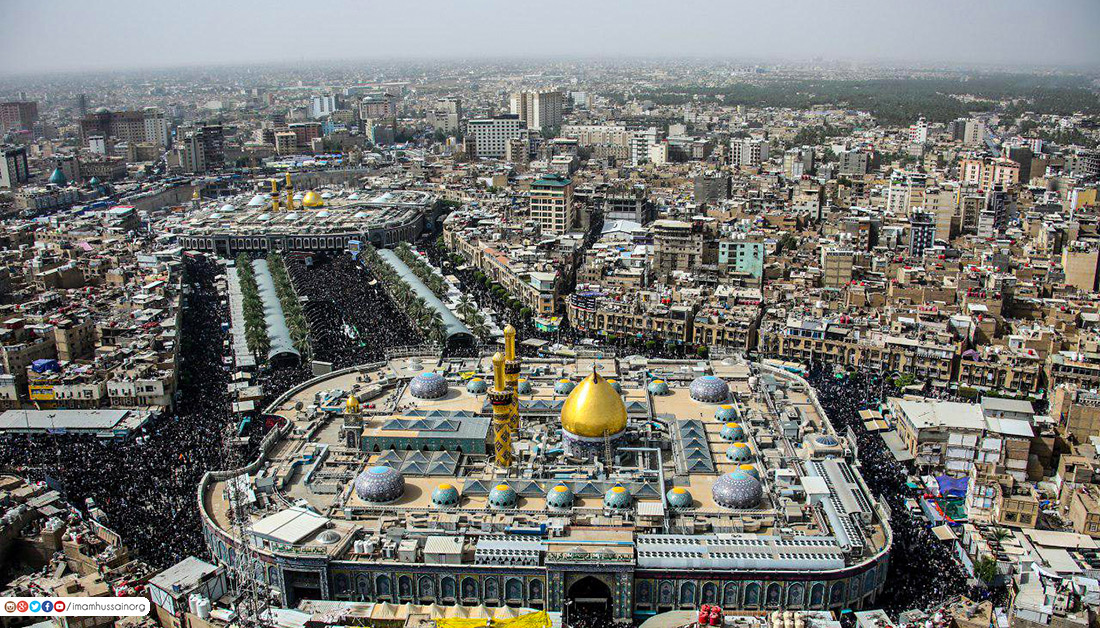
He pointed out that Iraq, more than any other country outside of Iran, occupies a unique position in both Shiite religious tradition and the Islamic Republic's regional strategy.
Therefore, the public mourning ceremonies in Karbala, Najaf, and other Iraqi cities carry significance far beyond simply expressing religious sentiment, he said.
The writer observed that for centuries, Iraq has constituted the sacred geography of Shiism, noting that its cities were not only centers of religious learning but also a constant source of political legitimacy for Shiite rulers.
The last three kings of the Qajar dynasty, including Muzaffar, are buried in Iraq. The Shahs of Iran (1896-1907), Mohammad Ali Shah (1907-1909), and Ahmad Shah (1909-1925) are buried in Karbala, reflecting the long-standing reverence associated with burial near the shrines of Shia imams, according to the writer.
US President Donald Trump stated that he was following the funeral procession for Khamenei, explaining that the Iranians had decided to take a week-long break from negotiations, as reported by Axios on July 4.
Trump added that he was surprised to see some Iranians weeping during the funeral because he had thought people hated Khamenei. He noted that he could have eliminated all the leaders in Iran, but he wouldn't because there would still be someone left to negotiate with.
The US president indicated that the Iranians had decided to take a week-long break from negotiations until the funeral was over, emphasizing that neither side would fire on the other during Khamenei's funeral.
Iran and the United States concluded their talks on the first of July 1. July saw a round of indirect talks with no sign of progress toward a lasting peace, focusing instead on issues supposedly resolved two weeks prior.
Reuters, citing unnamed sources, reported that negotiators from both countries spent two days in Doha discussing maritime traffic in the Strait of Hormuz and financial incentives for Iran—two pillars of the preliminary agreement signed on June 18—rather than addressing the more difficult issues that the framework was believed to have paved the way for, such as Iran's nuclear program.
Sources
- Khamenei’s funeral procession in Iraq embodies the geopolitics of mourning [Arabic]
- CNN: Khamenei’s funeral is a message demonstrating the Iranian regime’s resilience following the war [Arabic]
- Iran introduces a protocol featuring Quranic verses—conveying political messages—during the funeral procession of its Supreme Leader [Arabic]
- Trump's first comment on the funeral ceremony of Iranian Supreme Leader Ali Khamenei [Arabic]
- The Iraqi Coordination Framework calls on its supporters to participate widely in Khamenei's funeral procession [Arabic]