100 Million Displaced People – This Is How 20 Countries Evade Their Responsibility to Solve the Crisis
.jpg)
The United Nations warned on 23 May that Russia's war in Ukraine has caused the number of forcibly displaced people around the world to rise to more than 100 million for the first time ever.
UNHCR said that the number of people forced to flee conflict, violence, human rights abuses, and persecution has now exceeded the staggering 100 million, for the first time ever, because of the war in Ukraine and other deadly conflicts.
In its statement, UNHCR considered that this "alarming" figure should shake the world and push it towards ending the conflicts that are forcing record numbers of people to flee their homes.
According to the Norwegian Refugee Council: “A few countries are bearing almost all the responsibility, while most countries in the world have scarcely received any refugees at all.”

Shocking Numbers
The United Nations High Commissioner for Refugees indicated that the number of forcibly displaced people rose to 90 million by the end of 2021, driven by violence in Ethiopia, Burkina Faso, Myanmar, Nigeria, Afghanistan, and the Democratic Republic of the Congo.
Since Russia invaded Ukraine on February 24, more than eight million people have been displaced within the country while more than six million refugees have fled across the border.
"100 million is a stark, alarming, and thought-provoking figure. It is a number that should never have been reached," said the United Nations High Commissioner for Refugees, Filippo Grandi.
He warned that this figure "should serve as a wake-up call to resolve and prevent devastating conflicts, end persecution, and address the underlying causes that force innocent people to flee their homes."
This number includes refugees and asylum seekers and more than 50 million people displaced within their own countries.
The international response to people fleeing the war in Ukraine is very positive, Grandi noted, adding that "this rush of sympathy is very real and there is a need for similar mobilization with regard to all other crises in the world."
This number includes refugees, asylum seekers, and more than 50 million people displaced within their own countries
Grandi stressed that "humanitarian assistance is only a palliative, not a cure," stressing that "in order to reverse the trend, the only response is peace and stability so that innocents will no longer have to choose between the immediate danger of conflict and the difficulty of escape and exile."
First Time Ever
The Norwegian Refugee Council stated that the situation in the world has never been this bad stressing that “the world is collapsing.”
On Friday, Grandi criticized about two dozen countries that, in the name of health security, continue to close their borders to asylum seekers more than two years after the start of the Covid-19 pandemic. He suspects that these countries are using the order as an excuse not to reopen their borders.
A report by two NGOs published on May 19 showed there were nearly 60 million internally displaced people worldwide last year, many of them due to natural disasters.
The Secretary-General of the Norwegian Refugee Council, Jan Egeland, considered that the situation in the world "has never been this bad before," adding that "the world is collapsing."

Hosting Refugees
Although most countries deny their responsibility of granting protection to refugees. Other countries do help. Turkiye in particular has provided protection to more refugees than any other country in the last ten years, according to the Norwegian Refugee Council. In terms of the proportion of refugees hosted in comparison with the total population, no country comes close to Lebanon.
The Norwegian Refugee Council report listed the ten countries that have received the most refugees in relation to their population during the period 2011–2020.
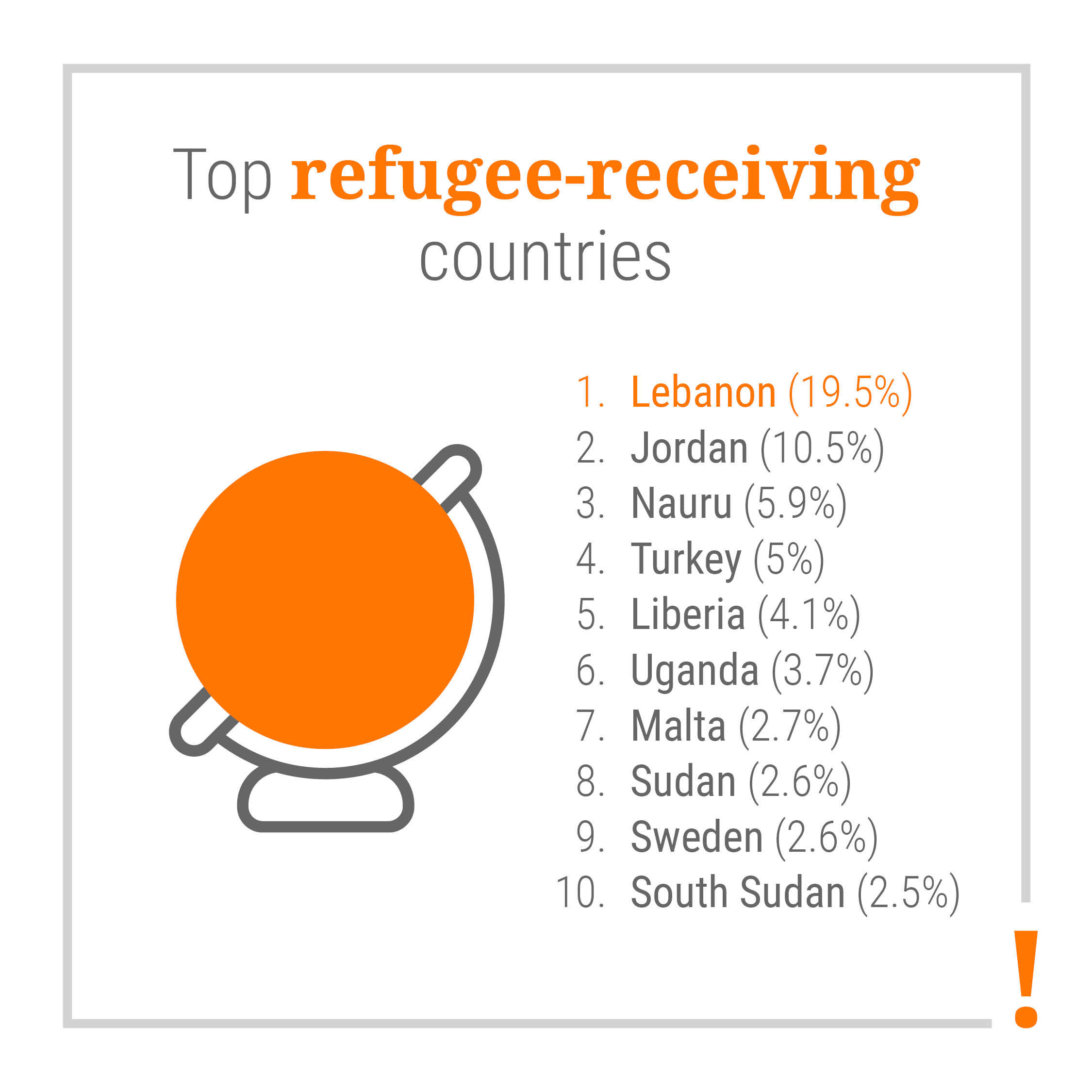
The most important of these countries are:
1. Lebanon, with 19.5 percent refugees of the total population. Lebanon has shown great hospitality to displaced people even if the country itself was in a difficult situation.
2. Jordan with 10.5 percent.
3. Nauru – 5.9 percent.
4. Turkiye – 5.0 percent.
5. Liberia – 4.1 percent.
6. Uganda – 3.7 percent. Uganda has received 1.7 million refugees over the last ten years and was described as one of the largest recipients of refugees in the world.
7. Malta – 2.7 percent.
8. Sudan – 2.6 percent. Sudan stands as the fifth largest recipient country in absolute numbers. It has hosted over one million refugees since 2010.
9. Sweden, of European countries, headed the list with its generous refugee policy. It has actively welcomed 2.6 percent of refugees.
10. South Sudan – 2.5 percent.
Although South Sudan is better known for its own displaced population, it is also home to more than 300,000 refugees from neighboring countries.
The other countries participating to solve the refugee crisis are:
Germany – 1,265,000 refugees (1.5% of the total population), Ethiopia – 943,000 (0.8%), United States – 773,000 (0.23%), Bangladesh – 675,000 (0.4%), Kenya – 394,000 (0.7%), Russia – 453,000 (0.3%), Cameroon – 416,000 (1.5%).
British Policy
Britain has been criticized by many for its decision to send its asylum seekers to Rwanda, the East African country. The United Nations High Commissioner for Refugees has called the British government's plan a "violation of international law" and said the attempt to "shift responsibility" for claims to refugee status was "unacceptable." However, British Prime Minister Boris Johnson says the plan is in line with international law.
British Home Secretary Priti Patel had issued a "ministerial directive" to start implementing the plan amid concerns from ministry employees who could not accurately determine the benefits of this policy.
The BBC stated that the ambiguity about the drawbacks meant that the government had to take personal responsibility for it by issuing the directive.
Under the British government scheme, which will cost Britain 120 million pounds, people who have entered the kingdom illegally from January 1 this year will be transferred to Rwanda to submit asylum claims in Rwanda and to stay there if the asylum claim is successful.