Who Pushed Karim Khan Out? Inside the Pressure War Against the ICC
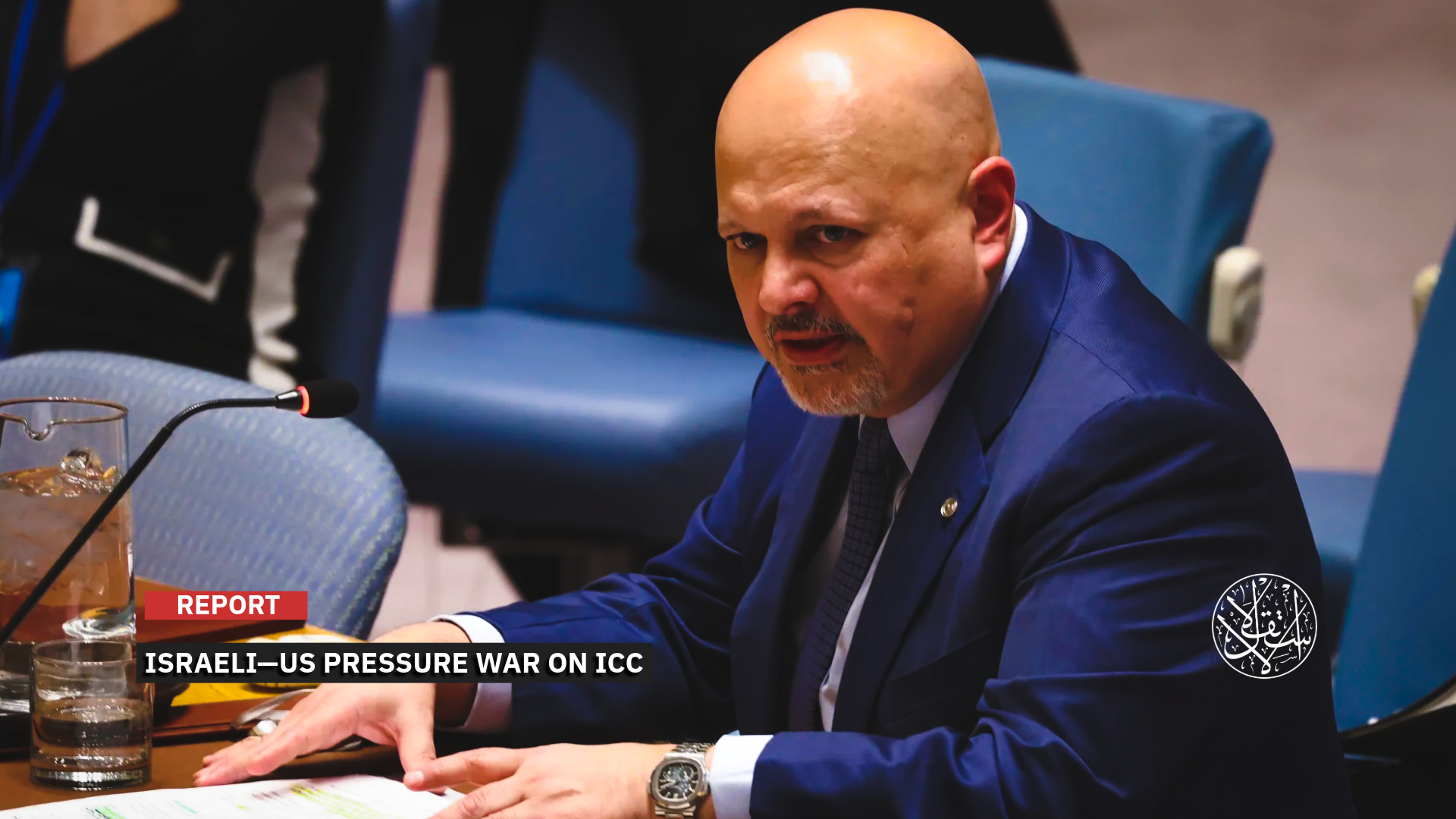
The ICC’s senior administrative body decided to temporarily suspend Khan from his duties.
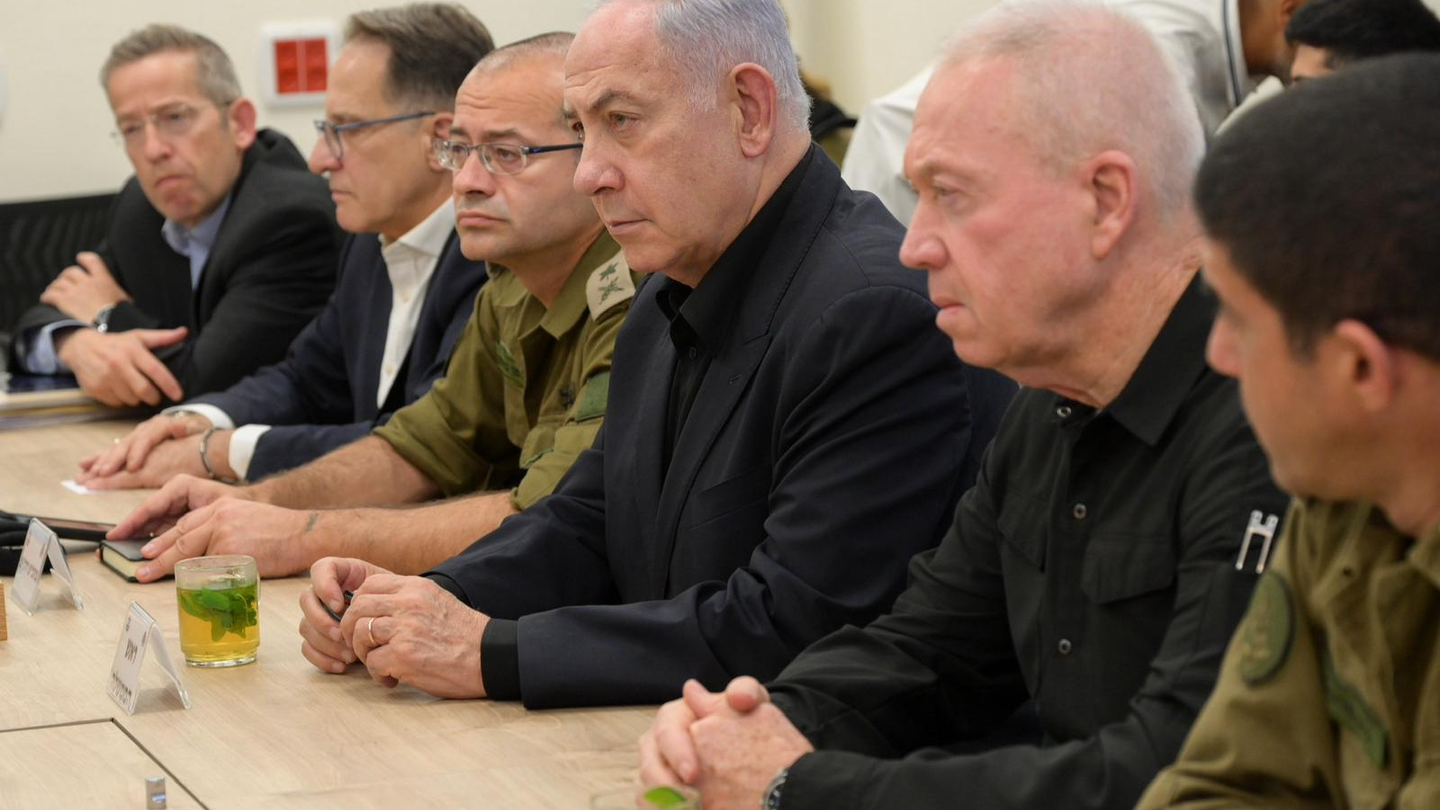
After issuing arrest warrants for Israeli Occupation Prime Minister Benjamin Netanyahu and former war minister Yoav Gallant over war crimes in Gaza, International Criminal Court (ICC) prosecutor Karim Khan found himself at the center of a different legal battle: allegations of sexual misconduct that led to the suspension of his duties and a recommendation for his removal.
The ICC’s senior administrative body decided to temporarily suspend Khan, while its executive office recommended his dismissal following an investigation into allegations brought by a female staff member in his office. But lawyers and people close to Khan have questioned the claims, arguing that they lack sufficient evidence. Some have gone further, suggesting the case has been used to damage his reputation and weaken his position at the court.
The ICC’s decision on June 10, 2026, triggered widespread debate, coming nearly two years after Khan took the lead on the case that resulted in arrest warrants for Netanyahu and Gallant. The timing has prompted observers to draw links between the latest developments and the political and legal campaign launched by the Israeli Occupation and its allies against the court since 2024.
Throughout that period, “Israel” repeatedly called for the Palestinian cause-related proceedings to be dropped, arguing that the ICC had exceeded its authority. It was also among those with the most to gain politically from weakening Khan’s position after he spearheaded the legal efforts that resulted in warrants against senior Israeli Occupation officials.
Following the suspension, Israeli officials described the move as evidence of what they called the court’s “corruption,” while “Israel’s” representative to the United Nations called for the arrest warrants against Netanyahu and Gallant to be withdrawn.
The controversy unfolded against a broader campaign of pressure on the ICC. The administration of U.S. President Donald Trump imposed sanctions on Khan and several ICC judges after the warrants were issued, including financial and banking restrictions and other measures. Critics described the move as an unprecedented attempt to pressure the court and undermine its judicial independence.
The Significance of the Decision
The suspension of ICC prosecutor Karim Khan is not merely an internal administrative measure at an international judicial institution. It reflects deeper shifts that have revived long-standing questions about the independence of international justice and its ability to pursue powerful states and their allies.
Khan’s suspension came after he led the court’s most consequential legal action against Israeli officials over the Israeli war on Gaza, exposing the ICC and its judges to unprecedented pressure, including U.S. sanctions targeting several court officials and repeated Israeli accusations that the tribunal was politically biased.
For that reason, the explanation offered by the ICC’s senior administrative body—that the measures against Khan were linked solely to internal allegations under investigation—has failed to convince many observers. Lawyers and analysts argue that the decision unfolded amid escalating pressure from Washington and “Israel” against the court.
The developments have raised broader questions over whether the United States and the Israeli Occupation have succeeded in intimidating the ICC and weakening its ability to operate independently.
The process behind the decision has also drawn scrutiny. A group within the court’s administrative oversight body moved to suspend Khan before the matter was referred to the ICC’s 125 member states.
The oversight office said the suspension would not determine the outcome of the case or affect member states’ vote on Khan’s future during an extraordinary session expected to be held as soon as possible.
Any disciplinary action would require a two-thirds majority vote, followed by a separate decision on whether to permanently remove him from office. Regardless of the outcome, the controversy surrounding the case appears unlikely to end there.
Since Khan sought arrest warrants for Benjamin Netanyahu and Yoav Gallant, the court has faced intense scrutiny and pressure. In May 2024, allegations of sexual misconduct involving a staff member in Khan’s office emerged.
The court’s Independent Oversight Mechanism (IOM) opened an investigation into the claims, but the case was later closed after the alleged complainant declined to participate in the proceedings. Investigators concluded that there was insufficient evidence to substantiate the allegations.
However, the case was reopened in October 2024 and referred to the United Nations Office of Internal Oversight Services (OIOS), which conducted a broader investigation into allegations of sexual misconduct and abuse of authority between November 2024 and December 2025. The inquiry produced more than 5,000 pages of testimony and evidence.
The findings were later reviewed by a three-judge panel tasked with determining whether Khan’s conduct amounted to serious misconduct, lesser misconduct, or did not constitute an offense warranting disciplinary action.
Even so, reports linked to the investigation indicated that the three judges did not find conclusive evidence, despite an earlier UN investigation finding a “factual basis” for the allegations.

Khan has denied all allegations against him, describing them as a politically motivated smear campaign. He also called his suspension unlawful, procedurally unfair, and unsupported by sufficient evidence.
The developments have raised new questions over why the case was referred to member states for a vote at this stage and whether political considerations played a role in the decision.
Those concerns have been amplified by the threats and sanctions faced by Khan and the ICC itself following his legal action against Israeli officials, which critics have described as an attempt to pressure the international judicial institution.
Khan’s fate will now be decided by the ICC’s 125 member states, while any further disciplinary action would require the support of at least 65 countries.
However, previous reports linked to the investigations have pointed to a lack of conclusive evidence proving the allegations beyond doubt, leading some to question the legal basis for the decision.
According to his defense team, Khan has the right to challenge any removal decision before the Administrative Tribunal of the International Labor Organization, which handles employment disputes involving ICC staff.
That means any attempt to dismiss him could trigger a lengthy legal battle, potentially resulting in his reinstatement or substantial compensation if procedural or legal flaws are found in the investigation or disciplinary process.
At the same time, some staff members within the Office of the Prosecutor have warned that Khan’s return could undermine confidence among employees and raised concerns about possible internal repercussions, including potential retaliation or deeper divisions within the ICC.
While the case remains open to multiple outcomes, it has evolved from a personal dispute involving allegations against a judicial official into a broader test of the ICC’s independence and its ability to operate free from international political pressure.

Sanctions Paved the Way for Removal
The United States imposed sanctions on ICC prosecutor Karim Khan after he sought arrest warrants for Israeli Prime Minister Benjamin Netanyahu and former War Minister Yoav Gallant over war crimes and crimes against humanity during their war on Gaza.
The measures did not stop with Khan. They were later expanded to include two of his deputies, eight ICC judges, the UN special rapporteur on the occupied Palestinian territories, and several Palestinian organizations that provided evidence and documentation to the court.
On February 6, 2025, U.S. President Donald Trump issued an executive order authorizing sanctions against the ICC and its prosecutor. Amnesty International said the move was aimed at preventing the ICC from exercising its independent jurisdiction and posed a direct threat to its work and staff.
The order echoed a similar measure issued by Trump during his first term in 2020, which was later revoked by President Joe Biden. But the new sanctions were widely viewed as a direct response to the ICC’s efforts to hold Israeli officials accountable for their crimes in the Palestinian territories under international law.
In November 2024, the ICC issued arrest warrants for Netanyahu and Gallant, as well as Mohammed Deif, the commander of the Qassam Brigades, on charges of war crimes and crimes against humanity.
Since then, Khan has faced intense political and media pressure, along with threats and sanctions from officials and governments in the West, over his support for pursuing accountability for Israeli officials accused of serious crimes during the Israeli war on Gaza.
After the charges against Netanyahu and Gallant were announced, pressure mounted on the ICC to withdraw the warrants or freeze the related legal proceedings.
Khan, however, stood by his position and continued defending the court’s independence, rejecting political interference in its decisions. He later described the measures taken against him as part of a politically motivated smear campaign.
Western officials had previously applied direct pressure on Khan. Media reports revealed that former British Foreign Secretary David Cameron warned him that the United Kingdom could reconsider its position toward the court if it proceeded with action against Israeli officials.
Other reports said a British-Israeli lawyer working on Netanyahu’s behalf told Khan in May 2024 that the court and its prosecutor would suffer serious consequences if the case against the Israeli prime minister moved forward.
Observers argue that such threats were not aimed solely at influencing a single case but also sent a broader warning to the international justice system itself—an attempt to limit its ability to pursue officials from countries with significant political power.
On several occasions, Khan has publicly addressed the pressure he faced over his legal actions, stressing that the core issue was the victims’ right to justice rather than political disputes between states.
In one of his statements, Khan said, “It’s not about us. It’s about victims and their right to justice. They're not worthless, they're not numbers, they're not abstract concepts.”
In a CNN interview in May 2024, Khan revealed that several Western leaders had contacted him in an attempt to discourage him from issuing the arrest warrants. He said one senior official directly told him that the court was created to deal with Africa and people like Putin, a remark that reflected the resistance among some Western powers to expanding the ICC’s reach to include their allies.
Although the United States and “Israel” are not members of the ICC, the court has jurisdiction over crimes committed on the territories of member states, including the Palestinian territories, where it has recognized its authority to investigate.
Following Khan’s suspension, the Israeli Occupation and its allies quickly moved to use the development to call for the cancellation of the arrest warrants against Netanyahu and Gallant, arguing that the prosecutor who led the case had become the subject of an internal investigation. However, the court’s legal proceedings are not formally tied to the personal status or employment position of its prosecutor.

A Cycle of Retaliation
Khan’s removal is only the latest chapter in a broader campaign of pressure targeting ICC officials and others who have accused the Israeli Occupation of genocide or called for the prosecution of its leaders.
U.S. sanctions have increasingly targeted ICC judges and prosecutors, including Khan, over the court’s decisions and arrest warrants involving Israeli and American officials.
Since Trump issued his executive order against the ICC in June 2025, his administration has moved to sanction at least 11 court officials, including nine judges and prosecutor Khan.
According to The Guardian, Khan and ICC staff were subjected to surveillance, intimidation, and threats over a decade-long intelligence operation aimed at disrupting investigations into Israeli war crimes in the Palestinian territories.
As a result of the sanctions, the affected judges and officials, including Khan, lost access to email accounts and had their bank accounts frozen.
The United States has defended the measures under a 2002 law known as the American Service-Members’ Protection Act, widely referred to as the “Hague Invasion Act.”
The law grants the U.S. president authority to use “all means necessary” to secure the release of American personnel or U.S. allies, including Israeli officials, if they are detained or imprisoned by the ICC.
Among those previously targeted by Washington was former ICC prosecutor Fatou Bensouda of Gambia, who faced years of pressure from “Israel” over her office’s investigation into crimes in Palestine.
In an interview with Al Jazeera English, Bensouda said former Mossad chief Yossi Cohen pressured her during a series of meetings in an attempt to stop the court’s investigation into Israeli war crimes in the occupied Palestinian territories.
Bensouda, who served as ICC prosecutor from 2012 to 2021, said that after the court opened a preliminary examination into the Palestine situation in 2015, unidentified men came to her home in The Hague and left an envelope containing $500. She said the gesture appeared intended to send a message that they knew where she lived.
She said she reported the incident to the court’s security officials and Dutch authorities but that no apparent action was taken. “I felt left alone. I felt unsupported,” she said.
The former prosecutor also described meetings with Cohen at a New York hotel during the UN General Assembly, where the focus was the ICC’s Palestine investigation. She said attempts were made to persuade her to drop the case, followed by threats against her and her family.
She said the sanctions imposed on her by the Trump administration in 2020 went far beyond preventing her from entering the United States. They affected both her personal and professional life, as her account at the United Nations Federal Credit Union was frozen, routine financial transactions were disrupted, and a Dutch bank closed an account linked to her mortgage.
Bensouda added that her son’s bank account in Gambia was also frozen, while money transfers to family members sometimes failed because intermediary banks refused to process them.
Among the ICC judges whom the United States has sanctioned or confirmed as targeted over their roles in cases involving “Israel” were Benin’s Reine Alapini-Gansou and Slovenia’s Beti Hohler. The sanctions against them were directly linked to their roles in the ICC’s pretrial chamber, which approved steps that led to the arrest warrants against Netanyahu and Gallant.
In December 2025, Washington added two more judges to its sanctions list after they took part in rejecting Israeli challenges to the court’s jurisdiction: Georgia’s Gocha Lordkipanidze and Mongolia’s Erdenebalsuren Damdin.
The U.S. State Department justified the move by claiming that the judges had directly participated in efforts related to the investigation, arrest, detention, or prosecution of Israelis “without Israel’s consent.”
Washington had previously sanctioned judges Solomy Balungi Bossa of Uganda and Luz del Carmen Ibanez Carranza of Peru over their roles in approving an investigation into war crimes involving U.S. forces in Afghanistan, in addition to the Israel-related proceedings.
In July 2025, the United States also imposed sanctions on Francesca Albanese, the UN special rapporteur on human rights in the occupied Palestinian territories, after she repeatedly accused the Israeli Occupation of committing genocide in Gaza. The measures included restrictions on her bank accounts and financial transactions.
On May 13, 2026, a U.S. federal court temporarily suspended the sanctions against Albanese, allowing her to travel to the United Nations headquarters in New York. But although the ruling was temporary, the Trump administration reinstated the sanctions, challenging efforts to limit the use of such measures against UN officials who do not align with Washington’s position.
The U.S. Court of Appeals later restored the sanctions on May 22, 2026, returning Albanese to the Office of Foreign Assets Control (OFAC) sanctions list.
Sources
- ICC chief prosecutor Karim Khan suspended amid sexual misconduct inquiry
- ICC prosecutor suspended over alleged sexual misconduct in ‘politically motivated smear campaign’
- ICC suspends top prosecutor after investigating misconduct allegations
- ICC chief prosecutor suspended after probe finds he committed serious sexual misconduct
- ICC chief prosecutor suspended after probe finds he committed serious sexual misconduct
- American Service-Members' Protection Act
- What do the Trump administration’s sanctions on the ICC mean for justice and human rights?