What is the Economic Significance of Ukraine’s Occupied Territories?
In the spring of 2014, a civil riot initiated in Ukraine, and the administrations of numerous cities of Ukraine were taken over, police stations were invaded in order to obtain guns. The driving force was Russian people with evident ties to Russian secret services.
Since that time, Russia took over the Crimean Peninsula, exploiting a power vacuum in Kiev after its president fled to Russia.
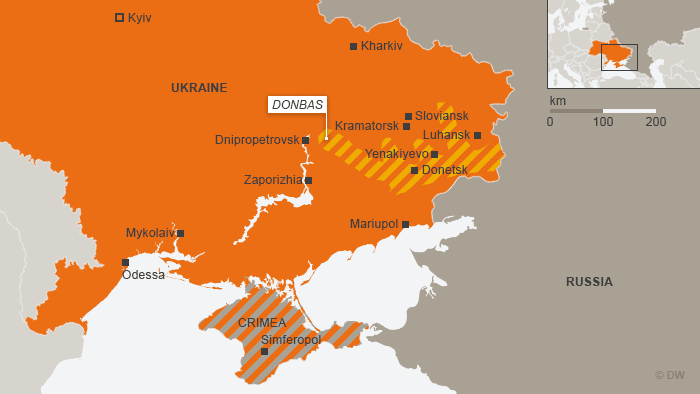
Meanwhile, separatists fought a war to declare independence from Ukraine in the Donbas region (Luhansk and Donetsk).
Over the past days, Russia approved the separatist control over Donetsk and Luhansk, and further expanded its military operations in the Donbas region, raising questions about the economic significance of that region.
I am convening today the EU defence ministers, to discuss the latest situation on the ground in #Ukraine in view of Russia’s unprovoked assault.
— Josep Borrell Fontelles (@JosepBorrellF) February 28, 2022
We will discuss further urgent needs & coordinate our assistance, with help of the clearing house managed by the EU Military Staff.
Russia’s Access
A country’s access to the sea can greatly influence its economic and political strength, and Russia’s access to the world’s oceans, aside from the Arctic, is limited.
As Political Analyst George Friedman says: “Russia has three potential points from which to access global maritime trade. One is through the Black Sea and the Bosporus, a narrow waterway controlled by Turkey that can easily be closed to Russia.
Another is from St. Petersburg, where ships can sail through Danish waters, but this passageway can also be easily blocked. The third is the long Arctic Ocean route, starting from Murmansk and then extending through the gaps between Greenland, Iceland, and the United Kingdom.”
The Crimean Peninsula is of strategic importance to grant access to Europe. According to the Center for Strategic and International Studies: “The control of Crimea gives Moscow continuing access to the naval base at Sevastopol, home to Russia’s Black Sea Fleet.”
“Sevastopol’s warm water port, natural harbor and extensive infrastructure make it among the best naval bases in the Black Sea,” it added.

Gas Supplies
“It should be no surprise then that Russia’s national strategy is to move its frontier as far west as possible. The first tier of countries on the European Peninsula’s eastern edge—the Baltics, Belarus, and Ukraine—provide depth from which Russia can protect itself, and also provide additional economic opportunities,” Freidman said.
“The key country for Russia after 1991 was Ukraine because the Ukrainian border went through Russia’s agricultural heartland, as well as large population centers and transportation networks,” he added.
Ukraine enjoys a strategic geographical location. As a result, it is continually a source of political and military interest among the world's main countries.
Because of its location on the Black Sea and its role as a bridge between Russia and the European Union, it has become a key area for a number of significant powers. Russia regards it as a back garden with significant security capabilities. The European Union regards it as a forward base against Russia.
40% of Russian gas is sent through Ukraine to Europe. This translates into 124 billion cubic meters of gas every year.
As a result, it is one of the most vital energy corridors in the area. The stability of the energy market in Europe and the stability of revenues in Russia depend on the political and security stability of Ukraine.
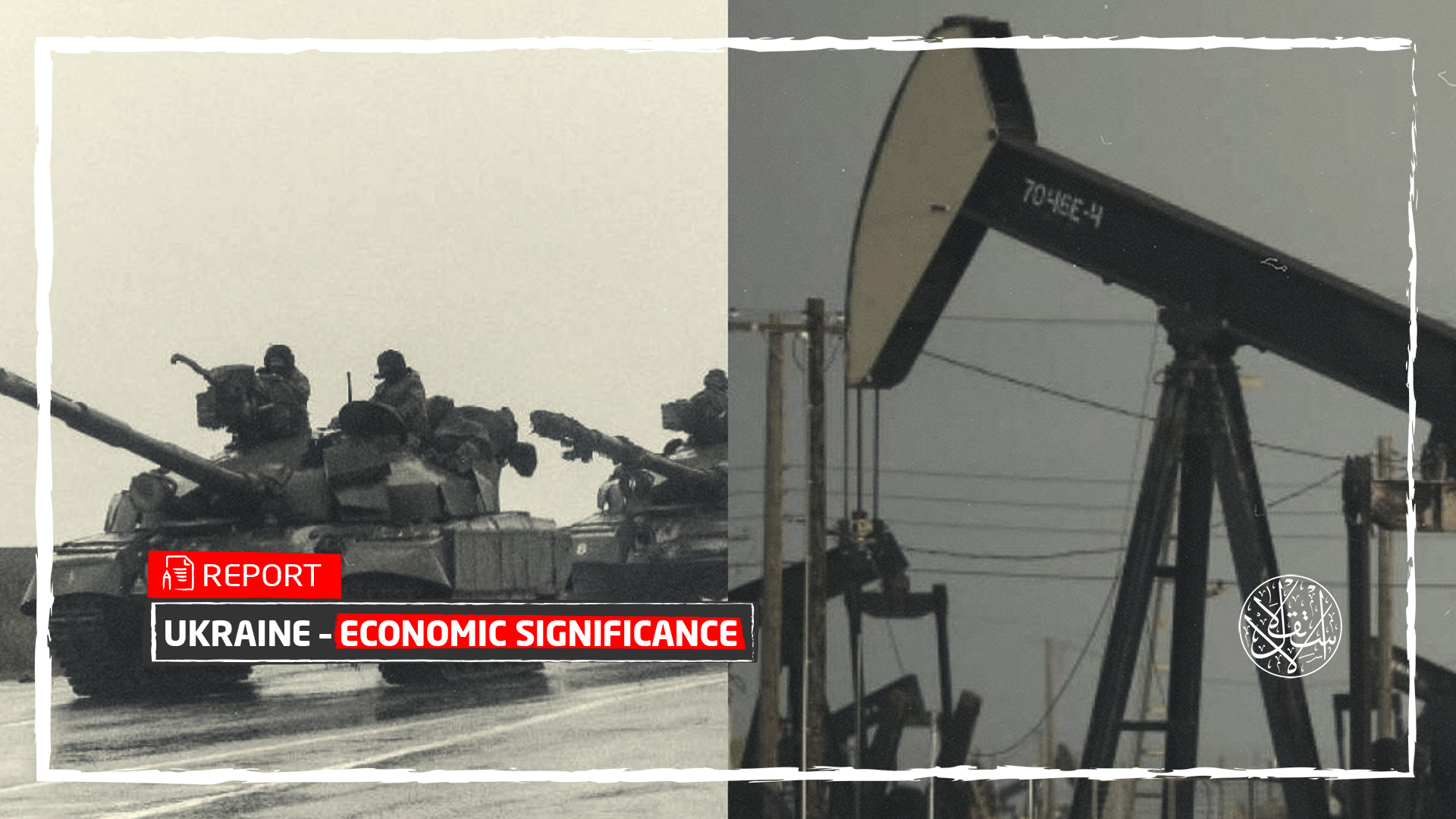
Moreover, Donbas’ region coal field is the fourth largest coal field in Europe, with extractable reserves estimated at more than 10 billion tons.
Military Industry
Although only 5% of the population lives in the Donbas region, they produce 20% of Ukraine's national product and produce 25% of Ukrainian exports.
Besides these symbolic justifications, there is one very tangible reason: Numerous companies in eastern Ukraine provide important raw materials and products to Russia - especially for the Russian space and defense industries.
Twelve types of Russian intercontinental ballistic missiles, along with spare parts and maintenance, come from the eastern Ukrainian city of Dnipropetrovsk alone. In the Donbas, a special steel is produced for the tanks of the Russian armed forces, and most Russian combat helicopters fly with engines from Zaporizhia.
Aleksey Kusch, a Kyiv-based analyst, told press agencies that the economic aim of Russia’s invasion of Ukraine is very simple—to lower the price tag of maintaining the occupied territories.
“To achieve that, Russia may want to remove the middlemen who pocketed the lion’s share of profits from the export of coal and steel and the delivery of humanitarian aid that was immediately resold on the black market,” Kusch added.
“They kept up to 70 percent of the profits,” he said.