Shiite Framework Challenges Trump by Backing Maliki: How High Will the Cost Be for Iraq?
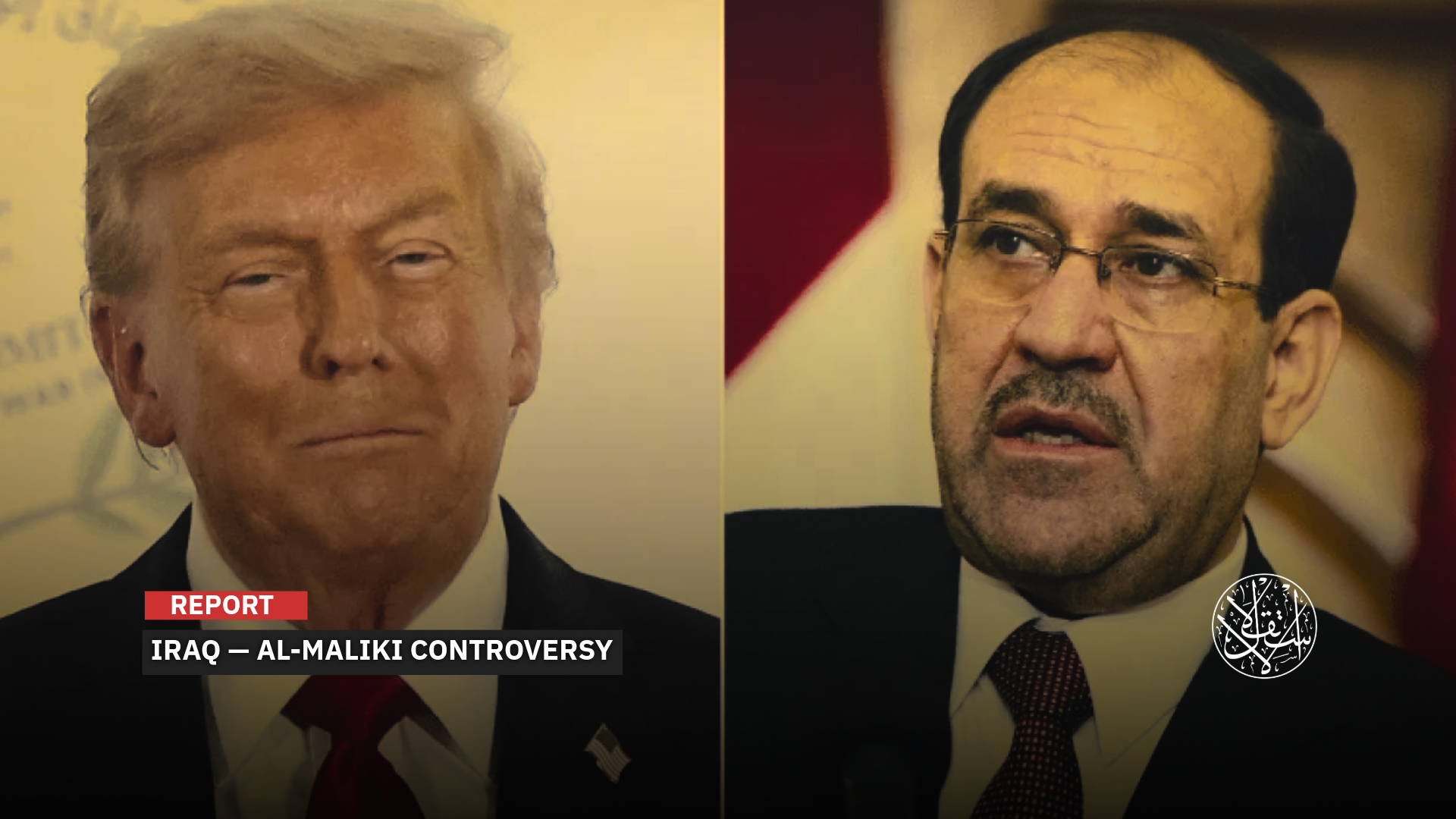
Al-Maliki officially rejects calls to withdraw from the race for Iraq’s premiership.
Iraq’s Shiite Coordination Framework has not backed down from nominating its senior leader, Nouri al-Maliki, to head the new government, but has instead reaffirmed its commitment to him, despite what was described as a “veto” signaled by U.S. President Donald Trump, who threatened to impose sanctions if al-Maliki returns to office.
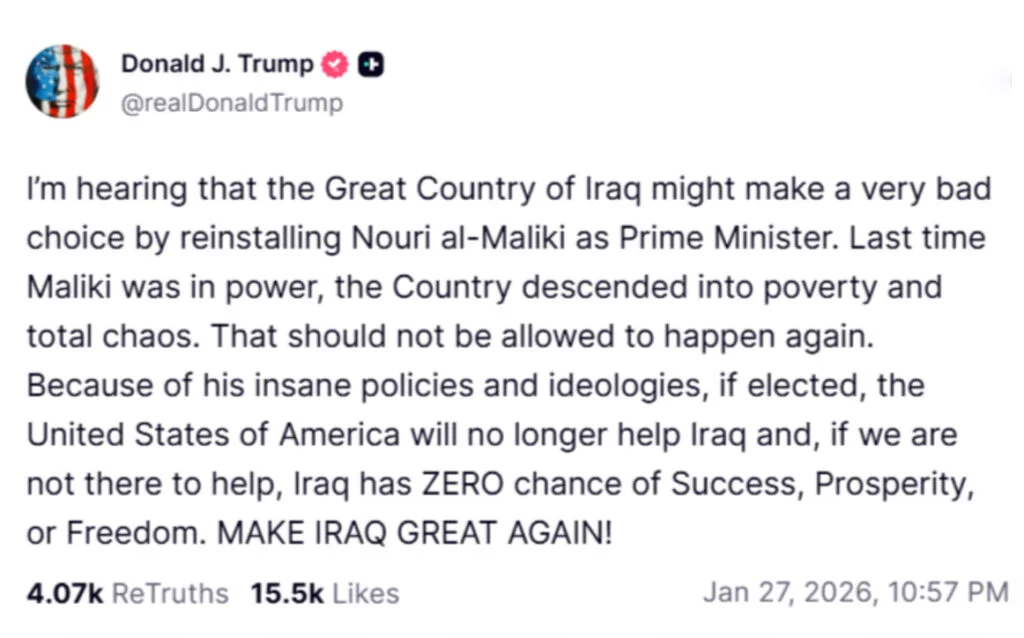
Trump wrote on his Truth Social platform on January 27, 2025, “I'm hearing that the Great Country of Iraq might make a very bad choice by reinstalling Nouri al-Maliki as Prime Minister.”
“Last time Maliki was in power, the Country descended into poverty and total chaos. That should not be allowed to happen again,” he added.
Trump warned explicitly, saying, “Because of his insane policies and ideologies, if elected, the United States of America will no longer help Iraq and, if we are not there to help, Iraq has ZERO chance of Success, Prosperity, or Freedom.”
“MAKE IRAQ GREAT AGAIN!” Trump concluded.
Internal Framework Clash
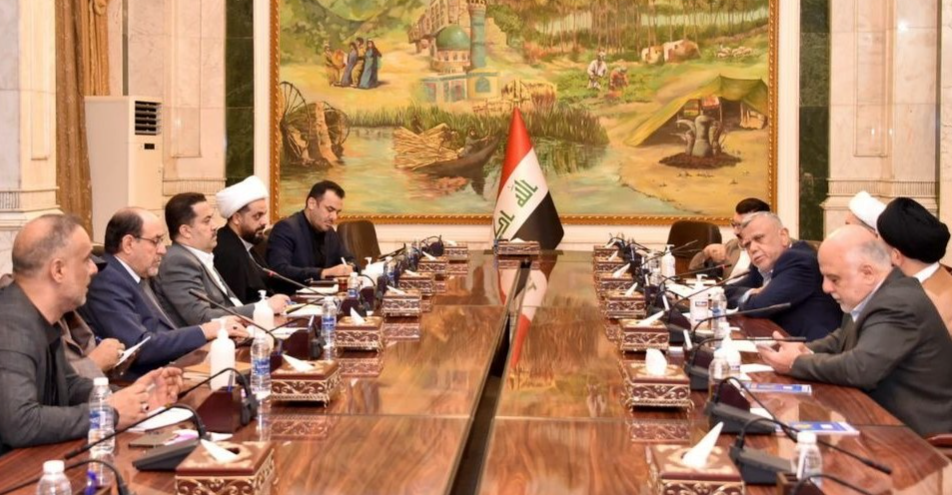
On January 31, 2026, Iraq’s ruling Shiite Coordination Framework announced it was holding firmly to the nomination of its senior leader, Nouri al-Maliki, for the post of prime minister, after he refused to withdraw his candidacy and insisted on moving forward with efforts to form the next Iraqi government.
In a statement, the framework said that “the selection of the prime minister is a purely Iraqi constitutional matter, carried out in accordance with the mechanisms of the political process and in a manner that safeguards the national interest, away from external dictates.”
It reaffirmed “its adherence to its nominee, Nouri Kamil al-Maliki, for the premiership.”
Following a regular meeting held at al-Maliki’s office, the framework stressed “its keenness to build balanced relations with the international community, particularly with influential global powers, on the basis of mutual respect and non-interference in internal affairs.”
On the same day, the leader of the State of Law Coalition, Nouri al-Maliki, said he would proceed in accordance with the will of the people and their right to choose their political system and leadership, stressing that he “will not relinquish the Iraqi people’s right to choose whom they trust,” according to the Iraqi News Agency, INA.
Al-Maliki added that he rejects “compromising the Iraqi people’s right to choose whom they trust and see as competent to lead this stage.”
He said, “We respect our national will and our independent decision, and we look forward to others respecting this decision just as we respect their will in managing their own affairs.”
“Choosing our government and our leaders is a national matter that must be respected, just as we respect the choices of others,” he continued.
He stressed that “respect for our will, our democracy, and our people’s right to choose their political system and leadership through constitutional institutions represents a fixed principle for us, and we will proceed in accordance with this will and will not retreat from it.”
On January 28, al-Maliki had rejected, via the platform X, what he described as “blatant American interference” in Iraq’s internal affairs, calling it a violation of the country’s sovereignty, in response to warnings from U.S. President Donald Trump.
Al-Maliki said the American intervention in the process of forming the Iraqi government was “contrary to the democratic system after 2003,” and described it as an infringement on the Coordination Framework alliance’s decision to choose its nominee for prime minister.
He reaffirmed his candidacy, indicating that he would continue to act “based on respect for the national will and the decision of the Coordination Framework, as guaranteed by the constitution,” in a way that “achieves the supreme interests of the Iraqi people.”
In contrast, senior Coordination Framework figure and former Prime Minister Haider al-Abadi warned against prioritizing personal considerations or narrow partisan calculations, stressing the primacy of the people’s and the state’s vital interests in dealing with any candidate or forthcoming governing formula, particularly in light of the exceptional circumstances facing Iraq and the region.
In a statement issued on January 31, al-Abadi said that “the unity of the Coordination Framework’s decision, and national unity toward any candidate, guarantee a unified national stance in protecting and strengthening the political system internally, and at the regional and international levels.”
In an apparent reference to his rejection of insisting on al-Maliki’s nomination for the premiership and disregarding U.S. warnings, al-Abadi affirmed that “the interests of the people rise above the interests of individuals, and the state is a trust that must not be gambled with under any circumstances.”
In a position aligned with al-Abadi’s view, Coordination Framework leader Ammar al-Hakim called for avoiding any risk to the achievements that have been made, and for maintaining security, military, and intelligence readiness to confront the challenges surrounding Iraq, according to a statement issued by his office on January 29.
An Awkwardly High Benchmark
Regarding possible scenarios for resolving the crisis following U.S. President Donald Trump’s rejection of Nouri al-Maliki’s nomination, Iraqi political analyst Latif al-Mahdawi said that “the Coordination Framework’s insistence on this nomination means it is playing with fire with Trump, who has set a high and embarrassing ceiling for the framework forces.”
At the same time, al-Mahdawi told Al-Estiklal that “the framework’s insistence, whether the result of miscalculation, stubbornness, or a prior arrangement and agreement, means that retreat would carry a heavy cost, as it would be seen as a moral defeat that would be difficult for all the forces that nominated al-Maliki to bear.”
The researcher predicted that “the framework forces will proceed with al-Maliki’s nomination until the moment his government is presented to parliament for a vote of confidence, and at that point it will not pass,” suggesting that this path could serve as “an exit that preserves the framework’s face, allowing it to say it exhausted all democratic steps, but parliament let it down, and therefore it respects the choice of the Iraqi forces.”
Al-Mahdawi noted that divisions within the Coordination Framework would pose an obstacle to al-Maliki assuming power.
He explained that “after Trump’s tweet, no unified statement was issued by the framework supporting al-Maliki’s nomination, and even the statement of insistence was issued only by the forces that nominated him,” something reflected in the positions of Haider al-Abadi and Ammar al-Hakim, who rejected pressing ahead with the nomination.
According to al-Mahdawi, “an agreement was reached within the framework for each party to issue its own separate position supporting al-Maliki and rejecting Trump’s tweet, instead of issuing a unified statement.” However, “the statements were limited to consensus on rejecting external interference, with a clear disparity in the level of support for al-Maliki’s nomination.”
“Some statements by framework forces included signals and hints about the need to find a solution and preserve the relationship with the United States,” he added, noting that “some of these forces had warned al-Maliki, before the announcement of his nomination, of American opposition to him, but he insisted on moving forward and did not heed those warnings.”
Al-Mahdawi pointed out that “there is extreme caution within the framework regarding any early withdrawal by al-Maliki, as that could open the door to additional pressure from Trump and new demands that might be considered humiliating to Iraq.”
He said this is what drives some forces to “maintain al-Maliki as the nominee for designation at the current stage.”
According to al-Mahdawi, “Those who support this scenario do not rule out the possibility of al-Maliki withdrawing later, even after the government wins confidence, as a tactical step and political maneuver,” despite the existence of “opposition within the framework to this proposal, on the grounds of protecting Iraq’s interests and its political standing.”
In the same context, the Iraqi newspaper Al-Mada reported on February 1, citing unnamed political sources, that “the Coordination Framework is studying several options to exit the crisis over selecting a prime minister, including the possibility of early elections.”
The newspaper said that “there is confusion within the Coordination Framework due to the recent American positions, and understandings appear to have returned to square one,” pointing to “circulating proposals within Shiite political corridors, including extending the government of Mohammed Shia al-Sudani for an additional year, followed by early elections.”
According to the newspaper, this proposal reflects “a broader reading than merely Trump’s objection to al-Maliki personally,” as Washington sees “general dissatisfaction with the results of the most recent elections, which brought more than 80 lawmakers from armed factions into parliament for the first time, forces that are demanding sensitive positions within the state.”
The newspaper noted that “the framework may wait for the end of the 15-day period separating the election of the president of the republic and the designation of the framework’s nominee to form the government before making its final decision.”
It added that “other options remain on the table alongside early elections, including returning to previous candidates or reopening nominations for the post of prime minister.”
Potential Isolation
Regarding the potential repercussions of maintaining Nouri al-Maliki’s nomination, Iraqi political analyst Mohammed Ali al-Hakim warned of “the danger of insisting on moving forward with this nomination in light of the declared American rejection,” arguing that this course “could open the door to grave political, economic and security consequences for Iraq.”
Al-Hakim told the Iraqi platform Al Jeebal on February 1 that “ignoring the American position cannot be treated as a marginal detail.”
“The United States remains an influential player on the international stage and possesses real pressure tools that it may resort to if it feels its interests are threatened, or that Iraq is heading toward confrontational policies,” he noted.
“The most dangerous scenario Iraq could face if it insists on this nomination is the possibility of economic or financial sanctions, or restrictions on international banking transactions,” warning that “such steps would be directly reflected in the exchange rate of the dinar, investment flows, and the government’s ability to meet its domestic and external obligations.”
“Iraq is still recovering from the effects of long years of isolation, sanctions, and conflicts, and any return to a state of tension with the international community would represent a serious setback to the path of openness achieved in recent years,” al-Hakim continued.
He stressed that “international isolation does not begin with major decisions, but with cumulative political positions that gradually weaken the confidence of international partners in the Iraqi state.”
According to al-Hakim, “Rejecting external interference in the formation of governments does not mean ignoring international power balances, nor bypassing the complex political and economic reality Iraq is experiencing,” calling for “the primacy of wisdom and national consensus, and the selection of a figure capable of managing this stage with the least possible external confrontations.”
Al-Hakim concluded that “the current stage requires responsible decisions that place Iraq’s supreme interest above narrow partisan calculations,” warning that “insisting on controversial choices could push the country into new crises, with the Iraqi citizen the first to pay the price and the last to reap the benefits.”
The Iraqi Presidency had announced in a statement issued on January 29 its categorical rejection of any form of external interference in the country’s political affairs, considering internal matters to be “a purely sovereign issue.”
The statement added that “Iraq’s internal issues are an exclusively sovereign matter decided by Iraqis alone, based on their free will under the constitution and through the democratic system founded on elections, which represent the true expression of the people’s choices.”
Nouri al-Maliki served as prime minister for two consecutive terms between 2006 and 2014, during which Iraq witnessed major security challenges, notably the rise of attacks by the Islamic State group, which at the time seized roughly one-third of the country’s territory, before Baghdad declared in 2017 that it had achieved “victory” over the group.
Sources
- “We Will Not Back Down”: Nouri al-Maliki Responds Again to Trump’s ‘Warning’ Over His Bid for Iraq’s Premiership [Arabic]
- Al-Hakim Calls for Security and Political Stability, Warns Against Jeopardizing Achievements [Arabic]
- Iraq Rejects Trump’s Interference in Maliki’s Premiership Bid [Arabic]
- Exclusive: Backing Maliki and Defying the U.S.: Warnings of Sanctions and Economic Fallout Amid International Isolation [Arabic]
- Coordination Framework Holds Firm on Maliki as Iraq’s Prime Minister, Hints at Cancelling Presidential Selection Session [Arabic]