Transatlantic Trust Under Strain: How Washington May Be Steering NATO Towards an Uncertain End
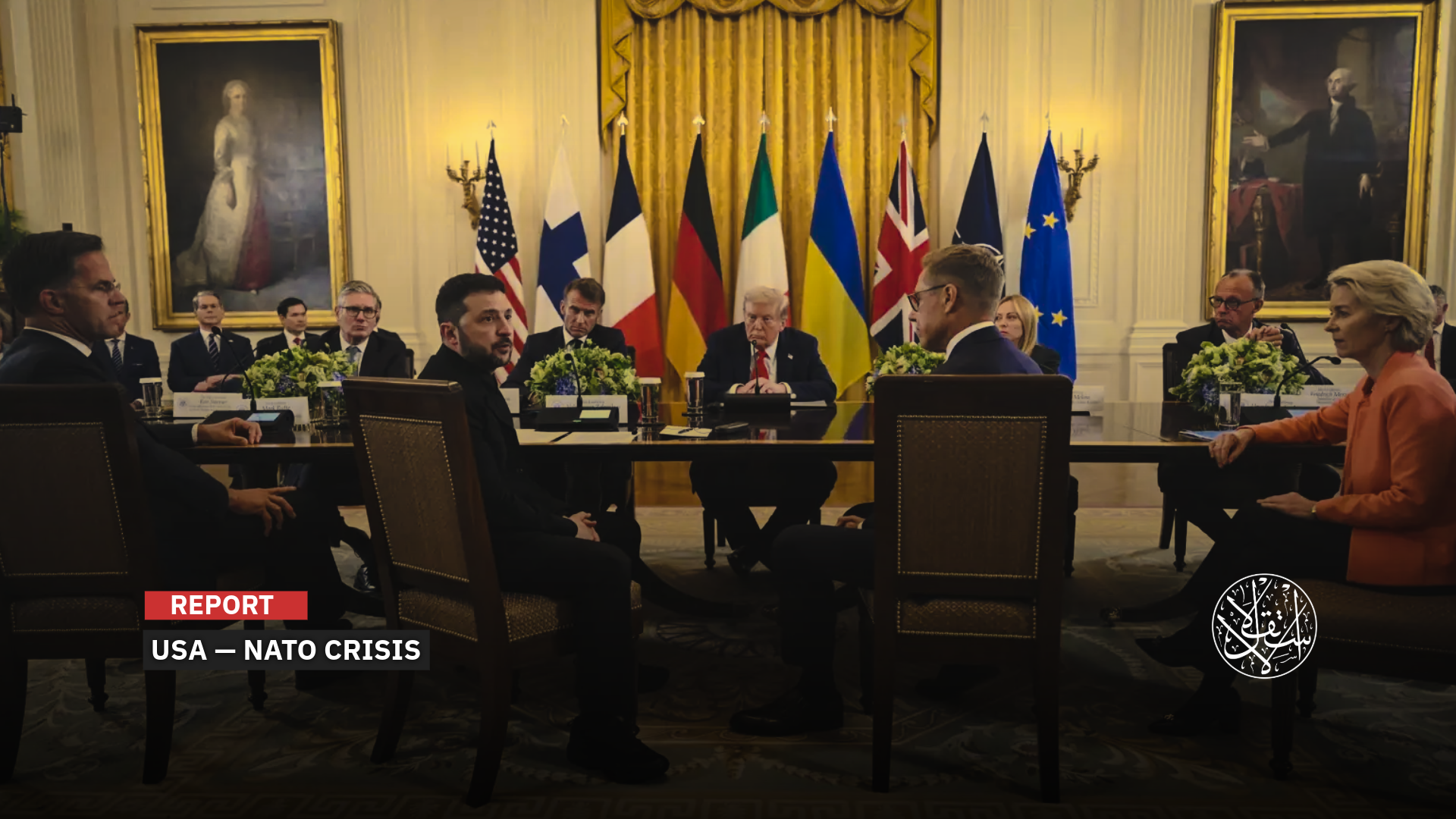
Trump leaves open the option of military force to seize Greenland.
Amid escalating tensions between the U.S. administration led by President Donald Trump and European Union countries, following Washington’s call to annex Greenland, the future of the North Atlantic Treaty Organization, NATO, has emerged as the central question of the current moment, particularly as the growing rift and lack of alignment between the United States and Europe deepen.
Greenland, an autonomous territory within the Kingdom of Denmark, holds a uniquely strategic geographic position. The world’s largest island lies between the Arctic Ocean and the Atlantic Ocean.
Although geographically part of North America, it is classified politically and geopolitically as part of the European sphere due to its status as a Danish territory.
A Threat of Force
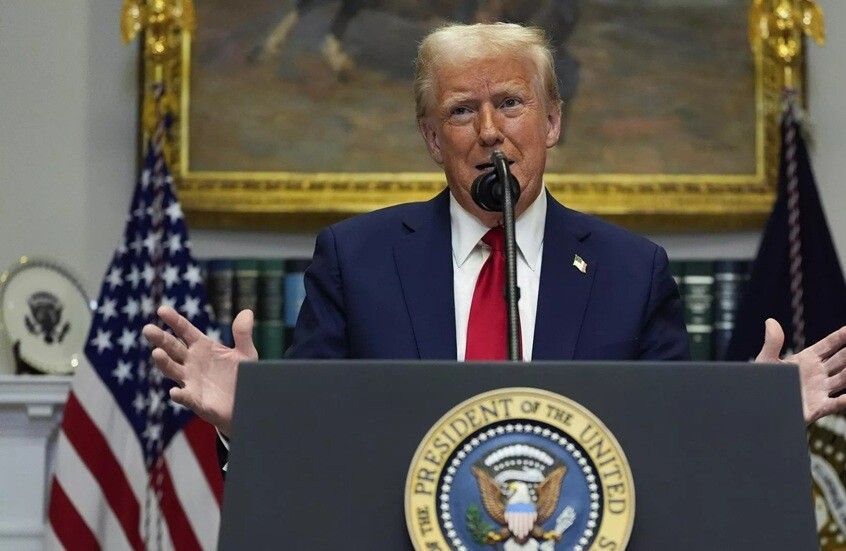
In an interview with the New York Post, President Trump said the United States will gain sovereignty over land in Greenland where American bases are located, taking ownership of those areas. “Yeah,” he told The Post in an exclusive Oval Office interview on Friday. “We’ll have everything we want. We have some interesting talks going on.”
The newspaper reported on January 24, 2026, that “One of the proposals being discussed would stop short of total American ownership but allow the US “sovereignty” over military bases on the island, like the Pituffik Space Base.”
On January 22, Trump announced that following his meeting with NATO Secretary-General Mark Rutte, the outlines of potential agreements regarding Greenland had been drawn up.
He noted that this agreement, if completed, would be a distinctive solution for the United States and all NATO member states.
Trump had previously justified the need for the United States to acquire Greenland with claims that the island is “surrounded by Chinese and Russian ships,” warning that it could fall under the control of one of the two countries if Washington failed to act.
On January 24, the White House published an AI-generated image of President Donald Trump alongside a penguin holding the American flag on the island of Greenland.
The image was posted on the platform X with the caption, “Embrace the penguin,” and a similar video was shared on TikTok, even though penguins do not live in Greenland.
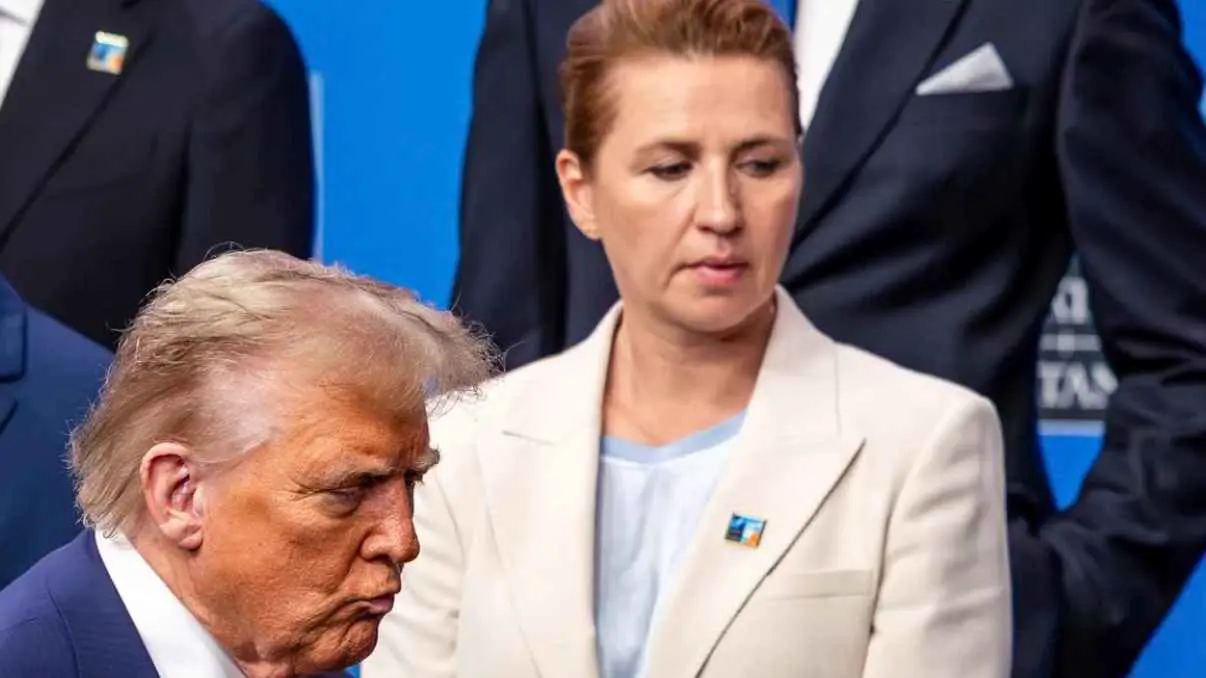
In the same vein, European officials said that President Donald Trump rebuked Danish Prime Minister Mette Frederiksen over the Greenland issue for 45 minutes during a phone call in January 2025, according to The New York Times.
In a report published January 25, the newspaper revealed that officials said Trump declared on January 7, 2025, before his formal inauguration, for the first time that he would not rule out the use of military force to seize Greenland. The following week, Frederiksen held what was described as a tense phone call with Trump, during which he reprimanded her for about 45 minutes, according to the sources.
The Danish prime minister told the newspaper in an interview that Trump “is capable of speaking very clearly,” while stressing that she is also capable of responding.
She limited her public comment on the call to saying, “A phone call between two colleagues has to be a phone call between two colleagues.”
Greenland’s Prime Minister Jens-Frederik Nielsen, speaking at a news conference on January 13, said that Greenlanders do not wish to be part of the United States, adding, “If we had to choose right now between the United States and Denmark, we would choose Denmark.”
“One thing must be clear to everyone. Greenland does not want to be owned by the United States. Greenland does not want to be governed by the United States. Greenland does not want to be part of the United States,” Nielsen added.
The Ultimate Test
Regarding the future of the North Atlantic Treaty Organization, NATO, amid strained relations between President Donald Trump’s administration and European Union countries, Jordanian writer and political analyst Hazem Ayad said Trump is placing the alliance to an exceptionally difficult test by demanding the annexation of Greenland to the United States.
In remarks to Al-Estiklal, Ayad said that “what is happening is not the first test of its kind; it was preceded by a series of tests, most notably Trump’s demand that member states shoulder greater responsibilities and increase their financial contributions to the alliance’s budget.”
He explained that Trump has long criticized the role of European countries and argued that NATO has lost its importance and value for the United States.
However, the Greenland test is the most dangerous, particularly as it comes in the post-Russia-Ukraine war phase, at a time when the alliance’s structure, philosophy, and founding motivations have become the subject of broad internal debate. He stressed that NATO has never been in a state of fragility, weakness, and fragmentation as it is now.
Ayad predicted that the decline in the alliance’s strategic value among its various members will deepen, especially as a number of European countries have begun searching for alternatives to the partnership and are redefining their relationship with the United States in ways that differ from the past.
He noted that some European countries no longer view the United States as an integrated alliance partner, but rather as a rival or competitor. This is evident in positions toward Russia and China, as some European states prefer greater openness toward China, while others seek a political recalibration of ties with Russia away from American influence.
“From this perspective,” Ayad added, “what has happened regarding Greenland constitutes a new test that compounds NATO’s predicament and at the same time deepens the crisis in relations between the United States and European countries.”
According to Ayad, “little reliance can be placed on the prospect of changes within the United States that would positively influence European countries’ stance toward NATO, which has undergone repeated tests across multiple files, whether in the war in Ukraine, in relations with China, or in the broader context of U.S.-European ties.”
“There is a shift in philosophy and objectives, alongside mounting turbulence in U.S.-European relations, turbulence that is not tied solely to Trump as an individual, but to the presence of a broad current within the United States that calls for retrenchment and a redefinition of interests, set against a growing European current demanding a redefinition of its relationship with the United States and with the wider world,” he concluded.
Teetering on Collapse
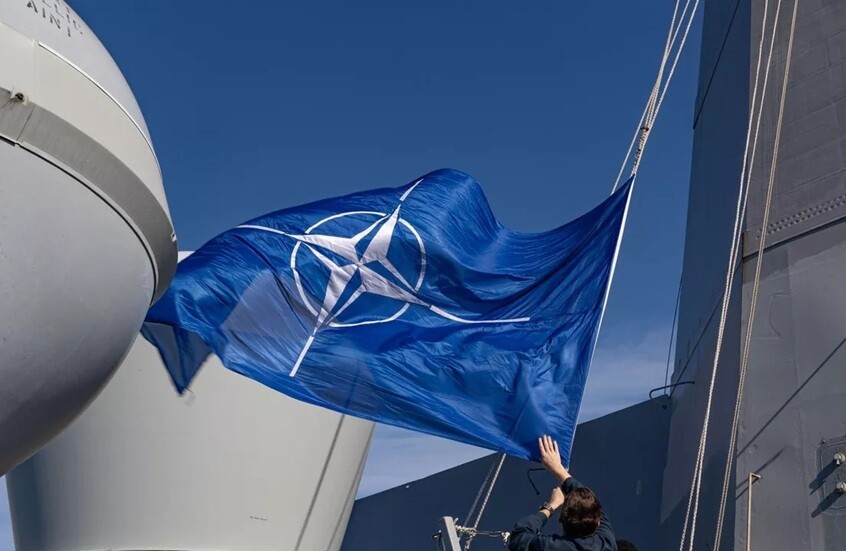
In an unprecedented development shaking the foundations of the North Atlantic Treaty Organization, NATO, American media reports have revealed that the U.S. Department of Defense, the Pentagon, has begun implementing practical steps to scale back U.S. participation in the alliance’s operational mechanisms, a move that international security experts say could mark the beginning of the unraveling of the most powerful military alliance in modern history.
The Washington Post reported on January 21, 2026, that the Defense Department is planning to reduce its participation in one of NATO’s advisory groups, the latest indication of President Donald Trump’s administration moving to scale down the U.S. military presence in Europe.
According to the newspaper, the decision will affect about 200 military personnel and will reduce U.S. involvement in nearly 30 alliance bodies and organizations, including centers of excellence responsible for training NATO forces in various aspects of modern warfare.
The withdrawal will not be immediate. The Defense Department intends not to replace personnel once their service terms end, a process that could extend over several years.
The reductions include advisory groups specializing in the alliance’s energy security, naval warfare, special operations, and intelligence.
These developments come amid a notable escalation by Trump toward U.S. allies. He has threatened to impose tariffs of 10 percent on all goods coming from European Union countries beginning February 1, 2026, rising to 25 percent by June 1, unless an agreement is reached regarding Greenland.
Danish Prime Minister Mette Frederiksen warned that any American attack on a NATO ally could signal the end of the alliance itself, stressing the difficulty of imagining the alliance recovering from a shocking breach of the treaty in which one ally attacks another to seize its territory.
According to The Washington Post, the American threats represent the most serious crisis NATO has faced in its 77-year history.
The newspaper quoted American expert Stephen Durlauf as saying these steps amount to the effective end of NATO in its known form, noting that the alliance is fundamentally built on credible commitments among its members.
Durlauf added that such policies would accelerate rising hostility toward the United States globally. He explained that even if Democrats were to win the 2028 election, the prospect of a future president adopting an approach similar to Trump’s would permanently erode trust.
The New York Times reported on January 24, 2026, that NATO “in its traditional form is approaching its end,” amid what it described as a negative shift in the United States’ approach to transatlantic security.
In its report, the newspaper wrote, “NATO as we know it, the alliance that has been the bedrock of trans-Atlantic security for over 75 years, is coming to an end,” Rajan Menon writes. “To be sure, its unraveling won’t be immediate and will entail all manner of disruption. But it will be no disaster.”
It added that European leaders, after attending the World Economic Forum in Davos, came to realize that the United States is no longer interested in guaranteeing Europe’s security and may even become a source of threat.
This followed remarks by President Donald Trump on the sidelines of the World Economic Forum in Davos on January 22, saying Washington “never needed NATO” and had never seriously asked anything of the alliance.
Trump also wrote on his account on the platform Truth Social on January 20, 2026: “No single person, or President, has done more for NATO than President Donald J. Trump. If I didn't come along, there would be no NATO right now!!! It would have been in the ash heap of History.”
Sources
- Trump: Washington will impose sovereignty over areas in Greenland that include U.S. bases
- American academic: NATO’s end is coming, and it is not a catastrophe
- From threat to action, a U.S. “partial withdrawal” plan signals the start of NATO’s collapse
- Trump: If I were not here, NATO would be in the dustbin of history
- “Walking with a penguin,” the White House publishes an edited image of Trump in Greenland and comments on it
- Because of Greenland, Trump rebuked Denmark’s prime minister for 45 minutes