Families of Tunisia’s Political Detainees Confront Kais Saied: What’s Behind the Standoff?
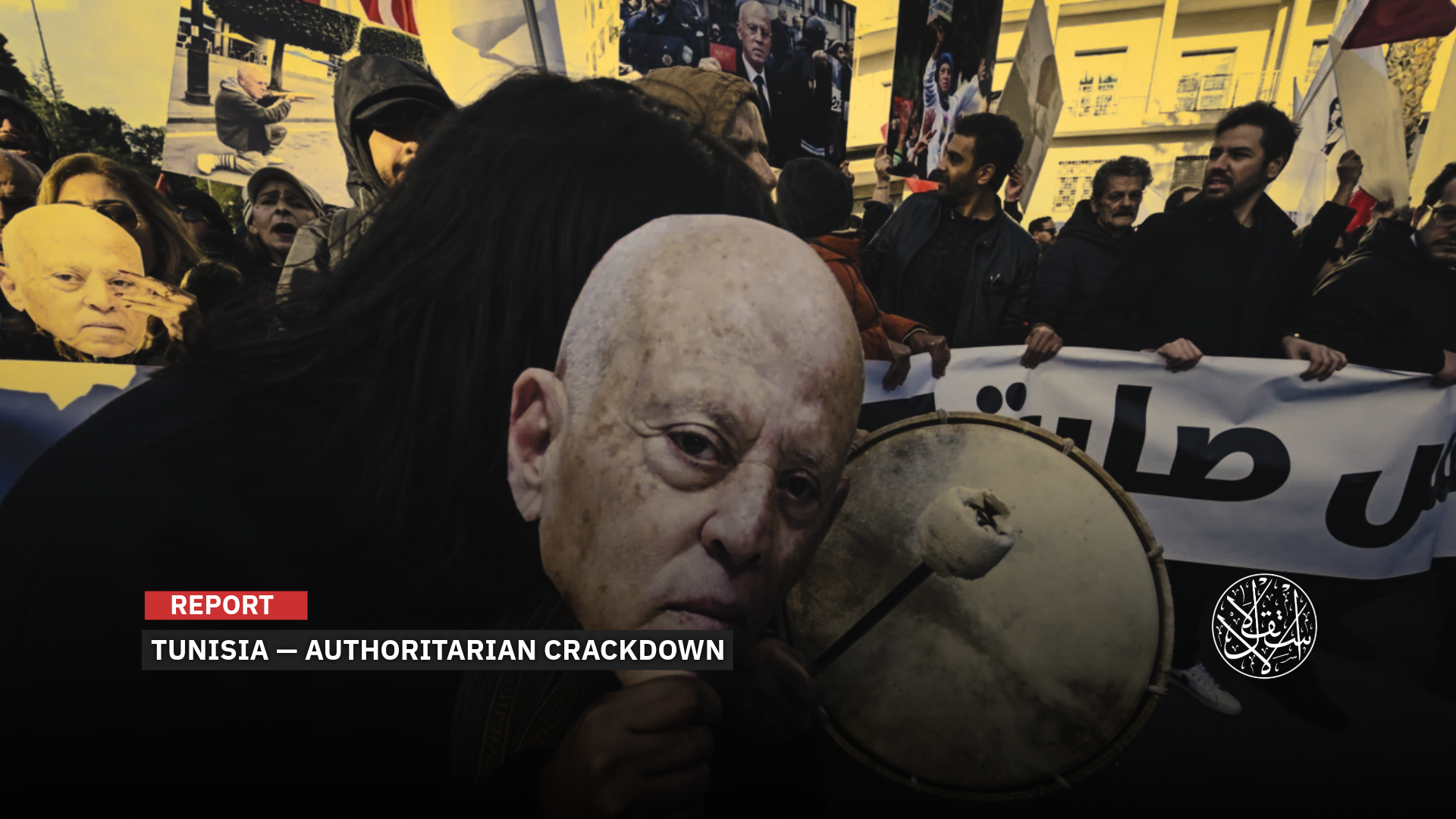
The authoritarian regime has turned Tunisia into one big prison.
As their numbers have surged to unprecedented levels in Tunisia, families of political detainees say they have been left with no option but to form a unified coordination body to demand the release of their relatives.
The move coincided with the anniversary of the 2011 Jasmine Revolution, which toppled the regime of former President Zine el Abidine Ben Ali, a moment that once symbolized hope for political freedom.
On January 14, 2026, the establishment of the National Coordination for the Liberation of Political Prisoners was announced. The body brings together political parties, civil society organizations, and the families of those held on political grounds.
The Coordination group says it aims to defend all prisoners facing political prosecution, whether they come from opposition movements, civil or trade union activism, journalism, or the wider public, positioning itself as a collective response to what families describe as an expanding campaign of detention.
Targeting of Opponents
Speaking at a news conference in the capital, Tunis, the founders of the coordination said, “In the face of a repression machine that spares no one, the need has become more urgent than ever to intensify and unify efforts to defend the release of political prisoners, including prisoners of civil activism and opinion.”
They pointed to what they described as “the entrenchment of an authoritarian system that has turned the country into a large prison, driven by an authority that sees conspiracy as the explanation for the country’s problems and imprisonment as the solution.”
The coordination said “the battle for the release of prisoners cannot be reduced to the legal, judicial aspect alone,” citing the absence of even the most basic guarantees of a fair trial.
The coordination said the battle for the release of prisoners cannot be waged solely before national public opinion, nor can the public space be reclaimed from attempts to confiscate it, without organizing joint action to confront the authoritarianism of those in power.
It said the issue of political detainees in Tunisia is a single collective cause, requiring the intensification, pooling, and development of efforts aimed at securing the release of detainees held in prisons following political trials that lack even the minimum guarantees of a fair trial, foremost among them the independence of the judiciary.
The formation of the coordination comes at a time when numerous politicians and human rights activists from across Tunisia’s ideological and political spectrum remain behind bars, facing a range of charges, most notably “conspiring against state security.”
Under President Kais Saied, Tunisia has seen a steady rise in prosecutions and the issuance of what critics describe as heavy prison sentences against a wide range of opponents.
Heavy sentences were handed down against a number of political figures, including Ennahda Movement leader Rached Ghannouchi, National Salvation Front head Ahmed Nejib Chebbi, former minister and secretary-general of the Democratic Current Party Ghazi Chaouachi, former Ennahda leader Abdelhamid Jelassi, and former minister Ayachi Hammami.
The authorities maintain that “the defendants are being tried on criminal charges and that the state does not interfere in the work of the judiciary,” while the opposition argues that these are political trials in which the courts are used to pursue those rejecting Saied’s coup measures.
On July 25, 2021, Saied began imposing what critics described as coup measures, including dissolving parliament, ruling by presidential decrees, adopting a new constitution and holding early legislative elections.

Shared Ordeal
Karim Marzouki, the defense lawyer for detainees in multiple cases, said the National Coordination for the Release of Political Detainees is founded on the principle of a shared human rights ordeal, which requires a united response.
In a Facebook post on January 14, Marzouki added that the coordination is based on the essential recognition that the issue of political detainees in Tunisia is a single collective cause.
He emphasized that this dimension requires intensifying, pooling, and developing efforts with the goal of securing the release of detainees held in prisons following political trials that lack even the most basic guarantees of a fair trial, foremost among them judicial independence.
Marzouki also stressed that the coordination brings together all detainees, their families, and support committees without exception, regardless of political affiliation, ideology, or the nature of the cases against them.
“Encouraging joint action now is the ceiling set by the framework of the coordination, and it represents the minimum moral duty toward detainees inside the prisons. Each of us, from our own position, remains called upon to overcome the ordeal as much as possible, in a lawful and effective way,” Marzouki said.
Political Stances
In response, a series of statements from opposition parties highlighted the depth of Tunisia’s crisis over rights and freedoms, calling for the release of political detainees and an end to political trials.
In this context, the Ennahda Movement said in a statement on January 14, “All political detainees must be released, and the unjust political trials must be stopped.”
The party also demanded “an end to restrictions on political parties and civil society organizations, a halt to the choking of freedoms, the trampling of rights, and the undermining of the gains achieved by our people thanks to our glorious revolution.”
Ennahda affirmed “its commitment to peaceful, civil, and lawful struggle to restore the democratic path and to save the country from the deterioration it has reached in all areas of national life.”
The party also called on “all political forces and civil society actors to coordinate, unite, and pool efforts to restore democracy and preserve the spirit of the revolution and its values of freedom, dignity, and social justice, despite the risks of backsliding and the erasure attempts carried out by the coup.”
Ennahda renewed its call for “an inclusive national dialogue among all democratic forces committed to the democratic path, in order to save Tunisia through a participatory national program that addresses the political, economic, and social issues at hand.”
The Republican Party said Tunisia is living under the weight of the July 25 system, which it says has reproduced authoritarianism and embarked on a systematic dismantling of public and individual freedoms.
In a statement on January 14, the party added that the Saied regime “has turned the judiciary into a tool of repression and revenge against opposition politicians, journalists, and opinion detainees, in a blatant assault on the gains of the revolution and the foundations of the rule of law.”
It stressed that “freedom is indivisible and non-negotiable, and any temporary release or isolated measure cannot hide the reality of hundreds of political prisoners and opinion detainees languishing in prisons, victims of arbitrary detention, prolonged pretrial detention, and politically motivated trials, in flagrant violation of laws and international conventions, and a clear breach of the demands of the revolution of freedom and dignity.”
The party held the current ruling system fully responsible “for this dangerous descent, for criminalizing political, civil, and journalistic activity, for undermining judicial independence, and for turning the judiciary into a tool of political elimination.”
The statement concluded that “the struggle for freedom, social justice, and national dignity will continue until the system of repression is overthrown, the rule of law and institutions are established, and the goals of the revolution are fully achieved.”
Khalil Zaouia, secretary-general of the Democratic Forum for Labour and Freedoms, said Tunisia has entered a critical historical turning point, in which the doors to openness and freedoms are gradually closing.
According to the Tunisian news site Babnet on January 14, 2026, Zaouia said the country is experiencing a siege on freedoms, the press, and political trials, while facing harsh and heavy judicial rulings that target political and civil activists.
“We are also going through an unbearable social and economic situation, with the high cost of living, shrinking job markets, and limited opportunities, which has driven young people away from public affairs and fueled their desire to emigrate, especially educated youth, the backbone of the state, including engineers and doctors, seeking a dignified life that secures their future,” he continued.
Zaouia emphasized that “hope remains in restoring the democratic path and the rule of law and institutions, a state that separates powers and empowers the judiciary to be independent and effective, reassuring citizens about their rights.”
He expressed his hope that this discourse will change, and that in the coming year the country will enter a transitional phase worthy of the revolution’s martyrs and that will restore Tunisia’s image abroad.
Grave Missteps
In his political reading of Tunisia’s broader context, Ziad al-Hashimi, spokesperson for the Dignity Coalition, said the country is witnessing a serious departure from the ideals of freedom, dignity, and justice that the 2011 revolution championed.
Al-Hashimi told Al-Estiklal that “injustice under the rule of the coup president, Kais Saied, no longer distinguishes between citizens and has become a systematic policy that affects everyone without exception, including the growing political imprisonment of opposition figures and activists.”
The party official added that “repression under the current president’s rule is no longer limited to a single group or movement, but has become a sword over every free voice, while economic and social crises intensify the suffering of the people.”
Regarding the path forward, al-Hashimi said, “The fundamental solution lies in a courageous self-examination by all national components and recognition that the nation can only be built on shared values.”
“It also requires establishing a system that guarantees every individual full rights and responsibilities, free from domination, revenge, exclusion, or the fueling of division,” he added.
Al-Hashimi called on all forces to “reject all forms of authoritarianism and monopolization of power, whatever the justification, and to move beyond narrow calculations toward a unifying project that ensures freedom, dignity, and justice for all Tunisians.”
He concluded by urging “dialogue between political and civil components of the nation to find a way out of a crisis that cannot tolerate neutrality,” noting that the issue of political detainees in Tunisia “is a negative manifestation of this crisis that calls for forces to unite to make it a thing of the past.”