From Partnership to Clash: How the Algerian Presidency and MSP Party Spiraled Into Open Conflict
“The authorities want tailor-made parties.”
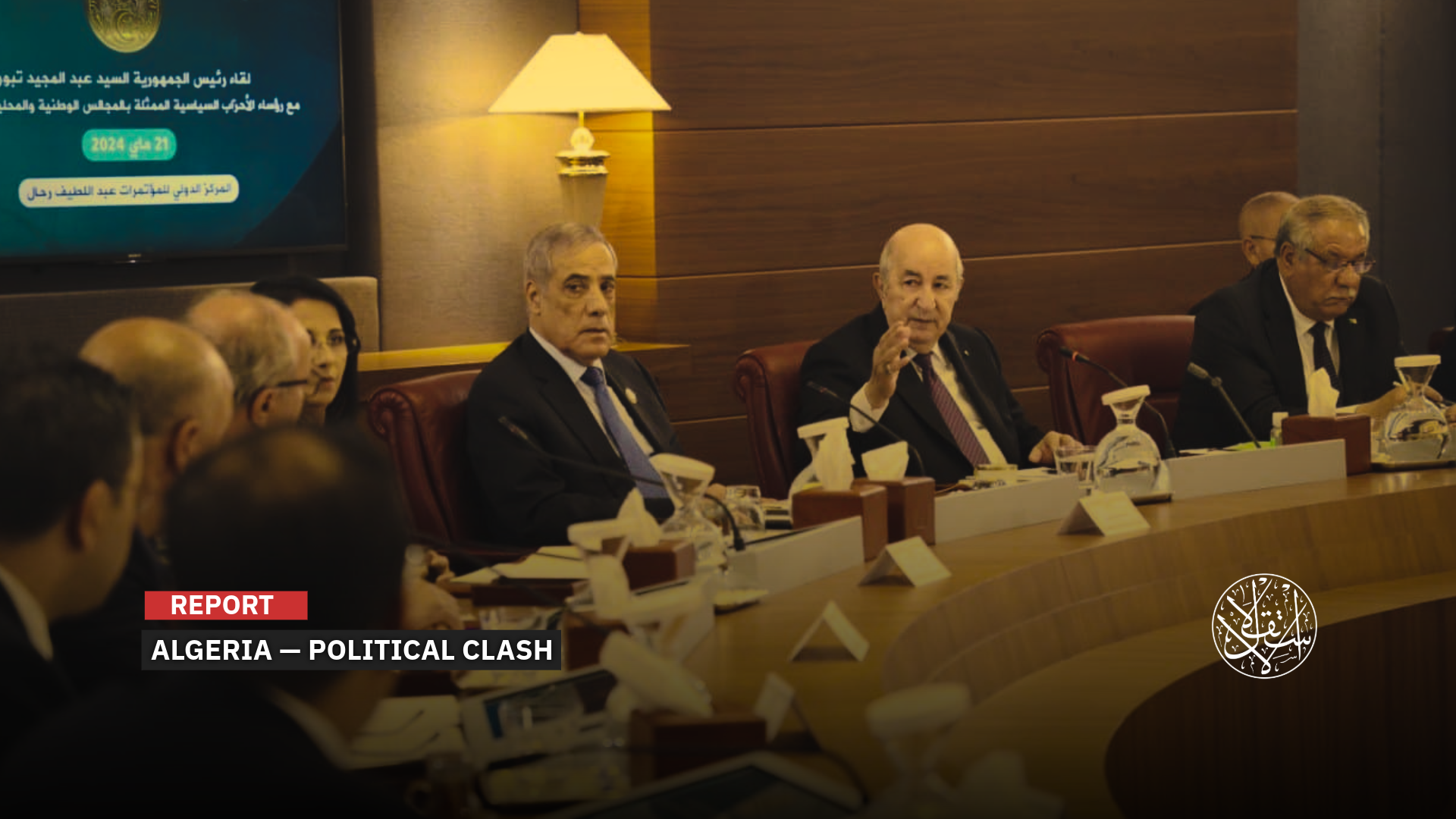
The Algerian presidency has launched a scathing verbal attack on the country’s leading Islamist party, sparking questions about the motives behind the criticism and its ties to the municipal and parliamentary elections set for mid-2026.
The presidency’s criticism of the Movement of Society for Peace (MSP) was delivered through the state news agency, carefully avoiding a direct mention of the party while signaling its target clearly.

Repeated Targeting
On January 7, 2026, Algeria Press Service (APS) accused MSP of “exploiting the anger of transport workers over a proposed traffic law in an opportunistic and irresponsible manner, revealing a predatory political logic that feeds on social imbalance rather than addressing it.”
The APS added that “with the upcoming parliamentary elections, a political party has once again positioned itself as the sole guardian of patriotism, distributing certificates of national loyalty through a crude and disruptive display that reflects political deceit.”
The report referenced the Islamist party’s stance, and that of its deputies, on the ongoing strike in the public transport and freight sectors, which began on January 1 over fuel price hikes and strict measures in the new traffic law, now under review by the upper house of parliament.
It went on to level serious accusations against the party, which holds 65 seats in parliament, claiming it “feeds on a culture of chaos, division, and obscurantism” and maintains “a relentless campaign against the government.”
The APS further alleged that the party “seeks to ignite every front, exploiting social grievances; it fans the flames using aimless, opportunistic opposition, driven solely by electoral calculation rather than coherent policy.”
This marks the second time Algeria’s presidency has attacked the MSP through the APS. The first came in late November 2025, when the Algerian official agency accused the party of “violating the constitution and showing bias against the president by interfering in foreign policy.”
Those November accusations followed MSP’s criticism of Algeria’s vote on the U.S. decision on Gaza at the UN Security Council.
The MSP, one of Algeria’s largest Islamist parties historically linked to the Muslim Brotherhood, has built a reputation for political moderation, siding with the state during security crises and defending the republican system.
The party has a long history of participation in government, serving between 1994 and 2012, before transitioning to a moderate opposition role. Its leader, Abdelali Hassani, ran in the September 2024 presidential election, finishing second to President Abdelmadjid Tebboune, who has met with Hassani on multiple occasions, most recently in July 2025.
Proactive Response
The latest report from the APS came a day after a statement from the MSP, signed by Hassani on January 6, 2026. The party said it was “following with deep concern and national responsibility the developments in the country’s social situation, particularly in light of the proposed traffic law amendments and sudden fuel price hikes, which have sparked strikes and protests in the transport and shipping sectors.”
The statement emphasized that these developments occur amid “a delicate economic and social context, marked by growing social and livelihood pressures that demand balanced and thoughtful approaches to issues directly affecting citizens’ daily lives. Solutions should rely on social dialogue to resolve disputes, overcome difficulties, and account for the complexities of the current situation.”
Hassani stressed that “social stability is a collective responsibility, and such challenges cannot be addressed through unilateral or purely administrative measures. They require a comprehensive approach based on dialogue, mutual listening, gradual reform, and public policies rooted in social justice and the realities of everyday life.”
The statement also emphasized “the importance of preserving stability and maintaining public calm, exercising wisdom, and denying provocateurs and agitators the chance to hijack serious national debate through demonization, accusations of disloyalty, and provocation.”
The party called for “the launch of a serious, responsible, and inclusive national dialogue with genuine political, economic, and social partners on priority political and economic reforms, and a review of proposed laws that directly affect citizens.”
It further urged “public efforts to address the root causes of social unrest, focusing on improving income, regulating prices, and restoring trust in public policy.”
Widespread Reactions
The APS’s report sparked significant reactions across Algeria’s social media landscape. Economist Ahmed Salami criticized the agency, saying it had strayed from its role and become a partisan actor, attacking parties and their statements.
In a Facebook post on January 8, Salami described the APS’s actions as “a clear departure from the purpose for which it was established.” He added that it was “a dangerous signal of shrinking freedoms and narrowing political pluralism, marking the start of public media being used to shape opinion rather than serve it.”
Salami argued that when the official media shuts out political parties, politics is hollowed out and the public is denied credible, independent information.
Amid the controversy, University of Algiers professor Belkheir Tahri said that “Algeria Press Service has effectively become a political party awaiting endorsement.”
In a Facebook post on January 9, 2026, he added, “The APS now serves as a mouthpiece for polishing the establishment’s image, attacking any party that refuses to fall in line.”
Algerian writer Alyzid Qnyfy said the APS’s attack on the MSP comes as parliamentary elections approach.
In a Facebook post on January 9, 2026, Qnyfy said the criticism could be read in several ways, most notably as a political effort to blunt the opposition’s influence.
“The party is being portrayed as exploiting social tensions solely for electoral gain, placing it in a negative light with news readers and voters alike,” he added.
Therefore, Qnyfy argued that the media attack on the news agency was not random, but part of a tense pre-election political context aimed at curbing Hamas as an opposition party ahead of the upcoming vote.
The writer also noted that the APS has a specific and clearly defined role within the media system and that it should adhere strictly to that mandate.
Meanwhile, political activist Faisal Sultan argued that the APS’s attack on the MSP at this level is unprecedented, suggesting that the party has successfully provoked the ruling system. “It pushed the government to use state television to respond to the party, giving it a prominence it could hardly have imagined, as if it were a strong electoral rival,” he said.
In a Facebook post on January 7, Sultan argued that the reasons behind the attack could be threefold: “Either the ruling authority has lost popularity, or the MSP is genuinely strong and influential, or the media is complicit in portraying the party as an emerging power, highlighting the presidency’s weakness and fear.”
A Political Reading
Amid these developments, Algerian writer and human rights advocate Anouar Malek argued that a news agency attacking a political party is neither rational nor acceptable, because the agency’s role is to report news, not to target any party for its political stance.
Malek told Al-Estiklal that the party had done nothing more than voice a political stance, something entirely legitimate and routine in any democratic system.
“But unfortunately,” he said, “Algeria Press Service’s dispatch shows that the authorities want tailor-made parties and have no interest in allowing any party to express its positions freely.”
“The APS’s statement also confirms an unprecedented drought in the political arena: parties respond to each other, but for a news agency to issue what is essentially an intelligence-style bulletin is a clear signal that the authorities have crushed all forms of political expression.”
“There is no longer a functioning party or political map,” Malek added.
The Algerian writer described the country as “effectively a military barracks, where the army dominates every decision.”
“Military dominance has reduced the media to a mouthpiece, hollowed out political pluralism, and left anyone who strays from the official line branded a traitor or terrorist or targeted through anonymous attacks in the state news agency.”
“Algeria has never before sunk to this level of authoritarianism,” Malek said.
“The authorities’ fear of the street and their failure to find solutions have led them to stumble to this point, attacking parties through anonymous intelligence-style dispatches from a news agency that should report the facts, not target politicians, opposition figures, and parties.”