Controlling the Narrative: Why ‘Israel’ Keeps Gaza Confined to 2G Telecommunications
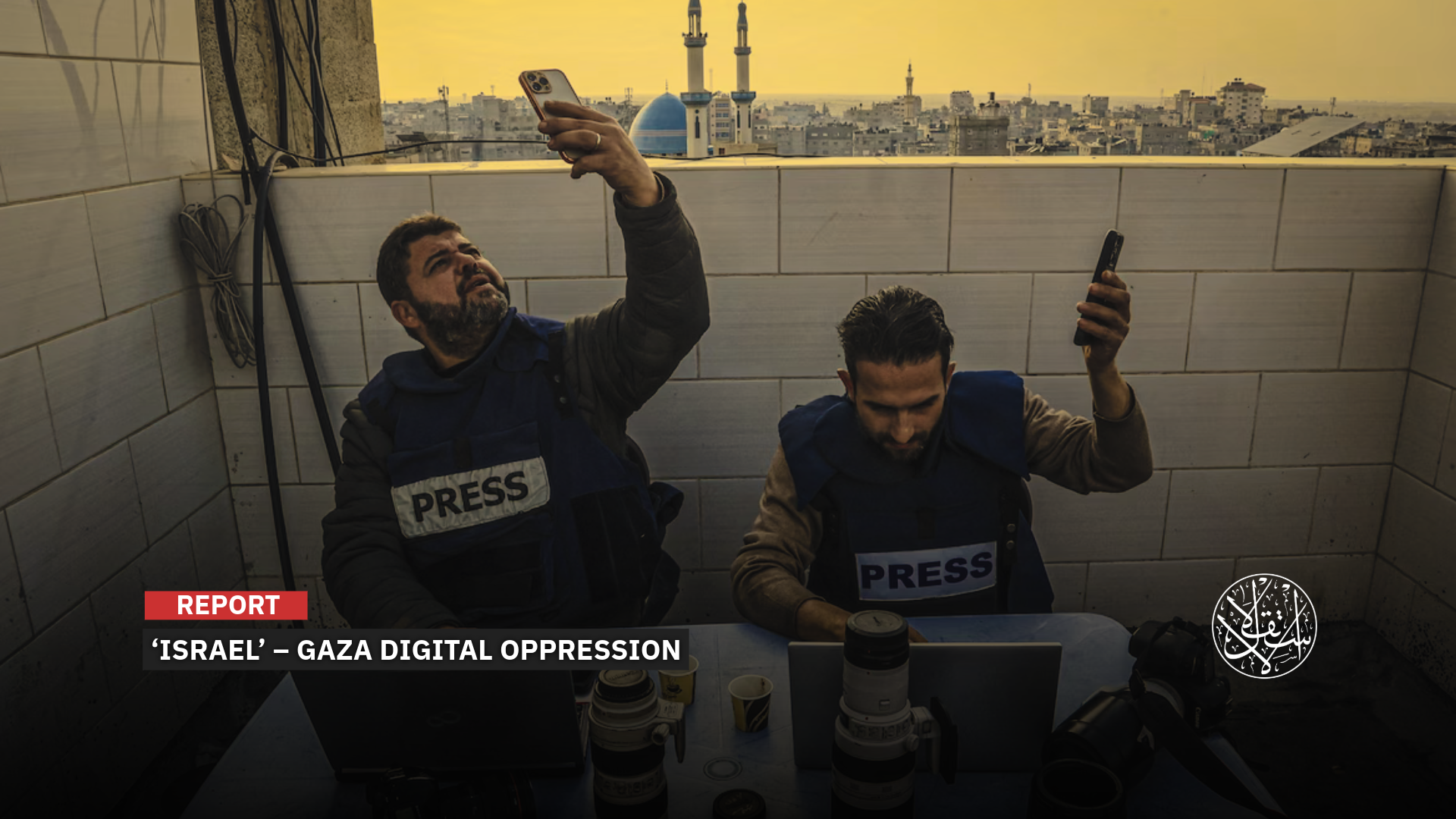
Depriving Gaza of technological development is a collective punishment to isolate the population.
In a move that could widen the digital divide, “Israel’s” Ministry of Communications approved on January 6, 2025, the rollout of 4G mobile services in Palestinian networks in the West Bank, excluding the Gaza Strip.
The decision follows an agreement reached in 2022 between “Israel” and the Palestinian Authority to enable the use of 4G and 5G technologies, though its implementation had previously been delayed due to the Gaza conflict and the resulting tensions.
The agreements were signed between Palestinian mobile operators, including Jawwal and Ooredoo, and Israeli and international companies such as Ericsson, marking the beginning of the transition to fourth-generation technology in the West Bank, a process expected to take four to six months.

Digital Divide
The decision to allow 4G in the West Bank highlights the stark technological divide, as the region only gained access to 3G services in 2018 after a prolonged Israeli ban prevented the technology from operating locally.
Since then, 3G represented the first relatively acceptable mobile internet experience for Palestinians in the West Bank, slightly narrowing the technological gap with “Israel.”
Now, with the transition to 4G, service levels in the West Bank are approaching modern global standards, particularly given that “Israel” itself moved to 4G back in 2013 and has recently begun building ultra-fast 5G networks within the occupied territories.
By contrast, residents of Gaza remain trapped in a primitive communications era, with mobile service limited to outdated 2G networks.
2G networks only support voice calls and short text messages, with near-negligible data transfer speeds of 9.6 kilobits per second.
At such slow speeds, using modern internet applications or sharing video and images via mobile networks in Gaza is virtually impossible.
Remarkably, “Israel” has itself begun phasing out older 2G and 3G networks within its territory, requiring users to have devices that support 4G or higher.
This means that the only technology currently available to Gaza’s residents is considered obsolete by “Israel,” which is actively seeking to eliminate it.
The consequences go beyond internet speed, affecting Palestinians’ access to information and modern digital services, entrenching a reality of technological deprivation in Gaza compared with relative progress in the West Bank.
Palestinians view Gaza’s exclusion from technological advancement as a form of collective punishment, keeping a population trapped for more than fifteen years, isolated and economically and informationally constrained.
“Israel” only finally moved on the 4G file when it directly served its own interests, coinciding with its closure of the old 3G networks still used by Palestinians.
Economic Monopoly
This technological divide also reflects “Israel’s” deep control over the telecommunications sector in the Occupied Palestinian Territories.
For decades, “Israel” has maintained both security and technical authority over frequency spectrums and communication networks in the West Bank and Gaza.
Any development or upgrade of Palestinian networks, such as the introduction of 3G in the past or 4G today, requires prior Israeli approval, due to “Israel’s” monopoly over frequency resources and coordination.
This control has delayed Palestinian access to modern technology for many years. Furthermore, Israeli telecom companies exploit this dominance by infiltrating the Palestinian market itself.
Israeli mobile providers operate within settlements, but the coverage of their towers extends over wide areas of West Bank towns and cities.
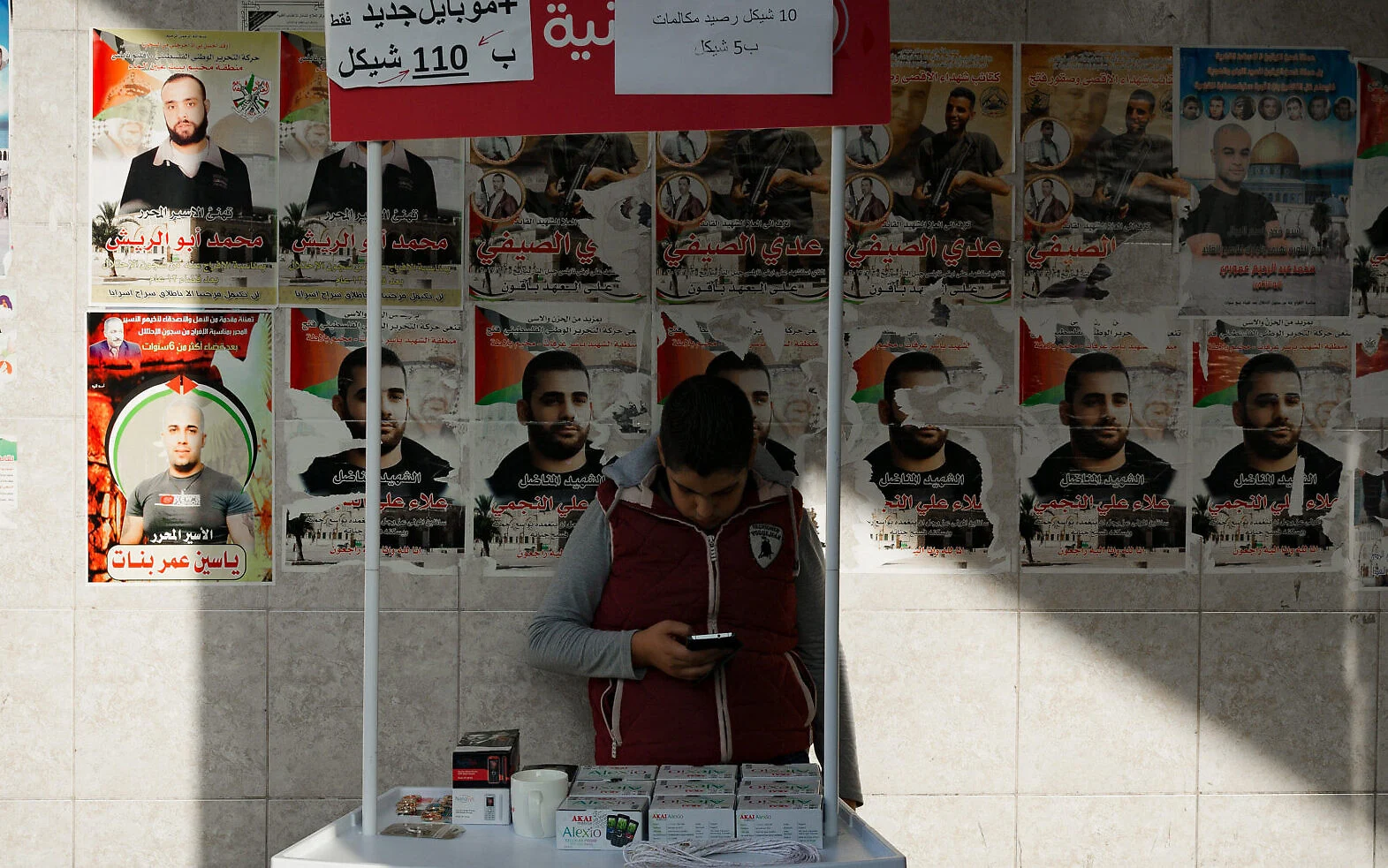
As a result, many Palestinians use Israeli SIM cards instead of their local operators, often because they offer faster service and lower costs.
This uneven competition allowed Israeli companies to capture roughly 30 percent of the Palestinian mobile market between 2013 and 2015.
It also caused substantial economic losses, estimated by the World Bank at between $436 million and $1.5 billion during the same period.
Simply put, the advantages in service quality and price favor Israeli providers, who have access to the latest technology, while Palestinian operators struggle under technical restrictions and weak infrastructure, in a clear monopolistic dynamic.
Economic motives to preserve Israeli companies’ dominance and prevent revenue from flowing to independent Palestinian infrastructure are among the reasons “Israel” has deliberately delayed lifting technical restrictions.
Under the Oslo Agreement of 1993 and the Paris Protocol of 1994, “Tel Aviv” controls the Palestinian telecommunications sector, including lines and cables linking the West Bank and Gaza to “Israel,” as well as international cables.
Cybersecurity Control
“Israel’s” control over the telecommunications sector extends far beyond technical and economic aspects, reaching into two additional dimensions: the flow of information and the political-security sphere.
Those who hold the keys to networks and the ability to operate or shut them down implicitly control the Palestinian population’s access to information and can isolate the territories from the outside world.
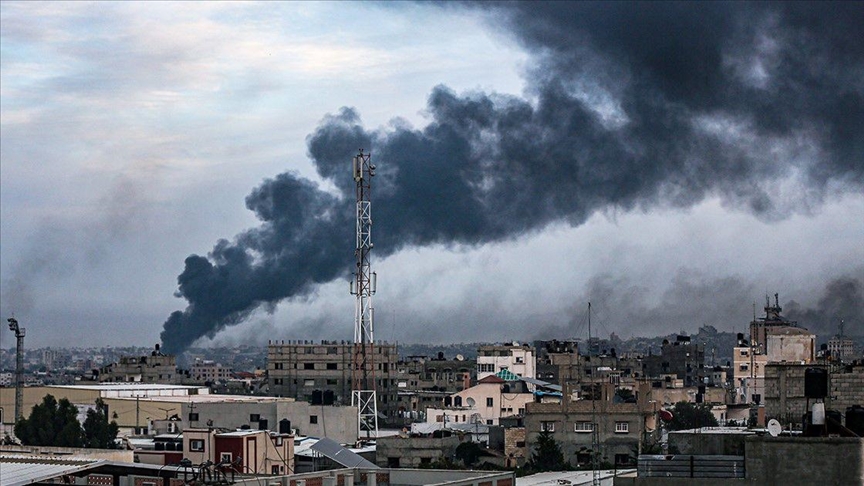
According to Gazan journalist Yasser Mohammed, this control “became starkly evident during the most recent Israeli war on Gaza (2023–2025), when the communications infrastructure was subjected to intensive bombing and total outages.”
He told Al-Estiklal, “On October 27, 2023, Gaza experienced a complete shutdown of internet and communications services for the first time after the targeting of communication networks and the loss of electricity and fuel.”
“More than two million people in Gaza suddenly found themselves entirely isolated from one another and the outside world, unable to request help or even follow what was happening around them.”
“This blackout, repeated several times over the two years of the assault, paralyzed relief and emergency efforts, while journalists and human rights defenders were unable to document violations due to the difficulty of communication or broadcasting live footage from the ground,” he added.
This painful experience demonstrated that “Israel’s” control of the telecommunications sector has become a strategic tool not only for economic pressure but also to dominate the narrative and prevent Palestinian voices from being heard during crises.
Human Rights Watch has warned that deliberately cutting internet and communications during wartime provides cover for atrocities and fosters a climate of impunity, as the digital blackout hides evidence and live reporting, allowing serious violations to occur out of sight of the world.
The second dimension is purely political and security-related. “Israel” ties any advanced technological development in Gaza to a coordination framework, which is absent in the Hamas-run Strip, unlike the West Bank under President Mahmoud Abbas, which cooperates and coordinates security-wise with the occupation.
The other publicly stated rationale is purely security-based, as “Israel” claims that granting advanced communication technologies to Gaza could enhance the ability of armed factions to coordinate, plan, and carry out attacks, according to a study published by Mais Qandeel, Senior Lecturer in International Law at Orebro University, Sweden.
Israeli officials openly stated during the war that cutting internet access in Gaza aimed to prevent Hamas from using it in its communications.
“Israel” regards some advanced communications equipment as “dual-use” materials that could be exploited for military purposes, such as controlling drones or electronic jamming, and has therefore included the denial of modern network equipment as part of its 18-year-long blockade policy on Gaza, according to the study.
Sources
- Israel approves upgrade to 4G mobile services to Palestinians in West Bank
- Israel grants 4G access to Palestinian West Bank cell companies after war delay
- Internet in Gaza: Limited even before war
- Israel/OPT: Civilians in Gaza at unprecedented risk as Israel imposes communication black-out during bombardment and expanding ground attacks
- Under a communication blackout, Gaza’s 2.3 million people are cut off from each other and the world
- Communication Blackouts: Israeli Cyberattacks Against Civilians in Gaza