Is Tunisia’s Official Support for Palestine Starting to Crack? Albanese Row Lifts the Lid
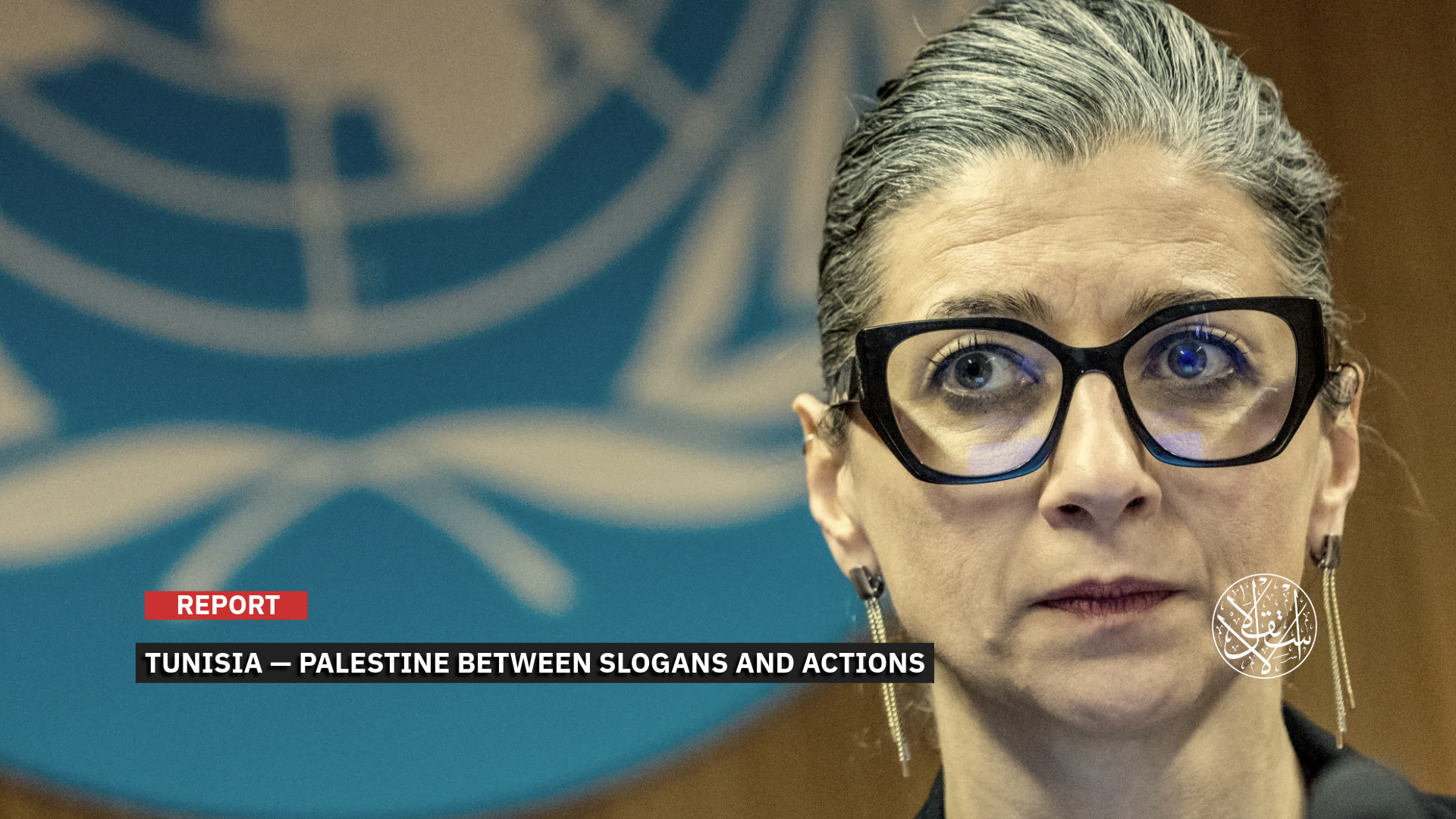
Albanese has previously said she and her family in Tunisia were subjected to pressure and personal threats.
Head of the Tunisian regime Kais Saied has found himself caught in a stark contradiction over Palestine: publicly championing the Palestinian cause while taking actions that constrain some of its most outspoken defenders.
The latest example came with Francesca Albanese, the UN special rapporteur on the occupied Palestinian territories, being barred from entering Tunisia for a second time. Albanese had been scheduled to visit the Faculty of Law, Economics, and Management in Jendouba, northwestern Tunisia, in June 2026.
Albanese has previously revealed that she faced pressure and personal threats targeting her family in Tunisia, including threats to kidnap her daughter.
The threats came amid an international campaign against the UN expert over reports in which she accused the Israeli Occupation of committing war crimes and genocide.
The backlash followed Albanese’s increasingly prominent advocacy for Palestinian rights, particularly in Gaza.
In March 2024, she presented a report to the UN Human Rights Council titled Anatomy of a Genocide, examining the legal definition of genocide and detailing evidence that Israeli violations—including attacks on civilians, the blockade, and the deliberate use of starvation—could meet that threshold.
The report concluded that there were reasonable grounds to believe “Israel” had committed genocide in Gaza. It called for the case to be referred to the International Criminal Court (ICC), for sanctions against Israeli Occupation officials, and for urgent action to end the blockade of the Gaza Strip.

Rights Groups Condemn Ban
The decision drew swift condemnation from Tunisian human rights organizations and political figures, including the Tunisian League of Human Rights (LTDH), which denounced the authorities’ cancellation of Albanese’s visit.
In a statement issued on June 15, 2026, the LTDH said Tunisian authorities had canceled Albanese’s planned visit twice—first at the end of April and again in June—without offering a clear or transparent explanation to the academic community or the public.
The organization said preventing students and civil society in Jendouba from hosting Albanese represented a missed opportunity and a real loss for the city’s academic, cultural, and human rights life.
It reaffirmed its commitment to the independence of universities and their role as spaces for scientific research, intellectual debate, and human rights advocacy, while urging the authorities to explain the decision and uphold the region’s right to benefit from international academic and rights initiatives.
The LTDH warned that repeatedly canceling the visit, despite efforts by partner organizations to make it happen, raised serious questions about Tunisia’s commitment to protecting freedom of thought, free expression, and open academic debate.
It added that such decisions damage the reputation of Tunisian universities as places of knowledge, dialogue, and the free exchange of ideas.
Political Questions
Tunisian journalist Saleh al-Azraq, a presenter on Alhiwar TV, questioned whether the decision had been driven by external pressure or an effective veto from outside Tunisia.
Al-Azraq noted that Albanese has drawn the anger of both pro-Israeli zionists and the U.S. administration, asking whether the Tunisian regime had blocked her visit to avoid friction with either.
He also pointed to Kais Saied’s repeated declarations that normalization with “Israel” amounts to “high treason,” arguing that if the slogan reflected genuine policy, Albanese should have been welcomed with a red carpet and allowed to meet freely with anyone in Tunisia, especially university students.
“Unless,” he added, “what the Tunisian authorities—and Kais Saied above all—have been saying is nothing more than empty political slogans.”
A Growing Political Backlash
Political analyst Nasr al-Din Souilmi argued that Albanese's advocacy for Palestine was the main reason behind the decision to prevent her from carrying out activities in Tunisia.
Speaking to Al-Estiklal, Souilmi said Albanese’s work is focused primarily on the Palestinian cause, not on authoritarian regimes or human rights conditions in Arab countries, arguing that her position on Palestine is what has made her a target of restrictions.
He described what he called a political contradiction: the Palestinian cause and resistance were central themes of Kais Saied’s election campaign, yet, he said, Saied later refrained from supporting it in international forums, avoided meeting prominent Palestinian advocates, and blocked activities linked to the very cause he had used as a political slogan.
Souilmi also pointed to what he called another contradiction: while Albanese, a prominent international rights figure, was prevented from visiting Jendouba University, Tunisian authorities approved the participation of “a controversial Lebanese singer” in the lineup of summer 2026 festivals.
He concluded that the current authorities were acting in the opposite way to their stated positions—restricting activists and those involved in breaking the Gaza blockade while allowing large sums of foreign currency to be spent on short-lived entertainment events.
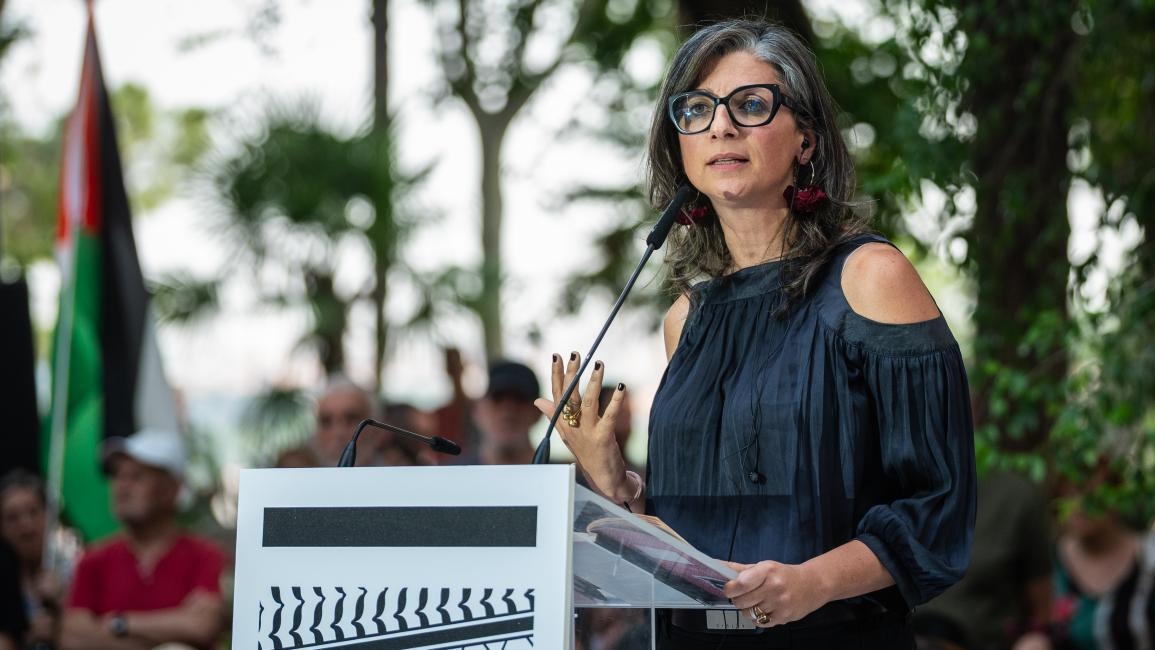
Francesca Albanese
Francesca Albanese, United Nations Special Rapporteur on the Occupied Palestinian Territories, has become one of the most controversial international figures in “the Israeli-Palestinian conflict,” driven by her outspoken positions and repeated reports accusing “Israel” of serious violations of international law.
Since the outbreak of the war on Gaza in October 2023, Albanese has emerged as a prominent voice on the global stage, arguing that “Israel’s” crimes in the territory go beyond “conventional military operations” and amount to war crimes, crimes against humanity, and acts that could fall under the legal definition of genocide.
Her March 2024 report, “Anatomy of a Genocide,” triggered widespread reactions inside and outside the United Nations. The report concluded that there were reasonable grounds to believe “Israel” had committed “acts” that constitute genocide in Gaza, calling for accountability, referrals to the ICC, and measures against those responsible.
The findings sparked anger from the Israeli Occupation government and its allies, who launched political and media campaigns demanding her removal and accusing her of bias against “Israel” and exceeding the mandate of her UN role.
The United States also targeted Albanese. In 2025, the administration of President Donald Trump imposed sanctions on her, a move human rights organizations described as an attempt to punish a UN official for criticizing “Israel’s” conduct during the aggression on Gaza.
Albanese has rejected the accusations and continued issuing reports, arguing that the sanctions represent part of a broader effort to weaken international accountability mechanisms and prevent legal action over violations against Palestinians.
At the same time, she has received growing support from international rights groups and European political figures. In May 2026, Spanish Prime Minister Pedro Sanchez awarded her the Civil Merit Order, recognizing her efforts to document Israeli violations of international law in Gaza.
A separate boost came from a U.S. federal court ruling in May 2026 that temporarily blocked the sanctions against her. The judge found that the measures likely violated her right to free expression by targeting her after she criticized “Israel’s” war on Gaza.
The legal and political battles surrounding Albanese have transformed her into a symbol of a wider struggle over international justice: between those demanding accountability for “Israel” over its genocide in Gaza and those opposing efforts to pursue legal action against the Israeli Occupation. That broader confrontation helps explain the controversy surrounding her planned activities and visits, including in Tunisia.
Court Ruling
Albanese has faced mounting pressure in recent years. In February 2025, Trump signed an executive order authorizing sanctions against senior officials and employees of the ICC after the court issued arrest warrants for Israeli Prime Minister Benjamin Netanyahu and former War Minister Yoav Gallant.
In July 2025, Washington imposed sanctions directly on Albanese, who had documented Israeli crimes in Gaza and called for accountability. She described the measures as part of a wider U.S. strategy aimed at undermining international justice institutions.
In response, Albanese’s husband and her daughter, a U.S. citizen, filed a lawsuit against the Trump administration in February 2026, arguing that the sanctions had effectively blocked her access to banking services and made daily life extremely difficult.
On May 13, 2026, U.S. federal judge Richard Leon in Washington temporarily suspended the sanctions, ruling that the administration had likely infringed on Albanese’s First Amendment rights by restricting her speech because of the views she expressed.
The judge also found that Albanese’s residence outside the United States did not remove the constitutional protections available to her, arguing that the U.S. administration sanctions appeared aimed at limiting her expression because of “the idea or message” she promoted.
Meanwhile, Sanchez urged the European Commission to activate its so-called “blocking statute” to shield Albanese and protect the independence of judges and prosecutors involved in international investigations.
Despite the sanctions and political pressure, Albanese has continued publishing critical reports on “Israel’s” violations. Her latest report accused more than 60 global companies—including major arms and technology firms—of contributing to Israeli crimes in Gaza and settlement activity in the occupied West Bank.
Official Contradiction
Restrictions targeting Palestinian rights advocates in Tunisia have extended beyond Albanese. Her planned lecture at Jendouba University was also intended to coincide with the 100th day since the detention of several activists linked to the Sumud Flotilla.
The National Committee for the Defense of Sumud Flotilla Activists (NCDSFA) accused Tunisian authorities of continuing to detain activists for their support of the Palestinian cause, describing the charges against them as politically motivated.
In a statement issued on June 14, 2026, the NCDSFA condemned the smear campaigns by figures close to the authorities against the activists, who have remained imprisoned for months along with the suffering faced by their families.
The activists were arrested on March 6, 2026, after Tunisia’s economic and financial judicial authorities ordered an investigation into alleged suspicious financial transfers involving the organization managing the Sumud Flotilla initiative.
Those detained included Nabil Chennoufi, Wael Nawar, Mohamed Amine Bennour, Ghassan el-Boghdiri, Jawaher Channa, and Sana Msahli.
The NCDSFA argued that the continued detention of several Sumud Flotilla leaders exposed the gap between the Tunisian authority’s public support for Palestine and its actual policies, citing the authorities’ refusal to criminalize normalization with “Israel” and their position on regional conflicts.
The NCDSFA blamed the continued detention of Sumud Flotilla activists and the suffering of their families on the current ruling system, accusing it of trying to manage its broader crisis by fabricating charges, including imprisoning Palestinian rights advocates as a form of punishment and to appease Western powers.
It said that incitement, smear campaigns, and public attacks carried out by figures linked to the ruling establishment were nothing more than a failed attempt to politically destroy the flotilla activists.
The NCDSFA called for the detainees’ release, an end to restrictions on those still free, and for them to be allowed to return to their normal lives and jobs.
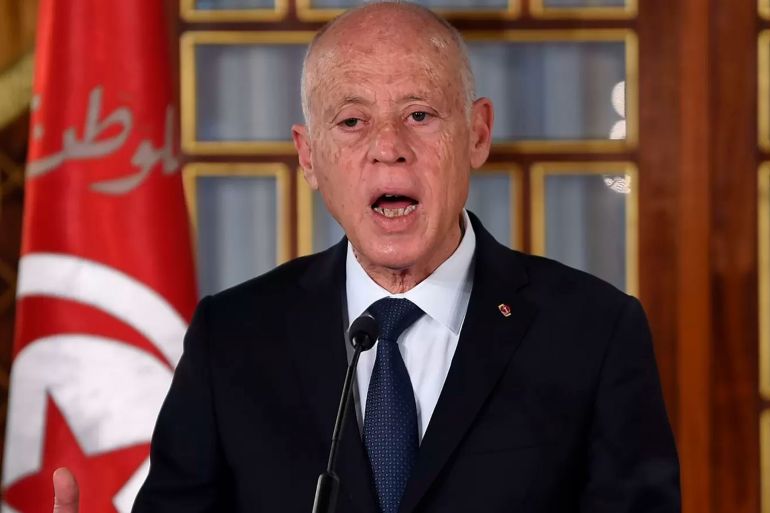
Between Slogans and State Policy
Since taking office at Carthage Palace in 2019, Kais Saied has portrayed himself as one of the Arab world’s strongest defenders of the Palestinian cause. His name became closely associated with the slogan “Normalization is a great betrayal,” a phrase that featured heavily during his presidential campaign and resonated widely among Tunisia’s pro-Palestinian public.
Yet that rhetoric has remained the subject of persistent political and human rights debate, with critics arguing that official statements have not translated into concrete policies or legislation reflecting such a position.
Opponents of the authorities point to several moments they say reveal a gap between Tunisia’s declared support for Palestine and its actual policies, most notably the stalled effort to pass a law criminalizing normalization with the Israeli Occupation and the absence of clear legal or political measures in that direction.
In recent years, political and rights groups have increasingly accused the authorities of exercising caution and, at times, pressure toward grassroots initiatives supporting Palestine, particularly those operating outside official channels.
Critics argue that restricting certain Palestinian solidarity activities contradicts the authorities’ own rhetoric of unwavering support for the Palestinian people.
Some observers believe the Tunisian leadership is attempting to balance its domestic pro-Palestinian messaging with broader diplomatic and strategic calculations, navigating a complicated regional and international environment that limits the room for maneuver.
But critics reject that explanation, arguing that such considerations cannot justify blocking internationally recognized figures known for defending Palestinian rights or restricting activists whose positions largely echo the authority’s own stated stance.
Human rights advocates say the controversy surrounding the decision to block Francesca Albanese’s visit and the continued detention of activists linked to the Global Sumud Flotilla has revived a long-running question in Tunisia: is there a widening gap between political slogans and actual regime practice?
Supporters of Saied, however, argue that Tunisia remains among the Arab countries most committed to the Palestinian cause at both the official and popular levels and that some decisions are driven by sovereignty and security considerations rather than a shift away from Palestine.
Still, the continuing political and rights debate over these cases has kept the question alive inside Tunisia: whether the country’s strong pro-Palestinian rhetoric is being matched by policies that allow broader public action and expression in support of the cause.