Hebron Under Israeli Occupation Control: What Remains of the Oslo Accords?
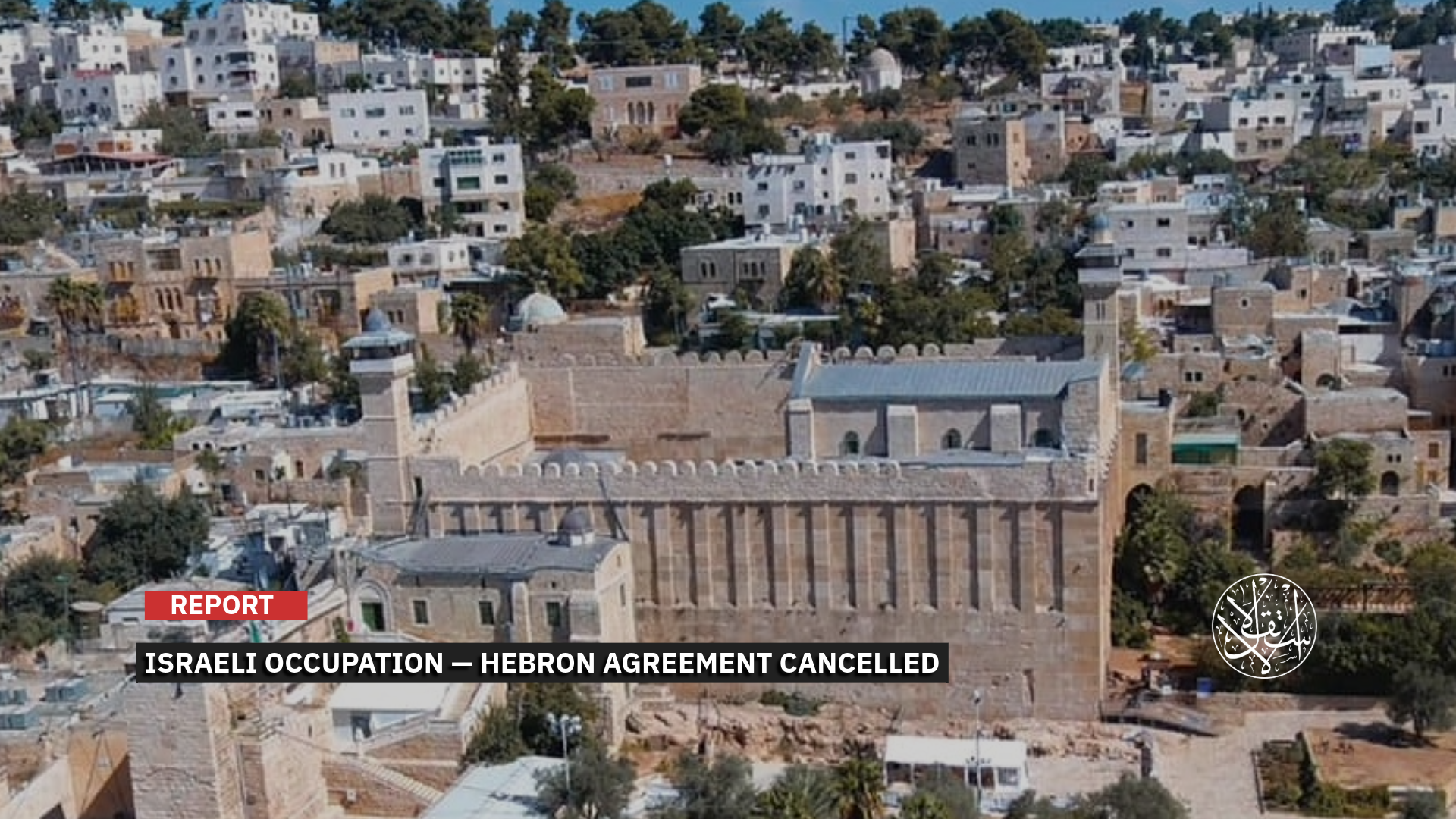
Israeli Finance Minister Bezalel Smotrich announced that the Hebron Agreement had been canceled.
Israeli Minister Bezalel Smotrich holds two key positions in Benjamin Netanyahu’s government. Since December 2022, he has served as the Israeli Occupation’s finance minister.
He also holds the additional post of “minister of defense” in charge of civilian affairs in the occupied West Bank, a role created with broad authority over the territory’s civil administration.
Under his coalition agreement with Netanyahu, Smotrich oversees the Israeli Occupation’s Civil Administration, the management of civilian affairs in the West Bank, coordination of government activities in the occupied Palestinian territories, and planning and construction matters related to settlements.
As leader of the Religious Zionist Party, a member of Netanyahu’s ruling coalition, Smotrich is widely seen as more than just a finance minister. He is one of the most influential figures shaping settlement policy and the future of the West Bank.
That is why statements by Smotrich on the West Bank, settlements, annexation, or Gaza carry weight beyond his finance portfolio. In practice, he speaks as the minister responsible for a wide range of West Bank affairs within “Israel’s” War Ministry, giving him direct influence over these issues.
The significance of that influence was underscored on June 16, 2026, when Smotrich announced the transfer of planning and construction powers in Hebron from the Palestinian municipality to the Israeli Civil Administration, which he oversees. The move followed a February 2026 decision by the Israeli Occupation cabinet granting him those powers and effectively canceling the Hebron Agreement, part of the Oslo II framework.

What Is the Hebron Agreement?
The Hebron Agreement is the common name for the “Protocol Concerning the Redeployment in Hebron,” signed on January 15, 1997, between the Israeli Occupation and the Palestine Liberation Organization (PLO). It was part of the implementation of commitments under the 1995 Oslo II Accord.
Under the protocol, the city of Hebron was divided into two areas:
The first area (H1) accounts for around 80 percent of the city and remains under Palestinian security and administrative control. It is home to the majority of Hebron’s Palestinian residents.
The second area (H2) makes up roughly 20 percent of the city and remains under Israeli Occupation military control. It includes the Old City, the Ibrahimi Mosque, and Israeli settlements inside Hebron.
On June 16, 2026, Israeli Finance Minister Bezalel Smotrich announced that the Hebron Agreement had been canceled as part of decisions expanding the powers of “Israel’s” Civil Administration in the city.
According to Israeli media reports, Smotrich said the move was aimed at restructuring planning and construction authorities in Hebron and transferring them from Palestinian local bodies to the Israeli Civil Administration.
He added that the measure was part of a policy aimed at strengthening Israeli sovereignty in the West Bank.
The statements came amid a growing political debate in the Israeli Occupation over the future of civilian administration in the West Bank, including settlement policy and administrative powers.

What Does It Have to Do With Oslo?
Israeli Finance Minister Bezalel Smotrich’s announcement regarding Hebron represents another step in a long series of administrative and political changes that have reshaped the city since the signing of the Oslo Accords, sparking debate over its implications for the legal and political status of the occupied West Bank.
Under the 1995 Oslo II Accord, the Israeli Occupation was expected to gradually withdraw from major Palestinian cities in the West Bank. However, the presence of Israeli settlers inside Hebron led to a separate agreement in 1997 between Israeli Prime Minister Benjamin Netanyahu and the late Palestinian President Yasser Arafat, known as the Hebron Agreement or the Protocol Concerning the Redeployment in Hebron, which divided the city into two areas: H1 and H2.
Under that arrangement, H1, which covers around 80 percent of the city, was placed under Palestinian Authority control, while H2, which includes the Old City, the Ibrahimi Mosque, and Jewish settlements, remained under Israeli Occupation military control.
The Palestinian Authority had previously overseen construction permits in most of the city, while the Israeli Occupation retained limited powers in areas under its control.
But the decision announced by Smotrich, according to his statements, transfers planning and construction powers in Hebron—including in sensitive areas—to what is known as the Israeli Civil Administration, effectively expanding “Israel’s” administrative control over the city.
Observers say the move reduces the role of the Palestinian Hebron municipality in managing planning and construction affairs and could further alter the city’s civil administration. Palestinian officials view it as another erosion of the agreements reached under Oslo.
The development followed a February 2026 decision by the Israeli Occupation cabinet to transfer planning and construction authority in Hebron to Israeli bodies as part of new administrative arrangements.
The powers include oversight of sensitive areas, including the Old City and the area surrounding the Ibrahimi Mosque, a historic religious site also known as the “Cave of the Patriarchs,” believed to contain the tombs of several prophets, including Ibrahim, peace be upon him.
The developments are part of a broader series of accumulated decisions and measures that have gradually changed the administration of certain sites in Hebron, particularly areas near Israeli Occupation settlements.
Previous human rights and media reports have pointed to efforts to strengthen administrative control over the Ibrahimi Mosque, drawing repeated Palestinian objections. The Palestinian Authority has described such moves as violations of existing agreements and changes to the established status quo in the city.
The site was also the scene of a deadly attack in 1994, when an Israeli Occupation settler opened fire inside the mosque, killing and wounding dozens of worshipers. The incident later led to new security and administrative arrangements that divided responsibilities at the site between the two sides.
Meanwhile, Palestinian data indicate that tensions in Hebron have continued, with concerns over the consequences of any further changes to the city’s civil administration or urban planning system, particularly amid deep disagreements between Israelis and Palestinians over its future.
The dispute comes as political divisions intensify over the future of the West Bank and the extent to which the Oslo Accords remain binding—agreements that have served as the main framework for Palestinian self-rule arrangements since the mid-1990s.

The Fallout of the Decision
The decision to impose Israeli control over Area H2 of the 1997 Hebron Agreement, replacing the role of the Palestinian Authority, marks the latest step in a long series of moves by Benjamin Netanyahu’s government—driven and strongly promoted by Finance Minister Bezalel Smotrich—to entrench Israeli occupation rule over the West Bank.
According to repeated statements by Smotrich, the goal is to significantly expand settlements and establish de facto Israeli control over West Bank territory.
The transfer of planning and construction powers in Hebron also represents a fundamental shift in “Israel’s” approach to administering the occupied West Bank, according to Palestinian assessments.
Nearly three decades after the signing of the Oslo Accords, which were built around a division of powers as a step toward a final settlement, the current Israeli government is moving to reclaim those powers unilaterally.
That makes the Hebron move less a dispute over municipal administration and more a broader attempt to reshape the legal and sovereign reality of the West Bank.
Because Netanyahu himself signed the Hebron Agreement in 1997 during his first term as prime minister, his government’s retreat from its commitments is viewed as a sign of a wider shift in “Israel’s” approach toward the idea of “peace” that underpinned the Oslo framework—despite government efforts to deny that it is abandoning the accords. Several ministers, however, have said the agreement has “effectively been buried.”
In response, “Israel’s” foreign ministry sought to downplay the significance of the move, insisting that it did not amount to an official cancellation of the Hebron Agreement but only a transfer of planning and construction authority. The statement highlighted divisions within the government over how to legally characterize the decision.
On May 10, 2026, far-right lawmakers in “Israel’s” government introduced a bill calling for the cancellation of the Oslo Accords, the Hebron Agreement, and the Wye River Memorandum. Netanyahu delayed the vote temporarily, citing his government’s focus on “developments” in southern Lebanon and the U.S.-Israeli war on Iran.
Observers consider the passage of such legislation one of the most consequential proposals under discussion, as it would effectively mean ending the Palestinian Authority’s role, dismantling the peace process, and formally imposing a full occupation framework over the West Bank and Gaza. Such a move could return conditions to the period before the 1993 Oslo Accords, with rising risks of confrontation and renewed unrest.
From this perspective, Smotrich’s decision reflects a strategy of “gradually dismantling Oslo”—weakening the accords step by step rather than ending them in a single move.
Since Oslo was signed, the Israeli Occupation has expanded its control over large parts of Palestinian territory while settlements in the West Bank have grown significantly. Smotrich has emerged as a central figure in policies aimed at reducing the Palestinian Authority’s role and expanding settlements across the territory.
Since the rise of the far-right religious bloc to power, calls to abolish the Oslo Accords have become a consistent part of the rhetoric of Netanyahu’s Likud party, National Security Minister Itamar Ben-Gvir’s Jewish Power party, and Smotrich’s Religious Zionist Party.

The Palestinian Authority relies on the Oslo framework for its legal, financial, and security foundations. Any cancellation of those agreements could therefore gradually weaken its legitimacy, reduce the role of its institutions, end security coordination with “Israel,” and potentially lead to the full return of direct Israeli occupation over the West Bank.
At the same time, the Israeli Occupation fears that a return to direct administration of Palestinian cities would create major security and economic burdens while increasing the likelihood of clashes and armed resistance.
“Tel Aviv” also worries that formally scrapping the agreements could intensify European and international pressure on “Israel” and put Arab countries that normalized relations with it under the Abraham Accords in a difficult position, given that those agreements were built around continued support for the principle of a “two-state solution” and opposition to annexing the West Bank.
Palestinian analyst Suleiman Abu Arshid said the cancellation of the Hebron Agreement effectively completes a broader process of dismantling the disengagement plan and opens the way for further settlement expansion.
He explained that the Israeli government’s decision to cancel the agreement, which is an extension of the Oslo framework, follows an earlier decision in mid-2024 to revoke the Northern West Bank Disengagement Agreement, implemented by Ariel Sharon in 2005. That withdrawal saw Israeli Occupation forces leave the Gaza Strip as well as the settlements of “Ganim,” “Kadim,” “Homesh,” and “Sa-Nur” in the northern West Bank.
According to analysts, these moves together could reopen the door to settlements returning deep into Palestinian population centers, from Jenin in the north to Hebron in the south. This would also include expanded settlement construction inside Hebron after planning and building powers were transferred from the Palestinian municipality to Israeli Occupation authorities.
Analysts have also warned that these policies could allow for the planning of additional settlements in Palestinian areas between Jenin and Nablus, according to an analysis published by Arab48 on June 16, 2026.
The four settlements dismantled in 2005 had served as settlement enclaves separating Palestinian communities and were a constant source of friction with Palestinians.
A report by Haaretz also said “Israel” is planning to build or legalize 18 settlements in strategic locations inside areas inhabited by around 720,000 Palestinians. Such plans would require expanding military deployments and establishing additional bases to protect those settlements, potentially increasing tensions.
The newspaper attributed this shift to the growing influence of the settlement movement within “Israel’s” government and military institutions, a trend reflected in current government policies, including Smotrich’s decision.
Observers argue that “Israel’s” objectives, consistent with Smotrich’s vision, go beyond transferring administrative powers and aim instead to impose full control over the West Bank.
Canceling the Hebron Agreement would give the Israeli Occupation wider freedom to approve settlement construction, accelerate expansion projects in the Old City, reduce the authority of the Palestinian municipality, and strengthen control over the area surrounding the Ibrahimi Mosque.
A number of Palestinian and Israeli analysts view the decision as part of a broader effort to gradually undermine the Oslo Accords.
Since the current right-wing government came to power, the Israeli Occupation has taken a series of steps, including expanding the powers of the Civil Administration, legalizing outposts, transferring authority from the military to civilian ministers, facilitating land registration for settlement purposes, and reducing the powers of Palestinian institutions. The Hebron decision is seen as another step in that broader trajectory.
Hebron holds particular importance because of its religious and political significance in “the Israeli-Palestinian conflict” and because it contains sensitive sites such as the Ibrahimi Mosque.
The city is also home to hundreds of Israeli Occupation settlers living under heavy military protection, while large parts of Hebron have remained subject to complex security arrangements since the Oslo era.
Hebron is the only Palestinian city where Oslo-era arrangements have remained so complicated, making any changes there especially significant for the future of the Palestinian cause.
Estimates suggest the city is home to around 800 Jewish settlers and 40,000 Palestinians, amid a heavy Israeli military presence and near-total Israeli security and administrative control over large parts of the city.
Sources
- Israel cancels Hebron Accords, takes powers from Palestinian municipality
- Smotrich Announces Hebron Planning Power Transfer amid Annexation Push
- Smotrich says he’s ‘abolished Hebron agreement,’ given Israel more power in flashpoint city
- Foreign Ministry denies annulment of Hebron Agreement, contradicting Smotrich's announcement
- Hebron Agreement Cancellation Deepens West Bank Shift and Fuels Settlement Expansion [Arabic]