After the French Parliament Abolished the Slavery Law: When Will the Victims Be Compensated?
“France abolished slavery in 1848, but the Black Code had never been formally repealed.”
After decades of waiting, the French National Assembly (parliament) moved to repeal the slavery law known as the Code Noir (Black Code), which turned people into property, reopening the debate about France's colonial legacy in Africa, as well as the issue of compensation for victims.
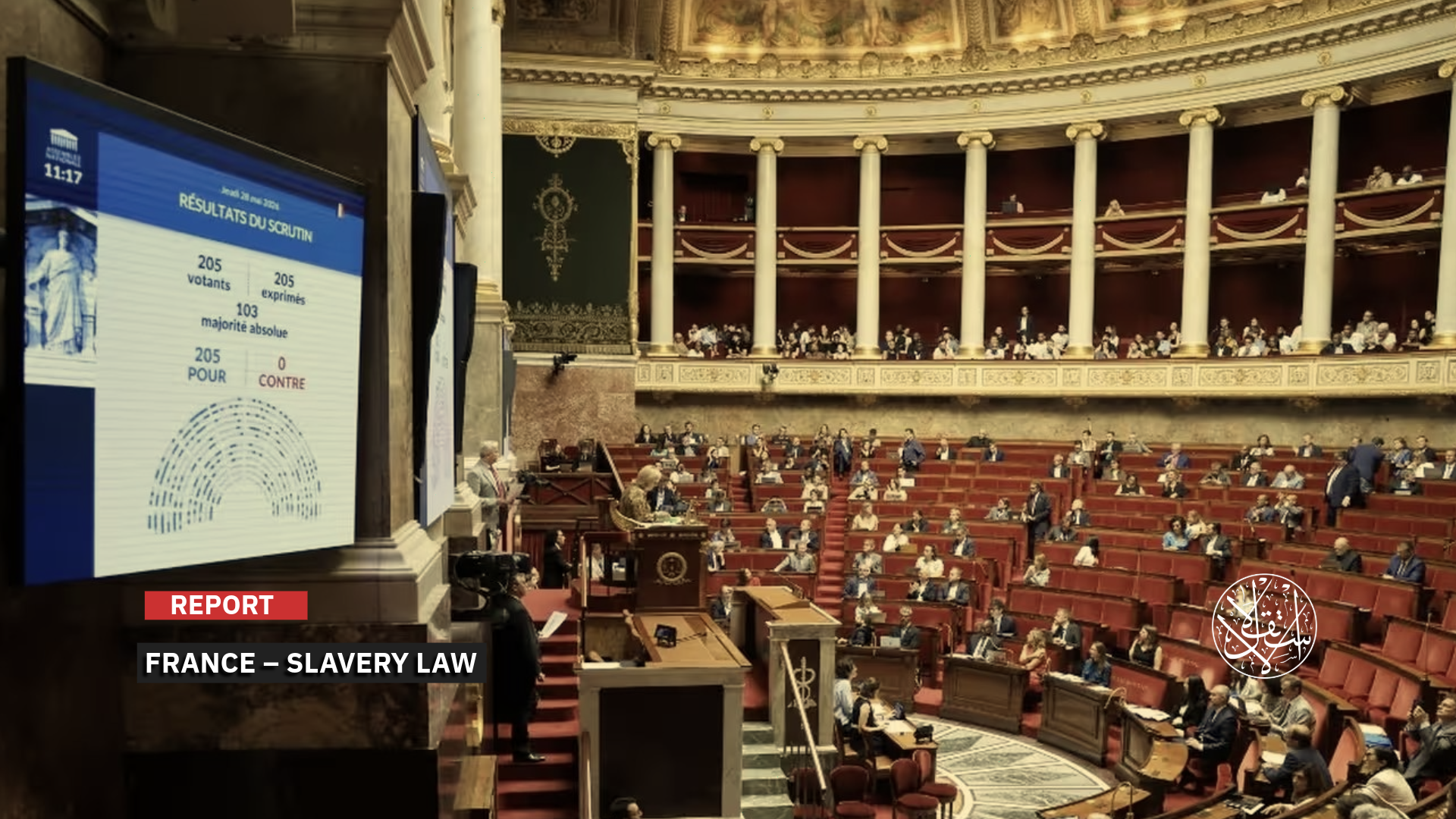
On May 28, 2026, the parliament passed a bill to repeal the Black Code, a decree issued by King Louis XIV in 1685 to regulate the status of slaves in various French colonies.
In a rare show of unanimity, the parliament voted 254 to 0 in favor of the bill that repeals the Black Code.
This law turned people into commodities, allowing them to be exploited for labor, and subjecting them to beatings, being sold, rape, and murder.
During the session, MP Steevy Gustave, whose family originates from Martinique and whose descendants were enslaved, told his colleagues that "repeal was a necessary step, but no single vote can undo centuries of suffering."
“We are not the descendants of slaves, but of human beings born free, who were then deprived of their most basic rights,” Gustave added, fighting back tears, noting that the French Empire later expanded to four continents.
Pressure Context
France was the third-largest slave-trading power in Europe, after Britain and Portugal, shipping approximately 1.4 million Africans between the 17th and 19th centuries to plantations whose sugar wealth enabled the development of the French cities of Nantes and Bordeaux.
France abolished slavery in 1794 during the French Revolution, but Napoleon Bonaparte ordered troops to Guadeloupe in 1802 to reinstate it. France abolished it again in 1848.
In 2001, the country recognized slavery and the slave trade as crimes against humanity (the Taubira Law).
French President Emmanuel Macron, who will leave office in 2027 after serving the maximum of two presidential terms, has previously expressed his support for abolishing these laws.
In mid-May 2026, President Macron stated that "the sixty articles of the Black Code should not have survived the abolition of slavery in the 19th century."
Macron emphasized that "the silence, even the indifference, we have maintained for almost two centuries regarding this Black Code is not forgetfulness, but rather a form of abuse."

Comprehensive Slavery
In his reaction to the event, journalist Stephen Grey-Vernier stated that the provisions of the Black Code governed the living conditions and social status of slaves.
In an analysis published on the website leclubdesjuristes on June 1, 2026, Grey-Vernier emphasized that these slaves, forced into baptism and indoctrination in Catholic, Apostolic, and Roman Catholic doctrines, were treated as mere commodities, subject to the same conditions as slaves.
"Slaves owned nothing; they could be bought, sold, or rented out. Marriage required the master's consent, and children born from these unions inherited their mothers' status as slaves. To prevent rebellions, the gathering of slaves belonging to different masters was prohibited," he said.
"Runaway slaves were punished with physical penalties, such as mutilation and branding, or with execution. The texts imposed specific obligations on masters, requiring them to provide a weekly ration of food and clothing and to care for elderly or sick slaves," he added.
Furthermore, the journalist argued that the French government is obligated to submit a report analyzing the contemporary effects of colonial law on the economic, social, cultural, and environmental development of the overseas territories, and on the descendants of enslaved people.
He emphasized that this report could make a valuable contribution to the ongoing discussions surrounding the sensitive issue of material and financial compensation for the effects of slavery.

Compensation for Victims
In this regard, the website franceinfo confirmed on May 28, 2026, that the issue of compensation had sparked considerable controversy.
Several members of parliament pointed out that former slave owners had received compensation, unlike the slaves themselves.
However, the same source adds, "The text did not address this issue, as its rapporteur, Max Mathiassen, wished to maintain the text's coherence and address the issue of compensation within a broader context."
He noted that members of parliament had approved an amendment stipulating that France must recognize that all laws that have enshrined the commodification of human beings, and regulated their deportation, exploitation, and the violence perpetrated against them, are inseparable from crimes against humanity.
Furthermore, French journalist of African descent, Sixtine Le Roux, in an analysis published on the French website lepelerin on June 10, 2026, pointed out that President Macron himself had addressed the issue of reparations.
Leroux stated that the word reparations has always been taboo in France, noting that the issue was first raised in the Taubira Law (2001).
"At that time, the subject was the focus of numerous debates in the National Assembly. The term even appeared in one of the articles of the proposed law, before being removed from the adopted text," she said.
"The question is not whether we support or oppose it, but rather how we address the consequences of a crime against humanity whose economic, social, cultural, and psychological effects are still felt today," she added.
"In my opinion, reparations should not be limited to financial compensation alone, but can take many forms: commemoration, anti-discrimination measures... all of this contributes to a process of redress," she noted.
She stated that reparations cannot be reduced to a mere check, as no amount of money can erase what people have suffered.
She emphasized that the resulting inequalities and historical injustices, particularly in France's overseas territories, must be at the heart of France's national debates.
It is worth noting that on March 25, 2026, the United Nations adopted a resolution classifying the transatlantic slave trade as "the most serious crime against humanity," while France abstained from voting.

Forced Measure
In a political analysis of the French move, academic researcher Mohamed Ali Othman affirmed that the parliament's decision to officially abolish the Black Code represents a historic step with profound symbolic significance, and an attempt to cleanse the legal system of the vestiges of the colonial era.
In an analysis published on the African Readings website on June 8, 2026, Ali Othman stated, "However, despite its moral dimensions and its efforts to address the legacy of colonialism and bridge the gap between the principles of the Republic and its historical reality, this measure falls short of bringing about a genuine and fundamental transformation in the course of contemporary Franco-African relations."
He argued that the current crisis between Paris and the African continent transcends mere outdated legal texts, both legislatively and practically, and is deeply rooted in concrete practices and ongoing strategies that the African mind perceives as an extension of neo-colonialism.
He emphasized that as long as the mechanisms of economic and financial dependence remain in place, the paths to reclaiming identity and looted cultural heritage are hampered by bureaucracy, and protectionist policies toward immigrants within France perpetuate marginalization, these legislative steps will remain, in the eyes of African elites and populations, mere political slogans and symbolic concessions driven by French pragmatism to contain the growing international influence of rival powers in the region.
Accordingly, he argued, "Building a shared and balanced future between the two sides requires not merely abolishing the archives of unjust laws, but rather a genuine dismantling of the mechanisms of contemporary domination."
The academic researcher concluded that it is essential to move from symbolic justice to concrete, practical steps based on full constitutional and economic equality, and the explicit recognition of historical rights and compensation, whether in overseas territories or deep within the African continent.