Palestinian Land for Sale in the U.S. and Britain: The Story Behind 'Luxury Settlements'
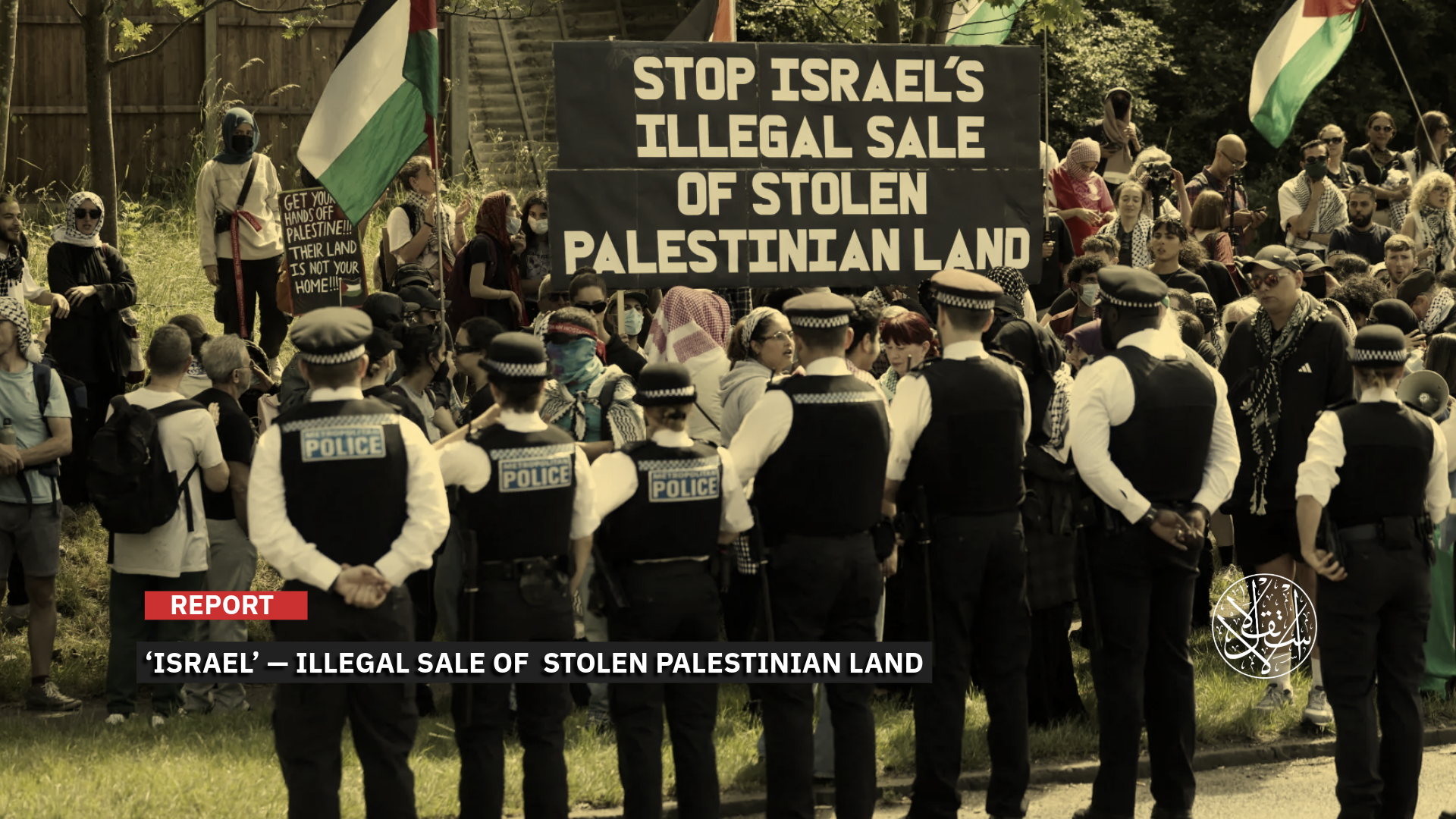
The event was held amid protests and opposition outside a synagogue in north London.
In a cross-border real estate network, housing units and construction projects in Israeli Occupation settlements across the occupied West Bank and occupied East Jerusalem are being marketed to buyers in Western cities, with developers, brokers, and mortgage advisers promoting the properties to prospective investors in London, New York, Toronto, New Jersey, Los Angeles, and beyond.
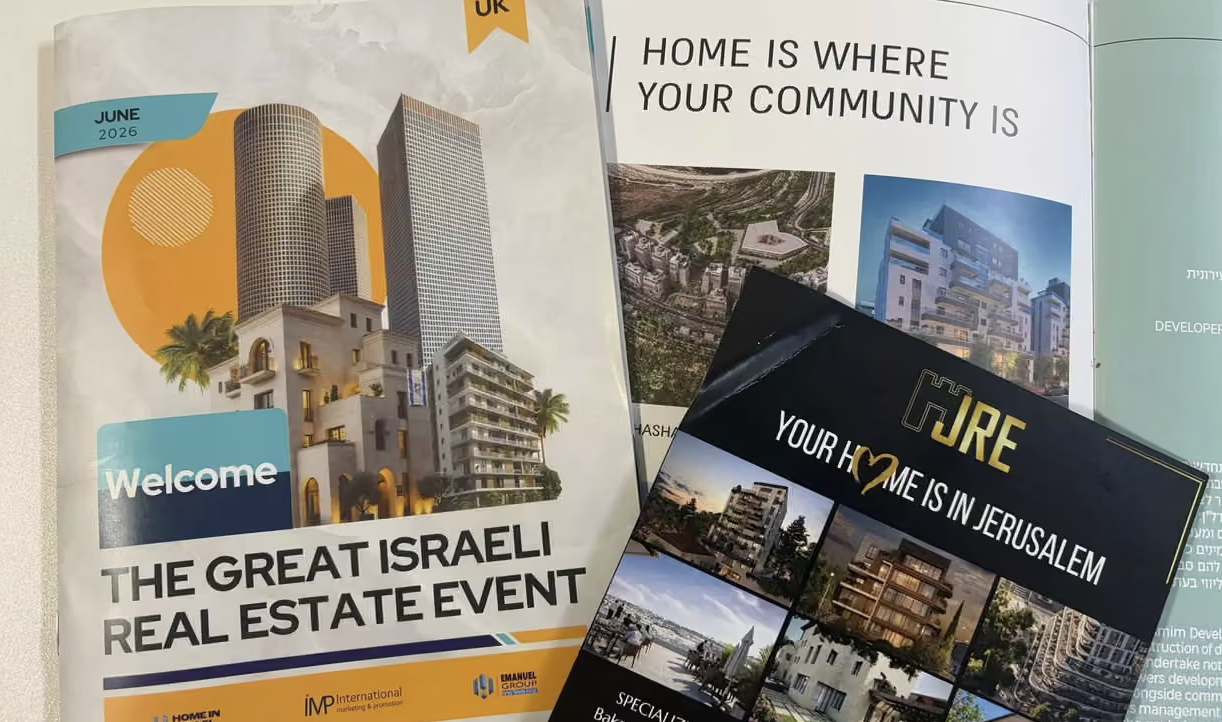
The latest example emerged in mid-June 2026 at the “Great Israeli Real Estate Event,” held inside the Edgware United Synagogue in north London, where promotional materials featured projects located in settlements across the occupied West Bank and occupied East Jerusalem.
According to The Guardian on June 17, 2026, the developments advertised included “Ma’ale Adumim,” “Giv’at Ze’ev,” “Kfar Eldad,” and “Teneh Omarim” in the occupied West Bank, as well as “Ramat Eshkol” and “Givat Hamatos” in occupied East Jerusalem.
What’s the Story?
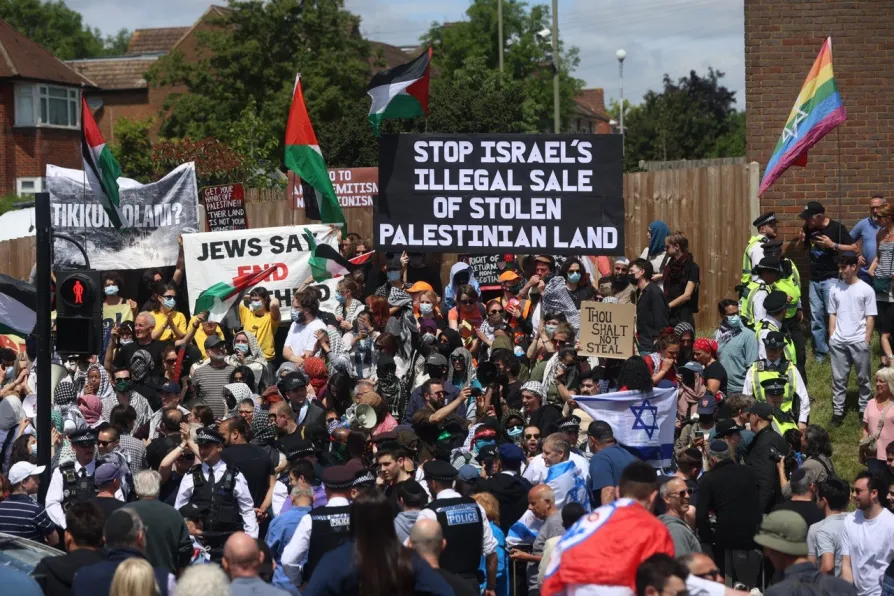
The event took place amid protests and opposition outside the synagogue in north London after it became the focus of political and human rights controversy days before it opened, following similar events previously held in Canada and the United States.
A total of 101 British MPs and members of the House of Lords sent a letter to Home Secretary Yvette Cooper urging authorities to block the event, citing concerns that it was marketing properties in settlements that Britain considers illegal under international law.
According to The Guardian, the London event was part of an international tour that had already stopped in Toronto and New York. Promotional materials invited attendees to find their “dream home” and explore the “best Anglo communities,” referring to residential areas aimed at English-speaking Jewish buyers.
The marketing was clearly directed at an overseas audience, presenting real estate as both a housing and investment opportunity tied to the Israeli Occupation, while including projects in the occupied West Bank and occupied East Jerusalem within the same portfolio—territories occupied since 1967 and regarded under international law as occupied territory.
In March 2024, a similar property roadshow traveled through Montreal, Toronto, Long Island, Brooklyn, and Teaneck, New Jersey, prompting hundreds of demonstrators to protest outside the Keter Torah synagogue in Teaneck.
The Guardian reported that the event was organized by “My Home in Israel,” while protesters accused organizers of promoting properties in settlements such as Ariel in the occupied West Bank. Authorities treated the gathering as a private event; organizations including the Council on American-Islamic Relations (CAIR) called for a federal investigation.
According to material documented by the Real Estate Israel website, the tour used slogans such as “Own a piece of the Holy Land” and featured settlements including “Neve Daniel,” “Efrat,” and “Ma’ale Adumim” alongside cities located inside the 1948 territories.
In Toronto, the Canadian Jewish News reported in March 2024 that a real estate event at a synagogue in Thornhill sparked demonstrations after one company showcased projects in Efrat, south of Bethlehem, and Ma’ale Adumim, east of occupied Jerusalem.
Further protests erupted in June 2024 outside the Adas Torah synagogue in Los Angeles after another event was accused of marketing properties in Israeli settlements in the occupied West Bank.
Jewish Journal quoted organizer Gideon Katz as saying that American interest in purchasing property in “Israel” had increased following October 7, 2023, and that his company had been organizing such exhibitions for years.
Under the headline “Americans Stealing Palestinian Land,” an investigation published by The Nation linked real estate events in New York and New Jersey to projects in settlements including “Gush Etzion,” “Kfar Eldad,” “Karnei Shomron,” and “Giv’at Hamatos.”
The August 26, 2025 investigation cited human rights complaints against companies marketing settlement properties to Jewish American audiences by portraying purchases as an extension of their connection to the “Holy Land.”
These exhibitions target overseas buyers with the financial means—and often the political, religious, or investment motivation—to purchase property, turning settlement real estate into a product marketed far beyond Palestine and making Western capitals part of the sales pipeline.
The Making of Settlement Real Estate
Occupied Palestinian land is not being marketed through hidden channels. The process begins with a real estate developer and moves through a chain of brokers and advisers before reaching potential buyers in Western markets.
The transformation of a settlement into a marketable property starts with the promotional material itself. At the London exhibition, settlement names from the occupied West Bank and occupied East Jerusalem appeared in marketing brochures, while maps and real estate descriptions presented these locations as ordinary parts of the Israeli housing market.
Promotional materials play a central role in this process. Brochures and display maps often erase or downplay the 1967 lines, presenting settlements as “neighborhoods” in occupied Jerusalem or the West Bank.
The Middle East Eye reported that companies participating in the event promoted projects in areas with contested legal status. “Jerusalem Real Estate,” for example, showcased projects in “French Hill” and “Ramat Eshkol” in occupied East Jerusalem, while Harey Zahav promoted developments in “Kfar Eldad” and “Teneh Omarim.”
The language used in these materials follows familiar real estate marketing formulas, featuring phrases such as “Anglo communities,” “family community,” “near Jerusalem,” “buying opportunity,” “flexible payment plans,” and “pre-launch prices.”
Rather than confronting buyers with the project’s location inside the occupied West Bank or occupied East Jerusalem, the marketing presents a comfortable residential area close to services and suitable for families—turning a settlement from a political and legal reality into a property package that resembles any other housing offer in a Western market.
“Ma’ale Adumim” offers a clear example. The Guardian reported that the settlement appeared in London event brochures and was promoted by marketing companies as a location suitable for English-speaking buyers and close to “Jerusalem.”
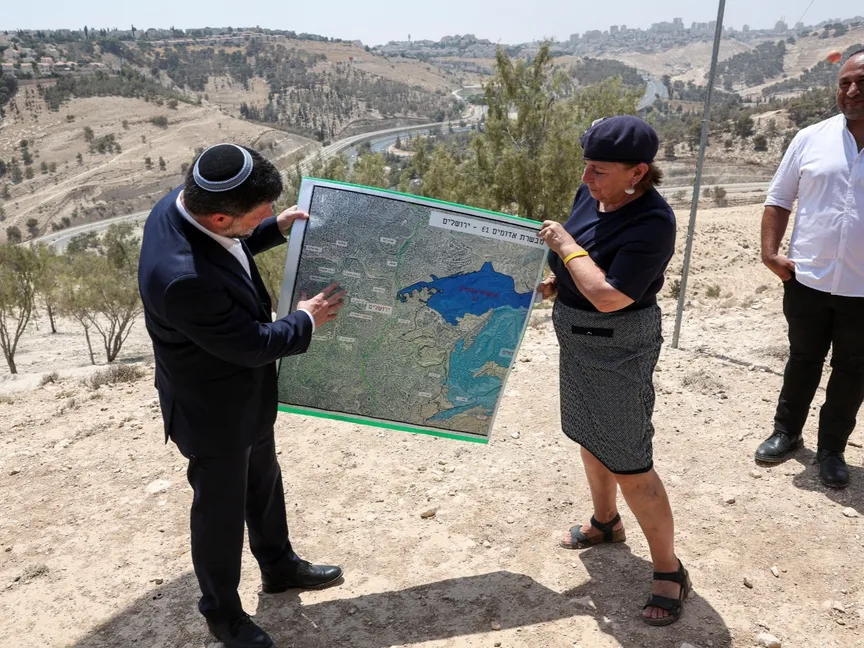
The Institute for Middle East Understanding (IMEU) describes the expansion project in the E1 area linked to “Ma’ale Adumim” as one of the most consequential settlement plans for the West Bank’s geographic continuity, arguing that it would deepen the separation between the northern and southern parts of the territory and further encircle occupied East Jerusalem.
“Giv’at Hamatos” was also among the promoted projects. Diplomats and observers have long viewed the settlement as particularly sensitive because of its location between “Jerusalem” and “Bethlehem.”
A 2025 investigation by The Nation found that real estate marketing materials presented “Giv’at Hamatos” as a “Jerusalem project,” a description that places it within the property market without highlighting its location in occupied territory.
“Kfar Eldad” and “Teneh Omarim” represent another layer of this marketing strategy. Middle East Eye reported in June 2026 that Harey Zahav promoted both projects at the London event.
In sales materials, the locations—”Kfar Eldad,” south of “Bethlehem” within the “Gush Etzion” settlement bloc, and “Teneh Omarim” near al-Dhahriya south of Hebron—are presented as residential communities close to “Jerusalem” or suitable for family life, despite being settlements in the occupied West Bank that are considered illegal under international law.
The process goes beyond displaying images and brochures. According to “My Home in Israel’s” promotional materials, the company offers overseas buyers a full purchasing pathway, including connections with developers and brokers, guidance on mortgages and taxes, and assistance with financial transfers.
Tivuch Shelly also appears in this network as a broker targeting foreign buyers. In 2025, the company published a blog about a New York and New Jersey tour that promoted a “Ma’ale Adumim” project as an opportunity for an Anglo-speaking community, highlighting schools, facilities, and payment options.
Some exhibitions also feature major companies such as Shapir Engineering, which appears on the United Nations list of companies working in Israeli settlements.
Legal and Commercial Responsibility
These events have exposed a clear gap between Western governments’ political positions and commercial practices, particularly as international law prohibits settlement activity in territories occupied since 1967 and considers Israeli settlements in the occupied West Bank and occupied East Jerusalem illegal.
On June 9, 2026, the British government updated its guidance page on “business risks in the Occupied Palestinian Territories,” advising companies and individuals to avoid financial transactions, investments, purchases, contracts, or economic activities inside settlements due to legal, financial, and reputational risks.
The guidance also states that “Israel” unilaterally annexed occupied East Jerusalem and that the United Kingdom does not recognize the annexation. Yet just five days later, the London property exhibition took place.
On June 17, 2026, The Guardian reported that British Foreign Office minister Hamish Falconer had written to the Advertising Standards Authority, asking it to examine evidence related to the promotion of properties in settlements.
The newspaper quoted the regulator as saying it could review advertising rules, while questions of international law remained a matter for the government.
In this sense, the issue in Britain moved through an advertising and consumer protection framework, even though it concerns real estate projects located in occupied territory.
That same day, the International Center of Justice for Palestinians announced that it had filed a formal complaint with the Advertising Standards Authority, arguing that the event’s promotional materials marketed projects in “Ma’ale Adumim” and “Efrat.”
The group argued that presenting these projects to a British audience could amount to misleading advertising, as buyers may not receive clear information about the property’s location, legal status, or the risks associated with purchasing a unit in a settlement.
In the United States, there are no explicit laws banning the marketing of overseas real estate, but legal experts argue that selling properties in settlements considered illegal under international law could potentially amount to supporting war crimes. So far, however, neither the Department of Justice nor the Department of Housing and Urban Development has opened publicly known cases over such sales.
Gabor Rona, a professor of law at Cardozo School of Law and former international legal director at Human Rights First, argues that buying and selling property in occupied Palestinian territory violates international law and multiple United Nations resolutions and could potentially constitute a war crime under the Rome Statute.
In an August 2024 article, Rona also raised the possibility that some events could involve violations of fair housing laws if participation was restricted on the basis of religion or national origin.
The Nation highlighted a similar concern in a 2025 investigation into real estate events in New York and New Jersey, linking them to projects in settlements including “Gush Etzion,” “Kfar Eldad,” “Karnei Shomron,” and “Giv’at Hamatos.”
The investigation also referenced human rights complaints over efforts to target Jewish American audiences and restrict access to some events, shifting the debate beyond the property itself to questions about marketing practices and who is being encouraged or allowed to buy.
Sources
- Real estate event in London ‘advertised sale of land in illegal Israeli settlements’
- Overseas business risk: Palestine
- ISRAELI REAL ESTATE EVENT
- A protest directed at an Israeli real estate expo at a Thornhill synagogue brought on a Jewish counter-demonstration—and the chaos led to three arrests
- The Americans Stealing Palestinian Land
- The Illegality of Israeli Settlement Real Estate Sales
- Exclusive: Illegal settlements promoted in London at Great Israeli Real Estate Event