Iraq’s ‘Chip Celebrities’: Business Fronts or Money–Laundering Gateways?
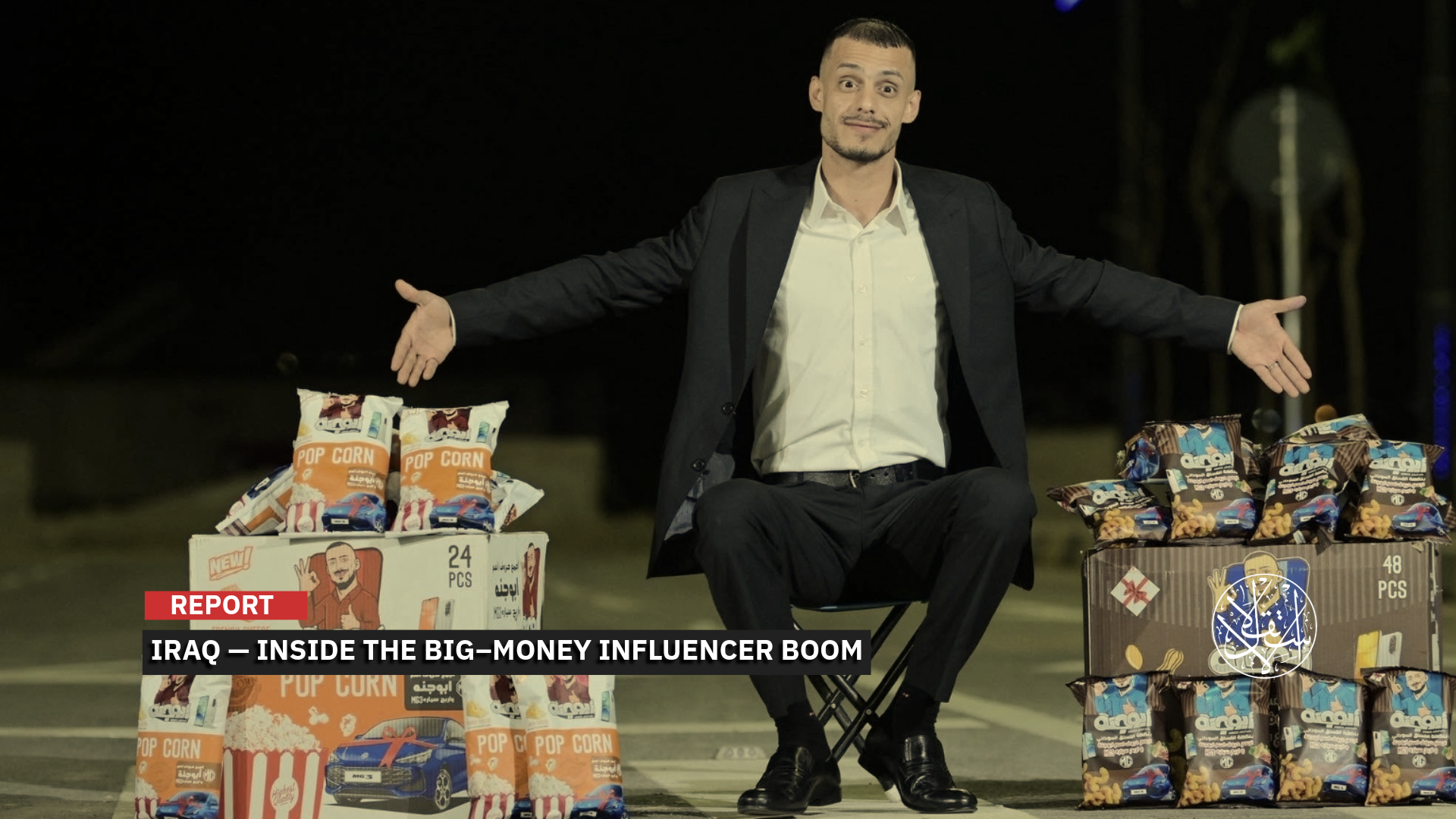
More than 21 public figures in Iraq launched food products within a single year.
As social media influencers in Iraq increasingly launch self-branded commercial products—particularly in the children’s food sector—questions are mounting over the sources of their wealth and the scale of funding behind their promotional ventures.
While some of these brands have grown into widely popular mass-market phenomena, extravagant giveaways and aggressive marketing campaigns have fueled suspicions about how they are financed and whether certain influencers are serving as public-facing fronts for deeper financial networks operating out of view.
Despite efforts by Iraqi authorities to pursue several content creators and investigate their financial dealings, their social and popular influence has continued to expand. Some now attract crowds and display levels of public clout that rival prominent politicians and senior officials, opening a broader debate about the growing power of influencers in Iraqi society and the economic, cultural, and even political reach they are beginning to command.
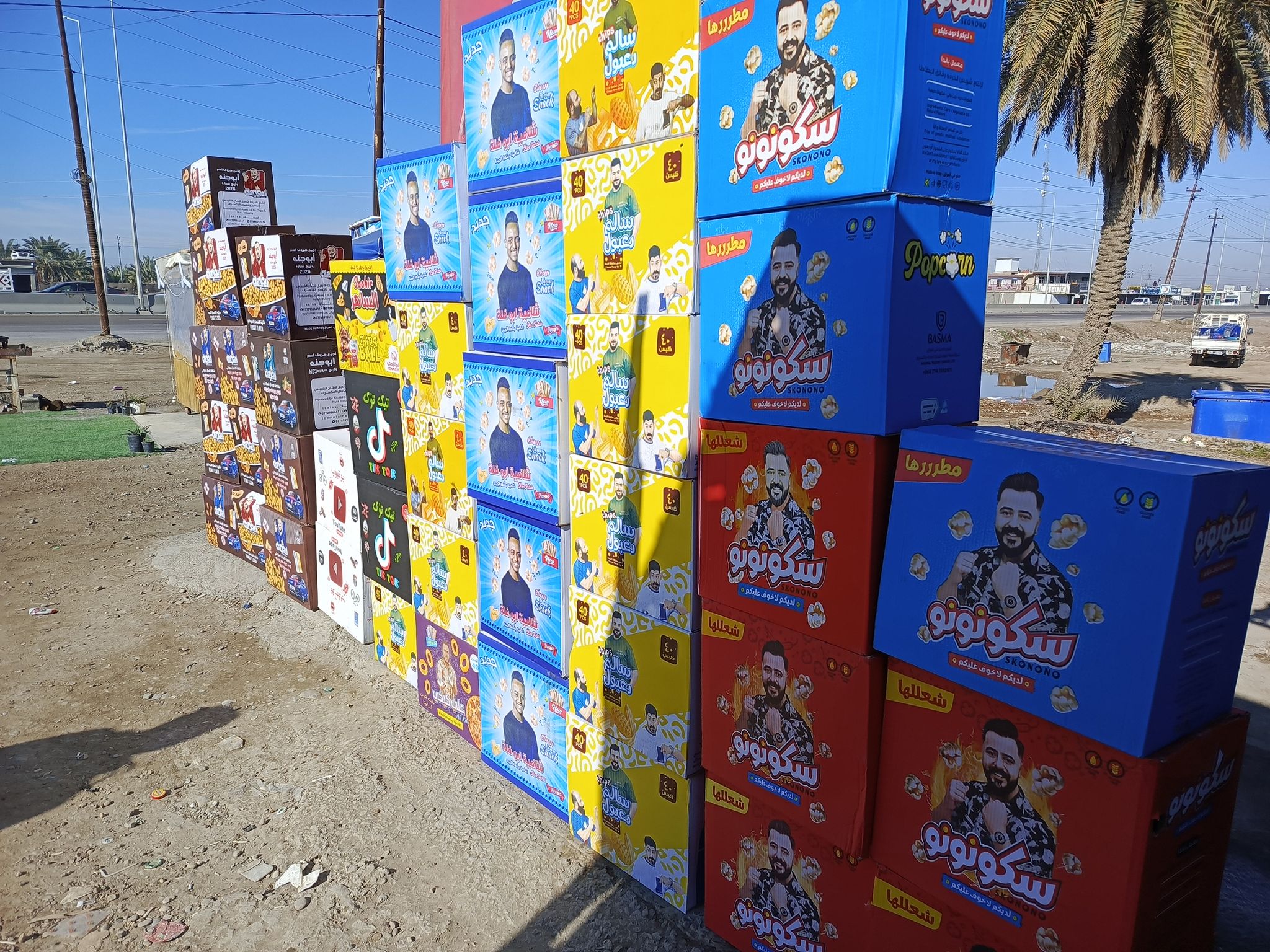
‘Iraq’s Chip Stars’
Within the span of a single year starting in mid-2025, around 25 Iraqi social media influencers launched their own branded snack products, including chips and popcorn, with some expanding into other items bearing their names such as ice cream, noodles, and energy drinks, most of which are marketed to children.
These influencer-led products quickly gained traction in Iraqi markets, driven in part by controversial marketing strategies. Some creators have offered high-value prizes tied to promotional giveaways while also distributing cash to individuals in need, framing it as a share of product profits.
Among the most controversial figures is content creator Abdulrahman Mohammed, known online as “Abu Jannah,” who previously owned a restaurant serving traditional Iraqi grilled fish (masgouf) in the northern city of Mosul.
On May 31, 2026, Iraqi security forces arrested “Abu Jannah” in Mosul under a judicial order linked to an investigation into the sources of the money and gifts he has been seen distributing on social media.
According to local media, the arrest took place inside one of his restaurants in the city, with authorities launching formal legal procedures in line with the court order.
Reports said the investigation is not related to his online content itself but focuses instead on the origins of the funds behind his giveaways and promotional campaigns, which have gained wide attention in recent years.
Mohammed al-Kakaei, head of the security committee in the Nineveh Provincial Council, said in a televised interview on June 1 that a lawsuit had been filed against “Abu Jannah” under Iraq’s “Where did you get this from?” law, citing concerns over unexplained wealth and the distribution of luxury cars.
He added that the state has the right to pursue such cases, stressing that the accused remains innocent until proven guilty, and that Abu Jannah is currently in custody pending investigation in Nineveh. If wrongdoing is established, legal action will follow; if not, he will be released.
Al-Kakaei also noted that there has been significant public confusion surrounding Abu Jannah’s sudden rise to prominence, adding that state institutions, including the Commission of Integrity and the Board of Supreme Audit, monitor financial disclosures and unusual wealth patterns among public figures.
In early January 2026, Iraqi security forces also arrested another content creator, Hossam Anad—known online as “Hassas”—on charges related to low-quality content and money laundering.
According to a statement issued at the time by the Iraqi Ministry of Interior, investigations later found that he had been involved in money laundering operations, and legal procedures were taken against him in line with judicial orders issued by the competent authorities.
Suspicious Fronts
Amid the ongoing controversy, social media platforms—particularly TikTok—have become one of the most influential forces in Iraqi society, attracting large numbers of young people seeking entertainment or income opportunities.
This rapid rise has been accompanied by growing concerns that some influencers are exploiting these platforms for questionable financial activities, believed to be linked to money laundering schemes designed to conceal illicit funds and reintroduce them into the formal economy.
These operations reportedly rely on methods that give money a legal appearance, including advertising contracts with companies that either do not exist or carry out no real business activity, in order to generate invoices and documentation that justify financial transfers into influencers’ accounts, according to a study published by Iraq’s “Shahid Khames” research center on August 19, 2025.
The study further notes that shell companies registered under the names of relatives or intermediaries are used to facilitate money transfers and obscure their true origins. It also highlights the inflation of marketing campaign and advertising values, allowing large sums to be justified despite being inconsistent with the nature of the declared activity.
The risk is further heightened by possible links between some influencers and politically or economically powerful figures, which could limit the effectiveness of oversight mechanisms and complicate investigations.
Although Iraq adopted an anti-money laundering and counter-terrorism financing law in 2015 in line with international standards, its implementation faces several challenges, particularly weak oversight of digital economic activities.
These practices have negative social and economic effects, contributing to the normalization of “quick wealth” culture and promoting unrealistic success models among young people, potentially shaping their educational and professional choices.
They also facilitate the integration of illicit funds into the formal economy, strengthening corruption and undermining transparency and fair competition, while creating a parallel economy driven by opaque financial flows that distort investment conditions and economic stability.
In light of these challenges, there is a growing need for more effective measures, including stronger regulation of digital advertising, requiring influencers to disclose their income sources and commercial contracts, and updating legislation to cover high-risk digital activities.
There is also a call for specialized digital financial intelligence units capable of detecting and tracking suspicious transactions—steps described in the study as essential to limiting the misuse of digital platforms for illicit activities and protecting society and the economy from long-term damage.
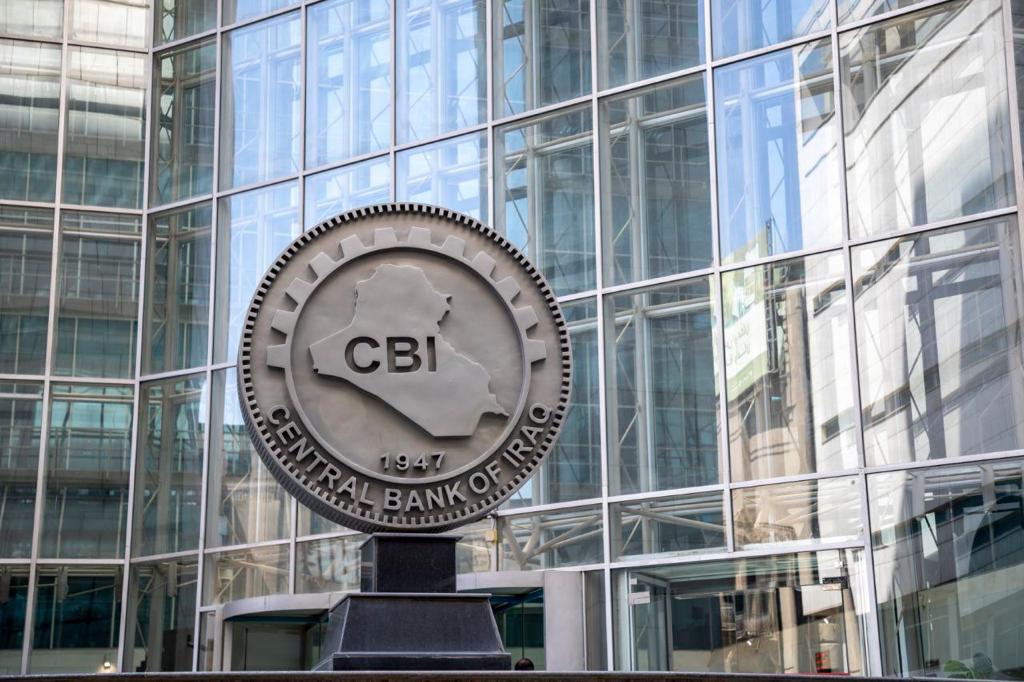
On November 26, 2025, the Central Bank of Iraq issued new instructions to banks regarding influencers, stating that they pose emerging risks to the banking sector.
It directed banks to classify social media influencers as “high-risk clients” due to the diversity and complexity of their income sources and to verify their advertising and marketing contracts along with detailed financial statements.
It also required influencers opening bank accounts to provide a link to their social media profiles and a recent screenshot showing follower counts as proof of account ownership, in addition to monitoring their financial transfers and sources of income due to concerns that some accounts may be linked to money laundering activities.
Soft Power
Assuming that Abu Jannah is currently one of the most controversial social media figures in Iraq, some have described him—and others like him—as a form of “soft power” directed at Sunni communities to promote Shiite influence, particularly given his focus on children’s products. Others, however, see him as merely a financial front for laundering illicit funds.
Not far from experiences in Colombia and Mexico, the growing financial power of armed militias in Iraq, combined with mounting U.S. sanctions, has pushed them to create less suspicious financial fronts to handle and launder their illicit revenues.
According to researcher Thanoon al-Mawsili, drug traffickers in parts of South America—particularly Colombia and Mexico—tend to bury large amounts of cash once their wealth grows too large in order to avoid detection by U.S. tracking units. In his view, what is happening in Iraq today follows a similar logic.
“As U.S. sanctions on armed militias and their leaders intensify and pressure increases both inside and outside the country—alongside recent strikes targeting Iran and its regional proxies—these groups have begun using Sunni-facing fronts to manage their illicit funds,” he told Al-Estiklal.
“Militias have injected hundreds of millions of dollars through Sunni-linked fronts to purchase large volumes of real estate across the country, particularly in high-end and expensive districts of Baghdad.”
“Abu Jannah is known for his proximity to Shiite armed groups,” he said, adding that suspicions were raised by his distribution of Chevrolet Tahoe vehicles, each priced in Iraq between $58,000 and $102,000.
Al-Mawsili said it was difficult to believe that sales of snack products could finance giveaways as lavish as Chevrolet Tahoe SUVs, especially after reports that Abu Jannah handed out 10 of the vehicles in a single day during Eid al-Adha, along with 250 iPhone 17s.
He further pointed to Abu Jannah’s perceived closeness to Shiite armed figures but warned that the greater concern lies in his recent use of religious phrases invoking Imam Ali, noting that he is followed by more than five million people on social media, giving him significant influence over public opinion.
On the same issue, Iraqi activist Umia Tikrit launched a sharp attack on Abu Jannah after he repeatedly used phrases she described as “dangerous for Sunni society,” particularly among children, who form a key part of his audience.
In a post on X dated May 28, she said Abu Jannah swears by Ali while distancing himself from his own identity and creed in order to please fellow citizens, calling him “extremely dangerous for our Sunni community because he targets children, and I do not rule out that he is being backed for this purpose.”
She added that Abu Jannah targets children in both his content and commercial activities and that millions of Sunni children in Iraq follow him, warning that his use of religious expressions invoking Imam Ali could influence a large number of young viewers.
She stressed that identity and creed are “a red line,” urging parents to be cautious about his influence and to raise awareness among their children about the risks of his content.
Tikrit also said she had previously warned against him, claiming he is backed by militia leaders in Mosul. She added that those supported by militias serve their own agendas, expressing regret that he has come to represent a prominent public face in the historic city of Mosul.
Sources
- Iraqi Security Forces Arrest Abu Jannah in Mosul [Arabic]
- Arrest of “Hassas” on Charges of “Low-Quality Content” and Money Laundering in Baghdad [Arabic]
- Central Bank on Decision to Include Influencers in Anti–Money Laundering Measures: Protection of the Economy, Not Restrictions [Arabic]
- How Is Money Laundered Through Iraqi Influencers?[Arabic]